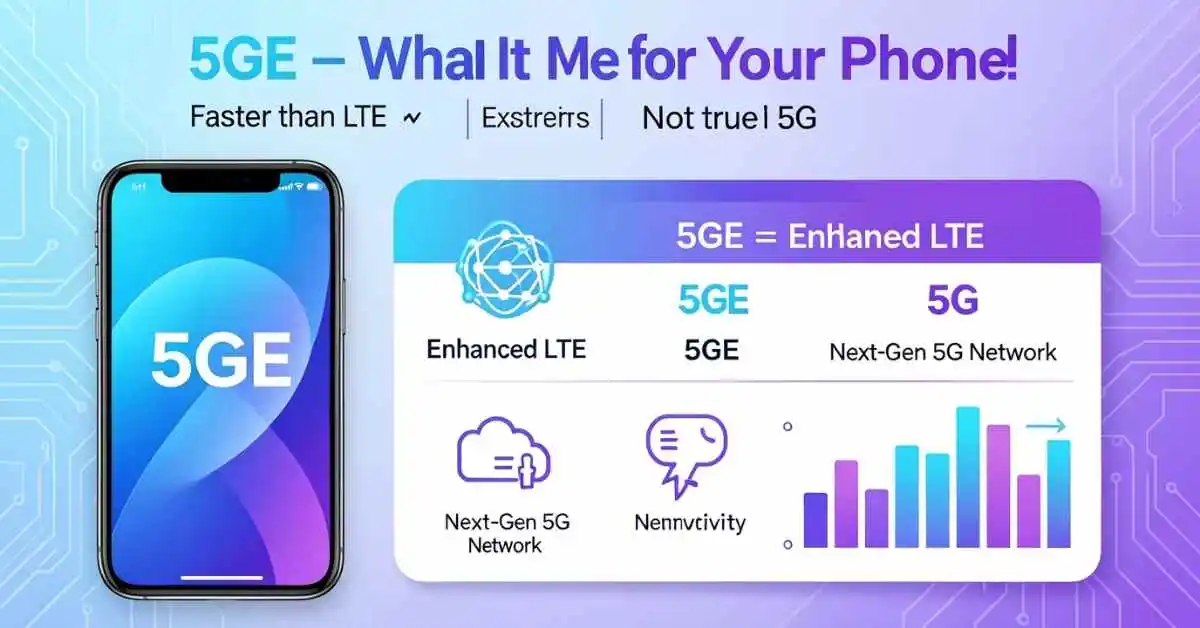
Many people notice the network icon on their smartphones and automatically assume it represents true 5G. However, in reality, this symbol does not indicate full 5G coverage. Instead, it represents 5G Evolution, an enhanced LTE network designed to deliver faster speeds, improved connectivity, and better reliability. Introduced by AT&T, this upgraded network uses advanced LTE technologies to provide a smoother mobile experience while full 5G infrastructure is still being rolled out across the country.
In this guide, every aspect of the enhanced LTE network is thoroughly explained, from the underlying technology to real-world performance comparisons with standard LTE and 5G. Additionally, this article covers which devices display the icon, how it affects everyday tasks like streaming and gaming, its advantages and limitations, and practical tips to maximize its use. By the end, readers will clearly understand how the network functions and what it truly offers.
What is 5GE? A Simple Definition
“5G Evolution” is essentially an upgraded 4G LTE network. Despite its name, it is not true 5G. Instead, it provides faster speeds, smoother browsing, and more reliable connectivity. The icon can be misleading because it resembles 5G, but it serves as a bridge between LTE and next-generation 5G networks.
Key Technologies Behind the Network Upgrade
- LTE Advanced: Turbocharged LTE providing higher speeds.
- Carrier Aggregation: Combines multiple frequency bands for faster data transmission.
- 4×4 MIMO: Uses multiple antennas to enhance speed and signal reliability.
- 256 QAM: Packs more data into each signal, increasing efficiency.
In short, this enhanced LTE network allows users to experience faster mobile performance while true 5G continues to expand. It improves overall connectivity but does not match the capabilities of next-generation 5G.
Why Phones Show 5GE
Many smartphones, including iPhones and high-end Android devices, display the 5GE icon when they connect to an enhanced LTE network. This icon signals better performance but does not indicate true 5G.
Key Points to Know:
- 5GE is primarily a marketing label.
- It signals enhanced LTE speeds, not real 5G.
- Availability depends on network coverage and device compatibility.
For instance, AT&T phones in urban areas may show 5GE, whereas rural locations may still display LTE due to limited infrastructure upgrades.
Technologies Behind 5GE
The main reason 5GE feels faster than LTE is due to several enhanced LTE technologies:
| Technology | Function | Benefit |
|---|---|---|
| LTE Advanced | Enhanced LTE standard | Faster speeds and better network stability |
| Carrier Aggregation | Combines multiple frequency bands | More data flows simultaneously |
| 4×4 MIMO | Uses multiple antennas | Stronger signal and consistent performance |
| 256 QAM | High-capacity modulation | More data transmitted per signal |
These technologies allow 5GE to outperform standard LTE, particularly in crowded areas, though it still cannot match the speed or low latency of true 5G networks.
5GE vs LTE vs 5G
Understanding the difference between LTE, 5GE, and true 5G is crucial for realistic expectations:
| Feature | LTE | 5GE | 5G |
|---|---|---|---|
| Network Generation | 4G | Enhanced 4G | Next-generation 5G |
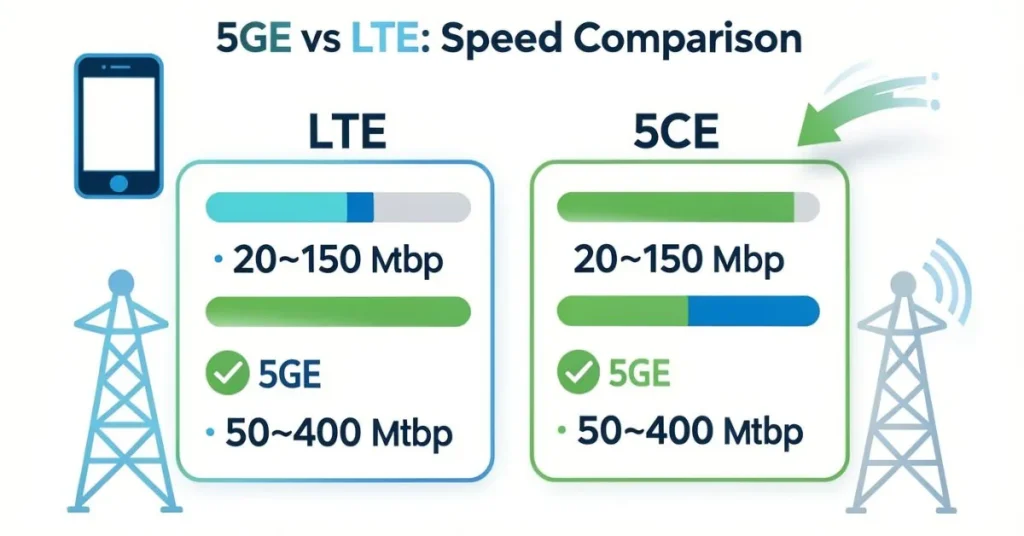
| Speed | 20–150 Mbps | 50–400 Mbps | Up to several Gbps |
| Latency | Medium | Medium | Extremely low (1–10 ms) |
| Infrastructure | LTE towers | Upgraded LTE towers | Dedicated 5G towers |
| Applications | Browsing & streaming | Faster downloads & streaming | AR/VR, cloud gaming, IoT |
Summary: While 5GE is faster than LTE, true 5G delivers significantly higher speeds, lower latency, and supports advanced applications like cloud gaming, AR, and smart city infrastructure.
Is 5GE Actually Faster Than LTE?
Yes, 5GE offers faster performance than LTE, but results vary depending on location, signal strength, and network congestion. Real-world speeds for 5GE often range between 50–400 Mbps, compared to LTE’s 20–150 Mbps. While this is a notable improvement, it does not match the speeds of true 5G, which can exceed 1 Gbps in optimal conditions.
Key Takeaways
- Enhanced LTE features improve download and upload speeds.
- Streaming and gaming are smoother in crowded areas.
- Users should not expect ultra-low latency like true 5G provides.
Which Phones Show 5GE?
The 5GE icon is displayed mainly on:
- Apple iPhones (models supporting LTE Advanced)
- Samsung Galaxy series phones
- Other high-end Android devices connected to AT&T
Devices from other carriers may not display 5GE, even if similar LTE enhancements exist.
Advantages and Limitations of 5GE
Advantages
- Faster than standard LTE
- Improved network reliability in crowded areas
- Smoother streaming and browsing
- Transitional step toward 5G
Limitations
- Not true 5G
- Limited to AT&T or similar carriers
- Speeds vary by location and congestion
- Can cause confusion due to the “5G” label
How 5GE Impacts Streaming and Gaming Performance
The 5GE network significantly improves mobile streaming and gaming experiences. With LTE enhancements like Carrier Aggregation and 4×4 MIMO, data flows faster and more consistently, reducing buffering, lag, and dropped connections.
Benefits:
- Video Streaming: HD and 4K videos load faster with minimal buffering.
- Mobile Gaming: Multiplayer games experience less lag and smoother frame rates.
- Real-Time Communication: Video calls remain stable and uninterrupted.
However, 5GE cannot match true 5G’s ultra-low latency, which is essential for VR gaming or cloud gaming applications.
Global Availability of 5GE Networks
While 5GE is primarily AT&T branding in the U.S., similar LTE Evolution networks exist worldwide under other names:
| Region | Carrier | Marketing Term | Notes |
|---|---|---|---|
| USA | AT&T | 5GE | Uses LTE Advanced, 4×4 MIMO, Carrier Aggregation |
| Canada | Rogers / Bell | LTE Advanced Pro | Similar performance as 5GE |
| Europe | Vodafone / EE | LTE-A / LTE+ | Advanced LTE without 5G branding |
| Asia | NTT Docomo (Japan) | LTE Advanced | Uses enhanced LTE prior to full 5G rollout |
Globally, many carriers use enhanced LTE before full 5G deployment.
Comparing 5GE Speeds Across Devices
Different devices experience varied 5GE performance depending on hardware, antennas, and software optimization:
| Device Type | Typical Download Speed | Typical Upload Speed | Notes |
|---|---|---|---|
| iPhone 12 / 13 / 14 | 100–400 Mbps | 20–80 Mbps | Efficient LTE Advanced usage |
| Samsung Galaxy S21 / S22 | 90–350 Mbps | 15–75 Mbps | 4×4 MIMO enhances reliability |
| Mid-range Android | 50–200 Mbps | 10–40 Mbps | Dependent on LTE Advanced support |
| Older Devices | 20–150 Mbps | 5–30 Mbps | Only accesses standard LTE |
Hardware plays a critical role: newer devices leverage 5GE features more effectively, giving better speed and stability.
How 5GE Bridges the Gap to True 5G
5GE acts as a transitional network between LTE and full 5G. By introducing LTE enhancements, carriers prepare both infrastructure and users for next-generation networks.
Benefits:
- Gradual user adaptation to higher speeds
- Testing and optimization of LTE towers
- Smooth handoff from LTE to 5G networks
While it does not provide full 5G features, 5GE sets the stage for IoT, smart cities, and ultra-fast streaming in the future.
Tips to Maximize Your 5GE Experience
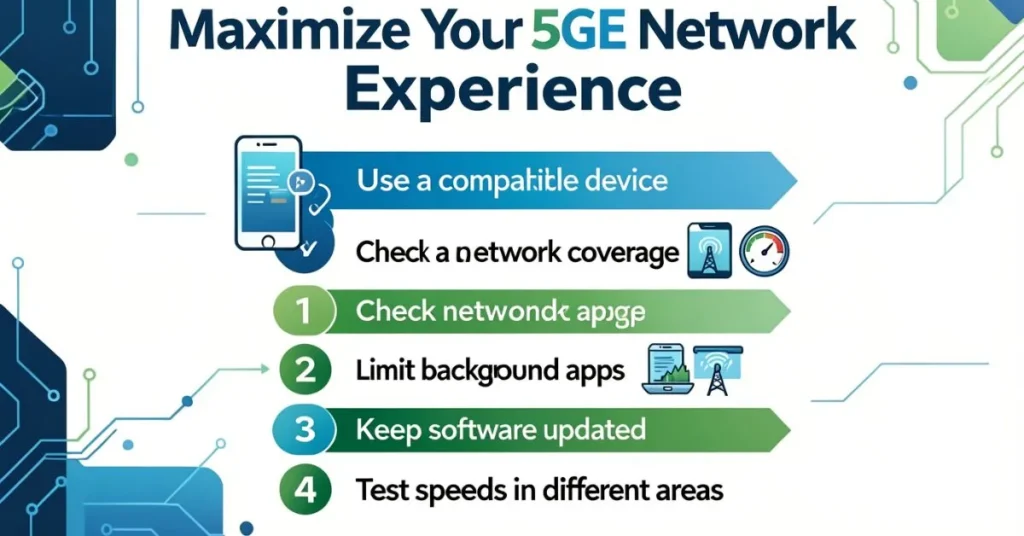
- Use a Compatible Device: Phones must support LTE Advanced and 4×4 MIMO.
- Check Network Coverage: Performance depends on tower proximity and signal strength.
- Limit Background Apps: Reduces simultaneous data usage for faster speeds.
- Keep Software Updated: Updates can optimize network performance.
- Test Speeds in Multiple Areas: Urban areas often provide better 5GE performance.
Frequently Asked Questions About 5GE
Is 5GE the same as 5G?
No, it is enhanced LTE.
Why does my phone show 5GE instead of LTE?
It connects to advanced LTE features.
Is 5GE faster than LTE?
Generally yes, but not as fast as true 5G.
Can all phones show 5GE?
Only compatible devices do.
Will 5GE be replaced by true 5G?
Yes, it is a transitional network.
Does 5GE affect my data plan?
No, it only improves network performance.
Conclusion
In summary, 5GE is a marketing term for enhanced LTE that bridges the gap between LTE and true 5G. It offers faster speeds, better reliability, and smoother streaming, but it is not real 5G. Users can enjoy improved mobile experiences while understanding that true 5G will deliver ultra-fast speeds, extremely low latency, and support for advanced applications like cloud gaming and IoT in the future.
By understanding the technologies, devices, and limitations behind 5GE, users can set realistic expectations and fully leverage the network’s benefits.
Click Here To Read About : what does icl mean slang

Hi, I’m Geoffrey Chaucer. I explore the stories and meanings behind words, turning ideas into clear, insightful writing. Through every article I craft, I aim to spark curiosity, share knowledge, and help readers uncover practical, meaningful truths in everyday life.