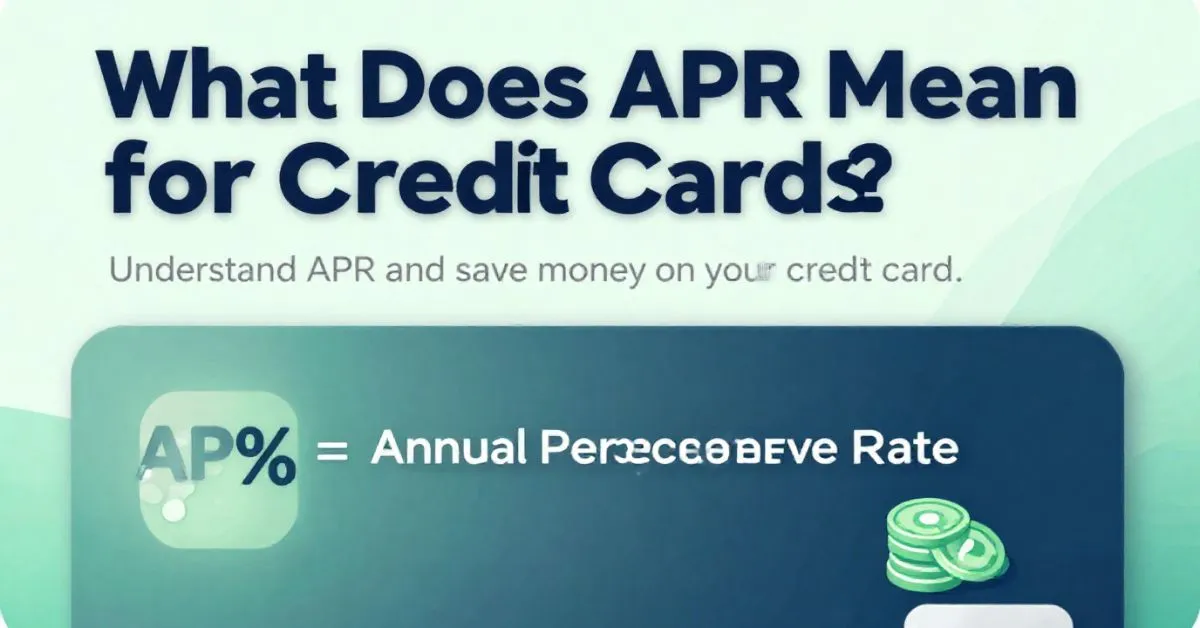
Have you ever seen APR on your credit card statement and wondered what it means? APR stands for Annual Percentage Rate. It is the cost you pay each year if you borrow money on your credit card.
If you don’t pay your full balance on time, APR decides how much extra money you owe as interest. The higher your APR, the more money you pay.
This guide will help you understand APR in simple words. You’ll learn how it works, why it matters, and how to use your credit card smartly to save money.
What Is APR? The Easy Definition
APR means the yearly cost of borrowing money. It tells you how much extra you pay when you don’t pay off your credit card balance fully.
Think of APR as the price you pay for borrowing money from the bank or credit card company.
- If your APR is 18%, you pay 18% interest on your unpaid balance every year.
- But the bank calculates it every day or month — so interest adds up faster!
APR includes not just interest but sometimes other fees, so it shows the true cost of borrowing.
Why APR Is Important
APR helps you know how expensive your credit card is. If you carry a balance, a high APR means more interest charges.
But if you pay your full balance on time, you usually won’t pay any interest because of the grace period (more on that soon).
Knowing APR helps you:
- Choose the best credit card
- Avoid paying too much interest
- Plan your payments better
Different Types of APR on Credit Cards
Your credit card may have different APRs for different transactions:
- Purchase APR
This applies when you buy things using your card. - Cash Advance APR
When you take cash from an ATM with your card, this APR is often higher and interest starts right away. - Balance Transfer APR
If you move debt from one card to another, this APR applies. Sometimes it starts at 0% for a while. - Introductory APR
Some cards offer a 0% APR for a few months to attract new customers. - Variable APR
This APR can change based on the market or bank rates. - Fixed APR
This stays the same unless the bank changes it under special conditions.
How Is APR Calculated?
The bank does not charge APR once a year. Instead, it breaks the APR into a small daily rate called Daily Periodic Rate (DPR).
Here’s how it works:
- Take your APR (for example, 18%)
- Divide by 365 (days in a year)
- You get the daily interest rate (about 0.0493% daily)
Each day, the bank charges interest on your balance using this daily rate. These daily charges add up over the billing cycle (usually 30 days).
What Is a Grace Period?
A grace period is the time you have to pay your full balance without paying any interest.
Usually, it is about 21 to 25 days after your billing cycle ends.
If you pay your full balance before the due date during this period, you don’t pay any APR interest on purchases.
But if you don’t pay in full, interest starts adding right away.
Note: There is no grace period for cash advances and balance transfers.
How Does APR Affect Your Credit Card Bill?
If you pay your full balance on time, APR does not cost you money.
If you don’t pay the full amount, interest builds up on the unpaid balance.
The higher your APR, the more interest you pay.
Paying only the minimum payment keeps you safe from penalties but costs more in interest and takes longer to pay off your debt.
APR vs Interest Rate: What’s the Difference?
People often think APR and interest rate are the same.
But interest rate is just the cost for borrowing.
APR is the full cost including fees like annual fees or late payment fees.
APR helps you understand the total cost of using the card.
How to Find Your Credit Card APR
You can find your APR in:
- Your credit card agreement (paper or online)
- Your monthly statement under “Interest Rates”
- Your bank’s mobile app or website
- By calling your credit card issuer’s customer service
Why Does APR Vary for Different People?
APR depends on:
- Your credit score (higher scores get lower APRs)
- Your income and debt
- Your credit history (on-time payments help)
- The type of card you choose
- Market conditions (if APR is variable)
How to Lower or Avoid Paying APR Interest
- Pay your balance in full every month.
- Use 0% introductory APR offers wisely for big purchases or transfers.
- Avoid cash advances if possible.
- Pay more than the minimum payment to reduce interest faster.
- Consider balance transfers to cards with lower APRs.
- Negotiate with your credit card issuer to lower your APR.
- Work on improving your credit score for better APR offers.
Common APR Myths — Don’t Get Tricked!
- Myth 1: APR is charged once a year.
Truth: APR is charged daily or monthly on your balance. - Myth 2: 0% APR means no fees.
Truth: You might still pay fees like balance transfer fees. - Myth 3: Paying the minimum stops interest.
Truth: Interest keeps building until you pay the full balance. - Myth 4: APR is same for all transactions.
Truth: Different APRs apply to purchases, cash advances, etc.
Easy Examples to Understand APR
If your APR is 18%, and you owe $1,000:
- Your daily interest rate is about 0.0493%.
- Each day, you pay about $0.49 in interest.
- Over 30 days, that adds up to around $14.79 if balance stays the same.
If your APR is 25%, daily interest is higher and you pay more interest every day.
How APR Affects Your Credit Score
APR itself does not affect your credit score.
But paying late or carrying high balances can lower your score.
How to Check Your Credit Card Terms and APR (Step-by-Step)
- Find your credit card statement or log in online.
- Look for the section called “Interest Rates and Fees”.
- Check the APR for purchases, cash advances, and balance transfers.
- Note any introductory rates or penalty APRs.
- If unsure, call your bank’s customer service for clear info.
Helpful Tips to Use Credit Cards Wisely
- Always try to pay the full balance to avoid APR charges.
- Use cards with 0% APR offers for big purchases and pay them off during the promo period.
- Keep your credit utilization below 30% (balance vs limit).
- Avoid cash advances due to high APR and fees.
- Review your credit card terms yearly for changes.
Summary: What You Need to Remember About APR
- APR is the yearly cost of borrowing on your credit card.
- It can change daily and depends on your card type and credit profile.
- Paying in full during the grace period helps you avoid interest.
- Different APRs apply to purchases, cash advances, and balance transfers.
- Use smart payment strategies to lower or avoid APR costs.
- Check your APR regularly and understand your credit card terms.
FAQs About APR on Credit Cards
Q: Can my APR change after I get the card?
A: Yes, if your APR is variable or if you miss payments and get a penalty APR.
Q: What is a penalty APR?
A: A higher APR charged if you miss payments or break terms.
Q: Does APR include fees?
A: APR includes interest and some fees, but not all fees like late payment fees.
Q: How do I find the APR on my card?
A: Look at your statement, credit agreement, or call your issuer.
Final Thoughts
Understanding APR helps you make smart credit card choices and avoid costly interest. Pay your balance in full, know your rates, and use your credit card wisely to save money and build good credit.

I am Clara Lexis, a writer driven by clarity, depth, and authenticity. My focus is on transforming ideas into meaningful content that is both informative and engaging. I write with intention to communicate clearly, thoughtfully, and with purpose.