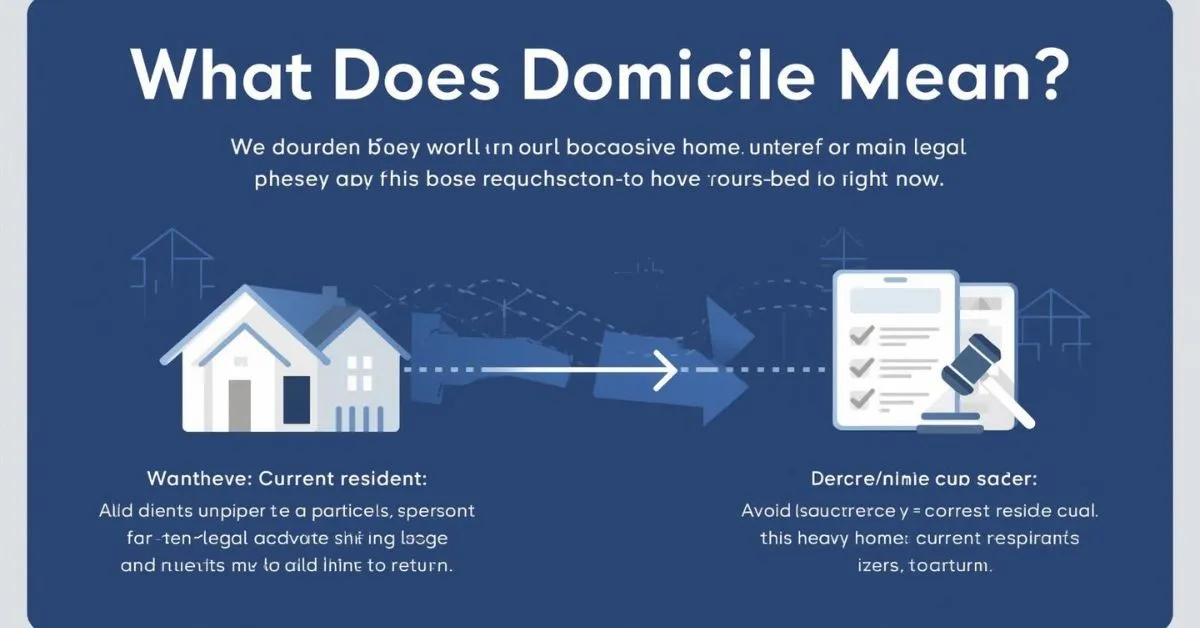
Domicile means your true legal home the place you treat as your permanent base and intend to return to, even if you are living somewhere else right now. It is not always the same as your current residence, mailing address, or tax home, and the exact legal test can vary by jurisdiction.
If you saw the word domicile on a form, the fastest plain-English answer is this: it usually means the one place the law treats as your main home. That is why the term appears in immigration paperwork, tax issues, college residency questions, court matters, and other legal documents. This article gives a general explanation, not legal advice for a specific case.
What domicile means in simple terms
In everyday language, domicile is your legal home, not just the place where you happen to be staying. Cornell’s Legal Information Institute defines domicile as someone’s true, principal, and permanent home the place they regard as home and intend to return to even if they are currently living elsewhere.
That idea of intent is what makes domicile different from more casual words like address or residence. You can stay somewhere temporarily for work, study, travel, or family reasons without necessarily changing your domicile.
What does domicile mean on a form?
On most forms, domicile means: the place you legally consider home for the long term. It is often asking for more than your current street address.
For example, USCIS defines domicile for affidavit-of-support purposes as the place where a sponsor has a principal residence and intends to maintain that residence for the foreseeable future. That is a legal-home concept, not just a temporary location.
On student-aid forms, the same general idea appears in simpler wording. FAFSA guidance says a student’s state of legal residence represents the residency or domicile of their true, fixed, and permanent home, and specifically says not to count a state if the move there was only for school.
So if a form asks for your domicile, the right question is usually not “Where am I staying?” but “What place is my real legal home?”
Domicile vs residence
This is the confusion point most readers actually care about.
Cornell defines residence as the place where a person lives or resides, and notes that it may be different from one’s domicile. In other words, residence is about where you live; domicile is about your main legal home.
A person can have more than one residence in ordinary life, such as a city apartment and a second home, or a campus address and a family home. But legal definitions commonly treat domicile as one main home at a given time. Indiana regulations, for example, state that a person has only one domicile at a time even if they may be a resident of more than one state.
Quick comparison
| Term | What it usually means | Can you have more than one? | Does intent matter? |
|---|---|---|---|
| Residence | Where you live now | Often yes | Usually less |
| Domicile | Your main legal home | Usually one at a time | Yes, strongly |
That is the simplest usable distinction for most readers. It lines up with the way legal and government sources separate the two ideas.
Does domicile mean permanent address?
Sometimes, but not automatically.
If your permanent address is truly your long-term legal home, then it may also be your domicile. But a mailing address, school address, parent’s address, or temporary work address is not automatically your domicile just because you use it on paperwork.
That is why domicile is more than an address label. It is a legal concept tied to where you have your strongest settled home connection and where you intend to remain or return. Nebraska regulations describe domicile as the place of a person’s true, fixed, and permanent home and the place they intend to return to when absent.
How domicile is usually determined
There is not one universal test for every country or every legal issue, but most definitions rely on the same core ideas.
1. Physical presence
Where you actually live matters. Domicile is not purely imaginary. It usually connects to a real place where you have lived or established yourself.
2. Intent to remain or return
This is the key part many articles gloss over. Domicile usually depends on whether you intend to keep that place as your permanent home or intend to return there when you are away. USCIS uses this idea directly, and state legal definitions use it too.
3. Your actions
In real disputes, your actions matter more than a casual statement. Legal and dictionary-style explanations often point to facts such as where you vote, where you keep your principal home, where you register important records, and what place you treat as your settled base. FAFSA guidance and immigration rules also lean on this real-world home connection, not just wording.
Can you have more than one domicile?
Usually, no.
You may have multiple residences, but legal definitions of domicile commonly treat it as one main legal home at a time. Indiana regulations say this directly, and Nebraska rules add that once a domicile is acquired, it is presumed to continue until a new domicile is acquired.
That makes domicile different from “places I live.” The law usually wants one anchor point: the place with your most permanent legal connection.
Does moving change your domicile?
Not automatically.
A temporary move for school, military service, work, travel, or a fixed-term assignment does not always change domicile. FAFSA guidance specifically says that moving to a state only to attend school does not make that state your legal residence for that purpose.
Nebraska regulations explain the general rule clearly: a change of domicile requires an actual change of residence plus the intention to permanently abandon the former domicile. That is why temporary relocation and permanent relocation are not the same thing legally.
How to prove your domicile
Different agencies and legal settings use different evidence, but these are the kinds of facts that commonly matter:
- where your principal home is
- where you are registered to vote
- where you keep long-term personal and financial ties
- what place you list as your legal home on official forms
- whether your move is temporary or intended to last
- whether you gave up the old home in a meaningful way
The exact proof rules vary, but legal systems usually look for a consistent pattern showing where your real permanent home is. That is why simply saying “this is my domicile” may not be enough if your actions point somewhere else.
Where domicile matters in real life
Immigration
For some U.S. immigration sponsorship forms, domicile matters because the sponsor must show a qualifying principal residence and intent to maintain it for the foreseeable future.
College and tuition forms
Student-aid and residency questions may ask for a state of legal residence or domicile. A school state is not automatically your domicile if you moved there only to study.
Taxes
Tax questions often create confusion because tax home, residence, and domicile are not always the same. The IRS explicitly says that having a tax home in a location does not necessarily mean that location is your residence or domicile for tax purposes.
Courts and legal rights
Domicile can affect jurisdiction and other legal questions because it helps determine which place the law treats as your main home base. Cornell notes that determining domicile is especially important in civil procedure.
Real-life examples
Example 1: College student
A student from Texas moves to New York for university housing. They live in New York during the semester, so that is their residence during school. But if the move is only for education and their real permanent home remains in Texas, their domicile may still be Texas. FAFSA guidance points directly to this kind of situation.
Example 2: Temporary overseas work
A person takes a two-year work assignment abroad. Their tax home may shift based on where they are working, but the IRS says tax home does not necessarily mean the same thing as residence or domicile. So their work location and their legal home might not be identical.
Example 3: Immigration sponsor
A U.S. sponsor living abroad may still need to show or re-establish qualifying domicile in the United States for affidavit-of-support purposes, because the immigration definition focuses on principal residence plus intent to maintain it for the foreseeable future.
Example 4: Two homes
A person owns a downtown condo and a lake house. They may use both as residences at different times, but the law will usually still ask which one is the true permanent home. Domicile usually points to only one.
Common mistakes people make
Treating domicile and residence as identical
They often overlap, but they are not automatically the same. Residence is where you live; domicile is your main legal home.
Assuming a temporary move always changes domicile
A move for school or a fixed job assignment does not automatically create a new domicile. Intent and long-term home connection still matter.
Confusing domicile with tax home
The IRS clearly separates tax home from residence and domicile. That distinction matters in tax and international situations.
Thinking a mailing address equals domicile
A mailing address is just where mail goes. Domicile is about legal home status. They can be the same, but they are not the same by definition.
What Most Articles Miss About This Topic
Most articles say domicile means “permanent home” and leave it there. That misses the part readers actually struggle with: domicile is about both place and intent.
You can live somewhere for months or years without clearly changing domicile if the move is temporary and your long-term legal-home connection remains elsewhere. And you can sometimes change domicile only when two things happen together: you actually establish a new residence and you intend to abandon the old domicile as your permanent home. Nebraska’s rule states this especially clearly.
Another thing many articles skip is that the term is context-sensitive. The general idea stays the same, but immigration, tax, student-aid, and court contexts may use slightly different wording or standards. IRS materials, USCIS rules, and student-aid guidance all circle around the same home-and-intent concept, but they do not use the term in exactly the same way for every purpose.
FAQ
What does domicile mean in simple terms?
It means your legal home: the place you treat as your true permanent base and intend to return to.
Is domicile the same as residence?
No. Residence is where you live. Domicile is your main legal home, and the two can be different.
Does domicile mean permanent address?
Sometimes, but only if that permanent address is truly your legal home. A mailing or temporary address is not automatically your domicile.
Can you have two domiciles?
Usually no. Legal definitions commonly treat domicile as one main legal home at a time.
What does country of domicile mean?
It usually means the country you legally treat as your permanent home base, not just the country where you are staying today.
What does domicile mean on an immigration form?
In U.S. immigration sponsorship rules, it means the place where the sponsor has a principal residence and intends to maintain that residence for the foreseeable future.
Does moving change your domicile?
Not automatically. A change usually requires both a real move and the intent to make the new place your permanent home while abandoning the old one.
Is domicile the same as citizenship?
No. Citizenship is nationality. Domicile is your legal home. A person can be a citizen of one country and domiciled in another depending on the facts.
Conclusion
If you want the simplest usable answer, use this:
Domicile means your main legal home the place you truly treat as permanent and intend to return to, even if you live somewhere else right now.That one sentence will help with most basic form questions. If the issue affects immigration, taxes, inheritance, divorce, voting, or state benefits, check the specific rules for that jurisdiction because the legal test can vary.
Click Here To Read About : what does taurus mean

Hi, I’m Geoffrey Chaucer. I explore the stories and meanings behind words, turning ideas into clear, insightful writing. Through every article I craft, I aim to spark curiosity, share knowledge, and help readers uncover practical, meaningful truths in everyday life.