The Emperor tarot card means authority, structure, stability, discipline, and leadership. When it appears upright, it often points to order, protection, responsibility, and strong boundaries. When reversed, it can warn about control issues, stubbornness, weak leadership, or problems with power.
The Emperor is one of the clearest power cards in the tarot deck, but it is not only about control. It is also about building a strong life, making smart choices, and creating order from chaos. This Major Arcana card can stand for a father figure, mentor, manager, protector, provider, or the part of you that needs to become stronger and more disciplined. In many readings, the Emperor is not just a boss. He is the person who builds solid foundations and keeps things steady.
The core meaning of the Emperor tarot card
At its center, the Emperor stands for order over chaos. He is linked with leadership, logic, rules, systems, planning, responsibility, and long-term stability. When this card appears, it often means success will come through structure, self-control, and smart decisions instead of emotion or impulse alone.
This card is also tied to the father archetype and what many readers call divine masculine energy. That does not mean the Emperor only stands for men. It means the card is connected to traits like protection, direction, authority, discipline, and building strong foundations. Many tarot readers see the Emperor as the “Ruler” archetype. This is the part of life that wants security, systems, and clear boundaries.
Where did the Emperor card come from?
The Emperor is not a modern tarot card. It has been part of tarot since the earliest known decks in the 15th century, including the Visconti-Sforza decks and the Tarot of Marseille tradition. Later, the Rider–Waite–Smith deck gave the card the look many modern readers know today. Occult groups like the Hermetic Order of the Golden Dawn also added deeper spiritual meaning by connecting the card with astrology and Kabbalah. Later, Aleister Crowley built on those ideas in his own tarot tradition.
This history matters because it shows why the Emperor has both a simple and a deeper meaning. On the surface, it is the ruler, king, or authority figure. In deeper tarot study, it becomes a card about law, order, power, structure, and the challenge of using authority in a fair and wise way.
The Emperor card symbolism explained
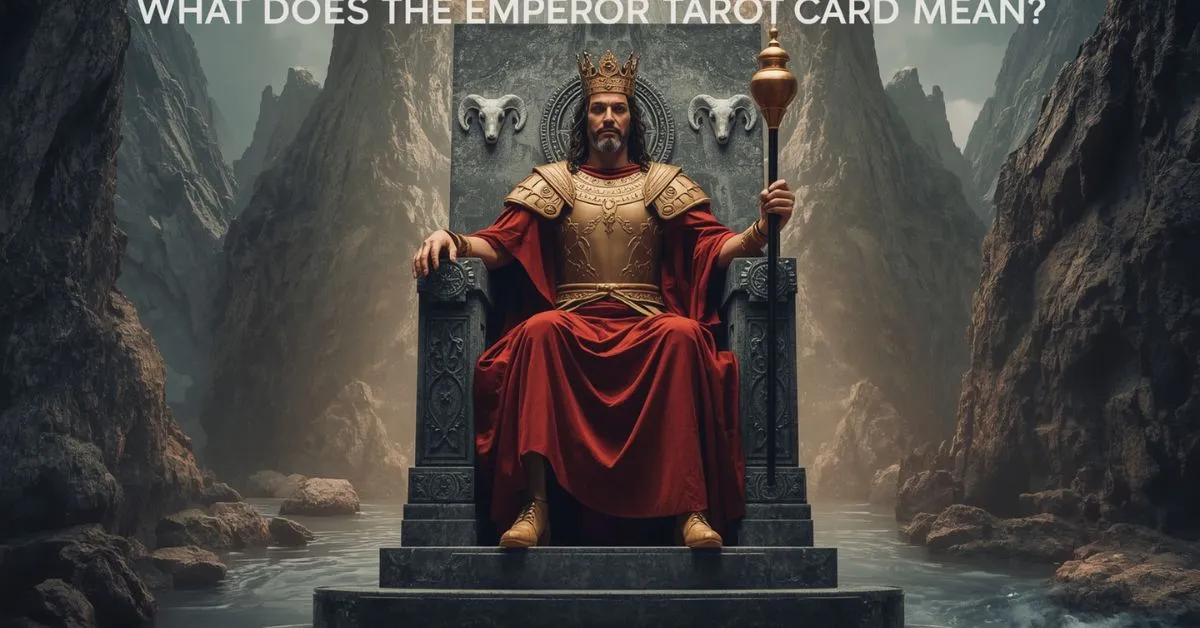
The Emperor card is full of symbols, especially in the Rider–Waite–Smith tarot deck. These details are important because they help explain the meaning of the card.
Card number IV
The Emperor is card IV in the Major Arcana. The number four stands for structure, foundation, balance, and stability. That fits the whole message of the card: build something strong, protect it, and manage it well.
Throne, stone, and ram heads
The Emperor sits on a stone throne. This shows stability, firmness, and strong authority. In many Rider–Waite–Smith style decks, the throne has four ram heads. These rams connect the card with Aries, the zodiac sign most often linked to the Emperor. Aries adds boldness, action, strength, and leadership.
Aries and Mars
The Emperor is linked to Aries, a cardinal fire sign ruled by Mars. This helps explain why the card feels strong, active, and decisive. Mars brings drive, ambition, courage, and a fighting spirit. Aries adds movement, confidence, and leadership.
Red robe, armor, and beard
The red robe stands for power, life force, passion, and energy. Under the robe, the Emperor wears armor. This suggests protection, readiness, and emotional control. His long white beard often shows wisdom, age, and earned experience. Together, these symbols show a leader who is strong, prepared, and not easily shaken.
Scepter, orb, mountains, and river
The scepter stands for command and authority. The orb stands for worldly power and responsibility. Behind him, the mountains suggest strength, endurance, ambition, and solid foundations. Many readers also notice a small river below the mountains. This can suggest that even though the Emperor looks tough and controlled, he still has emotion underneath the surface. He is not without feeling. He simply keeps it under control.
Upright Emperor meaning
When the Emperor appears upright, it usually points to healthy authority. This is the card of leadership, responsibility, discipline, strategy, and clear rules. It often appears when you need to organize your life, create better systems, or take charge of a situation. In personal growth readings, it can mean stepping into self-respect and learning how to lead yourself with confidence.
The upright Emperor can also stand for a father figure, husband, mentor, teacher, coach, boss, or older and well-established person. In many readings, it describes someone dependable, protective, practical, and respected. This person may not always be warm or emotional, but they often show care through action, support, and stability.
Reversed Emperor meaning
When the Emperor appears reversed, the same themes of power are still present, but now they are blocked, misused, too harsh, or too weak. Common reversed meanings include domination, too much control, stubbornness, poor boundaries, weak discipline, or struggles with authority. In some readings, it points to a controlling boss, strict parent, or possessive partner. In other readings, it points inward and asks whether you are avoiding responsibility or giving your power away.
A stronger reading of the reversed Emperor also includes shadow themes. This card can point to unhealthy power, fear-based control, emotional distance, or hard systems that no longer support growth. It may ask whether your structure is helping you feel safe or whether it has become too rigid and limiting. The reversed Emperor reminds you that strength without flexibility can turn into pressure and fear.
What does the Emperor tarot card mean in love?
In love readings, the upright Emperor often points to commitment, stability, loyalty, protection, and serious intentions. This is usually not a casual romance card. It often describes a relationship that wants strong roots, long-term plans, and a real sense of security. The Emperor brings logic, order, and stability to love, though sometimes it can feel a little traditional or emotionally reserved.
For singles, the Emperor may describe someone older, mature, responsible, and slow to open up. For couples, it can mean building a stronger foundation together through trust, planning, and shared goals. In reconciliation readings, the Emperor can suggest serious intent, but it usually asks for real action, honesty, and emotional maturity.
When reversed in love, the Emperor often points to power struggles, control issues, emotional distance, possessiveness, or one partner trying to dominate the other. It can also suggest stubbornness, fear of vulnerability, or a relationship that feels too strict and not emotionally open enough.
Career and money meaning
The Emperor is one of the strongest tarot cards for career, business, leadership, and long-term success. Upright, it often points to authority, discipline, structure, management, planning, and smart growth. It can show that you are ready to lead, run a project, improve a system, or move into a more senior role. It may also stand for a boss, mentor, executive, or respected authority figure who plays an important role in your work life.
For money, the Emperor usually favors control, planning, discipline, smart budgeting, and long-term security. This is not a card of risky choices. It is a card of careful thinking and steady growth. Reversed, it can point to poor planning, work stress, money disorder, weak systems, office conflict, or a lack of control in your financial life.
Emperor as feelings, intentions, yes or no, and as a person
As feelings, the Emperor often shows serious, steady, and protective emotions. This person may care a lot, but they may not express it in a soft or romantic way. Instead, they may show love through loyalty, reliability, support, and consistency. The card can also suggest a desire for control, clear boundaries, and emotional safety.
As intentions, the Emperor often means someone wants to create structure, define the relationship, act responsibly, or bring order to the situation. Reversed, it may show someone who wants control more than real closeness, or someone who is too insecure to lead in a healthy way.
As a yes-or-no card, the Emperor is usually a yes, especially when the question is about leadership, commitment, work, property, planning, or long-term success. But it is a serious yes. It says the result will come through discipline, effort, and strong choices, not luck. Reversed, the answer often leans toward no or not yet.
As a person, the Emperor is usually someone mature, dependable, practical, strong, and protective. This person may be a father figure, husband, manager, teacher, mentor, or authority figure. When reversed, the same person may seem controlling, cold, stubborn, or overly strict.
The Emperor vs the Empress vs the Hierophant
This comparison is helpful because many readers confuse these cards. The Emperor and the Empress are often seen as a pair. The Empress stands for nurture, fertility, abundance, creativity, intuition, and natural growth. The Emperor stands for order, law, boundaries, structure, and governance. One helps life grow. The other protects it and gives it form.
The Emperor is also different from the Hierophant. The Emperor is about worldly authority, systems, and external order. The Hierophant is more about tradition, teaching, spiritual systems, and formal belief. In simple terms, the Emperor rules practical life and outer structure, while the Hierophant rules sacred systems, learning, and tradition.
Upright vs reversed Emperor at a glance
| Area | Upright Emperor | Reversed Emperor |
|---|---|---|
| Core meaning | Authority, order, structure, stability | Control issues, rigidity, domination |
| Love | Commitment, protection, loyalty | Power struggle, possessiveness, distance |
| Career | Leadership, discipline, promotion | Bad boss, weak systems, stress |
| Money | Planning, security, restraint | Poor control, disorder, money pressure |
| As a person | Mature, reliable, protective | Controlling, stubborn, emotionally closed |
| Advice | Lead, plan, set boundaries | Stop forcing, rebalance power |
This table makes the card easier to understand at a glance. Upright, the Emperor builds order and security. Reversed, the same energy can become too hard, too controlling, or too weak.
Common mistakes when reading the Emperor
One common mistake is thinking the Emperor is always a positive success card. It can be powerful and helpful, but it can also become harsh, controlling, emotionally distant, or too rigid if the energy is unhealthy.
Another mistake is reading the Emperor only as a man. While it can stand for a father, husband, boss, or male authority figure, it more often stands for an energy or role: leadership, structure, protection, rules, and responsibility. Anyone can carry that energy.
A third mistake is ignoring the emotional side of the card. The Emperor is logical and controlled, but that does not mean emotion is missing. In love and feelings readings, this card often shows strong emotion expressed through action, support, and loyalty rather than soft words.
A fourth mistake is missing the deeper shadow side. The Emperor can also point to unhealthy control, rigid systems, oppression, fear-based leadership, and the pressure to always appear strong. That side of the card matters, especially when it shows up reversed.
Practical takeaways
If the Emperor appears in your reading, ask yourself:
- Where do I need more structure?
- Am I leading with wisdom or with fear?
- Do I need stronger boundaries?
- Am I building something stable for the future?
- Is authority helping this situation or harming it?
- Am I being disciplined, or am I becoming too rigid?
These questions help bring the card into real life. The Emperor is not just about control. It is about using power wisely, building a strong foundation, and creating order that supports growth instead of blocking it.
FAQ
What does the Emperor tarot card mean in love?
It usually means commitment, stability, protection, loyalty, and serious intentions. Reversed, it often points to control issues, emotional distance, or a power struggle.
What does the Emperor tarot card mean reversed?
Reversed, the Emperor often means domination, stubbornness, poor boundaries, weak discipline, abuse of authority, or problems with control and leadership.
Is the Emperor tarot card a yes or no?
Usually yes, especially for questions about leadership, commitment, work, planning, and long-term goals. Reversed, it often leans no or not yet.
What zodiac sign is linked to the Emperor?
The Emperor is most strongly linked to Aries. It is also connected with Mars, which adds themes of drive, courage, force, and leadership.
What does the Emperor tarot card mean as feelings?
As feelings, it often suggests serious, steady, and protective emotions. A person may care deeply but show it through actions, loyalty, and support.
What does the Emperor tarot card mean in career?
In career readings, it often points to leadership, promotion, management, strategy, structure, discipline, and support from a boss or mentor.
What is the Emperor’s connection to the Empress?
The Emperor and the Empress are a pair. The Empress stands for nurture, creativity, and abundance, while the Emperor stands for order, structure, and protection.
What deck is this meaning based on?
Most modern online meanings of the Emperor are mainly based on the Rider–Waite–Smith tradition, first published in 1909.
Conclusion
So, what does the Emperor tarot card mean? In most readings, it means authority, structure, discipline, stability, leadership, and long-term security. Upright, it points to healthy control, clear rules, strong boundaries, and practical wisdom. Reversed, it warns about domination, rigidity, weak systems, or unhealthy power dynamics. With roots in early tarot decks and deeper meaning added through Rider–Waite–Smith symbolism, astrology, and esoteric study, the Emperor remains one of the clearest cards for understanding how power should be used.
The best way to read the Emperor is not “be more controlling.” The real lesson is “build well, lead fairly, and create structure that protects what matters.” That is why this card remains so important in readings about love, work, identity, and personal growth.
Click Here To Read About : what does renewable mean

I am Clara Lexis, a writer driven by clarity, depth, and authenticity. My focus is on transforming ideas into meaningful content that is both informative and engaging. I write with intention to communicate clearly, thoughtfully, and with purpose.