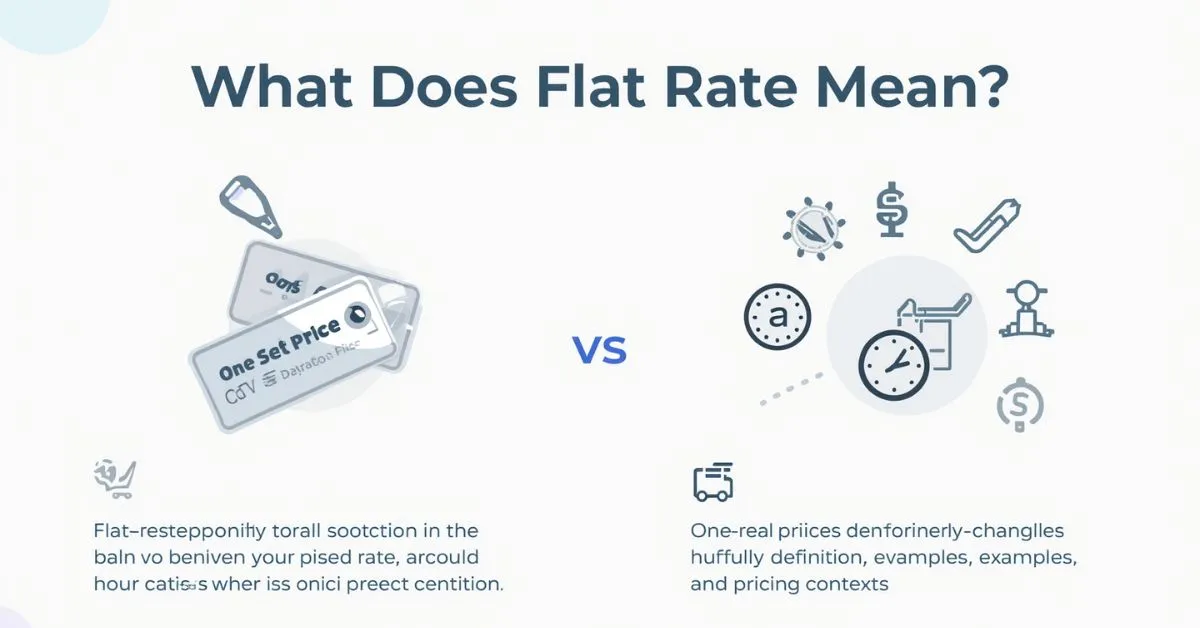
Flat rate means a charge or pricing level that stays the same within a specific offer instead of changing based on time, usage, or quantity. You’ll often see it in service pricing, shipping, subscriptions, and tax discussions, but the exact meaning depends on the context.
If you searched what does flat rate mean, you probably want a quick answer first, then a clear explanation of where the term shows up in real life. That matters because the phrase appears in very different places: repair quotes, invoices, shipping options, phone or software plans, and tax discussions. The core idea stays the same, but the details change depending on the system around it.
Quick definition at a glance
| Term | Simple meaning |
|---|---|
| Flat rate | A price or rate that stays the same within that offer |
| Flat-rate pricing | One set charge for a job, service, or plan |
| Flat-rate shipping | One standard shipping price for a qualifying box or envelope |
| Flat tax | One tax rate applied across taxable income |
This is why the phrase can sound simple but still confuse people. It is not one narrow “dictionary-only” term. It is a pricing concept used in several systems.
What flat rate means in plain English
In plain English, flat rate usually means you pay the same charge instead of a price that rises or falls case by case. Cambridge defines it as a charge that stays the same, while business pricing explainers describe it as a fixed price for a service regardless of the time or resources needed to finish the job.
That does not mean the same price always applies in every possible situation. It means the price stays fixed inside that specific pricing setup. For example, a plumber may have one preset price for replacing a faucet, while a shipping carrier may have one set price for a qualifying flat-rate box. Those are both flat-rate examples, even though they work differently.
Why this term confuses so many people
The biggest confusion is that people hear “flat rate” and assume it always means one universal price no matter what. That is usually not true.
A flat rate can mean:
- one set price for a job
- one standard shipping price for a qualifying package
- one plan price for a subscription
- one percentage rate in tax
So the phrase is consistent in principle, but flexible in application. That is why a mechanic, a shipping company, a software provider, and a tax explainer can all use the term correctly while meaning slightly different things.
Flat rate vs hourly rate
This is one of the most important comparisons because many readers run into the term on quotes, invoices, and service pages.
| Pricing model | How it works | Best for |
|---|---|---|
| Flat rate | One preset charge for the job or offer | Standard, predictable work |
| Hourly rate | The price rises with time spent | Unpredictable or open-ended work |
With flat-rate pricing, the customer knows the number upfront. With hourly pricing, the final cost depends on how long the work takes. Jobber explains flat rate as a fixed price for the service, while ServiceTitan contrasts it with time-and-materials and other labor-based pricing approaches.
Simple example
Imagine an electrician offers:
- Flat rate: $150 to install a ceiling fan
- Hourly rate: $75 per hour plus materials
If the work takes one hour, hourly billing may be cheaper. If it takes three hours, the flat rate may feel better for the customer. That is why flat rate is often attractive when the job is standard and the scope is easy to estimate.
Flat rate in service pricing
In service businesses, flat rate usually means a predetermined charge for a specific job, rather than billing the customer strictly for every hour spent. Jobber defines it this way, and ServiceTitan describes flat-rate pricing as direct cost plus markup in a standardized pricing structure for service work.
Why businesses use it
Service businesses often use flat rate because it:
- makes quotes easier to understand
- creates more consistent pricing
- helps customers approve work faster
- rewards efficiency when technicians complete standard jobs quickly
This works especially well when the task is predictable, such as installing a faucet, replacing a thermostat, or performing a standard inspection.
What may be included in a flat rate
Depending on the business, a flat rate may reflect:
- labor
- direct costs
- overhead
- markup
- standard job difficulty
That is one reason flat-rate pricing can look higher than a simple hourly estimate at first glance. It is often designed to cover the total service structure, not just the clock. ServiceTitan specifically frames flat-rate pricing around direct cost plus markup.
Flat rate vs time and materials
This is another distinction many articles skip, even though it matters in the real world.
Time and materials pricing usually means the customer pays for:
- the labor time spent
- the parts or materials used
Flat rate, by contrast, gives one predefined price for the job itself. This makes flat rate easier to quote and easier for customers to compare, while time and materials may fit jobs with unclear scope. ServiceTitan directly contrasts flat-rate pricing with time-and-materials billing in its pricing guidance.
Flat rate in shipping
In shipping, flat rate means there is a standard shipping price for a qualifying package option instead of recalculating the cost in the usual way for each shipment. USPS says its Priority Mail Flat Rate products let customers ship packages up to 70 pounds to any state at the same price within that product line.
What that means in practice
If you use a qualifying flat-rate box or envelope, the shipping cost stays the same as long as you follow the service rules. USPS presents this as a same-price option within that packaging type, and EasyPost explains that flat-rate shipping is based on the size of the box or envelope rather than the package’s dimensional weight.
Flat-rate shipping vs calculated shipping
| Shipping model | What affects the price |
|---|---|
| Flat-rate shipping | The qualifying package type and service rules |
| Calculated shipping | Weight, dimensions, destination, and other carrier factors |
This is important because flat-rate shipping is not always the cheapest option. It often makes more sense for dense or heavier items that fit the allowed packaging, while calculated shipping may be better for lighter packages. EasyPost explains that normal shipping costs often involve dimensional weight, which uses package dimensions to help determine price.
In Auto Repair and Labor
In auto repair and similar trades, this pricing model often refers to a standard labor charge for a specific job instead of billing strictly by clock time. That means an invoice may show one set labor amount for brake replacement, diagnostic work, or another routine service even if the actual time in the bay is different.
This is why customers sometimes feel confused by repair bills. Many assume labor always reflects exact time spent, but in many shops it refers to standardized job pricing instead.
Why Shops Use It
This approach helps repair shops:
- price routine work consistently
- estimate common jobs faster
- reduce large pricing swings caused by technician speed differences
For customers, the main benefit is predictability. The tradeoff is that the billed labor amount may not match the exact clock time they imagine.
In Subscriptions and Plans
In subscriptions, the term usually means one set plan price for access over a certain period, such as monthly or yearly, instead of charging by minute, unit, or transaction. This makes billing easier to understand because the customer sees one recurring amount instead of changing usage-based charges.
Example
A software tool may charge:
- $29 per month for one plan
That is a subscription model with one fixed plan price. The cost stays the same for that plan, even if one customer uses the service lightly and another uses it much more within the plan’s limits.
In Tax
In tax discussions, the phrase usually means a single tax rate rather than multiple rates applied at different levels. A flat tax is commonly defined as a system in which all taxable income is subject to the same percentage rate, regardless of income level or assets.
The Most Common Misunderstanding
People often confuse:
- same percentage
with - same dollar amount
A flat tax usually means the same rate, not the same total tax bill. If that percentage is applied to a larger taxable amount, the total paid will still be higher in dollars. That is the key point readers need to understand when they see this term in tax content.
Flat Rate vs Flat Fee vs Fixed Rate
| Term | Simple meaning |
|---|---|
| Flat Rate | A pricing structure that stays the same within the offer |
| Flat Fee | One single fee for a specific service |
| Fixed Rate | A rate that stays unchanged over time |
In everyday use, people often treat these as near-synonyms. But if precision matters, flat rate usually points to the pricing model, flat fee often points to the one-time charge, and fixed rate often points to stability over time.
When It Is a Good Deal
This kind of pricing often works well when:
- the job is standard and easy to estimate
- the customer wants a clear upfront price
- the shipment is heavy for its size and fits the allowed packaging
- the plan is simple and usage does not vary wildly
- the business wants predictable quoting
In these situations, it reduces uncertainty for both sides. That is one reason service businesses and shipping carriers use it so often.
When It Can Cost More
This model may be less attractive when:
- the job turns out to be very easy
- the shipment is small and lightweight
- the project scope is unclear
- usage varies a lot from customer to customer
- the customer only needs a very limited amount of service
This is where readers need nuance. “Flat” does not automatically mean “cheaper.” It usually means more predictable.
What Most Articles Miss About This Topic
Many articles define the concept as one fixed price and stop there. That is not wrong, but it misses the most useful clarification: this is one pricing idea that takes different forms depending on the system around it.
That matters because:
- in service pricing, it often means one set job price
- in shipping, it means one standard price for qualifying packaging
- in subscriptions, it means one plan price
- in tax, it means one rate, not one total payment
Another point many articles miss is that this structure is not automatically better for the buyer or the seller. Its real advantage is predictability. Whether it saves money depends on the specific job, package, or plan.
Common Mistakes People Make
Thinking It Always Means the Cheapest Option
It does not. It may save money in one situation and cost more in another.
Thinking It Means One Price for Everything
Usually it means one price within a specific offer or ruleset.
Confusing It With Hourly Billing
This model charges by the predefined job, plan, or service option. Hourly pricing rises with time.
Confusing Flat Tax With the Same Dollar Amount
A flat tax normally means one percentage rate, not the same total tax bill for every person.
Practical Takeaway
If you want the easiest way to interpret the phrase, ask these four questions:
- What exactly is being priced?
- What stays fixed?
- What rules or limits apply?
- What is the alternative pricing model?
Those four questions usually make the meaning clear right away.
FAQ
Does flat rate mean one fixed price?
Usually yes, but only within the rules of that specific service, plan, job, or shipping option.
Is flat rate the same as hourly?
No. Hourly pricing depends on time spent. This model uses a preset charge.
What does it mean in shipping?
It usually means a qualifying shipping option has one standard price rather than recalculating the cost for each shipment. USPS flat-rate products are a clear example.
What does it mean in auto repair?
It usually means the shop charges a standard labor amount for a job instead of billing strictly by exact clock time.
What does it mean in tax?
It usually means one tax rate applies across taxable income rather than multiple income-tax rates.
Is flat rate the same as flat fee?
They are close, but not always identical. A flat fee often refers to one single charge, while flat rate more often describes the overall pricing structure.
Conclusion
So, what does flat rate mean? In most cases, it means a charge or rate stays fixed within a defined pricing setup instead of changing with time, usage, or other variables. The phrase is simple at the core, but the exact meaning depends on whether you are looking at service pricing, shipping, subscriptions, repair labor, or taxes.
If you are building a pricing glossary or internal content cluster, the strongest next companion pages would be hourly rate explained, flat fee meaning, fixed vs variable pricing, and time and materials pricing.
Click Here To Read More About : what does post secondary education mean

I am Clara Lexis, a writer driven by clarity, depth, and authenticity. My focus is on transforming ideas into meaningful content that is both informative and engaging. I write with intention to communicate clearly, thoughtfully, and with purpose.