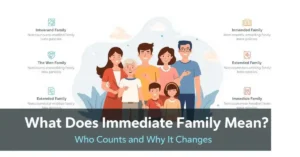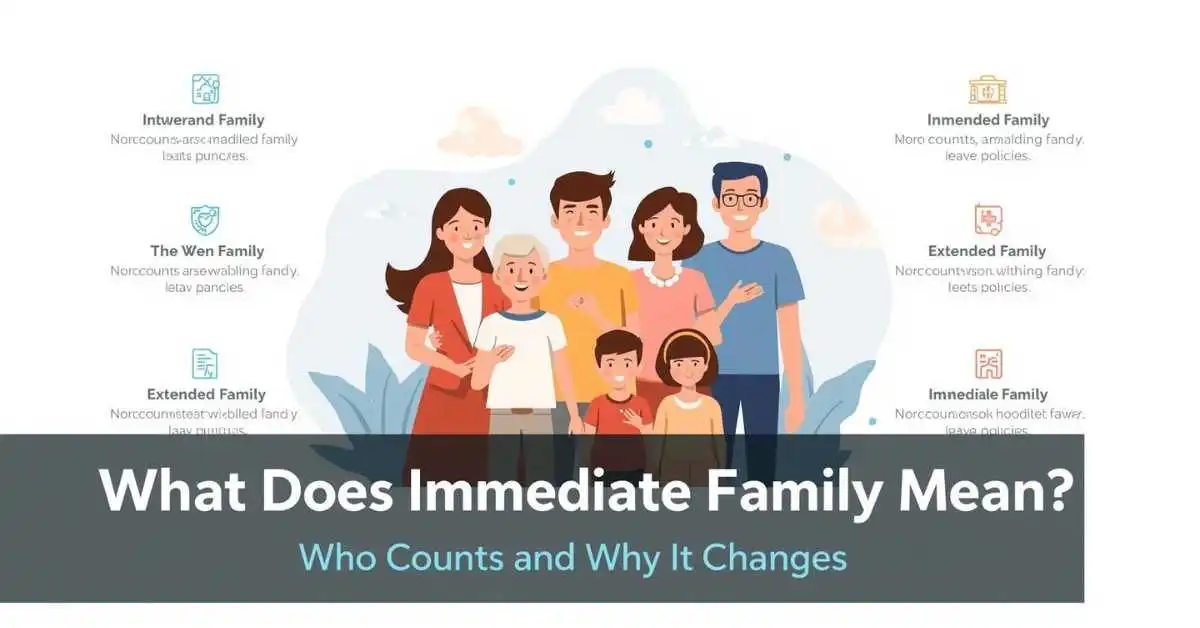
Immediate family usually means your closest relatives, such as your spouse, parents, children, and siblings.
In legal, workplace, immigration, and policy settings, the meaning can be broader or narrower and may also include grandparents, in-laws, step-relatives, adopted relatives, foster relatives, or a domestic partner, depending on the exact rule.
If you have ever asked what does immediate family mean, you are not alone. It sounds simple, but the answer changes with context. In everyday English, it usually means your closest family members.
On a job policy, hospital form, immigration document, insurance paper, or bereavement leave request, the definition may be much more specific. That is why a grandparent, stepchild, foster child, parent-in-law, domestic partner, or legal guardian may count in one situation but not in another.
This guide gives you a fast definition, a practical list of who counts, and a simple way to check the right answer for your exact case.
What immediate family means in simple words
The common definition
In plain English, immediate family usually means the people most closely related to you: your spouse, parents, children, and siblings. That is the standard meaning most people expect, and it is close to the dictionary definition used in everyday speech.
Why the meaning changes
The problem is that immediate family is not one universal legal list. A dictionary gives the common meaning, but a workplace policy, government rule, or legal form can define it differently. One law may include only a spouse, child, or parent.
Another may include grandparents, grandchildren, step-relatives, adoptive relatives, in-laws, household members, or someone who stood in loco parentis, meaning a person who acted like a parent.
Who is usually considered immediate family?
People usually included
In most everyday uses, these people are usually considered immediate family:
- spouse, husband, or wife
- parent, mother, or father
- child, son, or daughter
- sibling, brother, or sister
These are the closest relatives and the safest starting point when someone asks, what is immediate family or who counts as immediate family.
People often included depending on policy
In many work, legal, and official settings, the list can expand to include:
- grandparents and grandchildren
- parent-in-law or other in-laws
- step-parent, stepchild, and step-sibling
- adopted child and adoptive parent
- foster child and foster parent
- half-brother and half-sister
- domestic partner or de facto partner
- former spouse or former de facto partner
- a person who acted as a parent
- sometimes a household member or legal guardian
This wider version appears in some regulations and workplace rules, but not in all of them.
People usually not included unless the policy says so
These relatives are usually treated as extended family, not immediate family, unless a policy clearly includes them:
- cousin
- aunt
- uncle
- niece
- nephew
- first cousin once removed
- close family friend
Some state or agency rules may define the term more broadly, but you should never assume that broader version applies everywhere.
Quick reference table: Who counts as immediate family?
| Relative | Everyday meaning | Workplace policy | Legal or official meaning |
|---|---|---|---|
| Spouse | Usually yes | Usually yes | Often yes |
| Parent | Usually yes | Usually yes | Often yes |
| Child | Usually yes | Usually yes | Often yes |
| Sibling | Usually yes | Often yes | Sometimes |
| Grandparent | Sometimes | Often included | Sometimes |
| Grandchild | Sometimes | Often included | Sometimes |
| Domestic partner / de facto partner | Sometimes | Often included | Sometimes |
| Stepchild / step-parent | Sometimes | Often included | Sometimes |
| Adopted child / adoptive parent | Often yes | Often yes | Often yes |
| Foster child / foster parent | Sometimes | Sometimes | Sometimes |
| Parent-in-law / in-laws | Sometimes | Often included | Sometimes |
| Cousin / aunt / uncle / niece / nephew | Usually no | Usually no | Usually no unless stated |
The best way to read this table is simple: the closer the relationship, the more likely the person counts. But once you move beyond spouse, parent, child, and sibling, the exact wording of the policy or law matters much more.
What does immediate family mean at work?
Bereavement leave and compassionate leave
At work, people often search this term because they need to know whether they qualify for bereavement leave or compassionate leave. In many policies, immediate family includes more than the basic dictionary list.
For example, Australian Fair Work guidance includes a spouse or former spouse, de facto partner or former de facto partner, child, parent, grandparent, grandchild, sibling, and certain relatives of a spouse or partner. It also says step-relations and adoptive relations count.
FMLA and family leave
Under the U.S. Department of Labor’s FMLA overview, a worker may take leave to care for an immediate family member, defined there as a spouse, child, or parent with a serious health condition.
That is narrower than many workplace bereavement policies, which is a good example of why the same phrase can mean different things in different rules. FMLA also separately covers the birth of a child and placement of a child for adoption or foster care.
What this means for employees
If you are checking a company handbook, do not assume your employer uses the same meaning as a dictionary or a government leave law.
One employer may include a grandparent, adult child, sibling-in-law, or domestic partner. Another may not. Always read the policy definition first.
What does immediate family mean legally?
It depends on the law
A legal definition can be broader, narrower, or very specific to one statute. Some federal definitions include a spouse, parent, sibling, child, a person standing in loco parentis, or a household relative related by blood or marriage.
Other statutes define immediate family differently, including or excluding grandparents, half-siblings, or spouses of family members.
Immigration uses a special category
In U.S. immigration law, the related term immediate relatives has a very specific meaning.
USCIS says immediate relatives of a U.S. citizen are the spouse, the unmarried child under 21, and the parent of a U.S. citizen, with the parent category applying when the citizen is at least 21. That is not the same as the broader everyday meaning of immediate family.
Hospitals, forms, and insurance papers
On hospital forms, school records, insurance documents, or emergency contact paperwork, the term may be used more casually or may be formally defined. Sometimes the form asks for immediate family.
Other times it asks for next of kin, which is not always the same thing. That is why the heading alone is never enough. You need the actual definition or instructions on the form.
Immediate family vs extended family vs next of kin
Immediate family vs extended family
Immediate family usually means the closest relatives. Extended family usually includes relatives outside that inner circle, such as aunts, uncles, cousins, nieces, and nephews. So if someone asks, is a cousin immediate family, the answer is usually no unless a specific policy says yes.
Immediate family vs next of kin
These terms overlap, but they are not identical. Cornell’s Legal Information Institute explains that next of kin means a person’s closest living relative and is important in inheritance and death-notification contexts.
Under some federal leave rules, next of kin is defined as the nearest blood relative. So a person may be immediate family in everyday speech but not be the legally recognized next of kin in a specific process.
Real examples that make the meaning easier
Example 1: A grandparent dies
Many people naturally think of a grandparent as immediate family. In some bereavement or compassionate leave policies, that is true. In others, it may or may not be covered. The policy wording decides.
Example 2: A cousin is listed on a form
In ordinary use, a cousin is part of the family, but not usually part of the immediate family. Unless the document gives a broader definition, a cousin is usually extended family.
Example 3: A stepchild or adopted child
A stepchild or adopted child may count as immediate family in many workplace and legal settings. An adopted child is especially likely to count. A stepchild may also count, but it still depends on the exact rule.
Example 4: A domestic partner or de facto partner
Some systems include a domestic partner or de facto partner. Others focus only on a legal spouse. That is why one person may qualify for leave at one job and not at another.
Common mistakes to avoid
Assuming every source uses the same list
This is the biggest mistake. Dictionary meaning, HR meaning, immigration meaning, and statutory meaning are often different.
Thinking emotional closeness decides the answer
A beloved aunt, uncle, cousin, niece, nephew, or family friend may feel like immediate family, but that emotional truth does not automatically change the legal or policy definition.
Forgetting step, adoptive, foster, and half relationships
Many people miss these. Some policies clearly include stepchildren, adoptive relations, foster relations, or half-siblings, while others do not.
Confusing immediate family with household member
A household member may live with you and be covered by some leave policies, but that does not automatically make them immediate family in every system. Some rules mention both categories separately.
How to tell who counts in your case
Start with the common meaning
If there is no official definition, use the standard meaning: spouse, parent, child, or sibling. That is the safest plain-English answer.
Then check the exact source
If the term appears in a job handbook, legal form, court filing, school document, insurance policy, immigration rule, or hospital form, look for a section called definitions. That is where the real answer usually appears.
Look for names, not just the phrase
Do not stop when you see the label immediate family. Read the full list. Check whether it includes a grandparent, parent-in-law, sibling-in-law, legal guardian, ward, domestic partner, de facto partner, step-parent, foster parent, or household member.
Ask before you assume
If the matter affects leave, benefits, immigration, or legal rights, ask HR, the agency, or a lawyer for the written definition. A quick check can prevent a denied request or a filing mistake.
8) FAQ SECTION
1. What does immediate family mean in simple terms?
Immediate family usually means your closest relatives, especially your spouse, parents, children, and siblings.
2. Are grandparents immediate family?
Sometimes. In ordinary speech, many people include grandparents. In workplace or legal settings, it depends on the exact rule or policy.
3. Are siblings immediate family?
Usually yes in everyday use. In many work policies, siblings are included too, but some legal definitions may differ.
4. Are in-laws immediate family?
Sometimes. Some workplace policies include a parent-in-law or other in-laws, while others do not.
5. Is a cousin immediate family?
Usually no. A cousin is generally considered part of the extended family unless a specific policy says otherwise.
6. Are stepchildren, adopted children, and foster children immediate family?
Adopted children are often treated the same as biological children. Stepchildren and foster children may count too, but that depends on the exact law or policy.
7. Is immediate family the same as next of kin?
No. They can overlap, but next of kin is often a more specific legal term tied to inheritance, emergency contact, or formal priority rules.
8. Why does immediate family mean different things on different forms?
Because employers, agencies, and laws can define the term for different purposes. A leave rule, hospital form, and immigration category may all use different lists.
Conclusion
So, what does immediate family mean? In most everyday situations, it means your closest relatives: spouse, parents, children, and siblings. But in legal, immigration, hospital, insurance, and workplace settings, the answer may expand or narrow to include grandparents, in-laws, domestic partners, step-relatives, adopted relatives, foster relatives, or other close relations named in the rule.
The smartest approach is simple: use the common meaning in conversation, but use the written definition for anything official. Read the policy, check the list, and never guess when the wording matters.
Read Also About: Mean Well: Meaning, Examples, and How to Use It

I am Clara Lexis, a writer driven by clarity, depth, and authenticity. My focus is on transforming ideas into meaningful content that is both informative and engaging. I write with intention to communicate clearly, thoughtfully, and with purpose.