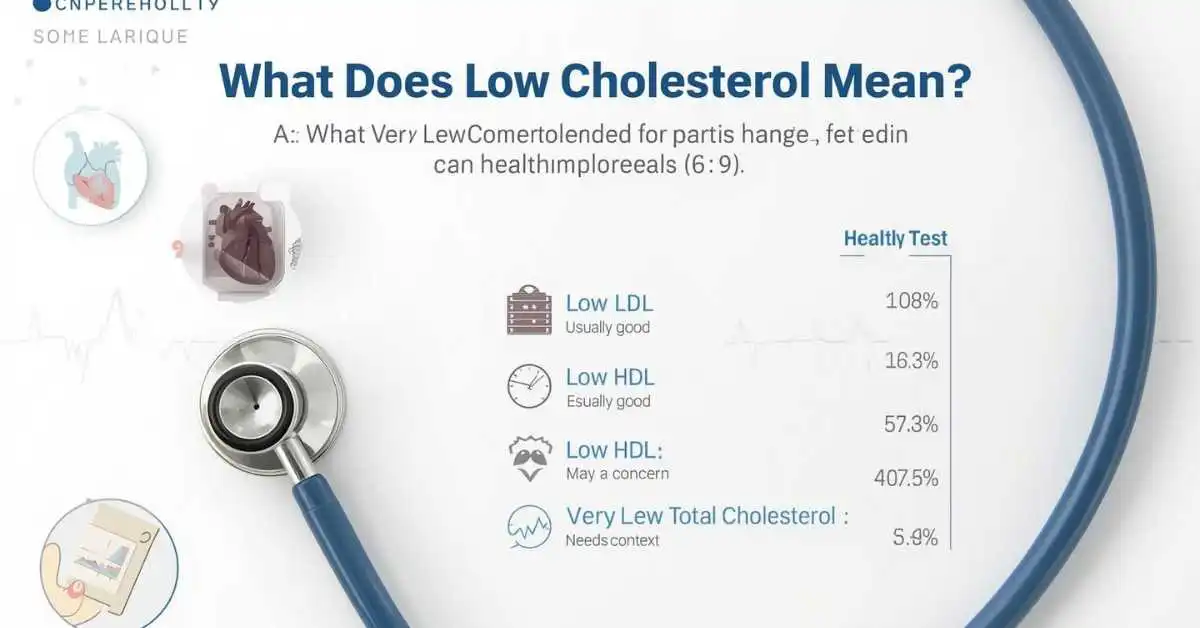
Low cholesterol can mean different things depending on which number is low. Low LDL is often good for heart health, but low HDL may raise cardiovascular risk.
Very low total cholesterol or very low LDL can also be linked with conditions such as hyperthyroidism, malabsorption, undernutrition, chronic infection, anemia, cancer, or rare inherited lipid disorders.
This guide explains what low cholesterol means, what counts as low, when it is good, when it may be a warning sign, and how doctors interpret the full picture.
It also covers major entities tied to this topic, including atherosclerosis, coronary artery disease, stroke, peripheral artery disease, statins, hyperthyroidism, diabetes, metabolic syndrome, malabsorption, hepatitis C, PCSK9, ABCA1, APOA1, familial HDL deficiency, Tangier disease, abetalipoproteinemia, chylomicrons, VLDL, and fat-soluble vitamins.
Quick answer: How to interpret a low cholesterol result
Low cholesterol usually falls into one of three patterns. The rough guide below reflects current patient-facing reference points from MedlinePlus, NHLBI, AHA, NHS, and Merck.
| Result pattern | What it often means | What to do next |
|---|---|---|
| Low LDL | Often beneficial for heart and stroke prevention | Usually good, especially if expected from diet, weight loss, exercise, or statins |
| Low HDL | Less “good” cholesterol helping remove cholesterol from arteries | Review lifestyle, smoking, diabetes, triglycerides, and medications |
| Very low total cholesterol | May be harmless, but can also reflect illness, undernutrition, malabsorption, or rare genetic disorders | Review symptoms, medical history, and the full lipid panel |
What low cholesterol actually means
Cholesterol is not one single number
A cholesterol test usually measures LDL cholesterol, HDL cholesterol, total cholesterol, and triglycerides. Some reports also calculate non-HDL cholesterol, and some clinicians may order ApoB or Lp(a) for a deeper cardiovascular risk assessment. VLDL is related too, but it is not always reported directly in routine testing.
That is why the phrase “low cholesterol” can be misleading. A person can have low LDL and normal HDL. Another person can have normal total cholesterol but low HDL. A third person can have unusually low total cholesterol because of an underlying health issue. These patterns have different meanings.
Low LDL is usually good
LDL is often called the “bad” cholesterol because it contributes to fatty buildup in arteries, a process known as atherosclerosis. That buildup raises the risk of coronary artery disease, heart attack, stroke, and peripheral artery disease. Lower LDL generally means lower cardiovascular risk, especially when the low value is intentional or expected.
The American Heart Association says lower is better for LDL, and MedlinePlus lists less than 100 mg/dL as optimal for healthy adults. For people already at high cardiovascular risk, treatment goals may be even lower.
Low HDL is different
HDL is the “good” cholesterol because it helps carry cholesterol away from the arteries and back to the liver. When HDL is low, that protective effect is weaker. Low HDL is therefore not interpreted the same way as low LDL.
For adults, MedlinePlus and NHLBI indicate that HDL is considered low below 40 mg/dL for men and below 50 mg/dL for women. Higher HDL is generally better, with 60 mg/dL or more often considered a strong level.
Very low cholesterol may need context
Merck Manual defines hypolipidemia as total cholesterol below 120 mg/dL (3.1 mmol/L) or LDL below 50 mg/dL (1.3 mmol/L). It also notes that very low lipid levels rarely cause a problem by themselves, but they can be a clue to another disorder.
What counts as low or healthy?
The table below combines commonly used adult reference points in mg/dL and mmol/L. These are general guides, not a diagnosis.
Your target may differ if you have diabetes, heart disease, a family history of early cardiovascular disease, or you take lipid-lowering medication.
| Lipid marker | General healthy guide | When it may be considered low or notable |
|---|---|---|
| Total cholesterol | Less than 200 mg/dL or about 5.18 mmol/L | Very low may deserve review if below 120 mg/dL or 3.1 mmol/L |
| LDL cholesterol | Less than 100 mg/dL or about 2.59 mmol/L | Very low may be below 50 mg/dL or 1.3 mmol/L |
| HDL cholesterol (men) | Above 40 mg/dL or about 1.0 mmol/L; 60 mg/dL or 1.55 mmol/L is strong | Below 40 mg/dL is low |
| HDL cholesterol (women) | Above 50 mg/dL or about 1.2–1.3 mmol/L; 60 mg/dL or 1.55 mmol/L is strong | Below 50 mg/dL is low |
| Non-HDL cholesterol | Less than 130 mg/dL or about 4.0 mmol/L | Higher values matter more than low values in routine risk assessment |
| Triglycerides | Less than 150 mg/dL or about 1.69 mmol/L | High triglycerides are more commonly the concern |
When low cholesterol is a good sign
Healthy low LDL
Low LDL often reflects positive changes such as a better diet, weight loss, more physical activity, or successful treatment with statins and other cholesterol-lowering medicines. In many patients, this is the intended result.
Lower risk of plaque buildup
Because LDL is a major driver of arterial plaque, lower LDL is usually tied to lower risk of blocked arteries over time. That matters for preventing coronary artery disease, stroke, and peripheral artery disease.
Some people naturally run low
Some people have naturally low lipid levels without any major health issue. Merck notes that certain PCSK9 gene mutations can lead to low lipid levels without serious consequences.
When low cholesterol can signal a problem
Low HDL can raise cardiovascular risk
Low HDL is often seen with smoking, physical inactivity, excess weight, obesity, diabetes, metabolic syndrome, and sometimes high triglycerides. The pattern of low HDL plus high triglycerides can be especially concerning because it is linked with fatty buildup in artery walls.
Very low total cholesterol may reflect another condition
Merck says unexpectedly low cholesterol may point to anemia, cancer, chronic infection such as hepatitis C, malabsorption, hyperthyroidism, or undernutrition. In those cases, the low result is not the disease itself. It is a clue that more evaluation may be useful.
Certain medicines can lower HDL
MedlinePlus notes that beta blockers, anabolic steroids, testosterone, progestins, and benzodiazepines can lower HDL in some people. That means a low HDL result sometimes has a medication link rather than a diet link.
Common causes of low cholesterol
Lifestyle and treatment causes
A low LDL result can come from a heart-healthy diet, reduced saturated fat intake, exercise, healthy weight loss, and medications such as statins. Exercise can also raise HDL while lowering LDL and triglycerides.
Endocrine and digestive causes
Low cholesterol may be seen with hyperthyroidism or malabsorption, where the body does not absorb nutrients well. Malabsorption can also lead to weight loss, diarrhea, and nutrient deficiencies.
Infection, chronic illness, and nutrition-related causes
Very low cholesterol may appear in chronic infection, including hepatitis C, in anemia, in some cancers, or with undernutrition. This is one reason an unexpected low result should be interpreted alongside symptoms and medical history.
Rare genetic causes
Rare inherited disorders can cause very low lipids. Merck specifically mentions abetalipoproteinemia and hypoalphalipoproteinemia.
In abetalipoproteinemia, there may be almost no LDL, and the body cannot properly form chylomicrons or very-low-density lipoprotein (VLDL). Fat absorption becomes impaired, which can lead to steatorrhea, poor growth, and low levels of fat-soluble vitamins such as vitamins A, D, E, and K.
Other rare disorders linked to very low HDL include familial HDL deficiency and Tangier disease, which involve genes such as ABCA1 and sometimes APOA1. MedlinePlus Genetics notes that Tangier disease is characterized by very low HDL, while familial HDL deficiency can increase the risk of early cardiovascular disease.
Symptoms: does low cholesterol itself cause symptoms?
Usually, no. Merck says low lipid levels rarely cause a problem on their own. Most people discover them on routine blood work.
When symptoms are present, they usually come from the underlying cause. For example:
- Hyperthyroidism may cause weight loss, sweating, anxiety, and a fast heartbeat.
- Malabsorption may cause diarrhea, oily stools, bloating, and nutrient deficiency.
- Undernutrition may cause fatigue, weakness, and unintended weight loss.
- Rare inherited disorders may cause poor growth, neurologic problems, or fat-soluble vitamin deficiency.
Common result patterns and what they often mean
The table below helps match common lab patterns to likely interpretations. It is not a diagnosis, but it is much closer to how clinicians think about a lipid panel in real life.
| Pattern | What it often suggests |
|---|---|
| Low LDL + normal HDL + normal triglycerides | Often a healthy pattern, especially with good diet, exercise, or statin use |
| Low HDL + high triglycerides | Often linked with insulin resistance, metabolic syndrome, diabetes, smoking, or inactivity |
| Low total cholesterol + unexplained weight loss or diarrhea | Consider undernutrition, malabsorption, hyperthyroidism, infection, or another illness |
| Very low LDL from an early age | Could be genetic, including low-lipid variants such as PCSK9-related patterns |
| Very low HDL with family history of early heart disease | Consider inherited low-HDL disorders such as familial HDL deficiency or Tangier disease |
How doctors read the full picture
The full lipid panel matters more than one number
Doctors do not interpret cholesterol in isolation. They look at LDL, HDL, total cholesterol, triglycerides, and non-HDL cholesterol together, then place those results beside your age, sex, family history, blood pressure, diabetes status, smoking status, and overall cardiovascular risk.
Fasting vs non-fasting testing
A cholesterol test may be fasting or non-fasting. The American Heart Association says either may be used, though you may be told to fast for 9 to 12 hours before some tests. If you do not fast, total cholesterol and HDL may still be usable, while other parts may need more context.
Extra tests sometimes help
If risk is unclear, clinicians may consider Lp(a), ApoB, or a coronary artery calcium (CAC) scan. AHA notes that every adult should have Lp(a) checked at least once in a lifetime, and ApoB can be useful when triglycerides are high, or when a person has type 2 diabetes or metabolic syndrome.
Common mistakes to avoid
Mistake 1: thinking all low cholesterol is good
Low LDL is often good. Low HDL often is not. Very low total cholesterol may be harmless, but it can also be a clue to illness.
Mistake 2: focusing only on total cholesterol
Total cholesterol alone can hide important patterns. LDL, HDL, triglycerides, and non-HDL cholesterol often give a much clearer picture.
Mistake 3: ignoring lifestyle and medication factors
Smoking, secondhand smoke, inactivity, weight, diabetes, alcohol, and some medicines can change HDL or LDL.
Mistake 4: stopping statins just because LDL looks low
If your LDL is low while taking statins, that may simply mean the treatment is working. Do not stop cholesterol medicine without talking to your clinician.
What to do if your cholesterol is low
If your blood work shows low cholesterol, take these practical steps:
- Ask which number is low: LDL, HDL, total cholesterol, or more than one.
- Review the full lipid panel: include triglycerides and non-HDL cholesterol.
- Think about context: recent diet change, weight loss, exercise, illness, or medication use.
- Check for symptoms: fatigue, diarrhea, poor appetite, weight loss, or thyroid symptoms.
- Discuss follow-up: repeat testing, thyroid studies, nutrition review, or further evaluation if the result is unexpected.
When to see a doctor
Talk to a doctor if:
- your HDL is low
- your total cholesterol or LDL is very low without a clear reason
- you have unintentional weight loss, diarrhea, poor appetite, weakness, or symptoms of thyroid disease
- your result changed sharply from prior tests
- you have a family history of early heart disease or unusual lipid disorders
The AHA says adults age 20 and older should have cholesterol and other traditional risk factors checked every four to six years if risk remains low, and more often when risk is higher.
FAQ SECTION
What does low cholesterol mean on a blood test?
It means one or more lipid numbers are lower than expected. The meaning changes depending on whether the low number is LDL, HDL, or total cholesterol. Low LDL is usually good. Low HDL is usually less favorable. Very low total cholesterol may need more context.
Is low cholesterol good or bad?
It can be either. Low LDL is usually beneficial for heart health. Low HDL may increase cardiovascular risk. Very low cholesterol can sometimes reflect an underlying illness or a rare inherited disorder.
What is considered low cholesterol?
Merck defines hypolipidemia as total cholesterol below 120 mg/dL or LDL below 50 mg/dL. For HDL, MedlinePlus and NHLBI consider values below 40 mg/dL in men and below 50 mg/dL in women to be low.
What causes low cholesterol?
Causes include healthy lifestyle changes, statin treatment, smoking-related low HDL, physical inactivity, diabetes, hyperthyroidism, malabsorption, undernutrition, chronic infection such as hepatitis C, anemia, cancer, and rare genetic disorders such as abetalipoproteinemia or familial HDL deficiency.
Can low cholesterol cause symptoms?
Usually not. Low cholesterol itself rarely causes symptoms. Symptoms usually come from the underlying cause, such as thyroid disease, malabsorption, or undernutrition.
Why is low HDL different from low LDL?
LDL contributes to plaque formation, so lower LDL is usually better. HDL helps move cholesterol away from arteries, so low HDL means less protection against plaque buildup.
Can statins make cholesterol too low?
Statins can lower LDL substantially, and for many people that is the treatment goal. A low LDL while on statins is often expected, especially in people at higher cardiovascular risk. The right target depends on the person’s overall risk profile.
Should I worry if my total cholesterol is low?
Not always. Low total cholesterol may simply reflect healthy low LDL. But if it is very low, new, or unexplained, especially with symptoms like weight loss or digestive trouble, it is worth discussing with a clinician.
Bottom line
So, what does low cholesterol mean? It depends on the number. Low LDL is usually a healthy finding. Low HDL can raise heart risk. Very low total cholesterol or very low LDL may sometimes point to another issue, especially if the result is unexpected or comes with symptoms. The best next step is to read the result as part of a full lipid panel, not as one isolated number.
If you publish this article on a health site, support it with strong internal links to your pages on LDL vs HDL, lipid panel results, triglycerides, statins, hyperthyroidism, and heart disease risk so the page becomes part of a real topical cluster instead of a stand-alone post.
Read Also About: What Is the Mean Value Theorem?

Hi, I’m Geoffrey Chaucer. I explore the stories and meanings behind words, turning ideas into clear, insightful writing. Through every article I craft, I aim to spark curiosity, share knowledge, and help readers uncover practical, meaningful truths in everyday life.