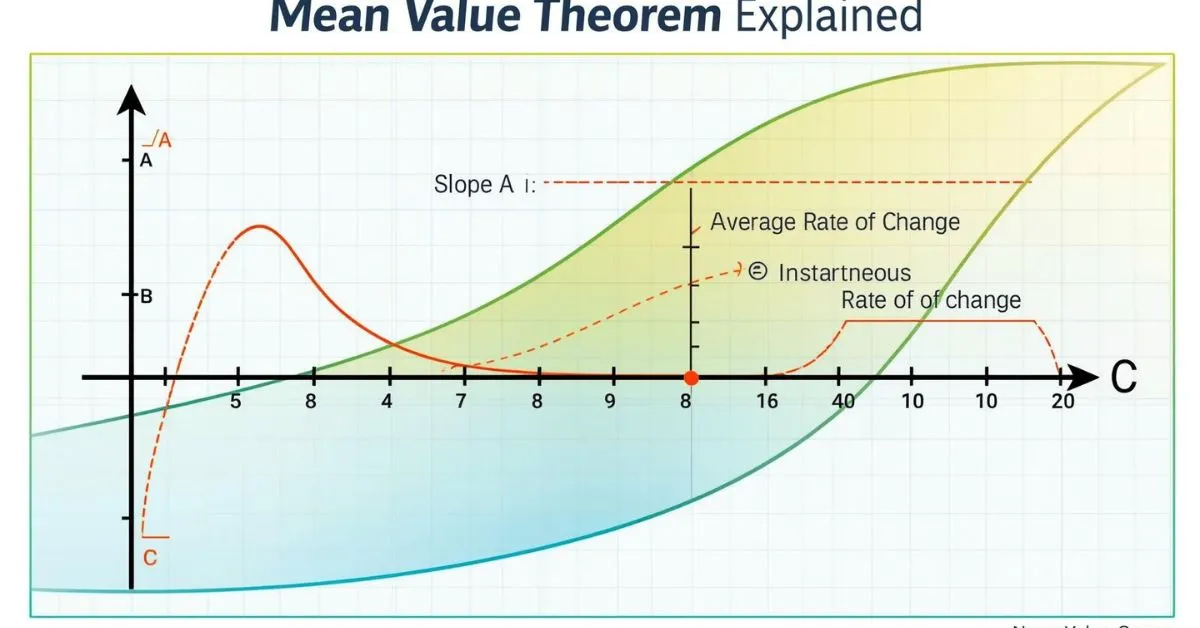
The mean value theorem is an important idea in Calculus. It explains how the average rate of change of a function relates to the instantaneous rate of change at some point. In simple words, the theorem says that for a smooth curve, there must be at least one point where the slope of the curve equals the average slope between two points.
This idea helps us understand how functions behave. It is widely used in mathematics, physics, engineering, and economics. Mathematicians like Joseph-Louis Lagrange helped formalize the theorem, building on ideas from Isaac Newton and Gottfried Wilhelm Leibniz.
In this guide, you will learn what the mean value theorem is, how it works, its formula, proof, and real-life applications.
Mean Value Theorem Definition
Simple Definition
The mean value theorem says:
If a function is continuous on a closed interval and differentiable inside that interval, there is at least one point where the derivative equals the average rate of change.
This means the function’s instant slope equals the average slope at some point.
Mean Value Theorem Formula
The formula for the mean value theorem is:
f'(c)=\frac{f(b)-f(a)}{b-a}
Where:
| Symbol | Meaning |
|---|---|
| f'(c) | derivative at point c |
| f(a) | function value at start |
| f(b) | function value at end |
| a, b | interval endpoints |
| c | point between a and b |
This equation shows that the derivative at c equals the average slope between a and b.
Understanding the Mean Value Theorem Visually
| Feature | Secant Line | Tangent Line |
|---|---|---|
| Definition | Connects two points on a curve | Touches the curve at a single point |
| Slope Represents | Average rate of change between the two points | Instantaneous rate of change at that point |
| Graph | Straight line crossing the curve | Line just touching the curve without crossing |
| Purpose | Measures overall change over an interval | Measures the exact rate of change at a specific point |
| Example | Slope of line connecting (x = a) and (x = b) | Slope at point (x = c) where (a < c < b) |
Key Idea
The mean value theorem says that at some point between the two endpoints, the tangent line will have the same slope as the secant line.
This idea connects two important concepts:
- Derivative
- Average rate of change
Conditions of the Mean Value Theorem
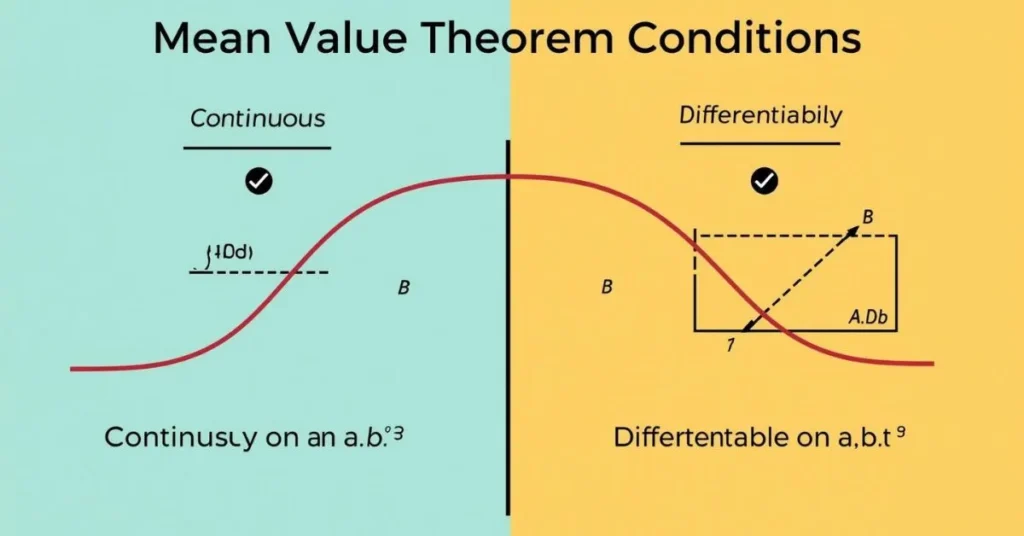
The theorem works only if two conditions are satisfied.
1. Continuity
The function must be continuous on the interval [a,b].
This means:
- no gaps
- no jumps
- no holes
This idea comes from the concept of Continuity (mathematics).
2. Differentiability
The function must also be differentiable on the open interval (a,b).
Differentiability means the function has a derivative everywhere inside the interval.
It cannot have:
- sharp corners
- cusps
- vertical tangents
This relates to the concept of Differentiability.
Mean Value Theorem Example
Examples make the theorem much easier to understand.
Example 1: Polynomial Function
Let:f(x)=x2
Interval:[1,3]
Step 1: Find the average rate of change
3−1f(3)−f(1) =29−1 =4
The average slope is 4.
Step 2: Find the derivative
f′(x)=2x
Step 3: Solve for c
Set derivative equal to average slope.2x=4 x=2
So the value of c is 2.
At x = 2, the tangent slope equals the average slope.
This confirms the mean value theorem.
Example 2: Trigonometric Function
Consider the function:f(x)=sinx
Interval:[0,π]
Step 1: Average slope
π−0sin(π)−sin(0) =π0 =0
Step 2: Derivative
f′(x)=cosx
Step 3: Solve for c
cosc=0
This occurs at:c=2π
So the theorem holds.
Proof of the Mean Value Theorem
The proof uses Rolle’s theorem, developed by Michel Rolle.
Step 1: Create a new function
Define:g(x)=f(x)−L(x)
Where L(x) is the secant line.
Step 2: Apply Rolle’s Theorem
Because:
- the function is continuous
- differentiable
- endpoints are equal
Rolle’s theorem guarantees a point c where:g′(c)=0
Step 3: Rearranging
This leads directly to:f′(c)=b−af(b)−f(a)
This completes the proof.
Real-Life Applications of the Mean Value Theorem
Although it is a mathematical idea, the theorem has many practical uses.

1. Motion and Speed
In physics, the theorem connects:
- average speed
- instant speed
If a car travels 120 km in 2 hours, the average speed is 60 km/h.
The theorem guarantees the car reached exactly 60 km/h at some moment.
2. Error Estimation
Scientists use the theorem to estimate errors in calculations.
It helps determine how much a function changes within an interval.
3. Economics
Economists use it to analyze:
- marginal cost
- marginal revenue
- growth rates
4. Engineering
Engineers apply the theorem when studying:
- system stability
- signal processing
- optimization problems
Relationship of Mean value Theorem With Other Calculus Concepts
The mean value theorem connects many key ideas.
Rolle’s Theorem
Rolle’s theorem is a special case of the mean value theorem where:f(a)=f(b)
Then the derivative must be zero somewhere between the endpoints.
Fundamental Theorem of Calculus
The mean value theorem helps support results related to the Fundamental theorem of calculus.
This theorem links:
- derivatives
- integrals
Limits and Derivatives
The theorem also relies on the concept of:
- Limit (mathematics)
- Derivative
These ideas form the foundation of calculus.
History of the Mean Value Theorem
The idea developed during the growth of calculus in the 17th century.
Important contributors include:
| Mathematician | Contribution |
|---|---|
| Isaac Newton | Early ideas of calculus |
| Gottfried Wilhelm Leibniz | Independent calculus development |
| Joseph-Louis Lagrange | Formal statement of theorem |
| Augustin-Louis Cauchy | Rigorous analysis framework |
Their work helped shape modern mathematical analysis.
Common Mistakes Students Make
Students often misunderstand the theorem.
Ignoring conditions In Mean Value Theorem
The function must be:
- continuous
- differentiable
Thinking there is only one solution
The theorem guarantees at least one value, but there may be many.
Confusing slopes
Remember:
| Type | Meaning |
|---|---|
| Average slope | Secant line |
| Instant slope | Tangent line |
FAQ Section
What is the mean value theorem in simple words?
The mean value theorem says that for a smooth function, there is at least one point where the instantaneous rate of change equals the average rate of change over an interval.
Why is the mean value theorem important?
It helps explain how functions behave between two points and supports many major results in calculus.
What are the conditions of the mean value theorem?
The function must be:
- continuous on the closed interval
- differentiable on the open interval
Is the mean value theorem always true?
It is true only when the required conditions are satisfied. If the function is not continuous or differentiable, the theorem may not apply.
What is the geometric meaning of the mean value theorem?
It means that at some point on the curve, the tangent line has the same slope as the secant line connecting two endpoints.
Conclusion
The mean value theorem is one of the most important ideas in calculus. It connects the average rate of change of a function with the instantaneous rate of change at a specific point.
By guaranteeing that a tangent slope equals the average slope somewhere in an interval, the theorem helps explain how functions behave. It also supports many important results in mathematics, including connections to derivatives, limits, and the Fundamental theorem of calculus.
Because of its power and wide applications in science, economics, and engineering, the mean value theorem remains a key concept in mathematical analysis.
Click Here To Read More About : Mean Arms

Hi, I’m Geoffrey Chaucer. I explore the stories and meanings behind words, turning ideas into clear, insightful writing. Through every article I craft, I aim to spark curiosity, share knowledge, and help readers uncover practical, meaningful truths in everyday life.