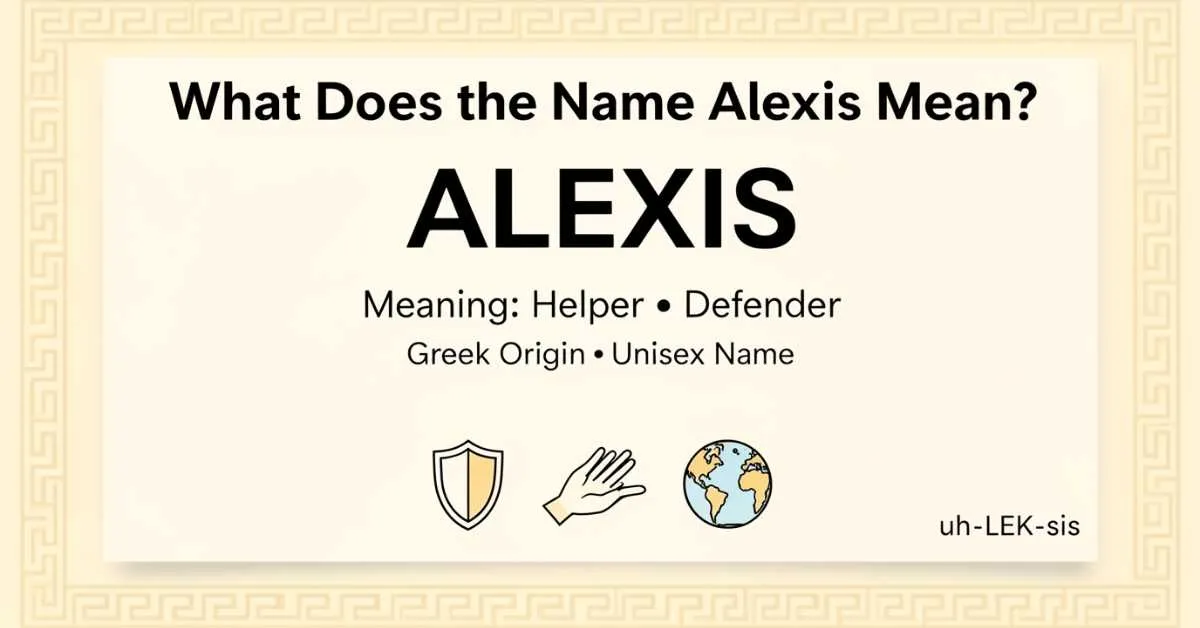
Alexis is a Greek name that means “helper” or “defender.” It comes from an Ancient Greek root linked to protecting and defending others. Today, Alexis is a gender-neutral (unisex) name, and in the U.S. it became especially popular from the 1990s into the 2000s, according to the U.S. Social Security Administration (SSA).
Alexis is a name that sounds modern, but its story is ancient. In just six letters, it carries a powerful idea. In the United States, it rose fast in popularity during the 1990s and stayed strong into the 2000s, which means many people recognize it right away.
If you’re choosing a baby name, naming a character, or just curious about your own name. This guide will give you clear answers; meaning, origin, pronunciation, famous examples, and why Alexis still fits today.
Meaning of Alexis
The name Alexis (given name) is built around the idea of protection.
- Core meaning: Helper and Defender
- Root idea: from a Greek verb linked to “to defend” (often shown as alexein in Ancient Greek language discussions)
Because of that root, many people explain Alexis with close meanings like:
- Protector
- Guardian
- Defender of the people
- Defender of mankindd
Those expanded meanings are not separate “new” definitions. They are simple ways to say what “defend” looks like in real life: someone who helps, shields, and stands up for others.
Origin of Alexis
Alexis has Greek origin. It comes from Classical Greek names and the Ancient Greek language, and it fits naturally inside Hellenic culture.
A trusted name-history source explains that Alexis comes from the Greek name Ἄλεξις (Alexis) meaning “helper” or “defender.” Another etymology source connects Alexis to Greek alexein, with the sense of warding off and protecting.
Greek mythology influence (how the “defender” idea shows up)
While Alexis itself is not a myth character name, the wider name-family is tied to Greek stories and titles. For example, Alexandra (a close relative name) is recorded as an epithet linked with the goddess Hera, and it carries the same “defend/protect” base.
So, even when you move from Alexis → Alexandra/Alexander, the theme stays the same: a protector.
Popularity of Alexis
If you care about baby name meaning and real-world use, popularity data helps you pick with confidence.
U.S. popularity (SSA trends by decade)
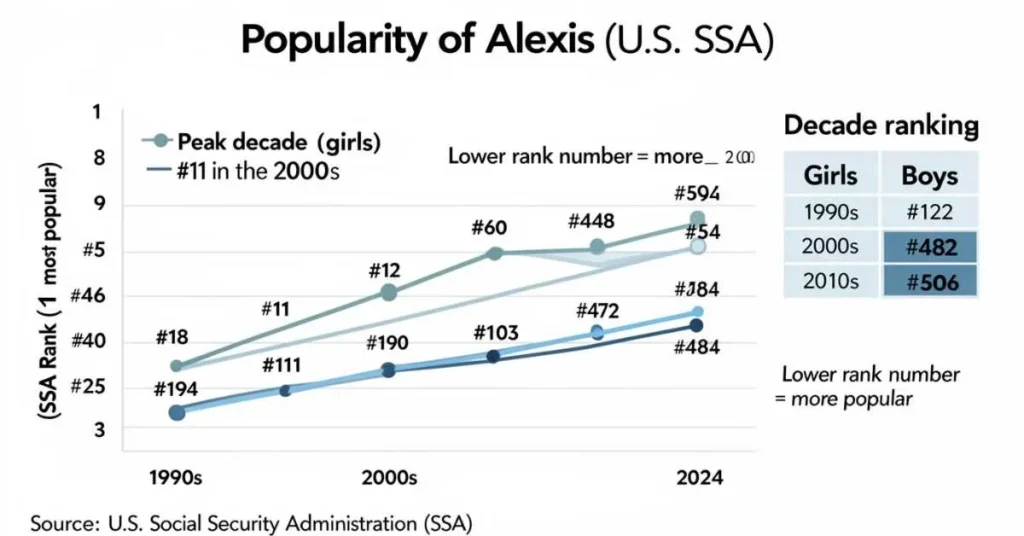
The SSA publishes decade lists. These show how strong the name was during big time periods:
Alexis in SSA decade rankings (U.S.)
| Decade | Girls rank | Boys rank |
|---|---|---|
| 1990s baby names | #18 | (in top 200; lower than girls) |
| 2000s popular names | #11 | (in top 200; lower than girls) |
| 2010s | #60 | not in top 200 boys list |
What this means: Alexis hit its strongest decade placement for girls in the 2000s, stayed well-known in the 1990s, and then cooled in the 2010s.
A recent snapshot (modern naming trends)
The SSA also tracks year-to-year movement. From 2023 to 2024, Alexis moved down in rank for both male and female in the SSA “decreased in popularity” tables.
That does not mean the name disappeared. It means it is less “top-trend” than it was at its peak.
Global use (where you see it)
- United States:
widely recognized and often seen as a modern classic, especially since the 1990s–2000s peak. - Greek-speaking world:
Names like Alexios (a Greek form) and Alexius (a Latin form) are very close to Alexis. People used these forms long ago in Greece and in churches. They help show the name’s old history and strong roots. - Spanish-speaking countries:
You often hear this name in daily life and in the media. For example, Alexis Sánchez is a famous football player. In Spanish-speaking countries, you may also hear Alejandra, which is a related name.
Gender: Is Alexis a Boy or Girl Name?
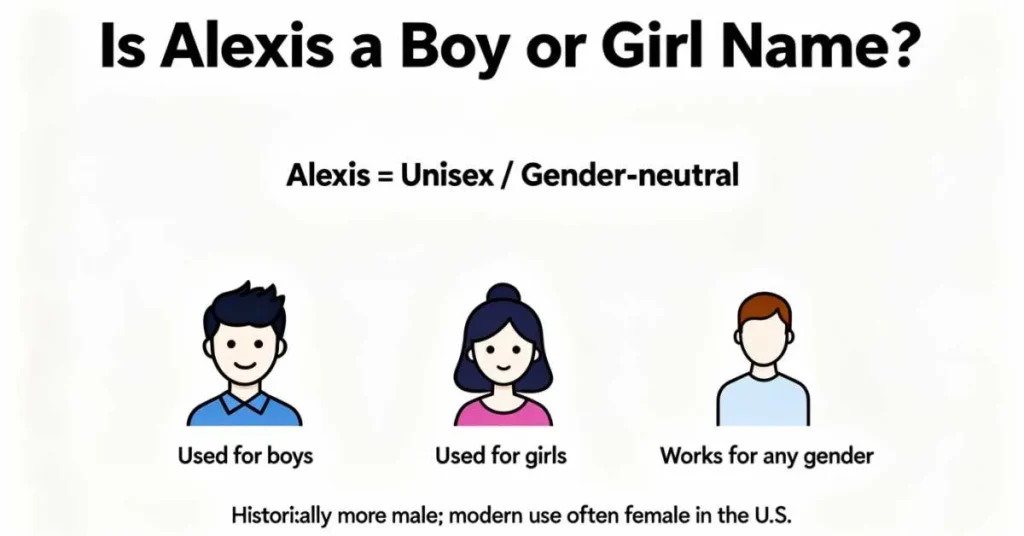
Alexis is a unisex name (also called a gender-neutral name). Historically, it began as a masculine name, and in modern times it became very common as a feminine name, especially in the U.S.
A simple way to think about it:
- Historical use: more often male (older Greek/Latin traditions)
- Modern use (U.S.): strongly familiar for girls, especially during the 1990s and 2000s
- Today: still works well for any gender, and many parents choose it for that flexibility.
Variations and Related Names
Alexis has a big family of related names across languages. This is one reason it travels well and feels “international.”
Close forms and spellings
- Alexios (Greek form)
- Alexius (Latin form)
Popular related names
- Alexander
- Alexandra
- Alexa
Why these connect: the same Greek “defend/protect” root appears across this whole group.
International variations you’ll recognize
- Alessia (Italian variation) (a popular Italian name in the wider “Alex-” family)
- Alejandra (Spanish variation) (a direct Alexandra-family form in Spanish)
Famous People Named Alexis
Seeing the name in real life helps it feel more “real” and trustworthy.
Well-known real people
- Alexis Bledel (actress)
- Alexis Ohanian (entrepreneur)
- Alexis Sánchez (footballer)
- Alexis Arquette (actress)
- Alexis Texas (public figure)
Fictional characters named Alexis
Fiction is a big reason names feel familiar.
- Alexis Carrington Colby (Dynasty)
- Alexis Rose (Schitt’s Creek)
Personality Meaning, Symbolism, and Spiritual Meaning of Alexis
People often search for alexis name meaning personality because they want more than a dictionary line.
Name personality traits (common theme)
Based on the meaning “helper/defender,” the name often gets linked with traits like:
- protective
- loyal
- calm under pressure
- supportive
- brave in a quiet way
That matches the built-in meaning: a protector and a guardian.
Numerology meaning (quick and simple)
In basic Pythagorean numerology, Alexis is often linked to the number 7. The number 7 is connected with thinking, learning, and looking for truth.
(If you use numerology, treat it as a personal belief tool; not as proven science.)
Name astrology meaning (what people usually mean)
When people ask for “astrology meaning,” they usually want the vibe of the name. Alexis is often described as:
- steady energy
- strong core
- helpful nature
Again, astrology is a belief system. Use it for fun if it fits your style.
Biblical meaning (and “Alexis in the Bible” searches)
Alexis is not a biblical Hebrew name. Its roots are Greek.
Many people link this name to Christian history because of Saint Alexis (also called Saint Alexius of Rome). He is honored in both the Roman Catholic Church and the Eastern Orthodox Church.
So the “biblical meaning” search is usually really about Christian tradition, not a name that appears in Bible stories.
Should You Choose the Name Alexis?
This is the parent decision part; simple, honest, and practical.
Why parents love it
- Strong + soft balance:
It sounds gentle, but the meaning is strong. - Easy to say:
It works in many accents and languages. - Fits any age:
Cute for a baby, solid for an adult. - International feel:
It is part of a bigger name family. That family includes Alexios, Alexius, Alexander, Alexandra, and Alejandra. These names are related and share a similar history. - Flexible style:
Classic enough for traditional families, modern enough for trend-aware parents.
Pronunciation (multiple languages)
- English: uh-LEK-sis
- Greek (common modern style): ah-LEK-sees
- Spanish: ah-LEK-sees
(Exact sounds vary by region, but these guides help most readers.)
Middle name pairing ideas
These are popular, easy matches that flow well:
Feminine-leaning combos
- Alexis Marie
- Alexis Grace
- Alexis Rose
- Alexis Sophia
Masculine-leaning combos
- Alexis James
- Alexis Daniel
- Alexis Michael
- Alexis Alexander
Neutral combos
- Alexis Jordan
- Alexis Taylor
- Alexis Quinn
- Alexis Riley
Entity Reinforcement: The “Alex-” Name Family in History
If you want a name with serious history behind it, Alexis is connected to major “defender” names.
- Alexander the Great carries the famous “defend” root in the larger Alex-name family.
- In Byzantine history, forms like Alexios were used by emperors, including Alexios I Komnenos.
- In church tradition, Saint Alexius of Rome helped keep the name respected across centuries.
This matters for SEO too: it ties the name to high-authority historical entities in a natural way.
FAQs About Alexis
What does the name Alexis mean in Greek?
It means “helper” or “defender.” It connects to Greek roots tied to defending and helping.
Is Alexis a strong name?
Yes. Its core meaning is about protecting others; like a guardian or defender of the people.
Is Alexis a biblical name?
It is not a Hebrew Bible name. It is Greek in origin. But it appears in Christian tradition through Saint Alexis (Saint Alexius of Rome).
Is Alexis a boy or girl name?
It is a unisex / gender-neutral name. Historically it leaned male, while modern U.S. use has been strongly female.
Alexis name meaning personality: what traits fit best?
People often connect this name with being loyal, helpful, and protective. This is because the name is linked to helping others and keeping them safe.
Spiritual meaning of the name Alexis
Many people connect it with a “protector” role: caring for others, standing up for what is right, and offering help when it matters.
What does Alexis mean in Hebrew?
Alexis is not originally Hebrew. It comes from Greek roots, so there is no “original Hebrew meaning.”
Alexis meaning in English
In English use, Alexis keeps its Greek-based meaning: helper/defender, and it’s used as a given name for any gender.
Is Alexis a rare name now?
It is less trendy than it was in its peak decades, but it is still well-known and widely understood. SSA trend tables show a long-term cool-down after the 2000s.
Final Thoughts
Alexis is a name with a clear meaning and a strong message: help, defend, protect. It has deep roots in Greek origin and the Ancient Greek language, real presence in history, and modern reach through culture, sports, and media.
If you want a name that feels confident, kind, and global, Alexis is an easy choice.
Click For Read About: What Does IMSG Mean in Text? Complete Guide for 2026

I am Clara Lexis, a writer driven by clarity, depth, and authenticity. My focus is on transforming ideas into meaningful content that is both informative and engaging. I write with intention to communicate clearly, thoughtfully, and with purpose.