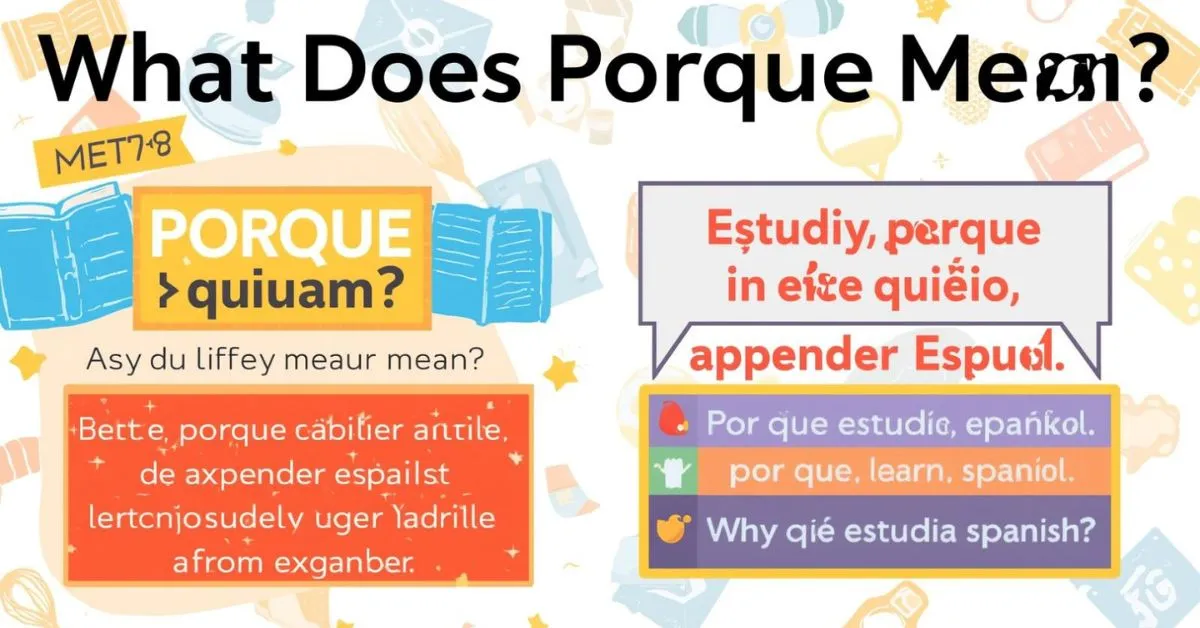
Porque is a Spanish word that translates to “because” in English. It is an essential term in Spanish, used to explain reasons, connect ideas, and answer questions. Understanding its meaning is critical for learners at all levels from beginner to advanced because using it correctly improves clarity, fluency, and comprehension.
Spanish learners often confuse porque with por qué, porqué, and por que, but each form serves a distinct purpose. For example, a beginner might incorrectly ask:
- ❌ ¿Porque estudias español?
- ✅ ¿Por qué estudias español?
This guide will cover:
- Meaning in Spanish
- Pronunciation and grammar rules
- Conversational and formal usage
- Synonyms and advanced examples
- Common mistakes, quizzes, and FAQs
By the end, you will confidently use it in any context.
Why Learners Often Confuse Porque and Por Qué
Many learners mix up the word with its question form, although they serve completely different functions:
- Because form → gives a reason
- Why form → asks a question
Key Difference Table
| Form | Meaning | Use | Example |
|---|---|---|---|
| Porque | Because | Explains a reason | Estudio porque quiero aprender español. |
| Por Qué | Why | Asks a question | ¿Por qué estudias español? |
Real-Life Examples
School Conversation:
- Teacher: ¿Por qué no entregaste la tarea?
- Student: No entregué la tarea porque estaba enfermo.
Friends Conversation:
- Friend 1: ¿Por qué sonríes?
- Friend 2: Sonrío porque recibí buenas noticias.
Family Conversation:
- Child: ¿Por qué no comiste?
- Parent: No comí porque ya había almorzado.
Tip: Questions = por qué, Answers = porque.
Porque Meaning in Spanish
Porque is a conjunction connecting a main clause to a reason clause. It is essential for expressing cause and effect in Spanish sentences.
Common Examples
| Spanish Sentence | English Translation |
|---|---|
| Estoy feliz porque es mi cumpleaños. | I am happy because it’s my birthday. |
| No salgo porque está lloviendo. | I’m not going out because it’s raining. |
| Aprendo español porque es útil. | I learn Spanish because it is useful. |
| Llegué tarde porque había tráfico. | I arrived late because there was traffic. |
Grammar Tips:
- Structure: Main Clause + porque + Reason Clause
- Avoid using porque at the start of a question
- Ensure subject-verb agreement in both clauses
Porque in Idiomatic Expressions and Phrases
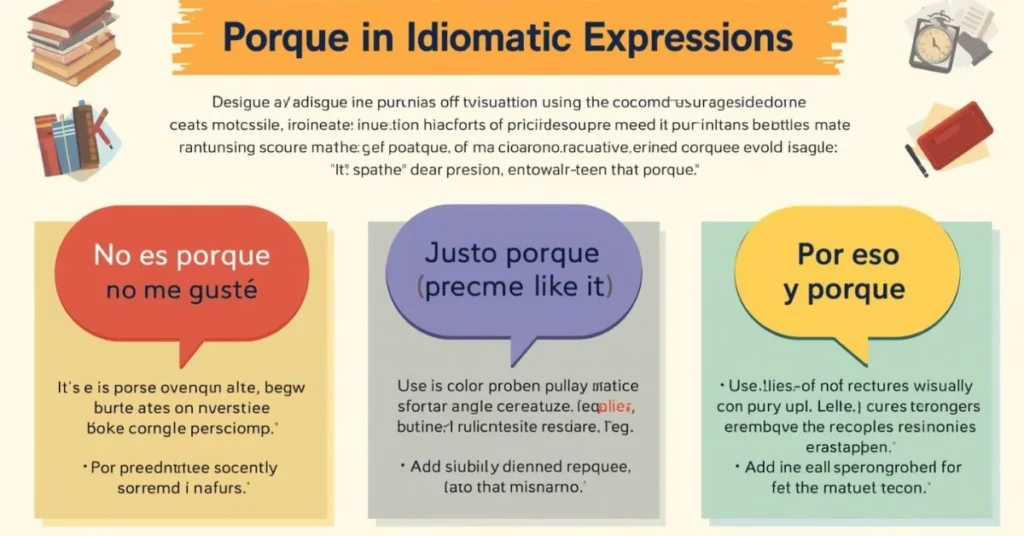
- Focuses on how porque is used in idiomatic expressions and common phrases in everyday Spanish.
- Examples include: No es porque no me guste, justo porque, por eso y porque.
- Mini-dialogues and explanations show learners how to sound natural and fluent in conversations.
Pronunciation Guide of Porque Mean
Porque is pronounced: POR-keh
- Por → sounds like “pore”
- Que → sounds like “keh”
- Stress falls on the first syllable: POR-keh
Tips for Correct Pronunciation
- Roll the “r” lightly to sound natural.
- Separate the syllables clearly: POR + KEH.
- Practice using full sentences:
- Estoy aquí porque te necesito. → I am here because I need you.
- No puedo salir porque está lloviendo. → I can’t go out because it’s raining.
- Listen to native speakers and repeat to capture proper intonation.
Common Mistakes
| Mistake | Why Wrong | Correct |
|---|---|---|
| por-ke | Stresses second syllable | POR-keh |
| porke | English “pork” sound | POR-keh |
| por-que | Confuses with por qué | POR-keh |
Other Conjunctions: Ya Que, Puesto Que, and Debido a Que
This section explains how different cause-expressing conjunctions compare in Spanish.
- Includes a comparison table and examples for formal vs casual writing.
- Helps learners understand when to use ya que, puesto que, or debido a que in essays, reports, or spoken Spanish.
The Four Forms of Porque Explained
Spanish has four forms of porque, and confusing them can cause errors:
| Form | Meaning | Type | Example |
|---|---|---|---|
| Porque | Because | Conjunction | Estoy cansado porque trabajé mucho. |
| Por Qué | Why | Question | ¿Por qué estudias español? |
| Porqué | The reason | Noun | No entiendo el porqué de su enojo. |
| Por Que | For which / so that | Formal/Advanced | Luchamos por que se respeten nuestros derechos. |
Mini Dialogue:
- Teacher: ¿Por qué no entregaste la tarea?
- Student: No entregué la tarea porque estaba enfermo.
- Teacher: Ahora entiendo el porqué.
- Student: Luchamos por que todos tengan igualdad en clase.
Using Porque in Everyday Conversation
Family
- Child: ¿Por qué no comiste?
- Parent: No comí porque ya había almorzado.
School
- Teacher: ¿Por qué no entregaste la tarea?
- Student: No entregué porque estaba enfermo.
Friends
- Friend 1: ¿Por qué sonríes?
- Friend 2: Estoy feliz porque recibí buenas noticias.
Tips for Natural Conversation
- Always answer questions with porque, not por qué.
- Combine multiple reasons for smoother flow:
- Llegué tarde porque estaba lloviendo y había tráfico.
- Add emotions to make your sentences sound realistic:
- Estoy cansado porque trabajé mucho.
Porque in Academic Contexts
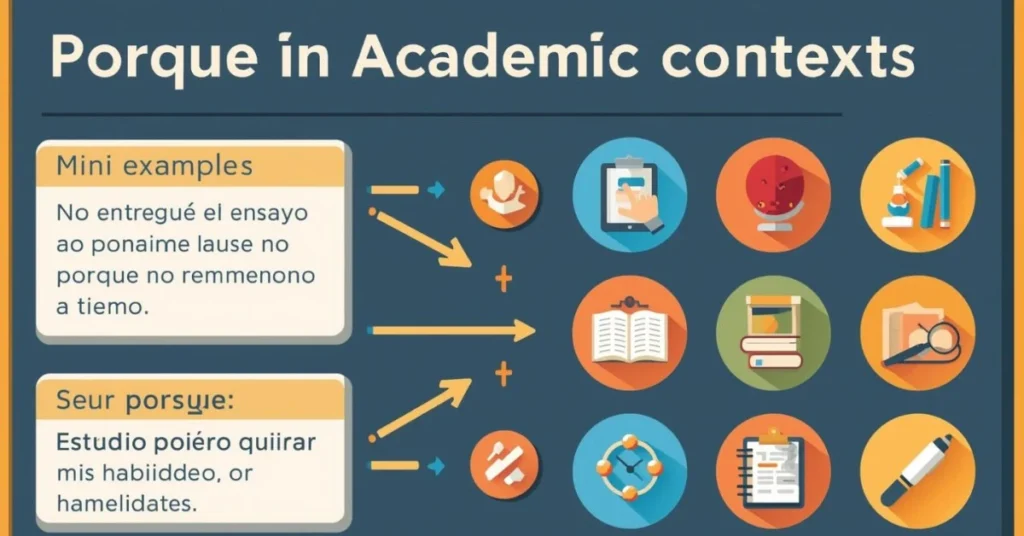
Explain porque in essays, homework, and oral presentations. Include mini-dialogues and examples:
- Teacher: ¿Por qué no entregaste tu ensayo?
- Student: No lo entregué porque no terminé a tiempo.
Tips:
- Avoid porqué vs porque confusion in writing
- Use porque to connect clauses logically in essays
- Practice sentences aloud to improve fluency
Porque in Professional and Workplace Contexts
Emails, Reports, and Meetings:
| Situation | Spanish | English |
|---|---|---|
| No puedo asistir a la reunión porque tengo otra cita. | I can’t attend because of another appointment. | |
| Report | El proyecto se retrasó porque hubo problemas con el proveedor. | The project was delayed due to supplier issues. |
| Meeting | Propongo cambiar la fecha porque necesitamos más tiempo. | I propose changing the date because we need more time. |
Porque in Literature and Formal Writing
Advanced usage of porque appears in essays, articles, novels, and other formal writing. Using porque correctly improves sentence flow, clarity, and logical connections between ideas.
- Correct: No asistí al evento porque estaba enfermo.
- Synonym: No asistí al evento ya que estaba enfermo.
Tip: In formal writing, porque links cause and effect smoothly, making sentences more professional and readable. Using synonyms like ya que, puesto que, or debido a que adds variety in essays and articles.
Advanced Porque Usage and Complex Sentences
Porque can connect multiple clauses, hypothetical scenarios, and several reasons in a single sentence. This is common in advanced writing and fluent speech.
Examples
- Llegué tarde porque estaba lloviendo y además el tráfico estaba terrible.
- No fui a la fiesta porque no me sentía bien y porque tenía que trabajar.
- Haría ejercicio porque quiero estar saludable y porque necesito liberar estrés.
Tips for Complex Usage:
- Combine because clauses with other conjunctions for nuanced meaning.
- Use porque to show cause-and-effect clearly in long sentences.
- Practice constructing multi-clause sentences for natural, fluent Spanish.
Common Mistakes and How to Avoid Them About Porque Mean
| Mistake | Why Wrong | Correct |
|---|---|---|
| ¿Porque llegaste tarde? | Question uses porque | ¿Por qué llegaste tarde? |
| Estoy feliz porqué es mi cumpleaños | Uses noun instead of conjunction | Estoy feliz porque es mi cumpleaños |
| No voy salir porque lluvia | Missing prepositions | No voy a salir porque está lloviendo |
Tip: Practice short dialogues daily to internalize correct usage.
Synonyms and Alternative Expressions of Porque Mean
| Expression | Meaning | Example |
|---|---|---|
| Ya que | Since / because | No salí, ya que estaba lloviendo. |
| Puesto que | Given that | No pude asistir, puesto que tenía una reunión. |
| Debido a que | Due to the fact that | Clase cancelada debido a que el profesor estaba enfermo. |
| A causa de | Because of | Llegamos tarde a causa de la lluvia. |
Short Quiz Test Your Knowledge
- Fill in: Estoy feliz recibí buenas noticias → porque
- Question: ¿Por qué / Porque llegaste tarde? → Por qué
- Which means “the reason”? → porqué
- True/False: “Porque” can start a question → False
- Fill in: No fui a la fiesta estaba enfermo → porque
Frequently Asked Questions
- Is “porque” one word?
Yes, for giving a reason. - What does “porqué” mean?
Noun meaning “the reason.” - Can “porque” start a sentence?
Yes, but not for questions. - Is “porque” used everywhere in Spanish?
Yes, universally. - How is “porque” different from “because”?
English uses “because” everywhere; Spanish separates porque, por qué, porqué, por que.
Final Summary & Takeaways
- Porque = because → reason
- Por qué = why → question
- Porqué = the reason → noun
- Por que = for which / so that → formal
Mastering porque improves fluency, clarity, writing, and comprehension. Practice with examples, dialogues, quizzes, and real-life usage to confidently speak and write Spanish.
Click here to read more about : what does the upside down emoji mean

Hi, I’m Geoffrey Chaucer. I explore the stories and meanings behind words, turning ideas into clear, insightful writing. Through every article I craft, I aim to spark curiosity, share knowledge, and help readers uncover practical, meaningful truths in everyday life.