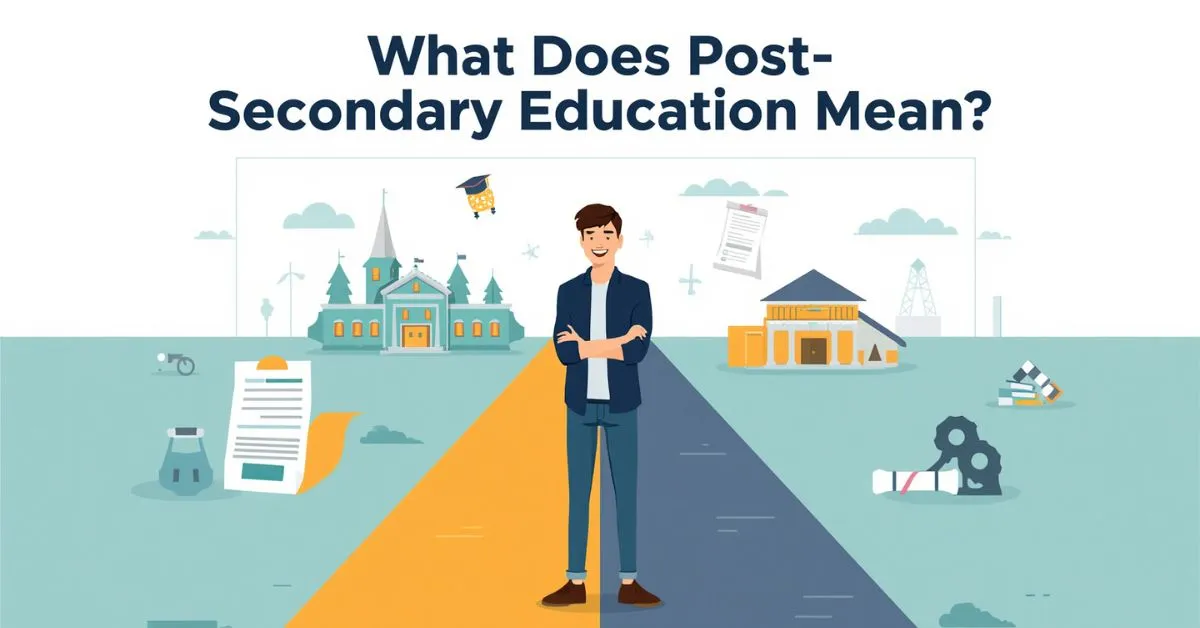
Post secondary education means any formal education, training, or learning program you take after finishing high school or secondary school. It includes colleges, universities, community colleges, trade schools, technical schools, certificate programs, diploma programs, and advanced degrees. In simple terms, it is the next level of education after high school.
If you have seen this term on a school form, scholarship application, job application, or college website, you are not alone. Many people understand the general idea but are still unsure what actually counts. Does college count? Yes. Does trade school count? Yes. What about a certificate program, online college, or graduate school? Usually yes, as long as it is a formal program taken after high school.
This guide explains the meaning of post secondary education in plain English, what counts, what does not, how it differs from secondary education, and why the term matters when choosing a school or filling out forms.
Post Secondary Education Meaning in Simple Words
The phrase sounds formal, but the meaning is straightforward.
- Secondary education usually means high school or the equivalent level of schooling.
- Post secondary means after secondary school.
So when someone asks, “What does post secondary education mean?” the answer is simple: it means any organized education or career training you do after high school.
This can include a four-year university, a two-year community college, a technical institute, a trade school, or a career certificate program.
What Counts as Post Secondary Education?
A lot of people assume post secondary education only means college or university. That is one of the most common mistakes. The term is broader than that.
Types of education that usually count
Post secondary education commonly includes:
- Colleges
- Universities
- Community colleges
- Trade schools
- Vocational schools
- Technical institutes
- Certificate programs
- Diploma programs
- Associate degree programs
- Bachelor’s degree programs
- Master’s degree programs
- Doctoral or professional degree programs
- Some apprenticeships or formal career-training programs
- Some continuing or adult education programs taken after high school
The key idea is this: if the program is a formal learning path that comes after high school, it usually falls under post secondary education.
What Does Not Count as Post Secondary Education?
Knowing what does not count is just as useful.
Usually not considered post secondary education
These typically do not count:
- Elementary school
- Middle school
- High school itself
- Informal self-study with no formal program
- Casual workshops with no recognized structure or credential
- General life experience without formal education or training
That is why the phrase appears on official forms. It helps separate high school education from education after high school.
What Counts vs What Does Not Count
| Counts as Post Secondary Education | Usually Does Not Count |
|---|---|
| College | Elementary school |
| University | Middle school |
| Community college | High school |
| Trade school | Informal hobby learning |
| Technical school | Unstructured self-study |
| Certificate program | Casual short workshop with no formal credential |
| Diploma program | General work experience alone |
| Graduate school | Pre-secondary and secondary schooling |
This kind of distinction is important when you are filling out applications or comparing education options.
Is College the Same as Post Secondary Education?
Not exactly.
College is one type of post secondary education, but it is not the only type. The term post secondary education is an umbrella category. It covers different education paths after high school, including academic and career-focused options.
That means:
- College is post secondary education
- University is post secondary education
- Trade school is post secondary education
- Technical training can be post secondary education
- Graduate school is also post secondary education
So if you hear someone use the term, they are talking about the broader category, not just one school type.
What Is a Post Secondary Institution?
A post secondary institution is any school or training organization that offers education after high school.
Examples include:
- A public university
- A private college
- A community college
- A vocational school
- A technical institute
- A nursing school
- A culinary school
- A recognized online college
This phrase often appears on applications, financial aid forms, admissions pages, and official education documents. If a form asks whether you attended a post secondary institution, it is asking whether you studied at any formal school or training program after high school.
Examples of Post Secondary Education
Examples make the meaning easier to understand.
Example 1: University degree
A student graduates from high school and enrolls in a university to study engineering. That is post secondary education.
Example 2: Community college
A student finishes high school and attends a community college for an associate degree in accounting. That also counts.
Example 3: Trade school
A graduate joins a welding or HVAC program at a technical school. That is post secondary education too.
Example 4: Certificate program
A working adult completes a formal medical billing certificate after high school. That still counts as post secondary education.
Example 5: Graduate school
A person with a bachelor’s degree goes to law school or completes a master’s program. This is still post secondary education, just at a more advanced level.
Example 6: Online college
A student takes a recognized online degree program after high school. That also falls under post secondary education.
Types of Post Secondary Education
Not everyone follows the same path. One reason the term is so useful is that it covers many different routes.
Academic degree programs
These are the traditional college and university pathways. They usually include broader academic study along with subject specialization.
Common credentials include:
- Associate degree
- Bachelor’s degree
- Master’s degree
- Doctorate
Career and technical education
These programs focus on practical, job-ready skills. They are often more direct and career-specific than traditional degree programs.
Popular fields include:
- Information technology
- Automotive technology
- Welding
- Electrical work
- Plumbing
- Cosmetology
- Culinary arts
- Medical assisting
- Dental assisting
- HVAC
- Graphic design
Certificate and diploma programs
These programs are often shorter than degrees and focus on a specific area of study or job skill. They can be a strong option for people who want targeted training without spending several years in school.
Continuing and adult education
Adults sometimes return to education to upgrade skills, change careers, or complete credentials. If the program is formal and taken after high school, it may fall within post secondary education.
Common Credentials You Can Earn
Different post-secondary programs lead to different outcomes. Here is a simple comparison.
| Credential | Typical Focus | Usual Time Length | Common Outcome |
|---|---|---|---|
| Certificate | Specific skill or job training | Months to 1 year | Entry-level career training |
| Diploma | Practical or technical training | About 1 to 2 years | Career-focused qualification |
| Associate Degree | Foundational academic or career study | About 2 years | Transfer to bachelor’s or direct employment |
| Bachelor’s Degree | Broad academic and major-specific study | About 4 years | Professional or academic career path |
| Master’s Degree | Advanced specialized study | 1 to 2 years after bachelor’s | Higher-level expertise |
| Doctorate / Professional Degree | Highest level of advanced study | Several years | Research, academic, or licensed professional roles |
This is one of the most useful ways to understand post secondary education: it is not one credential. It is a whole range of pathways after high school.
Post Secondary vs Secondary Education
This is where confusion often starts.
| Feature | Secondary Education | Post Secondary Education |
|---|---|---|
| Stage | Before graduation from high school | After high school |
| Main setting | High school or secondary school | College, university, trade school, technical school |
| Purpose | General education | Advanced study, specialization, or career training |
| Outcome | High school diploma or equivalent | Certificate, diploma, degree, or professional training |
The main difference is timing. Secondary education comes first. Post secondary education comes next.
Post Secondary vs Higher Education vs Tertiary Education
These terms are related, but they are not always used in exactly the same way.
Post secondary education
This is the broad term for education after secondary school.
Higher education
This term is often used mainly for colleges and universities, especially degree-granting institutions.
Tertiary education
This is another broad term often used internationally for education after secondary school. In many contexts, it overlaps closely with higher education.
In everyday use, people often use these terms almost interchangeably. Still, post secondary education is a very practical and inclusive phrase because it can cover both academic and technical pathways after high school.
Why Post Secondary Education Matters
Post secondary education matters because it can expand opportunities, improve job readiness, and help people build specialized knowledge. That does not mean every person needs the same path. It means learning after high school can take many forms, and each one can serve different goals.
It supports career preparation
Many careers require education beyond high school. Sometimes that means a bachelor’s degree. In other cases, it means a certificate, diploma, technical credential, or license.
It helps people develop specialized skills
Post-secondary programs often teach deeper skills than high school alone, whether those skills are academic, technical, creative, or professional.
It gives students more than one path
A student does not need to follow only the traditional university route. Community college, trade school, apprenticeship-based training, and certificate programs can all be valid and valuable choices.
Why Accreditation and School Quality Matter
Not all schools or training programs offer the same value. A program may sound appealing, but students should still look at quality before enrolling.
Important things to check include:
- Accreditation or official recognition
- Program reputation
- Course content
- Graduation requirements
- Career support
- Transfer options
- Licensing alignment where relevant
This matters because the name “post secondary education” is broad. A good choice is not just any program after high school. It is a program that genuinely supports your goals.
Cost, Financial Aid, and Planning
Another useful part of this topic is understanding that post-secondary options vary widely in cost.
For example:
- Community college may cost less than a four-year university
- Certificate programs may be shorter and more affordable than degree programs
- Some schools offer scholarships, grants, or financial aid
- Some students study part-time while working
That is why choosing a post-secondary path is not only about the label. It is also about cost, time, quality, and return on investment.
Common Mistakes About Post Secondary Education
Thinking it only means university
This is the biggest misunderstanding. University is one type, but not the only type.
Thinking short programs do not count
A certificate or diploma program after high school can still be post secondary education.
Forgetting trade and technical schools
Trade schools, vocational schools, and technical institutes are often part of post secondary education.
Assuming every student needs a four-year degree
For some careers, a shorter technical or professional training path may be the better fit.
Ignoring country or system differences
The exact labels may vary slightly by country, but the general meaning stays the same: education after secondary school.
How to Choose the Right Post-Secondary Path
Choosing the right option depends on your goals, timeline, budget, and learning style.
Ask what career outcome you want
Do you need a license, a degree, hands-on training, or a quick job entry path?
Compare the time commitment
A certificate, associate degree, and bachelor’s degree can lead to very different timelines.
Think about cost and flexibility
Some students prefer a lower-cost starting point, such as community college or a shorter technical program.
Match the learning style
Some people enjoy academic reading and research. Others do better with practical training and skill-based instruction.
Check whether the credential is respected
A program should help you move forward, not just give you a label.
Practical Takeaways
If you only remember a few things, remember these:
- Post secondary education means education after high school.
- It includes more than college and university.
- Trade schools, technical schools, certificates, diplomas, and graduate programs can also count.
- A post secondary institution is any formal school or training provider after high school.
- The best path depends on career goals, cost, timing, and program quality.
FAQs
Is college considered post secondary education?
Yes. College is one of the most common forms of post secondary education.
Is university the same as post secondary education?
University is part of post secondary education, but the term is broader. It also includes community colleges, trade schools, technical schools, and certificate programs.
Does trade school count as post secondary education?
Yes. Trade school usually counts because it is formal training taken after high school.
Is a certificate program post secondary education?
Yes, if it is a formal program taken after high school.
Does graduate school count as post secondary education?
Yes. Graduate school is an advanced type of post secondary education.
What is a post secondary institution?
It is a school or training provider that offers formal education after high school, such as a college, university, community college, or technical school.
Does online school count as post secondary education?
Yes, if it is a formal recognized program offered after high school.
What does post secondary education mean on a form?
It usually means any education you completed or are currently taking after high school, including college, trade school, university, or certificate programs.
Conclusion
So, what does post secondary education mean? It means any formal education or training that happens after high school or secondary school. That includes academic programs like college and university, as well as career-focused options like trade schools, technical institutes, certificate programs, and diploma programs.
The term is broad on purpose because there is no single path after high school. Some people pursue degrees. Others choose hands-on training or shorter credentials. The smartest approach is to understand what the term covers, then choose the path that matches your goals, budget, and future plans.
Click Here To Read About : what does naturalized mean

Hi, I’m Geoffrey Chaucer. I explore the stories and meanings behind words, turning ideas into clear, insightful writing. Through every article I craft, I aim to spark curiosity, share knowledge, and help readers uncover practical, meaningful truths in everyday life.