Renewable means able to be renewed, replaced, or replenished over time. In everyday English, people use it for something that can continue or be extended, such as a contract or subscription. In science and energy, the term usually describes a resource or power source like sunlight, wind, water, geothermal heat, or biomass that nature restores over time. That makes it different from coal, oil, natural gas, and uranium, which exist in limited amounts.
You see this word often in school lessons, climate articles, electricity plans, and business news. Most people who search “what does renewable mean” want a simple definition first. After that, they usually want to understand how the term applies to energy, natural resources, and the difference between renewable and nonrenewable sources. This guide explains the idea in plain English, gives real examples, and uses easy comparisons that make the concept easier to remember.
What does renewable mean in simple words?
In simple words, renewable describes something that can be renewed, restored, or replaced instead of being used up forever. That is the central idea behind the term.
You can think of it this way: if something renews itself or people can replace it over time, it falls into this category. The idea sounds simple, but it becomes more important when people talk about energy, climate change, and natural resources.
The two main meanings
The term has two common meanings, and both matter.
1. General meaning
It describes something that can be renewed or extended.
Examples include:
- a renewable contract
- a renewable permit
- a renewable subscription
2. Resource or energy meaning
It describes something that nature replenishes over time.
Examples include:
- solar energy
- wind energy
- hydropower
- geothermal energy
- forests
- water
- biomass
Today, most readers use the word in the second sense.
The word in everyday language
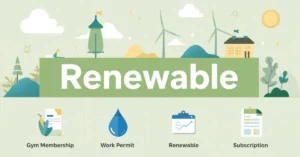
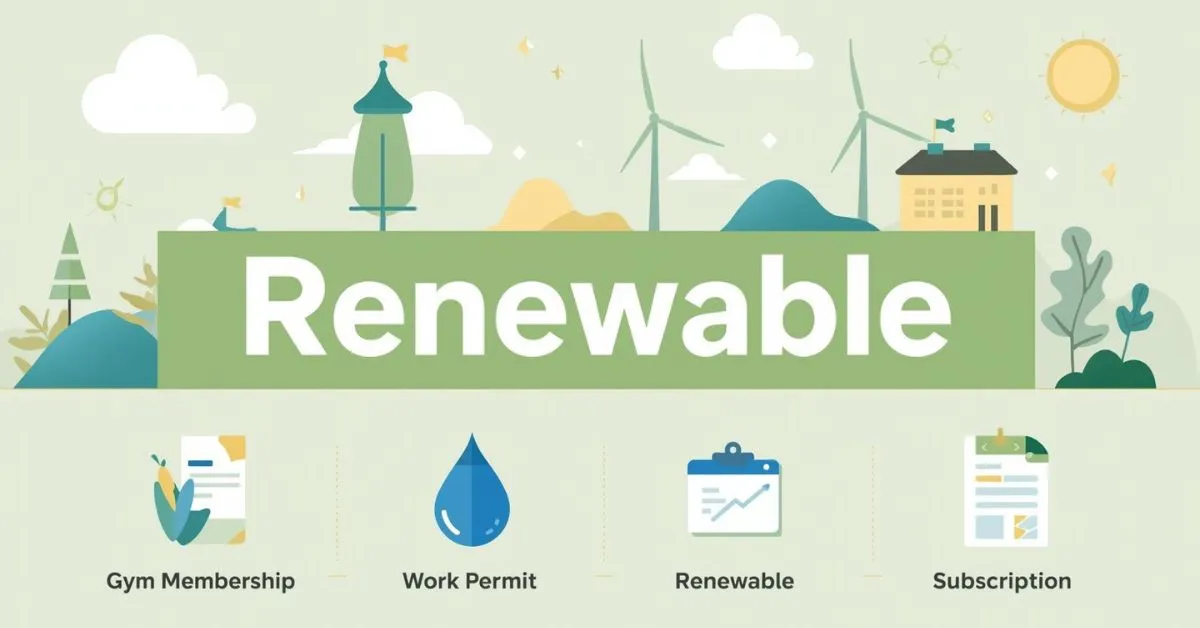
People do not use this term only in science or energy. You may hear it in ordinary life as well. A gym membership can be renewable. A work permit may be renewable. A lease can also be renewable for another term.
In each case, the core idea stays the same. Something does not end permanently. Instead, it can continue again for another period.
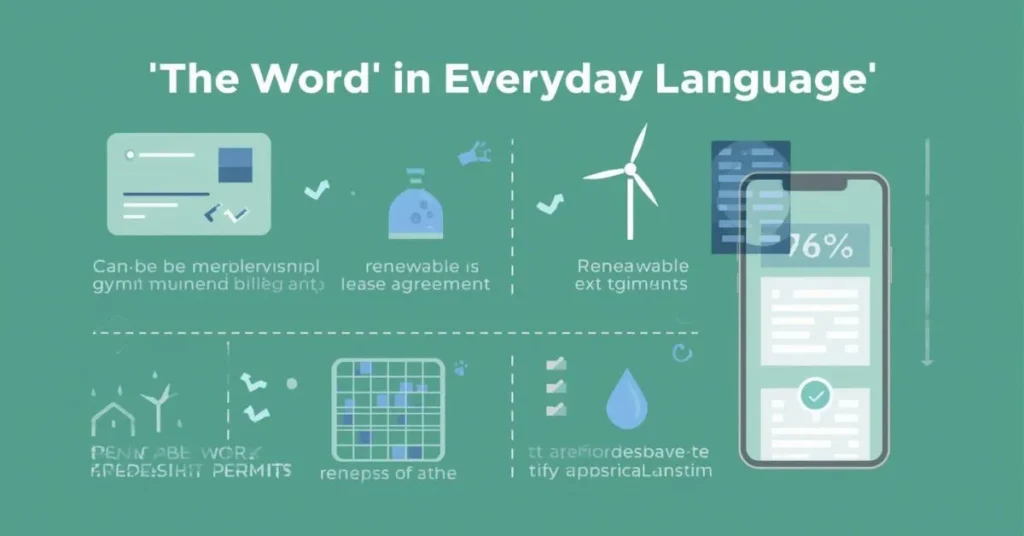
That everyday meaning helps explain why the resource-based meaning feels easy to grasp. In both cases, the thing does not disappear forever after one use.
What does it mean in energy?
In energy, the term refers to power that comes from sources nature replenishes. These sources do not run out in the same way fossil fuels do. Instead, they come from ongoing natural processes.
This is why many people connect the term directly with clean power systems and lower-carbon energy production. When governments, companies, and schools talk about the future of electricity, they often focus on these sources.
Main examples of renewable energy
The most common examples include:
- Solar energy from sunlight
- Wind power from moving air
- Hydropower from flowing water
- Geothermal energy from heat inside the Earth
- Biomass energy from plant material, wood, waste, biogas, landfill gas, and biofuels
These sources differ from coal, oil, natural gas, and uranium, which people usually classify as nonrenewable.
Why these sources matter
These power sources matter because they help countries produce electricity, heat, and sometimes fuel without depending fully on fossil fuels. They also play a major role in discussions about greenhouse gases, carbon emissions, climate goals, and energy transition.
Many people support more solar panels, wind turbines, hydropower systems, geothermal plants, and better biomass use because these systems can support long-term energy supply.
What are renewable resources?
A renewable resource is a natural resource that nature restores through ongoing cycles or that people can manage in a way that allows it to recover. This includes sunlight, wind, water, forests, grasslands, wildlife, and some forms of biomass.
The key point is not that the resource is endless in every place. The key point is that it can return, regrow, or recharge over time.
Easy examples
Here are some simple examples that make the meaning clearer:
- Sunlight is renewable because the sun keeps providing solar energy.
- Wind is renewable because atmospheric processes keep air moving.
- Flowing water is renewable because the water cycle keeps it moving through evaporation, clouds, rain, and rivers.
- Forests can be renewable when people replant trees and manage land responsibly.
- Biomass can be renewable when plant material regrows and people harvest it carefully.
These examples show why the term often appears in science, geography, and energy education.
One detail people often miss
A resource can be renewable and still be limited in real life. That point matters a lot.
Freshwater moves through the water cycle, but a region can still face water shortages. Wind and solar come from natural systems, but weather, season, location, storage, and grid access still affect how much energy people can use at a given time.
So the term does not mean unlimited. It means nature replenishes the source over time.
Renewable vs nonrenewable: what is the difference?
The easiest way to understand the concept is to compare it with its opposite: nonrenewable.
| Type | Meaning | Examples | Main idea |
|---|---|---|---|
| Renewable | Replaced or replenished over time | Solar, wind, hydropower, geothermal, biomass, forests, water | Comes back naturally or through responsible management |
| Nonrenewable | Not replaced fast enough for human use | Coal, oil, natural gas, uranium | Exists in limited supply and can run out |
This comparison helps students, readers, and beginners understand the topic quickly. One group renews over time. The other does not renew fast enough for normal human use.
A simple memory trick
Use this line to remember the difference:
Renewable comes back. Nonrenewable runs out.
That line is not a technical definition, but it works well as a quick mental shortcut.
Real-life examples in sentences
Seeing the word in context often helps more than reading a definition alone. Here are clear, natural examples:
- Solar and wind are renewable energy sources.
- Hydropower uses energy from flowing water.
- Forests are renewable natural resources when people manage them responsibly.
- Coal and oil are not renewable because they take extremely long periods to form.
- Her permit is renewable every year.
These examples show both the general meaning and the energy-related meaning.
Is it the same as sustainable, clean, or green?
Not exactly. These terms connect closely, but they do not mean the same thing.
Renewable vs sustainable
Renewable focuses on replenishment. It asks whether a source can return over time.
Sustainable is broader. It asks whether a system can continue long term without causing serious environmental, social, or economic harm.
A resource may be renewable, but poor management can still make its use unsustainable.
Renewable vs clean energy
Clean energy usually refers to energy that creates less pollution or fewer greenhouse gas emissions. Many renewable sources fit that description, especially solar, wind, and geothermal during operation.
Still, the terms are not perfect synonyms. Renewable refers to replenishment. Clean energy focuses more on environmental effect.
Renewable vs green power
People often use green power for electricity that offers strong environmental benefits. In everyday language, many writers use green energy and renewable energy in similar ways. Even so, policy rules and technical definitions may separate them in some cases.
Renewable vs recyclable
These words describe different ideas.
- Renewable means a source or resource can replenish over time.
- Recyclable means people can process a material and use it again.
Sunlight is renewable. Aluminum is recyclable. A forest may be renewable. A plastic bottle may be recyclable.
Common mistakes people make
1. Thinking the term means infinite
This is one of the biggest mistakes. A resource may renew naturally, but that does not make it limitless in every place or every season.
2. Thinking every source in this group has zero impact
No energy system is completely impact-free. Solar farms, dams, wind turbines, biomass systems, and geothermal plants can affect land, wildlife, materials, and ecosystems.
3. Confusing it with recyclable
Many people mix up these terms because both involve reuse in some way. But one refers to replenishment in nature, while the other refers to reprocessing materials.
4. Thinking nuclear belongs in the same category
Nuclear power produces low-carbon electricity during operation, but uranium is finite. Because of that, most standard explanations place nuclear in the nonrenewable category.
Why the word matters today
This word matters because it sits at the center of modern discussions about energy, electricity generation, natural resources, sustainability, greenhouse gases, climate change, and the global energy transition.
When people talk about reducing dependence on fossil fuels, building more solar panels, adding wind farms, expanding hydropower, improving geothermal systems, or managing biomass better, they are talking about systems that rely on sources nature can replenish.
Related topics this term helps you understand
Once you understand this concept, many connected topics become easier to follow:
- renewable energy
- renewable natural resources
- renewable sources of energy
- renewable vs nonrenewable resources
- solar energy and wind power
- hydropower and geothermal energy
- biomass and biofuels
- sustainability and climate goals
That is why the term appears so often in science content, educational pages, and environmental discussions.
Practical takeaway
If you want one short definition to remember, use this:
Renewable means able to be renewed or naturally replenished over time.
If you want the energy version, remember this:
Renewable energy comes from natural sources like sunlight, wind, water, geothermal heat, and biomass that nature restores over time.
That is the clearest answer for readers who want the meaning in simple language.
FAQ
What does renewable mean in one sentence?
It means something can be renewed, replaced, or naturally replenished over time.
What does it mean in energy?
In energy, it refers to power from natural sources like sunlight, wind, water, geothermal heat, and biomass that nature restores over time.
What are 5 examples of renewable energy?
The five main examples are solar, wind, hydropower, geothermal, and biomass.
What is the difference between renewable and nonrenewable?
Renewable resources can replenish over time, while nonrenewable resources have a limited supply and do not return fast enough for normal human use.
Is water a renewable resource?
Yes. Water is generally renewable because it moves through the natural water cycle, though local supplies can still become limited or overused.
Is biomass renewable or nonrenewable?
Biomass is usually renewable when it comes from plant material or waste that can regrow or be replaced over time.
Is nuclear energy renewable?
No. Most standard energy explanations classify nuclear as nonrenewable because uranium is a finite fuel source.
Why is renewable energy important?
It helps support long-term energy supply and plays a major role in reducing dependence on fossil fuels and lowering greenhouse gas emissions.
Conclusion
The meaning of renewable is straightforward: it describes something that can be renewed, replaced, or replenished instead of being permanently used up. In modern usage, people most often apply the term to energy and natural resources such as solar energy, wind power, hydropower, geothermal energy, biomass, water, and forests. The opposite is nonrenewable, which includes coal, oil, natural gas, and uranium. Once you understand that basic contrast, the whole topic becomes much easier to follow in science, climate, and everyday language.
Click Here To Read More About : what does the teardrop tattoo mean

I am Clara Lexis, a writer driven by clarity, depth, and authenticity. My focus is on transforming ideas into meaningful content that is both informative and engaging. I write with intention to communicate clearly, thoughtfully, and with purpose.