Many people see the words infer and inferior and think they are connected. They look almost the same. Because of this, people often believe the word inferior must come from infer, which means to guess or reach a conclusion.
But this idea is wrong.
The word inferior does not come from the verb infer. Its root meaning is different. It comes from a Latin origin, and the real meaning is about position, not thinking.
In this article, you will learn:
- The true word root of inferior
- Its etymology (word history)
- Why people confuse it with infer
- How it became a word about rank and quality
- How to use it correctly
Let’s break it down step by step.
Quick Answer (Clear Root Meaning)
The word inferior comes from the Latin root inferus, which means “lower,” “beneath,” or “below.” It does not come from the verb infer. The suffix -ior makes the word comparative, so inferior originally meant “more low” or “lower in position.”
Meaning of Inferior in Modern English
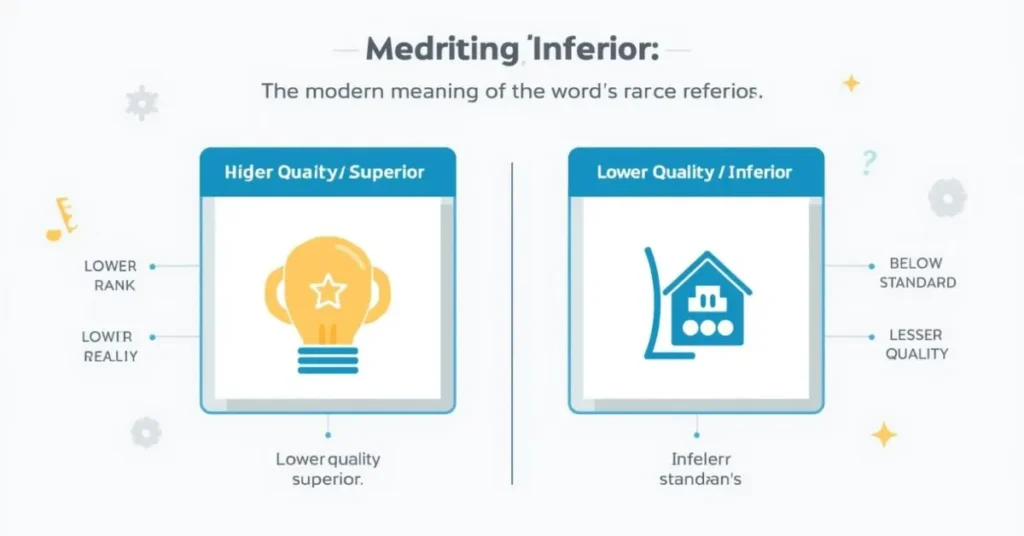
Today, inferior (adjective) describes something that is:
- Lower status
- Lower rank
- Lower quality
- Below standard
- Lesser
- Subordinate
The word is always about comparison. Something is inferior to something else.
Examples
- This phone is inferior to the new model.
- His role is inferior in the workplace hierarchy.
- This material is inferior in a product quality comparison.
The word appears often in a ranking system or hierarchy, where things are placed in levels.
How “Inferior” Shows Levels in a Ranking System
The word inferior is often used inside a ranking system. A ranking system is when things are placed in levels from high to low. This can happen in many parts of life.
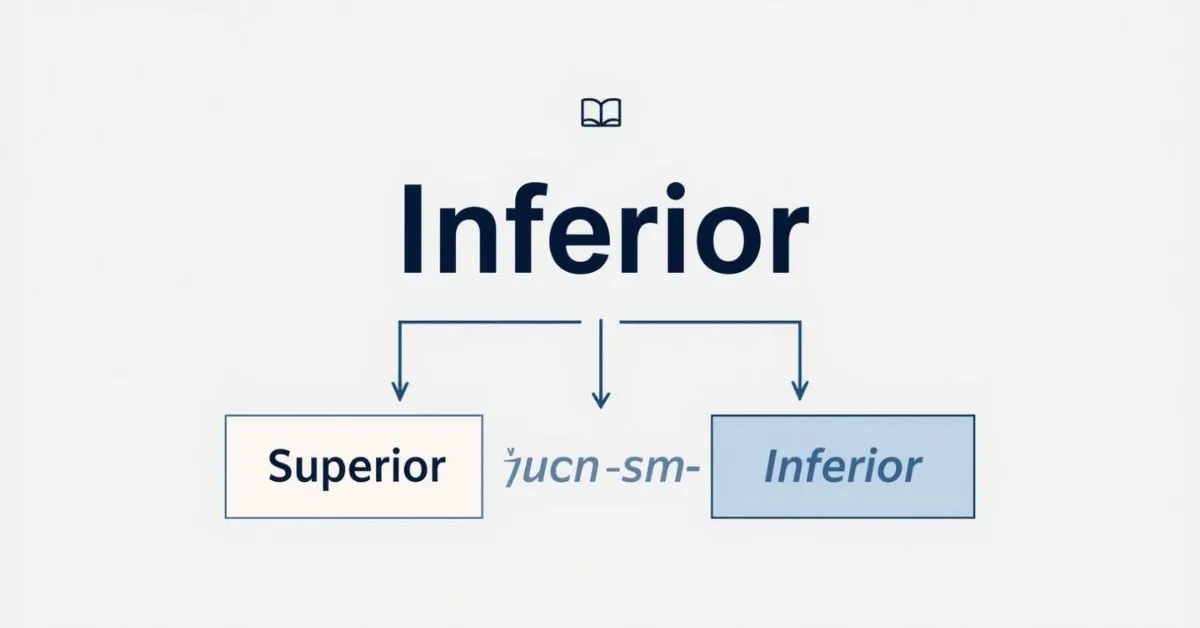
In a hierarchy, there is always a top level and a bottom level. The top level is often called superior, and the lower level is called inferior. This does not always mean “bad.” It means lower in position.
For example, in a workplace hierarchy, a manager has a higher role than an assistant. The assistant’s role may be described as inferior in rank. This only shows job level, not value as a person.
In the military ranks, soldiers follow a clear order. Higher ranks give commands. Lower ranks follow orders. The word inferior can describe a lower rank in this system.
The same idea works in product quality comparison. If one product works better, the other may be called inferior in quality. This helps people compare things in a simple way.
So, the word inferior is strongly linked to levels, order, and structure. It helps explain where something stands inside a system.
Why People Confuse Infer and Inferior
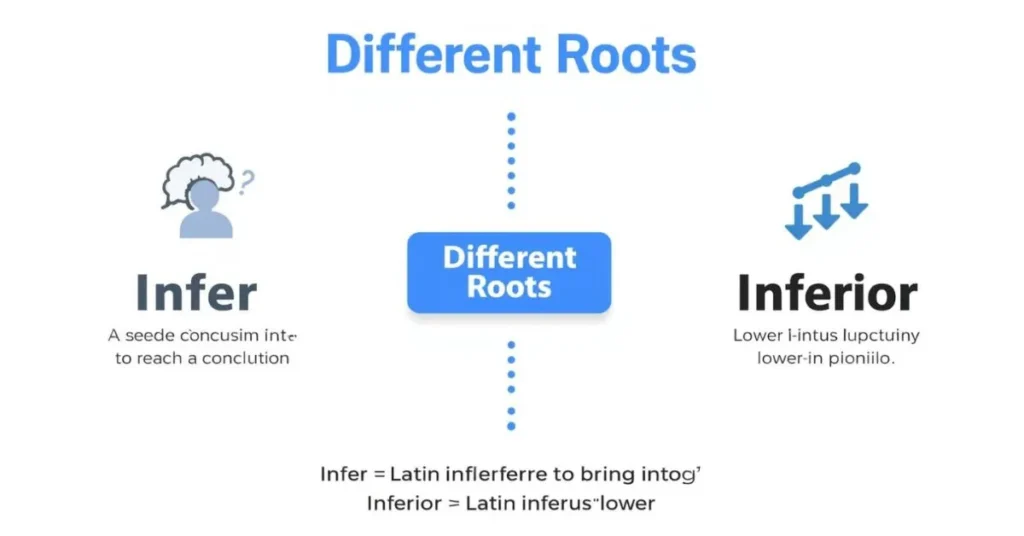
Many learners think infer and inferior come from the same root. This confusion happens because the words look alike. But their Latin origin is different.
Infer comes from inferre, which means “to bring in” or “to carry into.” Over time, this became the meaning “to reach a conclusion using facts.”
Inferior, however, comes from inferus, meaning lower or below. It is about position, not thinking.
The confusion is a common mistake in studying word roots. English has many words that look similar but have different histories. This is why learning etymology is important.
When people understand the difference, they avoid errors like:
- Thinking inferior means “not smart”
- Believing it is connected to reasoning
Instead, they see the true meaning: lower in a comparison.
This knowledge improves vocabulary and helps with correct word use in school, writing, and daily life.
Word Structure Breakdown (Linguistic View)
Let’s look at the structure.
inferior = inferus (lower) + -ior (comparative suffix)
1. Inferus
A Latin word meaning:
- lower
- beneath
- below
2. -ior
A comparative suffix in Latin grammar.
It shows adjective degree, like -er in English.
So the literal meaning of inferior was:
👉 “more low”
👉 “lower in position”
This shows that inferior belongs to comparative adjectives.
Why More Inferior Is Incorrect
Because the word already has a comparative suffix, saying:
❌ more inferior
is like saying:
❌ more lower
Correct form:
✔ inferior to
This is part of adjective degree rules.
Is Inferior Related to Infer?
This is the biggest confusion.
| Word | Latin Root | Meaning |
|---|---|---|
| Inferior | inferus | lower, beneath |
| Infer | inferre | to bring into |
Infer is about thinking.
Inferior is about position in a hierarchy.
They share letters, but their etymology is different.
History and Etymology of Inferior
The word entered English around the 1400s. It came from Latin through French.
Stage 1 – Physical Position
It meant something located below, like lower land.
Stage 2 – Social Hierarchy
It began to describe lower rank in systems like:
- Class system
- Military ranks
- Workplace hierarchy
Stage 3 – Quality Comparison
Later, it described lower quality in objects and services.
This change in meaning over time is called semantic shift.
Inferior vs Superior
The opposite word is superior.
| Word | Root Meaning | Modern Meaning |
|---|---|---|
| Superior | above | higher rank or quality |
| Inferior | below | lower rank or quality |
These words help explain levels in a hierarchy.
Contextual Use in Different Systems
The word appears in structured systems:
Social Hierarchy
Used to describe class levels.
Workplace Hierarchy
Shows job position levels.
Military Ranks
Describes command levels.
Product Quality Comparison
Used in reviews and testing.
In all cases, the word shows a lower level in a ranking system.
Words From the Same Root Family
Words connected to the idea of “below”:
| Word | Meaning |
|---|---|
| Inferior | lower |
| Infernal | from below |
| Inferno | place of fire below |
| Infra | below |
| Infrastructure | underlying base |
These strengthen the linguistic root meaning.
Psychological Meaning of Inferiority
The word also appears in psychology.
An inferiority complex means feeling:
- Less capable
- Low self-esteem
- Negative social comparison
- Perceived inadequacy
This meaning came later. It is not the original root meaning.
Common Misconceptions
❌ Inferior means “stuppid” — No
❌ It comes from infer — No
❌ It only describes people — No
It mainly describes rank, level, or quality.
How to Use Inferior Correctly
Use the pattern:
✔ inferior to
Examples:
- This brand is inferior to that one.
- His rank is inferior in the hierarchy.
- The old method is inferior.
Avoid:
❌ more inferior
❌ most inferior
Why Understanding Word Roots Matters
Knowing word roots:
- Improves vocabulary
- Prevents confusion
- Helps understand many related words
- Makes reading easier
Language becomes clearer when you understand etymology.
Frequently Asked Questions
1. Does the word “inferior” come from “infer”?
No. The word inferior does not come from infer. They look alike, but they have different Latin roots. Inferior comes from inferus, which means lower.
2. What does the root of “inferior” mean?
The root comes from the Latin word inferus, which means below, beneath, or lower in position.
3. What does “inferior” mean today?
Today, inferior means something is:
- Lower in rank
- Lower in quality
- Below another thing in a comparison
4. Is “inferior” a negative word?
Not always. It often just shows position in a hierarchy or ranking system. It does not mean a person has less value.
5. Why do people confuse “What Does the Root Infer Mean in the Word Inferior”?
People confuse them because they look similar. But infer means to make a guess using facts, while inferior means lower.
6. What is the opposite of inferior?
The opposite word is superior, which means higher in rank or quality.
7. Can we say “more inferior”?
No. This is wrong grammar. The word already has a comparative suffix (-ior). Just say inferior to.
8. Where is the word “inferior” used?
It is used in:
- Workplace hierarchy
- Military ranks
- Social hierarchy
- Product quality comparison
Final Summary
The word inferior does not come from infer. It comes from the Latin inferus, meaning lower or below. The suffix -ior makes it a comparative adjective, so the original meaning was “lower in position.” Knowing the real root helps stop confusion and shows how words grow from simple ideas about place.
Click Here To Read More: What Does APR mean for credit cards? Full Guide

I am Clara Lexis, a writer driven by clarity, depth, and authenticity. My focus is on transforming ideas into meaningful content that is both informative and engaging. I write with intention to communicate clearly, thoughtfully, and with purpose.