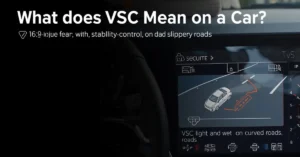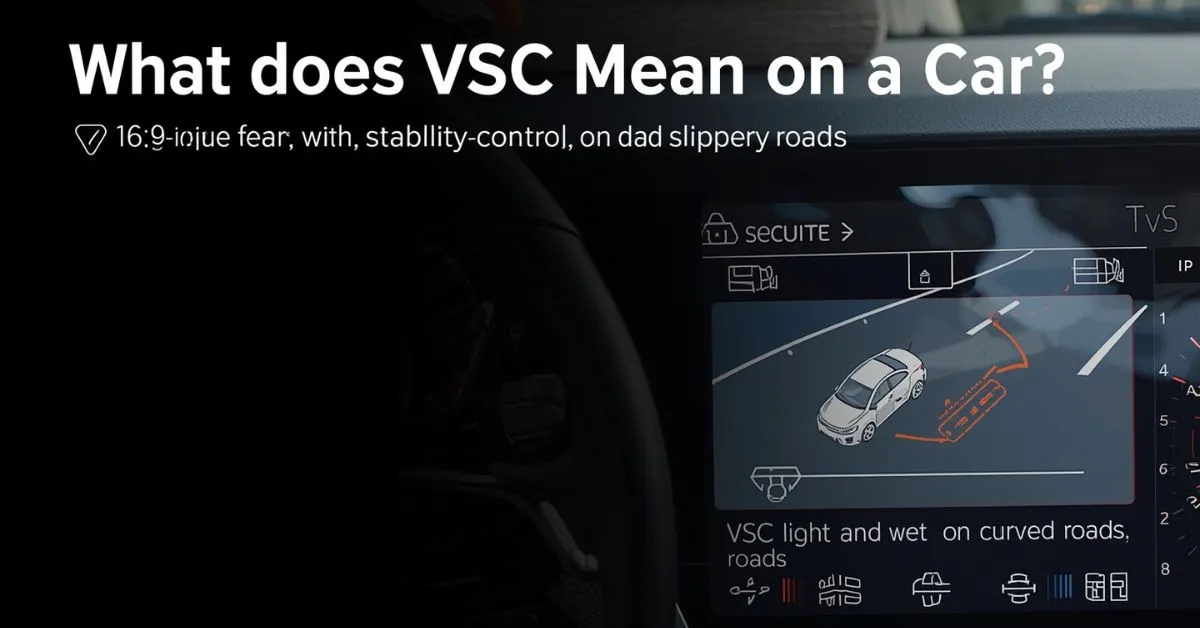
VSC usually means Vehicle Stability Control, a stability system used mainly by Toyota and Lexus. It helps the car stay on its intended path when it starts to slide by reducing engine power and applying braking to selected wheels. In practical terms, it is Toyota/Lexus language for a stability-control system similar to ESC.
If you just saw VSC, VSC OFF, or a related slip light on your dashboard, the fast answer is this: your car is talking about its traction-and-stability safety system. The next thing that matters is which light you saw and whether it is flashing or staying on. That tells you much more than the acronym alone.
Quick answer
| What you see | What it usually means | What to do |
|---|---|---|
| VSC flashing / slip light flashing | The system is actively helping on a slippery surface | Slow down and drive smoothly |
| VSC OFF | The stability system has been turned off | Turn it back on unless you are stuck in mud, dirt, or snow |
| VSC or slip light stays on steadily | The system may be off or there may be a fault that needs diagnosis | Check whether you pressed the switch; if not, get it checked |
Toyota manuals say the slip indicator blinks when the vehicle is going to skid and the system is operating. Toyota support also says the VSC OFF switch is used mainly to help free a stuck vehicle in fresh snow or mud. Dealer dashboard guides for Toyota vehicles also note that a slip-related light that stays on can indicate a malfunction in the TRAC/VSC system.
What VSC actually does
VSC is a safety system, not a performance feature. Lexus says VSC helps the driver maintain control in curves and turns, especially in wet or slippery conditions. When sensors detect the vehicle beginning to slip laterally, the system reduces throttle and applies braking to individual wheels to help correct the vehicle’s orientation.
That matches the broader industry definition of Electronic Stability Control, or ESC. NHTSA explains that ESC systems use automatic, computer-controlled braking of individual wheels to help the driver maintain control when the vehicle begins to lose directional stability. In simple terms, VSC helps stop a slide from becoming a spin or loss of control.
Is VSC the same as ESC?
For most drivers, yes in function, no in brand wording.
ESC is the broader regulatory and industry term. VSC is Toyota and Lexus language for their stability-control system. So if you drive a Toyota or Lexus, the car may say VSC where another brand would say ESC, stability control, or a brand-specific name. NHTSA’s federal materials use ESC, while Toyota and Lexus materials use VSC.
That distinction helps because many users think VSC is some completely separate system. In reality, it is part of the same general family of stability-control technology.
VSC vs traction control
This is another major confusion point.
Traction control is mainly about stopping wheelspin during acceleration on slippery surfaces.
VSC is broader. It is about keeping the whole vehicle on its intended path when it starts to slide or rotate in a turn. Lexus explains that VSC reduces throttle and applies brakes to individual wheels, while TRAC helps prevent drive wheels from spinning during acceleration.
Simple comparison
| System | Main job | Common situation |
|---|---|---|
| VSC | Helps maintain directional stability | Skidding in a curve, wet road slide, evasive maneuver |
| TRAC / traction control | Helps reduce drive-wheel spin | Snowy starts, muddy launch, wet acceleration |
| ABS | Helps prevent wheel lock during braking | Hard braking, slippery stops |
Lexus also describes VSC as part of a broader safety package that can work alongside TRAC, ABS, EBD, and other control systems. That matters because drivers often see VSC as a standalone feature when it is really part of a larger safety network.
What VSC OFF means
VSC OFF usually means the stability-control function has been switched off.
Toyota support says the VSC OFF button should mainly be used when both front wheels get stuck in fresh snow or mud. In those situations, turning off TRAC and VSC can help free the vehicle. That is one of the few normal reasons to intentionally disable the system. Once the car is moving normally again, the system should generally be turned back on.
This is where many articles stay too vague. The practical meaning is simple: VSC OFF is not usually a mystery light. It usually means the system is off. The important question is whether you turned it off on purpose or not.
Can you drive with the VSC light on?
Sometimes yes, but you should not ignore it.
If the light is flashing because the system is actively helping on a slippery road, that is not the same as a failure. It usually means the system is doing its job. Toyota manuals and dashboard guides describe the flashing slip indicator that way.
If VSC OFF is on because you manually disabled it to get unstuck, you can usually keep driving once you turn it back on and the vehicle is operating normally again. But Toyota recall and safety materials warn that turning off Vehicle Stability Control can increase crash risk because the vehicle loses an important stability aid.
If the warning stays on steadily and you did not turn it off, the safer answer is to have the vehicle checked. Toyota owner-manual material says the vehicle should be checked by a dealer if the indicator remains on after startup or comes on unexpectedly while driving.
First 3 things to check if your VSC light comes on
1. Did you press the VSC / TRAC switch?
This is the easiest explanation. Many Toyota vehicles let you disable TRAC or both TRAC and VSC with a button. Toyota support says this is mainly for situations like mud or snow.
2. Is the light flashing, steady, or showing VSC OFF?
That difference matters more than many drivers realize.
- Flashing usually means active intervention.
- VSC OFF usually means the system is disabled.
- Steady usually means the system may need attention.
3. Are any other warning lights on?
If VSC comes on with other warnings, especially a check engine or ABS-related issue, treat it more seriously. Toyota recall material notes that other systems can also be affected when VSC is turned off or disabled unnecessarily.
Why VSC lights come on in real life
Here are the most common real-world reasons:
Slippery road conditions
The system may activate normally on wet pavement, ice, gravel, or a sharp turn with reduced grip. In that case, a flashing slip light often means the system is working.
You turned the system off
This often happens by accident, especially if the driver pressed the VSC/TRAC button without realizing what it does.
The vehicle is stuck
Toyota explicitly says there are situations, especially in snow or mud, where turning off VSC and TRAC can help free the vehicle.
A fault needs diagnosis
If the warning stays on steadily or appears unexpectedly, the system may need service. Toyota manual and dealer materials support this interpretation.
Is VSC only on Toyota and Lexus?
Mostly as a name, yes.
Toyota and Lexus commonly use VSC. Other manufacturers usually use ESC or their own brand name for a similar stability-control system. NHTSA’s regulatory language is ESC, while Toyota/Lexus materials use VSC. That makes VSC feel brand-specific even though the underlying safety idea is widely used across modern cars.
What Most Articles Miss About This Topic
Most articles stop at “VSC means Vehicle Stability Control.” That is only the first part of the answer.
What drivers really need is the practical interpretation:
- A flashing light usually means the system is actively helping.
- VSC OFF usually means the system has been switched off, often intentionally or accidentally.
- A steady warning you did not trigger usually means you should check the system rather than just keep guessing.
Another thing many pages explain poorly is that VSC is not a substitute for careful driving. Lexus safety material makes that clear: VSC is designed to help maintain control, but road conditions, speed, and driver input still matter. So the best way to think about VSC is as a backup safety layer, not a guarantee.
FAQ
What does VSC mean on a Toyota?
It means Vehicle Stability Control, Toyota’s term for its stability-control system that helps reduce skidding and maintain control.
What does VSC mean on a Lexus?
It also means Vehicle Stability Control. Lexus describes it as an electronic system that helps the driver maintain control under adverse conditions.
What does VSC OFF mean?
It usually means the stability-control function has been turned off. Toyota says the switch is mainly for helping free a stuck vehicle in snow or mud.
Is VSC the same as traction control?
Not exactly. Traction control mainly helps with wheelspin during acceleration. VSC is broader and helps the vehicle stay on its intended path during a slide or loss of stability.
Can I drive with the VSC light on?
Sometimes, yes. If it is flashing during slippery conditions, the system may be operating normally. If it stays on steadily and you did not switch it off, Toyota materials indicate the vehicle should be checked.
When should I turn VSC off?
Toyota says mainly when trying to free the vehicle from fresh snow or mud. For normal driving, the system is generally meant to stay on.
Is VSC required on all cars?
The broader system category, ESC, became required on new U.S. passenger vehicles under NHTSA’s rulemaking and phase-in schedule. Brand naming varies, but the safety function is now standard.
Conclusion
If you want the shortest useful answer, here it is: VSC means Vehicle Stability Control, and on most Toyota and Lexus models it refers to the system that helps the car stay stable when it begins to slide. A flashing light usually means it is working. VSC OFF usually means it has been turned off. A steady light you did not trigger usually means it should be checked.
That is the distinction that makes the topic much easier to understand in real life. If the light is unexpected, the safest next step is to check whether the system was manually turned off and, if not, get the car diagnosed soon.
Click Here To Read More About : what does flat rate mean

Hi, I’m Geoffrey Chaucer. I explore the stories and meanings behind words, turning ideas into clear, insightful writing. Through every article I craft, I aim to spark curiosity, share knowledge, and help readers uncover practical, meaningful truths in everyday life.