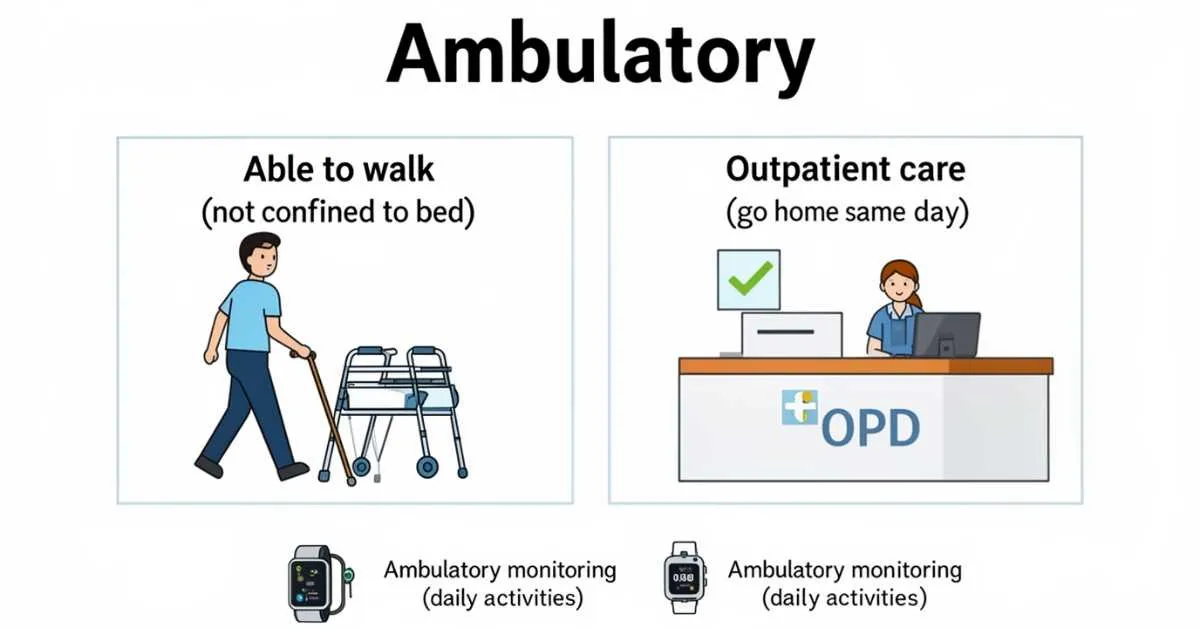
Ambulatory (adjective) means a person can walk and is not stuck in bed. In healthcare, it often means outpatient care. This is care you get at an ambulatory clinic, an outpatient department (OPD), or an ambulatory care center, and then you go home the same day. It can also mean a test done while you move around during your normal daily activities.
If you saw this word on a hospital note, a clinic sign, or an insurance paper, you may wonder what it really means for you. The good news is that the meaning is usually easy to spot once you know the context.
In this article, you will learn how doctors use the term, how it appears on bills and discharge papers, and the quick clues that help you understand it fast.
Why you’re seeing this word
You may see ambulatory on a hospital note, a clinic sign, or an insurance paper. The word has two common uses:
- Walking ability (a person’s mobility)
- Outpatient care (care without an overnight stay)
Once you know the context, the meaning becomes clear.
Quick rule: person vs place
Use this simple check:
- If it describes a person, it usually means able to walk and not bedridden.
- If it describes a service or facility, it often means outpatient care (same-day care).
Meaning 1: Ambulatory patient
An ambulatory patient is someone who can stand and walk. They are capable of movement and not confined to bed.
This can look different from person to person:
Common mobility levels (what notes often mean)
- Independent mobility: walks without help
- Assisted walking: walks with help from a person
- Walking aid: walks with a walker or cane
- Temporary mobility limits: can walk, but only short distances for now
- Non-ambulatory: cannot walk (the opposite)
Why hospitals write this down
Clinicians do a mobility assessment to plan safe care. It helps them decide:
- Is there a fall risk?
- Does the person need rehabilitation or physical therapy?
- What is safe for hospital discharge?
- Is home health care needed after leaving?
This is also common in senior care, especially in assisted living and a nursing home, where walking safety matters every day.
Wheelchair vs ambulatory
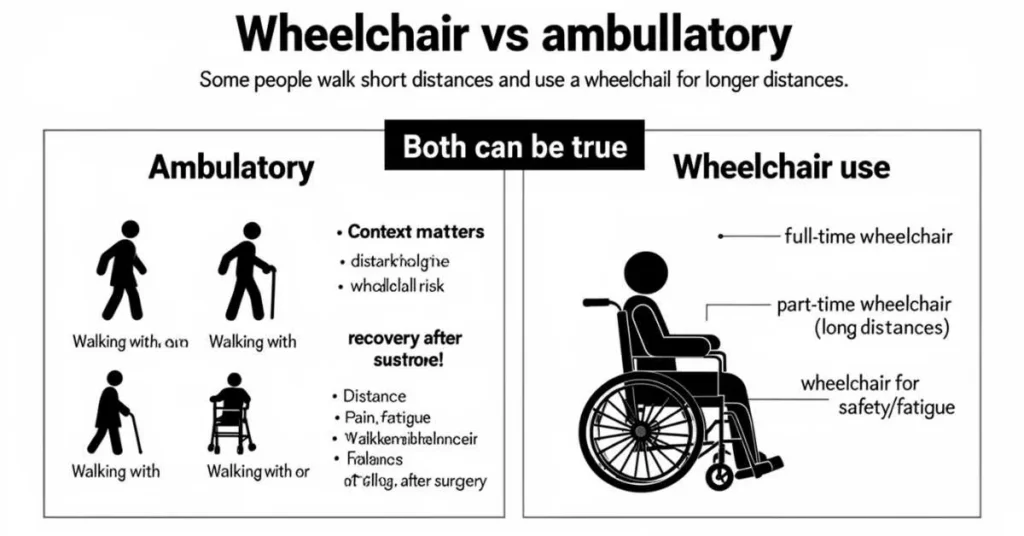
People often think it must be one or the other. But wheelchair vs ambulatory depends on distance, strength, and safety.
A person can be ambulatory and still use a wheelchair:
- for long distances
- during post-surgery recovery
- when pain or fatigue is high
- to reduce fall risk
So “ambulatory” does not always mean “no wheelchair.” It means the person can walk at least some of the time.
Meaning 2: Ambulatory care
In healthcare, ambulatory care usually means outpatient care. This is care where you are not admitted as an inpatient.
What outpatient status means
A simple way to think about it:
- Outpatient status: you get care and go home the same day
- Inpatient: you are formally admitted to stay in the hospital (often overnight)
Medicare explains that you can be an outpatient even if you spend the night, as long as you were not admitted as an inpatient.
Where ambulatory (outpatient) care happens
You may see these terms:
- Ambulatory clinic
- Outpatient department (OPD)
- Primary care clinic
- Ambulatory care center
- Other outpatient areas inside a hospital or medical facility
These are all common ways health systems label outpatient services.
Ambulatory surgery (day surgery) and surgical centers
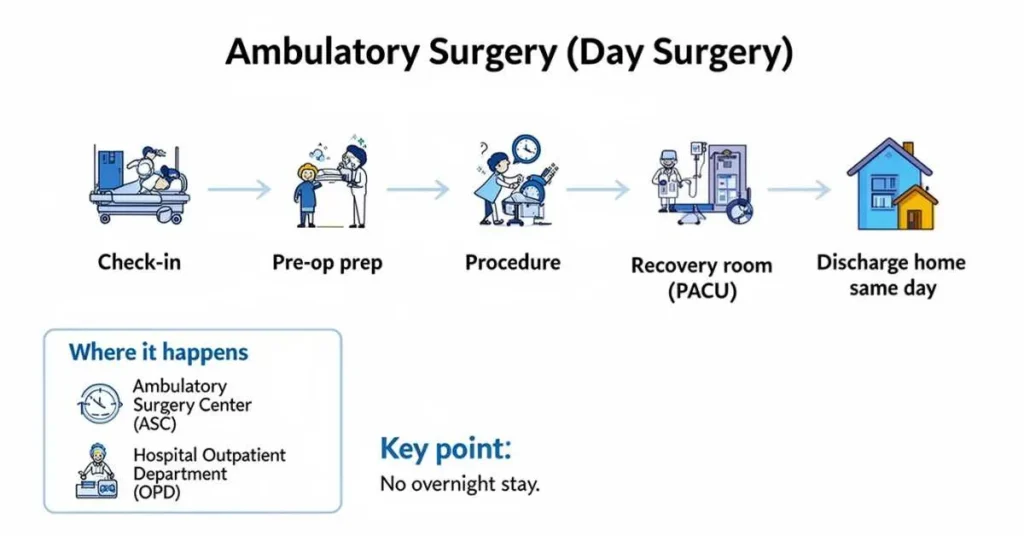
Ambulatory surgery (also called day surgery) means a procedure where you go home the same day.
Many procedures are done in a surgical center, also called an ambulatory surgery center (ASC). ASCs focus on same-day surgical care.
After day surgery, your care team usually gives clear steps for:
- pain control
- safe walking and activity
- wound care
- follow-up visits during post-surgery recovery
If you are treated and sent home, that may be listed as outpatient care. If you are admitted to a hospital bed, that becomes inpatient.
Ambulatory monitoring
Sometimes the word means testing done during normal life, not in a hospital bed.
Ambulatory blood pressure monitoring (ABPM)
ABPM measures your blood pressure over 24 hours, including sleep.
Ambulatory ECG monitoring (Holter monitor)
A Holter monitor is a small wearable device that records heart rhythm during daily activities, often for 1–2 days.
These tests are called ambulatory because you keep moving about while the device collects data.
How it appears in medical documentation
Medical notes are short. You may see phrases like these:
- “Ambulatory independently” → walks on their own
- “Ambulatory with assistance” → needs a helper
- “Ambulatory with cane/walker” → uses a walking aid
- “Non-ambulatory” → cannot walk
This is part of a basic mobility classification used for safety, therapy planning, and discharge planning.
Ambulatory status in medical report (insurance and legal use)
You may see “ambulatory status in medical report” in paperwork for:
- insurance claim evaluation
- disability assessment
- a review of functional capacity (what you can safely do)
These decisions often use medical documents. This can include notes about how you walk, therapy notes, and a doctor’s exam. If a term is unclear, ask the doctor or therapist to explain what the record means in plain language.
Ambulatory vs ambulance
These words sound similar, but they are different:
- Ambulatory: walking ability or outpatient care
- Ambulance: emergency transport
A simple memory trick: amble means walk, and it comes from the same root idea.
Latin origin and word roots
The term has a Latin origin. Dictionaries trace it back to Latin ambulare, meaning “to walk.”
This is why it fits medical terminology so well:
- the word roots point to walking and movement
- the adjective form describes a person (walking) or a care setting (outpatient)
You do not need to memorize prefix and suffix structure to understand it. Just remember the core idea: walk / move about.
FAQ:
What does ambulatory mean in medical terms?
It usually means able to walk and not bedridden, or it means outpatient care (same-day care).
Ambulatory meaning in hospital notes; what should I look for?
Look for clues like “with assistance,” “with walker,” or “non-ambulatory.” Those words describe the walking condition and safety level.
What is ambulatory status?
It is a short label for mobility. It tells whether you can walk on your own, need help, or need a device.
Ambulatory care meaning; what is it?
It means outpatient care in clinics and other settings where you are not admitted overnight.
Ambulatory vs non ambulatory; what is the difference?
Ambulatory means can walk. Non-ambulatory means cannot walk.
Ambulatory surgery meaning; what does it mean?
It means same-day surgery. Many of these procedures are done in ambulatory surgery centers (ASCs).
Key takeaways
- Ambulatory (adjective) often means able to walk and not bedridden.
- In healthcare, it often points to outpatient status and ambulatory care (no formal admission).
- It can also describe monitoring like ABPM and a Holter monitor worn during daily life.
- It is not the same as “ambulance.”
Medical note: This article is for general education, not medical or legal advice. If you are reading your own report or claim, ask your clinician or insurer for case-specific guidance.
Click For Read More About: What Does Irrational Mean? Complete Guide With Examples

I am Clara Lexis, a writer driven by clarity, depth, and authenticity. My focus is on transforming ideas into meaningful content that is both informative and engaging. I write with intention to communicate clearly, thoughtfully, and with purpose.