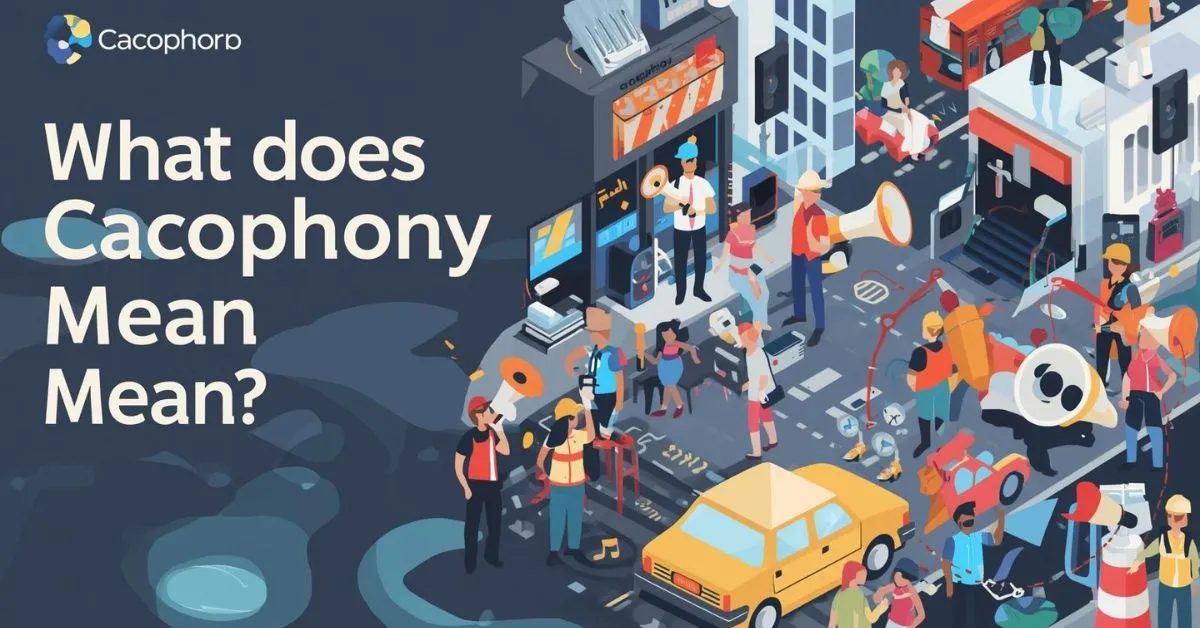
Cacophony means a harsh, unpleasant mix of clashing sounds. It usually describes noise that feels jarring, chaotic, or overwhelming, such as traffic, shouting, alarms, or discordant music.
The word can also be used figuratively for a confusing mix of voices, opinions, colors, or other competing elements.
Quick Answer
| Term | Meaning |
|---|---|
| Cacophony | A harsh, unpleasant mix of sounds |
| Pronunciation | kuh-KOF-uh-nee |
| Part of speech | Noun |
| Tone | Usually formal or descriptive |
| Common opposite | Euphony or harmony |
| Example | “The street was a cacophony of horns, sirens, and shouting.” |
What does cacophony mean in simple words?
In simple words, cacophony means an ugly or unpleasant mix of sounds happening together.
It is not just any loud sound. The word usually suggests that the sounds clash with each other and create a rough, noisy effect.
For example:
- one dog barking outside might be just noise
- barking dogs, car horns, a siren, and people yelling at the same time can feel like cacophony
That difference matters. Cacophony is about harsh combination, not only loudness.
How to pronounce cacophony
Cacophony is usually pronounced:
kuh-KOF-uh-nee
The stress falls on KOF.
A simple way to remember it is:
- kuh
- KOF
- uh
- nee
Part of speech, word form, and tone
Cacophony is a noun.
The adjective form is cacophonous.
Examples:
- “The crowd created a cacophony of noise.”
- “The room felt cacophonous and hard to focus in.”
The word often sounds a little more formal than everyday words like noise or racket. That makes it useful in:
- essays
- reviews
- journalism
- literary analysis
- more polished descriptive writing
What does cacophony imply?
When people use the word cacophony, they usually mean more than “something was loud.”
The word often implies:
- several sounds happening together
- sounds that do not blend well
- an unpleasant or jarring result
- sensory overload or disorder
- difficulty thinking, listening, or focusing
So while noise is broad, cacophony is more specific and vivid.
Cacophony vs noise, dissonance, harmony, and euphony
These words are related, but they are not identical.
| Word | Meaning | Best used when | General feel |
|---|---|---|---|
| Cacophony | A harsh, clashing mix of sounds | Multiple sounds feel jarring together | Usually negative |
| Noise | Any unwanted or unpleasant sound | You want a broad everyday word | Usually negative |
| Dissonance | Lack of harmony, especially in sound or music | You are describing tension or mismatch | Tense, technical, sometimes artistic |
| Harmony | Sounds that work well together | You want to show pleasing order or agreement | Positive |
| Euphony | Pleasant, smooth, musical sound | You are describing beauty in sound or language | Positive |
The easiest way to remember the difference
- Noise = broad everyday word
- Cacophony = harsh mix of sounds
- Dissonance = lack of harmony, often used in music or more abstract discussion
- Euphony = pleasant sound
- Harmony = sounds fitting together well
Is cacophony just another word for loud noise?
No. That is one of the most common mistakes.
A sound can be loud without being cacophonous.
For example:
- a loud bell can be loud, but not necessarily a cacophony
- a brass band can be loud, but still organized and musical
- a construction site with drilling, engines, shouting, and metal crashing may feel cacophonous
So the better definition is:
cacophony = harsh, clashing, layered sound
Cacophony in everyday life
You do not need to be reading poetry or literary criticism to use this word. It works well in ordinary descriptions too.
Here are natural examples:
- “Morning traffic created a cacophony of horns, engines, and sirens.”
- “The cafeteria was a cacophony of voices, trays, and laughter.”
- “The storm brought a cacophony of thunder, wind, and rattling windows.”
- “The market was a cacophony of music, shouting vendors, and passing motorcycles.”
In each example, the word works because many sounds are competing at once.
Cacophony in literature
In literature, cacophony can refer to actual harsh sound inside a scene, but it can also describe the sound quality of language itself.
Writers sometimes choose rough, hard, or crowded sound patterns to make a line feel:
- tense
- violent
- chaotic
- ugly
- emotionally heavy
This often happens through:
- harsh consonant sounds
- abrupt rhythm
- clashing word choices
- rough sound patterns that are harder on the ear
That is why cacophony is often discussed as a sound device in poetry and prose.
A writer describing war, panic, machinery, or confusion may not want soft, flowing language. A harsher sound pattern can match the scene better.
Why writers use cacophony on purpose
Writers may use cacophony to:
- create discomfort
- reflect confusion or conflict
- imitate real harsh noise
- build tension
- make a scene feel crowded or unstable
This is also why the word is often taught alongside euphony, which refers to pleasing, smooth sound.
Cacophony in music
In music, cacophony usually refers to sound that feels abrasive, discordant, dense, or overwhelming.
Sometimes people use the word critically, meaning the music sounds messy or unpleasant to them.
Other times it is used more neutrally or analytically. A musician or composer may intentionally create harsh sound to produce:
- intensity
- tension
- unease
- emotional pressure
- dramatic contrast
So in music, cacophony does not always mean failure. Sometimes it means the harshness is deliberate.
Can cacophony be used figuratively?
Yes, and this is something many short definition pages do not explain clearly enough.
Although the word is most strongly tied to sound, it can also be used more figuratively to describe an overwhelming or chaotic mixture.
Examples:
- “The debate became a cacophony of interruptions and accusations.”
- “Social media turned into a cacophony of opinions.”
- “The advertisement was a visual cacophony of bright colors and competing text.”
- “The room held a cacophony of smells from spices, smoke, and perfume.”
In these cases, the word keeps the same core idea: too many competing elements at once, creating an unpleasant or chaotic effect.
How to use cacophony in a sentence
A very natural pattern is:
a cacophony of + plural sounds / voices / elements
Examples:
- “The station filled with a cacophony of announcements, footsteps, and rolling luggage.”
- “The classroom erupted into a cacophony of laughter and side conversations.”
- “The rally dissolved into a cacophony of chants and shouting.”
- “The film opens with a cacophony of alarms and metallic crashes.”
You can also use the adjective form:
- “The room felt cacophonous after everyone started talking at once.”
- “The soundtrack becomes intentionally cacophonous during the final scene.”
When not to use the word cacophony
This is another area where many articles stay too vague.
Do not use cacophony when:
- there is only one sound
- the sound is loud but not clashing
- the sound is smooth, pleasant, or coordinated
- a simpler word like noise is clearer for the context
For example:
- a single alarm is usually not a cacophony
- one person speaking loudly is usually not a cacophony
- a well-balanced choir is not a cacophony, even if it is powerful
Use the word when you want to emphasize harsh mixture, not just volume.
Common mistakes people make
1. Using it for any loud sound
Cacophony usually suggests multiple clashing sounds, not just one loud one.
2. Treating it as exactly the same as chaos
Chaos is broader. Cacophony is usually tied to harsh sound or a harsh mix of competing elements.
3. Assuming it only belongs in poetry class
It is common in literary discussion, but it also works well in reviews, journalism, essays, and vivid everyday writing.
4. Thinking it must always describe something bad
Usually it has a negative tone, but in music, literature, and film discussion, it can describe an intentional artistic effect.
5. Forgetting the figurative use
The word can apply to voices, arguments, colors, or smells when the mixture feels excessive or overwhelming.
What Most Articles Miss About This Topic
Most articles stop at a short dictionary-style definition and do not explain what makes cacophony different from simpler words like noise. That leaves readers with only half the answer.
Here is what really helps:
It is about sound quality, not just volume
A loud sound is not automatically a cacophony. The word usually describes harsh overlap or clash.
It often suggests layering
Cacophony usually works best when several sounds or elements pile up together.
It has a useful figurative sense
The word is not limited to literal sound. It can describe a chaotic mixture of voices, opinions, colors, or even smells.
It matters in writing and analysis
Students, readers, and writers often see cacophony in discussions of poetry, prose, music, and film because it helps explain how harshness is created on purpose.
It makes your description more precise
Saying “the room was noisy” is fine. Saying “the room was a cacophony of chatter, music, and ringing phones” is more exact and vivid.
Quick reference table
| Question | Quick answer |
|---|---|
| What does cacophony mean? | A harsh, unpleasant mix of clashing sounds |
| Is it just loudness? | No, it usually means harsh overlap, not only volume |
| Can it be figurative? | Yes, it can describe voices, opinions, colors, and other chaotic mixtures |
| What is the adjective form? | Cacophonous |
| What is the opposite of cacophony? | Euphony or harmony |
| Is it always negative? | Usually, but it can be used neutrally in artistic analysis |
FAQ
What does cacophony mean in simple words?
It means a harsh, unpleasant mix of sounds that clash together and feel jarring or overwhelming.
What is an example of cacophony?
A busy street full of horns, sirens, engines, and people shouting is a clear example of cacophony.
What is the opposite of cacophony?
The opposite is usually euphony or harmony, depending on the context.
Is cacophony the same as dissonance?
Not exactly. Dissonance usually means lack of harmony, especially in music, while cacophony more broadly describes a harsh, clashing mix of sounds.
Can cacophony be used in literature?
Yes. In literature, it can describe both harsh sound inside a scene and rough, jarring sound patterns in the language itself.
What is the adjective form of cacophony?
The adjective form is cacophonous.
Can cacophony describe something other than sound?
Yes. It can be used figuratively for a confusing or unpleasant mixture of voices, colors, smells, or opinions.
Conclusion
Cacophony means a harsh, clashing mix of sounds, not just any loud noise. Once you understand that it usually implies overlap, roughness, and unpleasant sound quality, the word becomes much easier to recognize and use correctly.
It is especially useful in descriptive writing, literary analysis, music discussion, and everyday situations where “noise” feels too vague. Used well, cacophony gives your writing more precision and more impact.
Click Below To Read About:
What Does Cash Advance Mean? Credit Card Fees, APR, Risks
What Is Geometric Mean? Formula, Examples, and When to Use It

I am Clara Lexis, a writer driven by clarity, depth, and authenticity. My focus is on transforming ideas into meaningful content that is both informative and engaging. I write with intention to communicate clearly, thoughtfully, and with purpose.