Many people search what does hoax mean after seeing a strange post, fake warning, or shocking message online. A hoax is something false that is shared as if it were true. It is made to trick people.
This guide gives the hoax meaning in English in very simple words. It also covers hoax definition and examples, hoax vs scam, hoax vs prank, fake news meaning, what does misinformation mean, how to identify a hoax, internet hoax examples, and hoax message meaning.
By the end, you will know what a hoax is, how it spreads, and how to spot one fast.
What Does Hoax Mean?
Hoax meaning in English
The word hoax means a false story, warning, or act that is made to fool people.
A hoax is not just wrong by mistake. It is usually shared on purpose to trick others.
Many people also ask, what is a hoax? The simple answer is this:
A hoax is a fake claim or made-up event that is meant to deceive people.
Simple hoax definition and examples
Here is a plain hoax definition:
- A hoax is false information shared as truth
- A hoax is made to fool, shock, or confuse people
- A hoax may spread online, in messages, in news-like posts, or in real life
Here are quick examples:
- A post says a famous actor died, but it is false
- A message says a school is closed, but no official source confirms it
- A fake warning says a product is deadly, but the claim is made up
- A false bomb threat is reported to cause panic
These are all forms of a deceptive claim.
Pronunciation, word type, and plural form
| Word Detail | Meaning |
|---|---|
| Word | hoax |
| Pronunciation | hohks |
| Part of speech | noun, verb |
| Plural | hoaxes |
| Simple meaning | a fake claim meant to trick people |
You may hear people say:
- “That story was a hoax.”
- “They tried to hoax the public.”
What Is a Hoax and How Is It Used?
Hoax as a noun
As a noun, hoax names the false story or fake act.
Examples:
- The email was a hoax.
- The warning turned out to be a hoax.
- The internet hoax spread very fast.
Hoax as a verb
As a verb, hoax means to trick or fool someone with false information.
Examples:
- Someone tried to hoax the town with a fake alert.
- The group hoaxed readers with a false post.
Hoax in a sentence
Here are easy sentence examples:
| Sentence | Meaning |
|---|---|
| The bomb threat was a hoax. | The threat was fake. |
| The viral photo was a hoax. | The photo was used to mislead people. |
| Many users shared the hoax message. | People passed along a fake message. |
| The class learned how to identify a hoax. | The class learned how to spot false information. |
Hoax Definition and Examples in Real Life
Internet hoax examples
Many people search for internet hoax examples because online hoaxes are common. They often appear on social media, blogs, video platforms, and chat apps.
Common internet hoaxes include:
- Fake celebrity death posts
- False giveaway offers
- Fake health warnings
- Edited screenshots
- Old photos shared as new events
- Fake weather alerts
- Made-up crime stories
- AI-made images used as “proof”
A viral false post can spread in minutes on Facebook, X, TikTok, YouTube, Instagram, Reddit, or WhatsApp.
Hoax message meaning
People also ask about hoax message meaning. A hoax message is a fake text, email, or chat message that tells people something untrue.
A hoax message often says things like:
- “Share this now before it gets deleted”
- “Your account will be closed tonight”
- “A dangerous person is going door to door”
- “This product causes cancer”
- “A company is giving away free phones”
These messages use fear, urgency, or excitement. That makes people share them without checking facts.
Public safety hoaxes and real harm
Some hoaxes are not just annoying. They can be dangerous.
Examples include:
- Fake bomb threats
- Fake school closure notices
- False missing child posts
- Fake police warnings
- False disaster alerts
These hoaxes can waste time, cause panic, and hurt trust. Emergency workers, schools, and families may react to false information. That is why some hoaxes can become legal matters.
Hoax vs Scam vs Prank vs Rumor
Hoax vs scam
Many readers search hoax vs scam because the two words sound close. They are related, but they are not the same.
A hoax is false information meant to trick people.
A scam is a trick meant to steal money, data, or access.
Example:
- “A shark is in the city fountain” may be a hoax
- “Click here to claim money and enter your bank details” is a scam
Some posts are both. A fake giveaway may start as a hoax and end as a scam.
Hoax vs prank
People also search hoax vs prank. A prank is usually a joke. A hoax is more serious.
A prank is often playful.
A hoax is meant to make people believe something false.
Example:
- Putting fake eyes on office items is a prank
- Posting a fake emergency alert is a hoax
A prank becomes more like a hoax when it causes fear, confusion, or public harm.
Hoax vs rumor and fake news meaning
A rumor is information that may or may not be true. People pass it around before checking it.
A hoax is usually false on purpose.
Many people also ask about fake news meaning. Fake news is false or misleading content that looks like real news. Some fake news stories are hoaxes because they are created to fool readers.
Here is a simple comparison:
| Term | What it means | Main goal |
|---|---|---|
| Hoax | False claim shared as true | Trick people |
| Scam | Fraud to steal money or data | Profit |
| Prank | Joke or trick | Humor or surprise |
| Rumor | Unchecked information | Spread gossip or uncertainty |
| Fake news | False story in news style | Mislead readers |
What Does Misinformation Mean and How Is It Linked to Hoax?
What does misinformation mean?
Many readers move from what does hoax mean to what does misinformation mean.
Misinformation is false information that is shared, even if the person sharing it does not know it is false.
Example:
- Your friend shares an old flood photo and thinks it is from today
That is misinformation if your friend believes it is true.
Misinformation vs disinformation
This is a helpful difference:
- Misinformation = false information shared without knowing
- Disinformation = false information shared on purpose
A hoax is often a kind of disinformation, because it is created to trick people.
How hoaxes connect to manipulated media
Today, some hoaxes use:
- Edited images
- Short video clips without context
- Deepfake audio
- AI-made photos
- Fake documents
- Cropped screenshots
This is called manipulated media when real or fake media is changed to mislead people. A hoax can use manipulated media to look more real.
How to Identify a Hoax
Fast warning signs
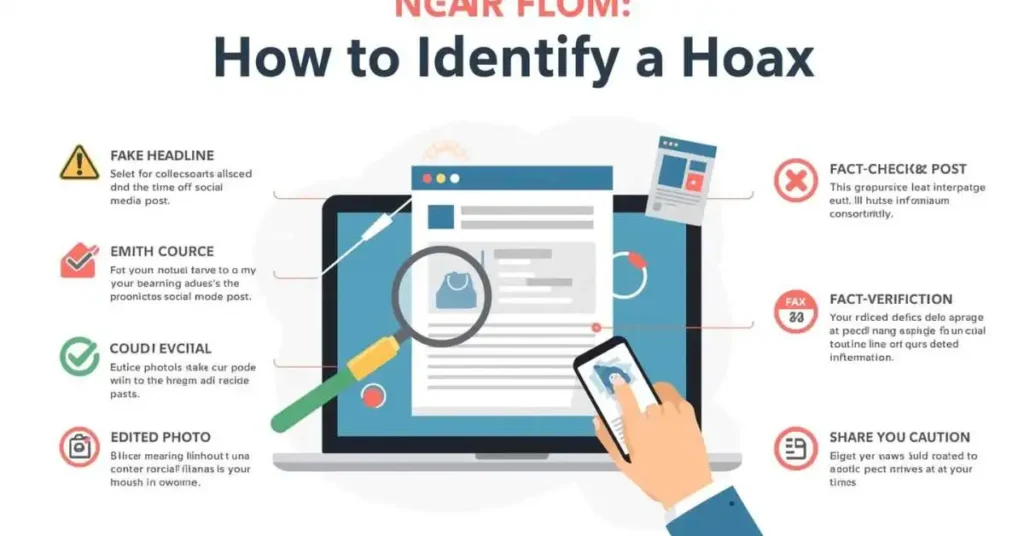
Many people search how to identify a hoax because false stories can look real.
Watch for these signs:
- The headline is shocking
- The post says “share now”
- There is no trusted source
- The image looks strange or edited
- The date is old or missing
- The claim sounds too wild to be true
- The account is unknown or fake
- The message uses fear or panic
These signs do not prove a hoax every time, but they are warning flags.
Simple fact-check steps
Use this easy check list before you share:
| Step | What to do | Why it helps |
|---|---|---|
| 1 | Check the source | Trusted sources are easier to verify |
| 2 | Look for the date | Old content is often shared as new |
| 3 | Search the claim | Real stories usually appear in many reliable places |
| 4 | Check the photo | Images may be old, edited, or taken from another event |
| 5 | Read past the headline | Headlines can be misleading |
| 6 | Pause before sharing | Many hoaxes spread because people rush |
Example of checking a suspicious post
Imagine you see a WhatsApp post that says a local mall is giving away free shopping cards.
You should:
- Visit the mall’s official website or social page
- Search online for the same offer
- Check the date and spelling in the message
- Look for strange links or fake logos
If nothing official supports the claim, it may be a hoax or scam.
Why Do People Make Hoaxes?
Common reasons behind hoaxes
Not every hoax has the same goal. People create hoaxes for many reasons.
Common reasons include:
- To get attention
- To go viral
- To make money from clicks
- To spread fear
- To push an agenda
- To damage trust
- To create confusion
- To joke in a harmful way
Why people share hoaxes so fast
Hoaxes spread because they trigger strong feelings.
People share them when they feel:
- Shock
- Fear
- Anger
- Curiosity
- Excitement
This is why social media hoaxes move fast. A dramatic post gets clicks. A calm fact check often spreads more slowly.
Common Words Related to Hoax
Synonyms and near-synonyms
These words are close in meaning to hoax, though each has its own shade of meaning:
- deception
- fraud
- trick
- sham
- fake
- fabrication
- false report
- made-up story
- false information
- misleading post
Some of these overlap with scam, rumor, misinformation, and disinformation.
Antonyms and common phrases
Words with the opposite meaning include:
- truth
- fact
- reality
- proof
- authenticity
Common phrases with hoax include:
| Phrase | Meaning |
|---|---|
| bomb hoax | a fake bomb threat |
| internet hoax | a fake claim spread online |
| hoax call | a false phone report |
| hoax message | a fake text or email |
| viral hoax | a fake story shared by many people |
These phrases help you understand the meaning of hoax in real use.
Can a Hoax Be Illegal?
When a hoax is just false content
Some hoaxes are silly or low-level. For example, a fake rumor about a movie release may waste time but not cause major harm.
Still, even small hoaxes can hurt trust.
When a hoax becomes serious
A hoax may become illegal when it involves:
- False bomb threats
- Fake police calls
- Dangerous public warnings
- Fraud or identity theft
- False medical claims that cause harm
- Fake emergency reports
These cases can waste public resources and put people at risk.
Why Understanding Hoax Matters Today

Hoaxes in social media and daily life
You may see hoaxes in:
- WhatsApp groups
- Facebook posts
- X threads
- TikTok videos
- YouTube clips
- Email chains
- Community pages
That is why knowing what does hoax mean is now a basic digital skill.
Why readers, students, and families should care
Understanding hoaxes helps you:
- Avoid sharing false information
- Protect friends and family
- Think before you click
- Spot scams faster
- Read news with care
- Build media literacy
In short, learning the hoax meaning in English is not just about vocabulary. It helps you stay safe and informed.
Quick Table: About Hoax Meaning
Easy summary table
| Question | Short answer |
|---|---|
| What does hoax mean? | A fake story or act meant to trick people |
| What is a hoax? | False information shared as true |
| Is hoax the same as scam? | No. A scam usually tries to steal money or data |
| Is hoax the same as prank? | No. A prank is usually a joke; a hoax is more deceptive |
| Can hoaxes spread online? | Yes. Many spread through social media and chat apps |
| How to identify a hoax? | Check the source, date, image, and facts before sharing |
FAQ About the Meaning of Hoax
What does hoax mean in simple words?
A hoax is a false story, warning, or act that tricks people into believing something untrue.
What is a hoax in one sentence?
A hoax is a fake claim shared as if it were real.
What is the difference between a hoax and fake news?
A hoax is any false act or story meant to deceive. Fake news is false content written or shown in a news style. Some fake news stories are hoaxes.
What is the difference between hoax and misinformation?
People usually create a hoax on purpose. People may share misinformation even when they think it is true.
Can a text or WhatsApp forward be a hoax?
Yes. A fake warning, fake giveaway, or fake emergency message sent by text, email, or WhatsApp can be a hoax message.
Are all rumors hoaxes?
No. A rumor is unverified information. A hoax is usually false on purpose.
Conclusion
So, what does hoax mean? A hoax means someone creates a false story, claim, warning, or act to trick people. The word hoax closely links to deception, false information, and misleading content.
A hoax can appear as a fake alert, edited image, hoax message, rumor, or internet post. That is why it helps to know how to identify a hoax, understand hoax vs scam, learn hoax vs prank, and know the difference between hoaxes, fake news, misinformation, and disinformation. When you slow down, check the source, and verify the facts, you are much less likely to fall for a hoax or spread one.
Read More New Post: What Does Bawdy Mean? Complete Guide with Examples

I am Clara Lexis, a writer driven by clarity, depth, and authenticity. My focus is on transforming ideas into meaningful content that is both informative and engaging. I write with intention to communicate clearly, thoughtfully, and with purpose.