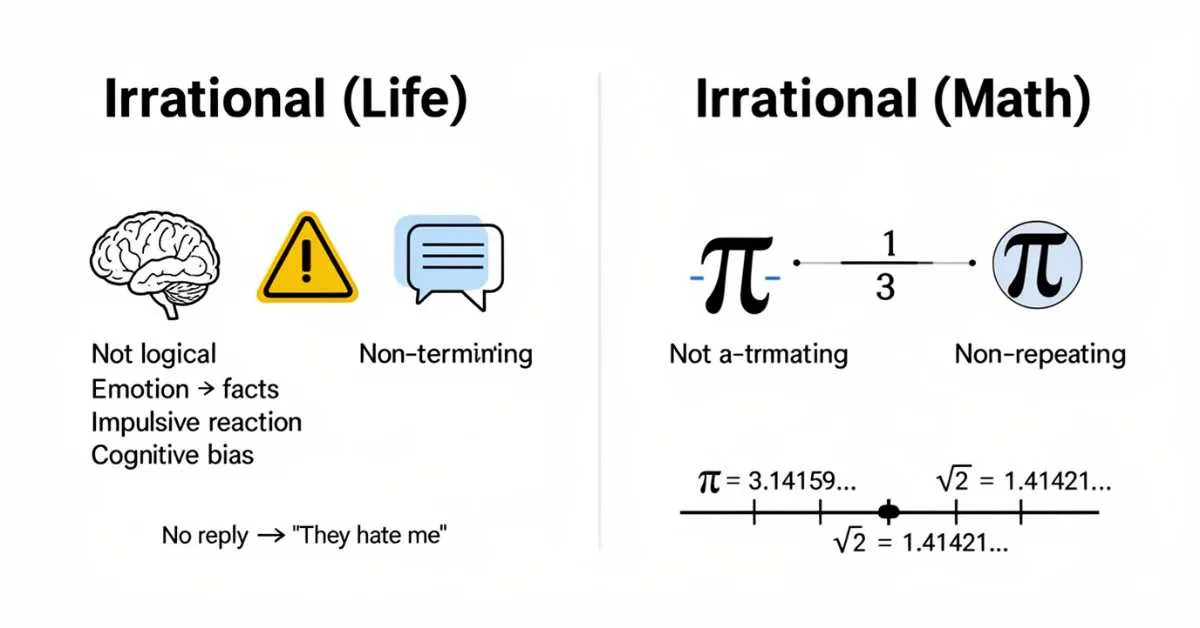
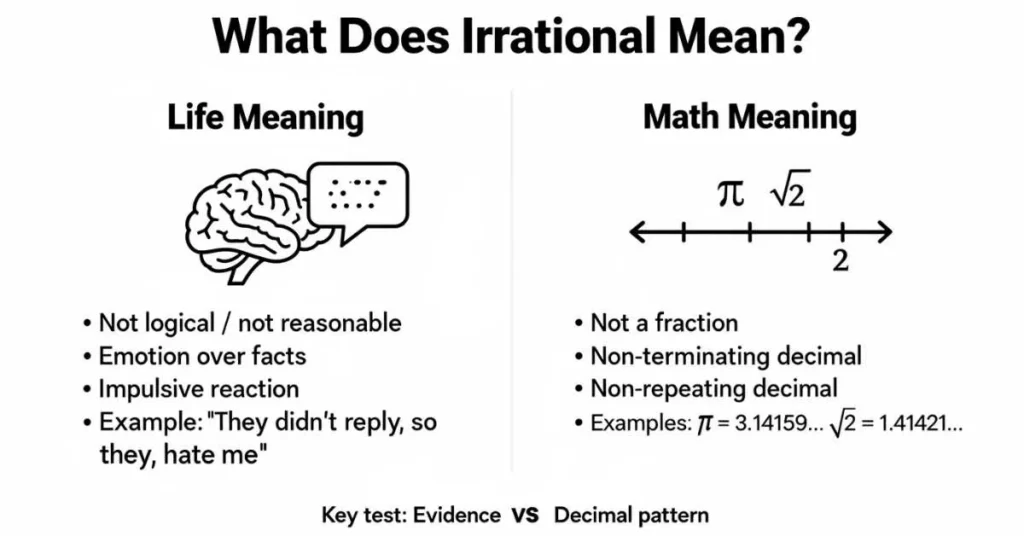
Irrational (adjective) means not logical or not reasonable. In life, it describes thoughts or actions against reason, often driven by emotion instead of facts. In math, an irrational number cannot be written as a fraction. Its decimal expansion never ends. And never repeats.
Irrational means not logical or not reasonable. In daily life, it describes thoughts or actions driven by emotion instead of facts. In math, an irrational number is a real number that cannot be written as a fraction and has a decimal that never ends and never repeats.
But here’s the surprise: in math, irrational doesn’t mean “ccrazy” at all. It describes special numbers like π (pi) and √2 that can’t be written as simple fractions.
In this guide, you’ll learn both meanings with clear examples, so the word finally makes sense.
Math Meaning vs Life Meaning
| Word Use | What it means | Key signs | Simple example |
|---|---|---|---|
| Life (everyday) | Not based on facts or clear thinking | emotional decision, impulsive reaction, lack of logic | “They didn’t reply, so they hate me.” |
| Math | A number that is not a fraction | non-terminating decimal, non-repeating decimal | π = 3.14159… and √2 = 1.41421… |
What Does Irrational Mean in Simple Words?
In simple words, it means without clear thinking. It is unreasonable thinking or illogical behavior. It often happens when feelings are strong and the brain reacts fast.
This does not mean a person is “sstupid.” It means the thought or decision is not based on facts. Many smart people act irrational when they feel stress or fear.
Easy examples of irrational thoughts:
- “I made one mistake, so I will fail.”
- “Everyone is judging me.”
- “If they are quiet, they must be angry.”
These ideas can feel true. But they may not match reality.
Irrational Meaning in Psychology
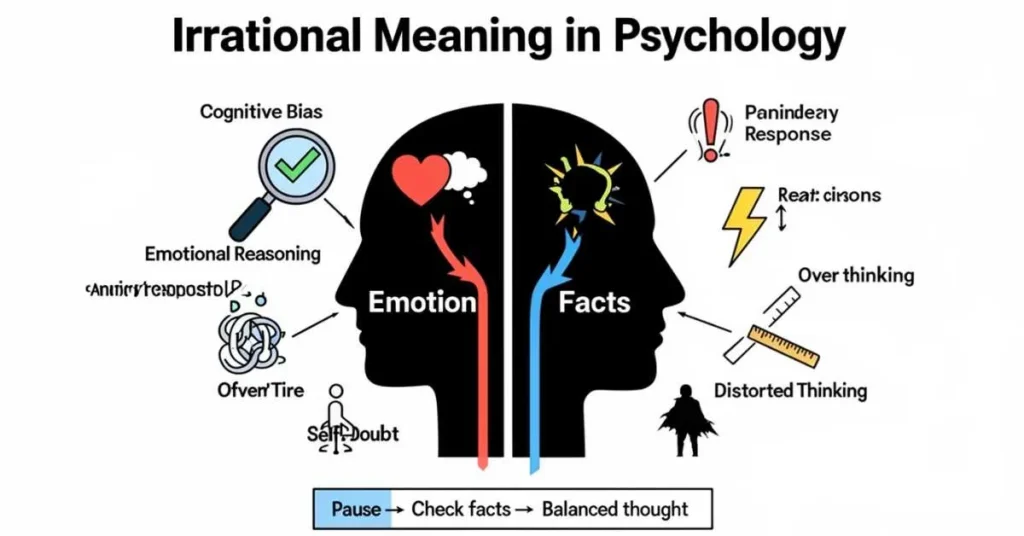
Irrational meaning in psychology often connects to the brain’s safety system. When you feel danger, your body can enter a stress response. That may create an anxiety response or a panic reaction. In that state, it is easy to make an emotional decision.
Two common causes are:
Cognitive bias
A cognitive bias is a mental shortcut. It helps you decide fast, but it can also lead to mistakes.
Emotional reasoning
Emotional reasoning happens when emotions lead the verdict.
Example: “I feel worried, so something bad will happen.” Worry is a signal, not a fact.
Other common patterns:
- Fear-based thinking (expecting danger without proof)
- Overthinking: (replaying worries again and again)
- Distorted thinking: (seeing things in extreme ways)
- Self-doubt: (assuming you are not good enough)
- Low emotional control: (reacting before calming down)
Irrational Behavior Examples
Here are clear behavior examples you may notice:
Relationships
- “They didn’t invite me, so nobody likes me.”
This often comes from self-doubt and emotional reasoning.
School or work
- “If it’s not perfect, it’s a failure.”
This is distorted thinking and can stop progress.
Money and spending
- “I’m upset, so I should buy something now.”
That can be an impulsive reaction, not good decision making.
Public fear and financial markets
Sometimes a strong social reaction spreads fast. In financial markets, rumors can cause economic panic. People may follow the crowd because fear feels urgent. That is public fear in action.
Rational vs Irrational
The difference between rational and irrational is often the quality of the reason behind the choice.
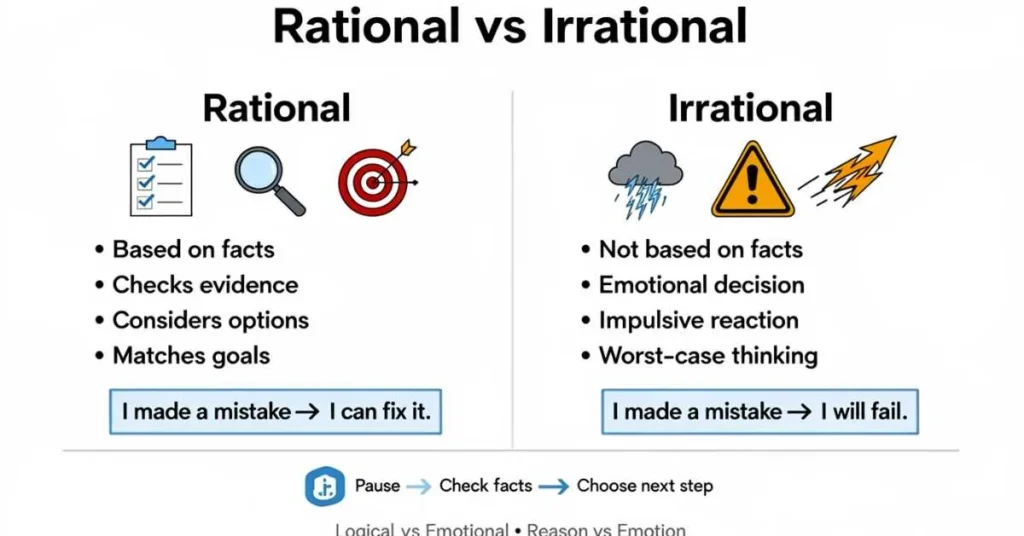
- Rational: based on facts, evidence, and goals
- Irratiional: against reason, driven by fear or emotion
This connects to:
- Logical vs emotional
- Reason vs emotion
- Sensible vs irrational
Try these quick questions (critical thinking):
- What evidence do I have?
- Am I guessing or using facts?
- Is my reaction too big for the situation?
- What would I tell a friend?
These steps improve critical thinking, logical reasoning, and better decision making.
Irrational Fear Meaning: Irrational Fear and Phobia
Irrational fear meaning is simple: the fear is much bigger than the real risk.
- Irrational fear: fear that does not match danger
- Phobia: a strong fear that feels hard to control
Fear can be useful. It helps you stay safe. But fear becomes irrational when it pushes you to avoid normal life or believe worst-case stories without proof.
People can also feel irrational anger. This happens when anger is stronger than the event. Stress can make small problems feel huge.
How to Fix Irrational Thoughts
You can’t stop every irrational thought. But you can change how you respond.
The 3-step reset
- Name it: “I’m having the thought that…”
- Check facts: “Is this not based on facts?”
- Balance it: “What is a sensible explanation?”
Example:
- Irrational: “I’m nervous, so I will fail.”
- More rational: “I’m nervous because it matters. I can prepare.”
This is simple critical thinking and better emotional control.
Irrational Meaning in Math
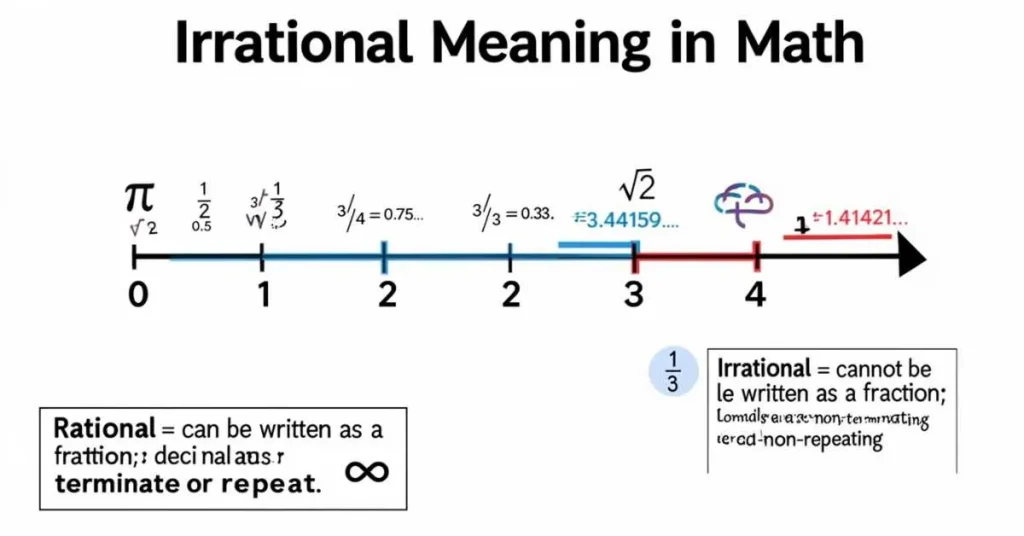
Now let’s cover its meaning in math. This is part of the number system.
Rational number
A rational number is any number you can express as one whole number divided by another (with the bottom number not zero).
- 3/4, 7/2, 5/1
Rational numbers also include decimals that end or repeat: - 0.5 (ends)
- 0.333… (repeats)
Irrational number
A number cannot be written as a fraction. When you write it in decimal form, the digits keep going forever and do not repeat in a pattern.
- Non-terminating decimal (never ends)
- Non-repeating decimal (never repeats)
Both rational and irrational numbers are real numbers.
Irrational number definition (short):
A real number that cannot be written as a fraction and has a decimal that never ends and never repeats.
Visual Math Explanation: How to “See” Irrational Numbers
Here is a simple way to picture it:
1) Fractions land on “neat” decimals
Think of a number line. Many points are easy to name with fractions:
- 1/2 = 0.5
- 3/4 = 0.75
These are rational numbers, and their decimals end.
2) Some decimals repeat like a loop
- 1/3 = 0.333…
The pattern repeats forever. That is still rational.
3) Irrational numbers never form a loop
Numbers like Pi (π) and square root of 2 (√2) never repeat:
- π = 3.14159…
- √2 = 1.41421…
You can mark their points on the number line, but you can’t write them as an exact fraction.
A “square picture” for √2
Imagine a square with sides of length 1. The diagonal is √2.
That diagonal length is real and measurable, but it cannot be written as a perfect fraction.
This is why these numbers are real numbers, but not rational numbers.
Why the Word Has Two Meanings (Easy Word Roots)
The word comes from Latin origin and clear word formation.
- The root word “rational” relates to reason.
- The prefix “ir-” meaning not changes the meaning to “not rational.”
- This is an adjective structure: it describes a person, thought, or number.
Learning word roots is great for vocabulary building.
A Short Note on Philosophy
In logic in philosophy, people study how good reasoning works. Ideas like rationalism (focus on reason) and empiricism (focus on evidence) connect to human reasoning.
Modern fields like behavioral psychology and decision theory study how people make choices in real life. They also study why people sometimes make unfair or biased choices.
FAQs:
What does irrational mean in simple words?
It means not logical, not reasonable, and not based on facts.
What is irrational meaning in psychology?
It often means thoughts that are changed by bias, strong feelings, stress, or fear.
What is irrational meaning in math?
It means an irrational number: a real number that cannot be written as a fraction and has a non-terminating, non-repeating decimal.
What is the difference between rational and irrational?
Rational uses facts and clear reasons. Irrational goes against reason or ignores evidence.
What is irrational fear meaning?
It is fear bigger than the real risk. In stronger cases it can be a phobia.
Conclusion
Irrational has two main meanings. In life, it means not logical, not reasonable, and against reason; often caused by emotion, stress, or distorted thinking. In math, it means an irrational number, like π or √2, with a decimal that never ends and never repeats.
When you know the difference, you can think more clearly, communicate better, and understand irrational numbers with more confidence.
Read Also This Post: What Does the Upside Down Emoji Mean? 🙃 Ultimate Guide

Hi, I’m Geoffrey Chaucer. I explore the stories and meanings behind words, turning ideas into clear, insightful writing. Through every article I craft, I aim to spark curiosity, share knowledge, and help readers uncover practical, meaningful truths in everyday life.