Have you ever wondered about the meaning of this concept? In simple terms, Nominal describes something minimal, symbolic, or existing in name only. Its meaning changes depending on context.
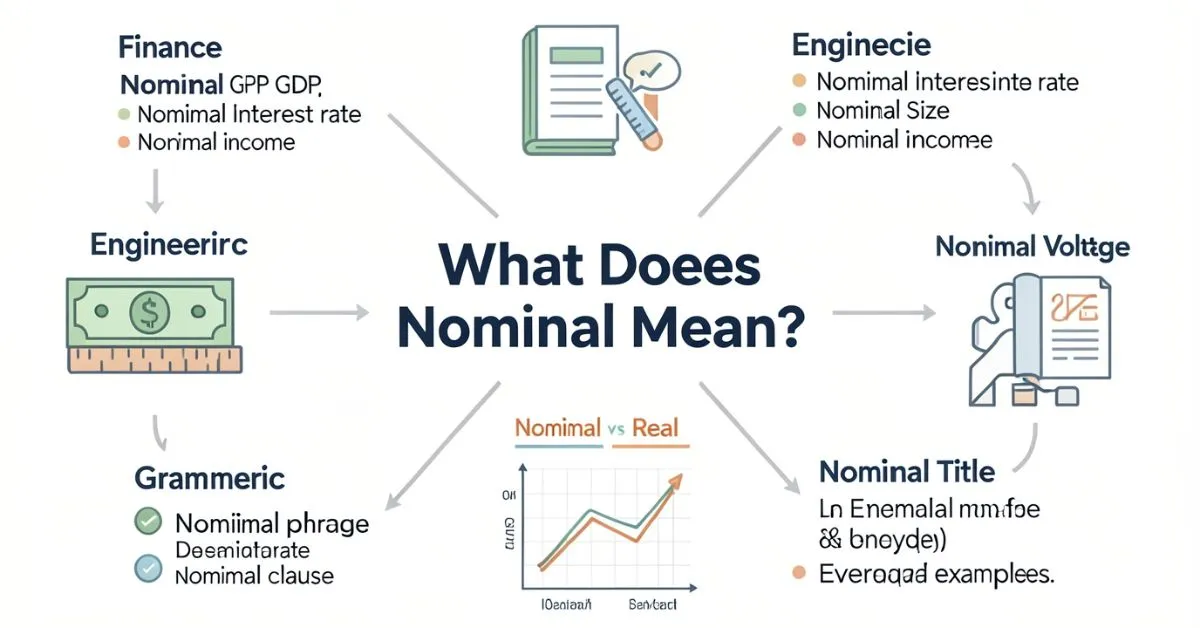
In finance, it refers to stated or unadjusted values, such as GDP figures, interest rates, income, or product prices. In engineering, nominal means a standard value, like voltage, size, or power. And in grammar, it shows phrases or clauses that act like nouns. It can also change verbs or adjectives into nouns.
This idea also shows up in statistics, measuring things, building, and everyday life. It helps people make smart choices. This guide will explain it in simple words, give examples from different areas, compare stated and real numbers, and show how to use them the right way.
Nominal Meaning in Simple Words
First, let’s understand this concept in everyday life:
- Minimal or Small: A fee of $1 can be symbolic and practically insignificant.
- In Name Only: A title may exist officially but carry little real responsibility.
- Stated or Standard Value: Sometimes, it refers to a number or label serving as a reference, even if the actual measurement differs.
This idea is often contrasted with real values, which show the true or adjusted amount. For instance, a salary might be listed as $50,000, but after accounting for inflation, the purchasing power could be $47,500. Similarly, a pipe labeled 2 inches may measure slightly less, such as 1.9 inches.
Nominal in Finance
In finance, stated values appear as unadjusted figures:
| Concept | Meaning | Example |
|---|---|---|
| GDP | Total output at current prices | $22 trillion (2025) |
| Interest Rate | Stated rate on loans or savings | 5% stated rate |
| Income | Earnings without adjustment | $50,000/year |
| Price | Goods or services | $100 product |
| Exchange Rate | Currency value | 1 USD = 0.85 EUR |
For example, GDP shows the total value of goods and services at current prices. However, after inflation, the real GDP may be lower. Similarly, a 5% stated interest rate may yield only 3% after adjustments. Knowing the difference between the listed number and the real number is important for people who invest, spend money, or compare costs over time.
Long-tail keywords: What does nominal mean in finance? What does nominal mean in accounting?
Nominal in Engineering & Technical Fields
In engineering, standard reference values guide design and construction:
- A pipe labeled 2 inches may measure slightly less, but using the labeled size ensures compatibility and safety.
- Standard voltage ratings help engineers build reliable systems.
- Using standard sizes in construction helps workers plan and put things together. Even if the real measurements are a little different.
| Term | Reference | Actual Example |
|---|---|---|
| Pipe Size | 2-inch | 1.9-inch |
| Voltage | 120V | 118–122V |
| Lumber | 2×4 | 1.5×3.5 in |
| Battery | Rated 2000 mAh | Actual may vary |
| Motor | Rated 500W | Actual varies |
Long-tail keywords: Learn what nominal means in engineering. How standard voltage and sizes explain nominal in electrical terms. Understanding nominal in construction helps with planning and measurement accuracy.
Nominal in Grammar and Linguistics
In grammar, this concept describes nouns or noun-like structures:
- Nominal Phrase: A group of words acting as a noun (The red car).
- Nominal Clause: A clause functioning as a noun (What she decided surprised everyone).
- Nominalization: Turning verbs or adjectives into nouns (decide → decision, happy → happiness).
Grasping these structures helps writers create clear, formal, and precise sentences. Academic writing uses nominalization to make ideas short and clear. Everyday writing uses nominal phrases and clauses to make sentences easy to understand.
Nominal in Statistics and Data Analysis
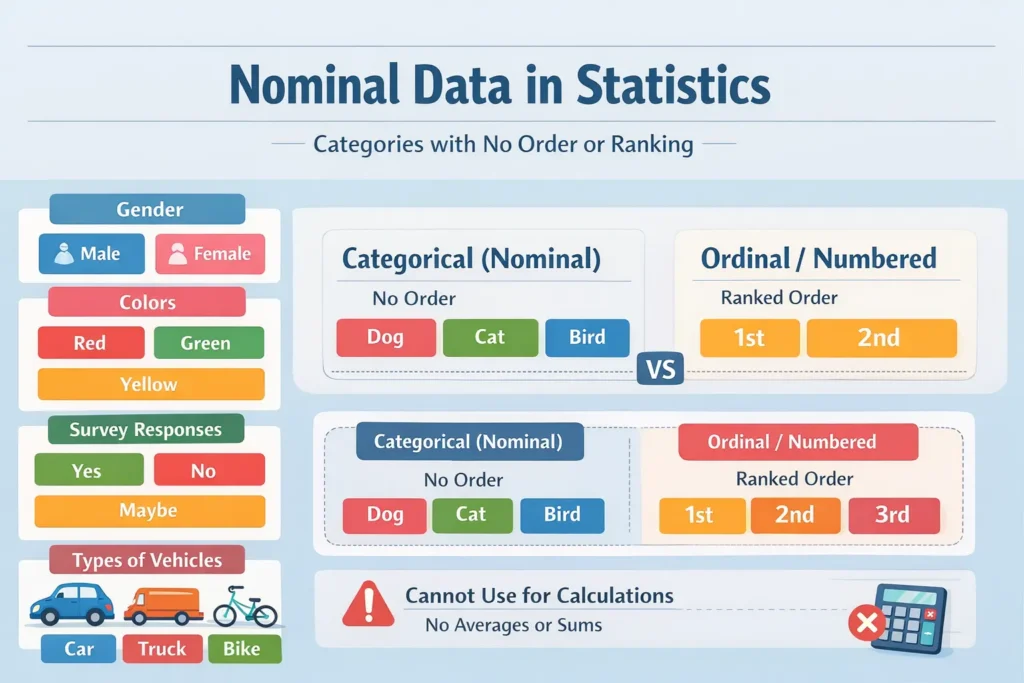
In statistics, this concept appears as categorical data with no ranking:
- Examples: Gender, colors, vehicle types.
- Characteristics: These values can be counted or grouped but cannot undergo arithmetic operations.
- Practical Use: Correct classification prevents errors in analysis and ensures meaningful interpretation.
Survey responses like Yes, No, Maybe represent distinct categories. Analysts often use these groups to sort results and see patterns without using numbers.
Nominal in Measurement and Construction
In construction and manufacturing, reference values simplify planning and maintain consistency:
- Standard Lumber Size: A 2×4 piece typically measures 1.5×3.5 inches.
- Pipe Size: Labeled for convenience, actual internal/external diameters may vary.
- Windows & Doors: Standardized reference sizes ensure proper fit in projects.
Using these dimensions allows teams to plan and assemble materials efficiently. Even if real measurements differ slightly.
Long-tail keywords: How nominal sizing applies to lumber, wood measurements, and windows. What does nominal mean in construction?
Real vs Stated Figures – Key Differences
| Field | Stated/Reference | Actual/Real |
|---|---|---|
| Finance | Unadjusted values | Adjusted for inflation |
| Engineering | Standard reference | Measured/actual |
| Everyday Life | Minimal/symbolic | True or substantial |
Examples:
- Salary: $50,000 stated → $47,500 real after inflation.
- Pipe: 2-inch labeled → 1.9-inch actual.
- Voltage: 120V labeled → 118–122V actual.
Understanding the difference between stated and real values helps make informed decisions across multiple domains.
Everyday Examples
- Reference Measurement: A 2-inch gap in furniture serves as a standard reference.
- Small Fee: A $1 parking or membership charge is mostly symbolic.
- Minor Delay: A few minutes late has minimal impact.
- Official Title: A formal role may carry little real responsibility.
These examples show how stated or symbolic values appear in daily life.
Practical Applications of Reference Values
People use standard reference values to simplify tasks and decisions:
- In finance, they allow comparisons without adjustments.
- In engineering, standard sizes and voltages ensure safety.
- In construction, labeled dimensions help teams plan and assemble efficiently.
- In daily life, small fees or symbolic roles provide clarity and quick communication.
Using reference points reduces errors and keeps processes predictable.
How to Compare Stated and Actual Figures
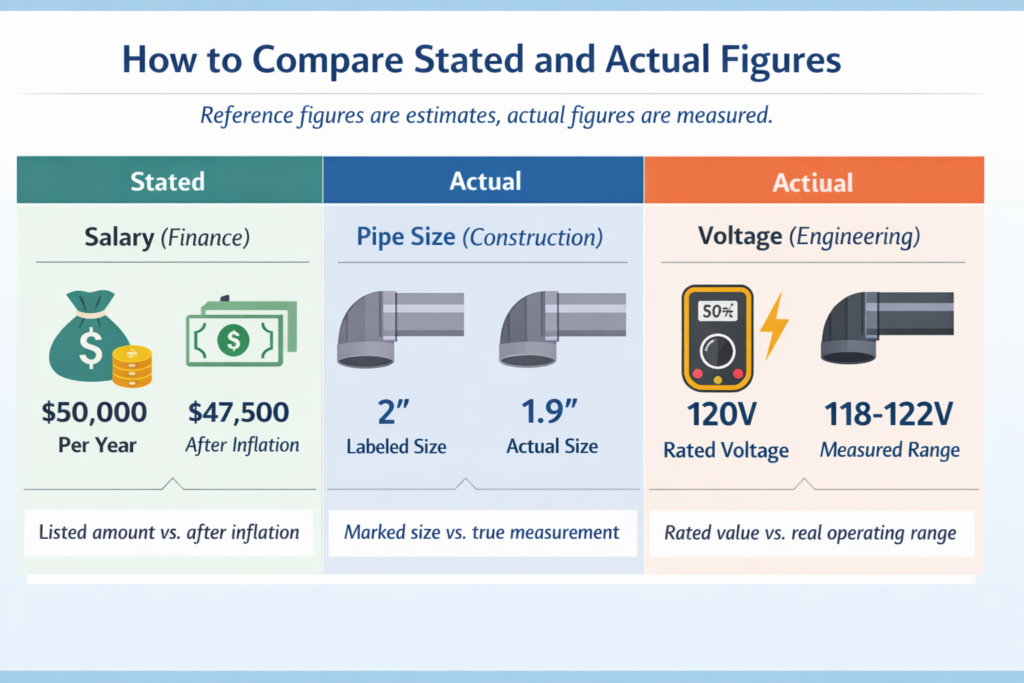
Comparing labeled or reference numbers to real measurements ensures accurate decisions:
- Salaries may appear higher on paper, but inflation reduces actual value.
- Pipes labeled 2 inches may measure slightly smaller.
- Devices rated for a voltage may operate within a safe range.
Simple comparisons help prevent costly mistakes in finance, engineering, and daily tasks.
Common Misunderstandings and Mistakes
People often assume labeled or reference numbers are exact:
- A 2×4 piece of lumber rarely measures exactly 2 by 4 inches.
- Ignoring inflation can overstate income.
- Overestimating symbolic fees or minor delays creates misjudgments.
Knowing these mistakes helps you plan better and understand numbers correctly in work and daily life
FAQs
1. What does this concept mean in finance?
It describes stated or unadjusted values like GDP, interest rates, or income.
2. What is a stated value?
A reference number or labeled measurement, such as bond face value or pipe size.
3. Is it always minimal?
Not always; it can be symbolic or stated rather than truly small.
4. How is it used in grammar?
Refers to noun-like structures: nominal phrases, clauses, and nominalization.
5. How does it differ from real?
Reference values are stated or symbolic; real values are actual or adjusted.
Conclusion:
This idea shows values that are just stated or symbolic. Real values show the true or actual amount. Knowing the difference helps in money, building, grammar, data, and everyday life. Always check whether a value is symbolic or reflects the true figure to make informed and accurate decisions.
Examples Across Fields:
- Finance: GDP, interest rates, income, product prices.
- Engineering: Pipe size, voltage, dimensions, battery capacity, motor power.
- Grammar: Phrases, clauses, nominalization.
- Statistics/Data: Categories without ranking.
- Everyday Life: Small fees, delays, official titles, approximate measurements.
Click here to read about : what does payee mean

Hi, I’m Geoffrey Chaucer. I explore the stories and meanings behind words, turning ideas into clear, insightful writing. Through every article I craft, I aim to spark curiosity, share knowledge, and help readers uncover practical, meaningful truths in everyday life.