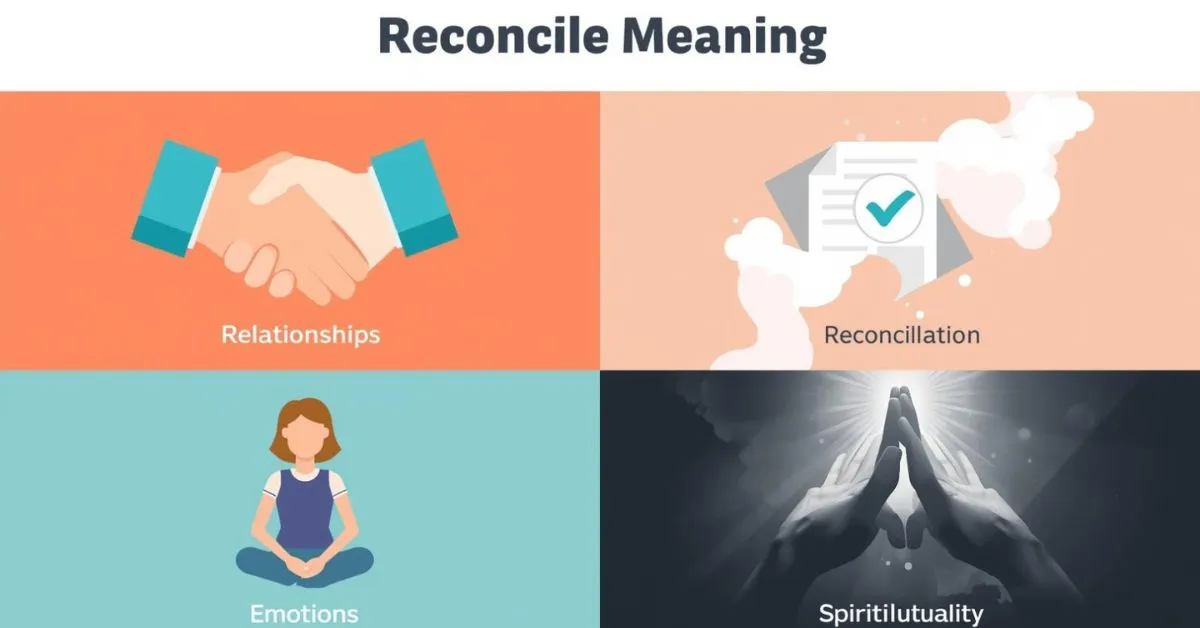
Have you ever come across the word “reconcile” and wondered what it really means? It’s a term used in many areas of life, from relationships and finances to emotions and spirituality. At its core, it refers to bringing things into agreement, restoring balance, or accepting difficult situations.
For instance, friends might make up after a disagreement, showing forgiveness and repaired trust. Businesses often match their financial records to ensure everything adds up correctly. On a personal level, someone might come to terms with past mistakes to find peace of mind.
This guide will explain the concept in simple terms, show practical examples, highlight different uses. And offer strategies for resolving conflicts, managing finances, and finding personal or spiritual balance.
Simple Definition of Reconcile
At its core, reconcile meaning is to restore harmony, settle differences, or adjust for agreement.
Dictionary definition:
“To restore friendly relations or make two things agree.”
Simple words:
- Patch things up after a disagreement
- Settle differences
- Match financial records
- Accept a difficult reality
Reconcile in a sentence:
- “They reconciled after the argument.”
- “She reconciled her bank statement with her ledger.”
- “He reconciled himself to the news.”
Reconcile pronunciation: /ˈrɛkənsaɪl/
Verb forms: reconcile, reconciled, reconciling
Etymology: Latin reconciliare, meaning “to bring together again.”
Core Meanings of Reconcile
1. Reconcile in Relationships
In relationships, reconcile is all about conflict resolution and forgiveness. It helps restore trust and make peace between people.
Examples:
- “They reconciled after months of silence.”
- “She reconciled with her brother to patch things up.”
Related entities: restore relationship, settle differences, forgiveness, conflict resolution.
Using reconciliation in relationships promotes emotional healing and strengthens bonds. People who reconcile effectively often experience inner peace and improved mental adjustment.
2. Reconcile in Accounting / Finance
In finance, this term means checking records to make sure they are correct. Companies compare bank statements, ledgers, and balance sheets to see if the numbers match. If something is missing or wrong, they fix it.
For example:
- “The accountant checked the company’s ledger to make sure the books were balanced.”
- “She reviewed all transactions at the end of the month to confirm the totals were correct.”
This process includes comparing entries line by line, reviewing reports, and adjusting mistakes. It is a key part of the accounting process.
When businesses review their financial records regularly, they can spot errors early. As a result, reports stay accurate and reliable. In addition, careful record checking builds trust and keeps finances organized.
3. Emotional or Personal Reconciliation
Reconciliation also happens internally. To reconcile with oneself means acceptance of past events or mistakes. This helps in emotional healing and the coping process.

Examples:
- “He reconciled himself to the loss of his pet.”
- “She is reconciling with past decisions to find inner peace.”
Related entities: acceptance, mental adjustment, inner peace, coping process.
By practicing emotional reconciliation, people develop resilience, reduce stress, and experience a sense of calm.
4. Religious / Biblical Reconciliation
In Christianity, reconcile has a spiritual dimension. It refers to reconciliation with God through forgiveness in Christianity, atonement, and biblical reconciliation.
Examples:
- “Believers seek to reconcile with God through prayer and repentance.”
- “Biblical reconciliation teaches spiritual restoration and forgiveness.”
Related entities: Reconciliation with God, spiritual restoration, atonement, biblical reconciliation.
Spiritual reconciliation encourages people to restore relationships with others and fosters inner peace.
Synonyms of Reconcile
Different situations require different words. Reconcile synonyms include:
- Settle – disputes or accounts
- Resolve – solve a problem
- Harmonize – align ideas
- Mend – relationships or emotions
- Adjust – fit or match records
- Restore – return to balance
- Come to terms – accept reality
Examples:
- “They mended their friendship after years of conflict.”
- “She adjusted the ledger to reconcile accounts.”
- “He came to terms with past mistakes.”
Reconcile vs Resolve – What’s the Difference?
| Aspect | Reconcile | Resolve |
|---|---|---|
| Focus | Restore harmony or agreement | Solve a problem |
| Usage | Relationships, emotions, accounting, religion | Problems, disputes, conflicts |
| Process | May require acceptance or forgiveness | Requires action or decision |
| Example | “They reconciled after the argument.” | “They resolved the billing mistake.” |
Remember: Resolve focuses on solutions; reconcile focuses on restoring harmony.
How to Use Reconcile in a Sentence
Relationships:
- “They reconciled after a long argument.”
- “She reconciled with her old friend to restore their relationship.”
Accounting:
- “Reconcile your bank statement with your ledger to prevent errors.”
- “The finance team reconciled accounts during the month-end process.”
Emotional / Personal:
- “He reconciled himself to the change in his plans.”
- “She reconciled past mistakes to achieve inner peace.”
Religious / Spiritual:
- “Reconciliation with God is a key part of spiritual restoration.”
- “The congregation reconciled through prayer and forgiveness.”
Common Phrases Using Reconcile
- Reconcile differences – restore agreement
- Reconcile accounts – match financial records
- Reconcile with someone – repair relationships
- Reconcile oneself to – accept reality
- Reconcile the past – find emotional peace
Examples:
- “They worked hard to reconcile differences in the team.”
- “She reconciled her bank accounts before taxes.”
- “He reconciled himself to the news.”
The Importance of Reconciliation in the Workplace
Reconciliation in the workplace ensures conflict resolution, financial accuracy, and strong relationships.
Examples:
- Employees reconcile after disputes to maintain teamwork.
- Companies reconcile financial records to prevent errors.
Benefits:
- Builds trust among coworkers
- Reduces misunderstandings
- Improves productivity
Reconciliation Strategies for Relationships
- Communicate openly – express feelings honestly
- Apologize sincerely – take responsibility
- Listen actively – understand the other’s perspective
- Forgive genuinely – release resentment
- Rebuild trust gradually – consistent positive actions
Outcome: Stronger relationships and emotional healing
Step-by-Step Guide to Reconcile Accounts
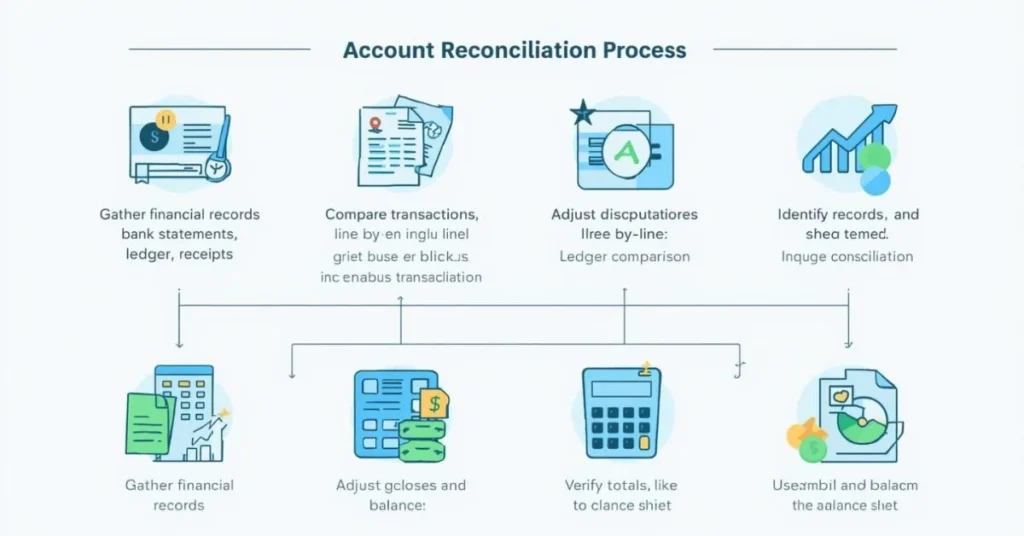
- Gather financial records, ledger, and bank statements
- Compare transactions line by line (ledger comparison)
- Identify discrepancies
- Adjust records to match (account reconciliation)
- Verify totals and balance the balance sheet
Tip: Regular reconciliation avoids errors and ensures financial stability.
Psychological Benefits of Reconciliation
- Reduces stress – resolving conflicts eases tension
- Promotes emotional healing – achieve inner peace
- Improves relationships – restore connections
- Encourages personal growth – learn from past mistakes
Reconciliation supports both mental and emotional health.
Common Mistakes When Using Reconcile
- Confusing reconcile with resolve
- Ignoring context – relationships, finance, or emotion
- Overusing the word – use reconcile synonym instead
- Skipping forgiveness in personal reconciliation
- Neglecting regular bank reconciliation in finance
Real-Life Examples of Reconciliation
Seeing reconcile meaning in action makes it easier to understand. Here are real-life examples across relationships, finance, emotions, and spirituality:
| Context | Example | Key Benefit |
|---|---|---|
| Relationship | “After years apart, the siblings reconciled.” | Restores trust and harmony |
| Accounting | “The accountant reconciled the ledger with the bank statement.” | Prevents financial errors |
| Emotional | “She reconciled herself to the loss of her pet.” | Promotes inner peace and acceptance |
| Spiritual | “The congregation reconciled with God through prayer.” | Encourages spiritual restoration |
Quote: “Reconciliation is not just about fixing mistakes; it is about restoring peace and building stronger bonds.” – Anonymous
These examples show that reconciliation is versatile and meaningful in all areas of life.
Tips to Practice Reconciliation Daily
Reconciliation is a skill you can develop. Practicing it daily helps in relationships, finance, and personal growth.
Tips for Daily Reconciliation:
- Reflect regularly – Check your emotions and past mistakes.
- Communicate proactively – Talk openly to settle minor conflicts.
- Keep records accurate – Reconcile financial transactions frequently.
- Forgive often – Let go of grudges and resentment.
- Seek spiritual balance – Pray, meditate, or journal to reconcile with life events.
Eye-catching table:
| Area | Daily Practice | Outcome |
|---|---|---|
| Relationships | Apologize or say thank you | Stronger bonds |
| Finance | Reconcile accounts | Accurate financial records |
| Emotions | Journal feelings | Mental adjustment & inner peace |
| Spiritual | Pray or meditate | Spiritual restoration & calm |
Frequently Asked Questions (FAQ)
Q1: What does reconcile mean in simple words?
A: Reconcile means to restore harmony, make things agree, or accept something difficult.
Q2: What does reconcile mean in accounting?
A: It means comparing financial records like ledger and bank statements to ensure they match.
Q3: Can reconcile mean forgive?
A: Yes, in relationships, it includes forgiveness and restoring the relationship.
Q4: Is reconcile the same as resolve?
A: No. Resolve solves a problem; reconcile restores harmony.
Q5: What is reconciliation in the Bible?
A: It is reconciliation with God through forgiveness, spiritual restoration, and atonement.
Q6: How do you reconcile bank statements?
A: Compare transactions, identify differences, adjust records, and ensure accuracy.
Summary
Reconcile is more than a word it is an action. It means restoring harmony, making things agree, or accepting difficult events. It applies to relationships, financial records, emotions, and spiritual life.
By learning what reconcile means, you can fix problems. You can use simple examples to understand it better. You can practice solving fights in a calm way and you can use easy steps to make peace.
Read Also About : What Does a QR Code Mean? Full, Easy-to-Understand Guide

Hi, I’m Geoffrey Chaucer. I explore the stories and meanings behind words, turning ideas into clear, insightful writing. Through every article I craft, I aim to spark curiosity, share knowledge, and help readers uncover practical, meaningful truths in everyday life.