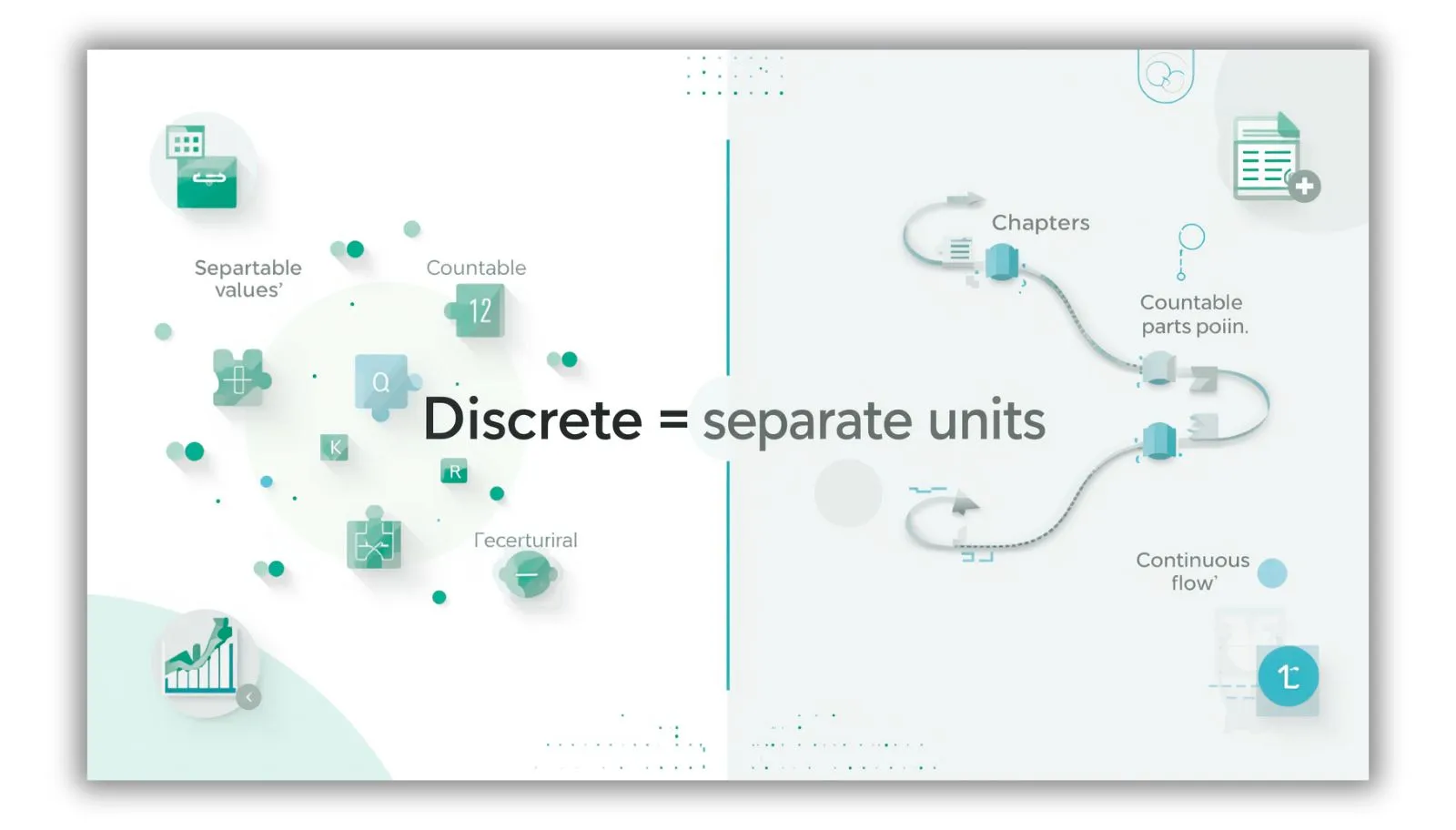
Discrete means separate, distinct, or individually identifiable. People use the word when they want to describe something as its own unit rather than part of one continuous whole. For example, chapters in a book, buttons on a keyboard, and countable survey answers all show the idea clearly.
Quick Answer: Discrete at a Glance
| Item | Answer |
|---|---|
| Word | Discrete |
| Part of speech | Adjective |
| Pronunciation | di-SKREET |
| Simple meaning | Separate, distinct, or individual |
| Example sentence | The report has three separate sections. |
| Opposite | Continuous |
| Common mix-up | Discreet, which means careful or private |
A simple way to remember the difference:
Discrete = separate.
Discreet = careful or private.
Although the two words sound the same, they do not share the same meaning.
What Does Discrete Mean in Simple Terms?
In simple terms, discrete describes things that you can separate, count, name, or identify one by one.
For instance, a book may have chapters. Each chapter belongs to the same book, yet each one has its own beginning, ending, and purpose. That makes the chapters separate parts of a larger whole.
The same idea applies to many everyday examples:
- A keyboard has individual keys.
- A survey has separate answer choices.
- A task list has individual steps.
- A course has separate modules.
- A data set may contain countable values.
So, instead of thinking of the word as complicated, think of it as a more precise way to say separate or distinct.
How to Pronounce Discrete
Pronounce discrete as:
di-SKREET
It sounds exactly like discreet, which explains why many people mix them up. However, pronunciation does not make the meanings interchangeable.
Use discrete for separation.
Use discreet for privacy, tact, or subtle behavior.
Discrete vs. Discreet: What’s the Difference?
The most common mistake involves confusing discrete with discreet.
| Word | Meaning | Correct Example |
|---|---|---|
| Discrete | Separate, distinct, individual | The project has three separate phases. |
| Discreet | Careful, tactful, private, subtle | Please be careful and private about the surprise. |
Here is the easiest rule:
Use discrete when you mean separate.
Use discreet when you mean careful, private, or tactful.
Correct vs. Incorrect Examples
| Incorrect | Correct | Why |
|---|---|---|
| Please be discrete about the news. | Please be discreet about the news. | The sentence means private or tactful. |
| The data is discreet. | The data is discrete. | The sentence means separate or countable. |
| The course has five discreet modules. | The course has five discrete modules. | The sentence means separate modules. |
Memory Trick
Look at the spelling of discrete. The two “e” letters sit apart from each other.
That small visual clue can help you remember that the word relates to separation.
Examples of Discrete in a Sentence
Examples make the meaning easier to understand. Below are several natural ways to use the word in everyday, academic, and technical contexts.
Everyday Examples
- The book has ten separate chapters.
- Each drawer holds a different category of supplies.
- The job breaks down into several individual tasks.
- The playlist groups songs into separate moods.
- The museum display presents history in clear time periods.
School and Writing Examples
- The essay presents three distinct arguments.
- The teacher explains the topic step by step.
- Each lesson focuses on one specific skill.
- The paragraph should make one clear point before moving on.
- The course separates the material into learning modules.
Math and Data Examples
- The data set contains countable values.
- The number of students in a class uses separate whole numbers.
- Survey answers such as “yes” and “no” create clear categories.
- A graph may show individual points rather than a smooth line.
- Whole numbers often help explain this idea in math.
Technology Examples
- A digital signal uses separate values.
- Software stores information in individual fields.
- A system may complete several separate operations.
- Some computers use a separate graphics card.
- Surround sound may use individual audio channels.
Discrete vs. Continuous
People often compare discrete with continuous, especially in math, statistics, science, and data analysis.
Separate values come in individual units. Continuous values, by contrast, flow across a range.
| Feature | Discrete | Continuous |
|---|---|---|
| Basic idea | Individual units or values | Smooth range or flow |
| Usually found by | Counting | Measuring |
| Example | Number of students | Student height |
| Values | Separate points | Any value within a range |
| Simple image | Dots | A line |
For example, the number of pets in a home uses whole counts: 0, 1, 2, or 3. You would not normally say a home has 2.5 pets.
A pet’s weight works differently. Since weight can include decimals, it falls along a range.
As a beginner-friendly rule:
You often count separate values and measure continuous ones.
Still, context matters. In some technical situations, the way someone records or models the information can change how they classify it.
Discrete in Different Contexts
The same core idea appears in many fields. However, each field applies it in a slightly different way.
| Context | Meaning in That Context | Example |
|---|---|---|
| Everyday English | Separate or distinct | separate sections of a report |
| Writing | Clearly separated ideas | distinct points in an essay |
| Math | Countable values or structures | integers or graph nodes |
| Statistics | Counted values or categories | number of customers |
| Data analysis | Individual data points or choices | survey response options |
| Technology | Defined units, states, or components | digital values or data fields |
| Audio | Separate sound channels | surround sound channels |
| Medicine | Separate visible findings | distinct lesions |
| Business | Separate groups, tasks, or stages | customer segments |
Across these examples, the central idea stays the same: something stands apart clearly enough to identify, count, or discuss on its own.
What Does the Word Mean in Math?
In math, the term usually describes values, objects, or structures that exist separately instead of flowing across a smooth range.
Common examples include:
- Whole numbers
- Integers
- Sets
- Graph nodes
- Countable objects
- True / false values
- Separate steps in a process
For instance, when you count chairs in a room, you use whole numbers. You can count 12 chairs or 13 chairs, but not 12.6 chairs in a normal count.
That is why discrete mathematics often focuses on countable structures such as sets, logic, graphs, combinations, networks, and algorithms.
What Does It Mean in Data and Statistics?
In data and statistics, the term often describes values that you count rather than measure.
Examples include:
- Number of students
- Number of website visits
- Number of sales
- Number of support tickets
- Number of spelling errors
- Survey answers such as yes, no, or maybe
- Product ratings such as 1, 2, 3, 4, or 5 stars
Data Example
Imagine a coffee shop tracks how many drinks it sells each day.
| Day | Drinks Sold |
|---|---|
| Monday | 84 |
| Tuesday | 91 |
| Wednesday | 77 |
Each drink counts as one item. Therefore, the daily totals use separate countable values.
Now compare that with drink temperature. Since temperature can move smoothly across a range and include decimals, it works as a continuous measurement.
What Does It Mean in Technology?
In technology, the term often points to separate units, states, components, or values.
For example:
- Digital values
- Binary states
- Data blocks
- Software fields
- Separate hardware components
- Individual audio channels
- Distinct system operations
A digital button may have two states: on or off. Because those states are clearly separate, they fit the idea well.
Similarly, a separate graphics card handles graphics processing apart from the main processor. Audio systems may also use individual channels for different speakers.
In short, technology often uses this concept when a system handles information or components as defined units.
Everyday Meaning
In everyday language, the word usually means separate or clearly distinct.
You might use it when talking about:
- separate tasks
- separate rooms
- separate choices
- separate stages
- separate groups
- separate parts of a larger plan
For example:
“The project has five separate steps.”
A more formal version would be:
“The project has five discrete steps.”
Both sentences work. However, the second one sounds more precise and professional.
When Should You Use This Word?
Use it when separation matters.
It works well with words like:
- sections
- tasks
- categories
- values
- stages
- units
- components
- choices
- points
- phases
For casual writing, separate often works better. For academic, technical, or professional writing, discrete may give the sentence more precision.
Compare:
Clear and casual:
“The guide has separate sections.”
More formal:
“The guide has discrete sections.”
Choose the simpler word when precision does not matter. Choose the more technical word when you need to emphasize clear boundaries between parts.
When Not to Use It
Avoid this word when you mean:
- private
- tactful
- careful
- subtle
- quiet
- secret
- unobtrusive
In those cases, choose discreet.
Examples:
- She gave him a discreet warning.
- Please stay discreet about the private matter.
- The hotel offers discreet service for public figures.
In each sentence, the meaning relates to tact or privacy, not separation.
Synonyms
Useful synonyms include:
- separate
- distinct
- individual
- specific
- particular
- detached
- independent
- unconnected
- isolated
- separately identifiable
The best choice depends on the sentence. In most everyday writing, separate will sound the clearest.
For formal or technical writing, distinct, individual, or separately identifiable may fit better.
Antonyms
Common opposites include:
- continuous
- connected
- merged
- blended
- combined
- unified
- integrated
- uninterrupted
- indistinct
For example, separate values stand apart from each other. Continuous values, meanwhile, flow across a range.
Word Origin: Why the Confusion Happens
The confusion between discrete and discreet makes sense because the words sound alike and share related historical roots.
Modern English, however, separates the meanings clearly.
Use one spelling for separation. Use the other for careful or private behavior.
That distinction matters most in professional writing, where choosing the wrong word can change the meaning of a sentence.
Common Mistakes
Mistake 1: Using the Wrong Spelling
Incorrect:
“She was discrete about the private conversation.”
Correct:
“She was discreet about the private conversation.”
The sentence describes careful behavior, so discreet fits.
Mistake 2: Assuming Separate Means Unrelated
Separate parts can still work together.
Chapters form a book. Steps form a process. Data points form a set. So, while each part stands apart, the parts can still connect within a larger system.
Mistake 3: Treating the Word as a Synonym for Unimportant
The word does not mean small, minor, or irrelevant.
A company may have separate revenue streams, and each one may matter a great deal.
Mistake 4: Using a Formal Word When a Simple One Works
Sometimes plain language wins.
Instead of writing:
“Put the snacks into discrete containers.”
Write:
“Put the snacks into separate containers.”
The second sentence sounds more natural for everyday use.
Quick Quiz: Discrete or Discreet?
Choose the right word.
- The course has five ___ modules.
- Please be ___ about the surprise party.
- The graph shows separate data points.
- The assistant handled the private matter in a ___ way.
- Each department has a separate responsibility.
Answers
- Discrete
- Discreet
- Discrete
- Discreet
- Discrete
Remember: separation calls for discrete. Privacy or tact calls for discreet.
How to Know Whether the Word Fits
Ask yourself these questions:
- Can I separate the items?
- Can I count, name, or identify each part?
- Do clear boundaries exist between the parts?
- Would “separate” or “distinct” make sense here?
- Am I talking about units, categories, values, stages, choices, or parts?
When the answer is yes, the word probably fits.
However, when the idea involves privacy or careful behavior, choose discreet instead.
What Most Articles Miss About This Topic
Many explanations stop after saying the word means separate. That answer helps, but it does not fully explain how people actually use the term.
A better way to understand it is:
separately identifiable within a larger whole.
That difference matters.
A chapter stands apart, yet it still belongs to a book. A step has its own role, yet it still belongs to a process. A data point has its own value, yet it still belongs to a data set.
Therefore, the word does not always mean disconnected, unrelated, or isolated. More often, it means clear enough to recognize on its own.
This is why the same term appears in writing, math, statistics, technology, business, science, and medicine. Each field separates different things, but the main idea remains consistent.
In practical terms:
It describes separation that matters for how something gets organized, counted, analyzed, or understood.
FAQs
What does discrete mean in simple words?
It means separate, distinct, or individual. The word describes something you can identify as its own unit.
What is an example?
The number of students in a classroom works as a simple example. You count students as whole individuals, not as a smooth measurement.
Does it mean separate?
Yes. Separate is the simplest synonym. More precisely, the word describes something separate enough to count, identify, or consider on its own.
What is the difference between discrete and discreet?
One means separate or distinct. The other means careful, tactful, private, or subtle.
Example:
- Discrete: The report has three separate sections.
- Discreet: Please handle the announcement carefully and privately.
What does it mean in math?
In math, it usually describes separate or countable values, such as whole numbers, graph nodes, sets, or true / false values.
What does it mean in statistics?
In statistics, it often describes countable values, such as the number of students, sales, clicks, errors, or survey responses.
What is discrete data?
It is data made of separate, countable values. Examples include customer counts, product ratings, number of pets, and yes / no responses.
What is the opposite?
The most common opposite is continuous. Separate values stand apart, while continuous values form a smooth range.
Can separate things still connect?
Yes. Separate parts can belong to one larger system. Chapters, steps, data points, and components can all connect while still remaining individually identifiable.
Is age discrete or continuous?
It depends on how someone records it. Age in whole years often works as a countable value. Exact age in years, months, days, or seconds works more like a continuous measurement.
Is money discrete or continuous?
In everyday use, people usually count money in units such as dollars and cents. Some models may handle it differently depending on precision.
Is time discrete or continuous?
People often experience time as continuous. However, clocks, simulations, videos, and data systems can divide time into fixed intervals.
How do you use it in a sentence?
Example: “The project has several separate phases.”
A more formal version: “The project has several discrete phases.”
Conclusion
Discrete describes something separate, distinct, or individually identifiable.
Use it for units, values, categories, tasks, stages, parts, or choices that stand apart clearly enough to recognize on their own.
Most importantly, do not confuse it with discreet.
Discrete relates to separation.
Discreet relates to privacy or tact.
Once you understand that difference, the word becomes much easier to use correctly in everyday writing, school, data, math, technology, and professional communication.
Click Here To Read About : what does ws mean

Hi, I’m Geoffrey Chaucer. I explore the stories and meanings behind words, turning ideas into clear, insightful writing. Through every article I craft, I aim to spark curiosity, share knowledge, and help readers uncover practical, meaningful truths in everyday life.