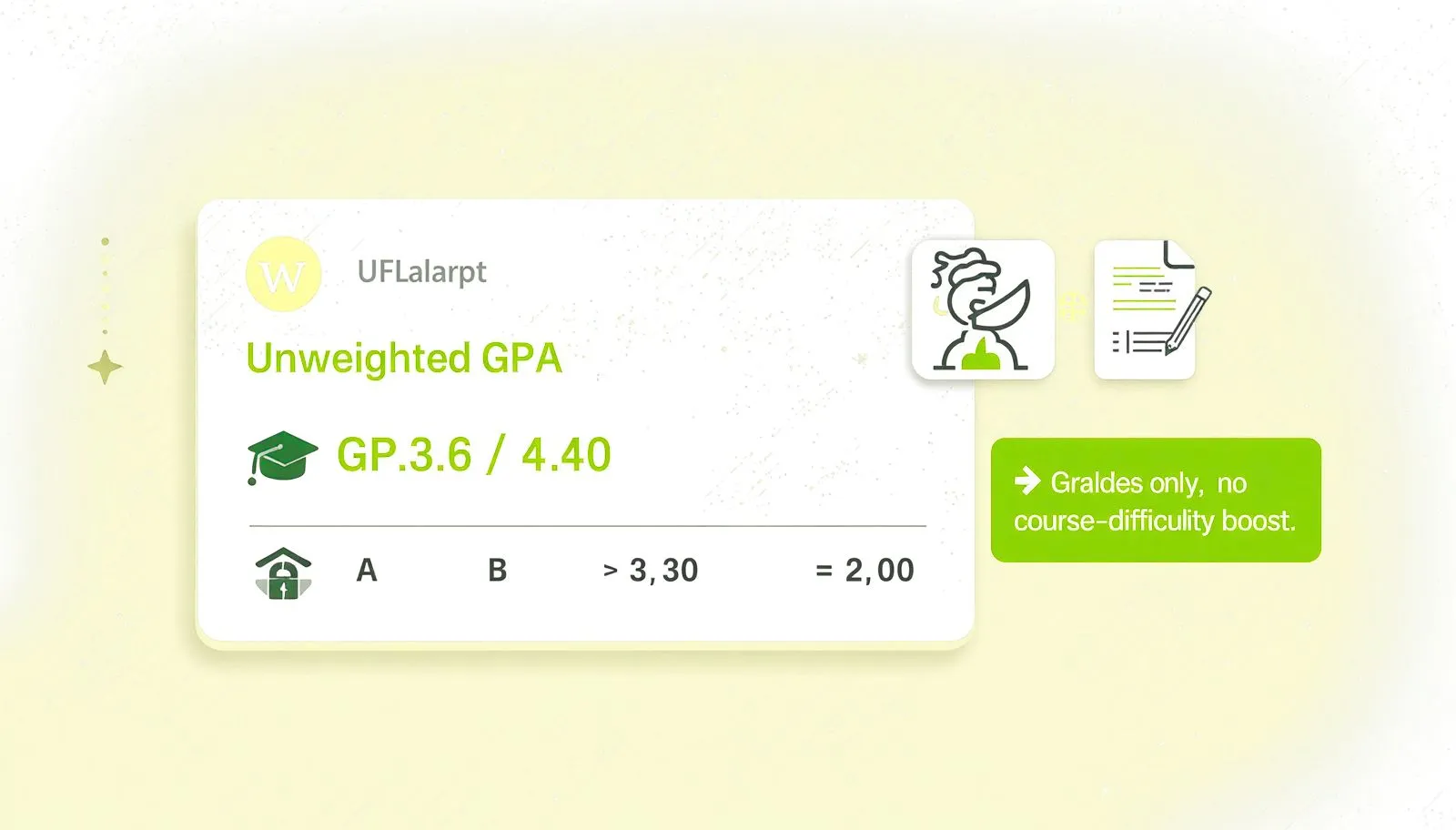
An unweighted GPA is your grade point average without extra points for harder classes such as honors, AP, IB, or dual enrollment. Most schools use a 0.0 to 4.0 scale, where an A equals 4.0, a B equals 3.0, and so on. In simple terms, it shows your grades without adjusting for course difficulty.
You may see this number on a transcript, school portal, scholarship form, or college application. Some schools label it as UW GPA, UGPA, or cumulative unweighted GPA.
At its core, this score answers one question: What grades did you earn?
However, it does not fully answer another important question: How challenging were your classes?
That distinction matters because two students can have the same GPA but very different course schedules.
What Is an Unweighted GPA?
An unweighted GPA converts your class grades into grade points and averages them on a standard scale.
In many U.S. high schools, the highest possible score is 4.0. A student with a 4.0 usually earned A-level grades, although exact grading rules can vary by school.
The word unweighted means your school does not add bonus points for advanced coursework.
For example:
| Class Type | Grade | GPA Value |
|---|---|---|
| Regular English | A | 4.0 |
| Honors English | A | 4.0 |
| AP English | A | 4.0 |
Although AP English may require more work, the grade still counts as 4.0 on this scale.
What Does It Mean on a Transcript?
On a transcript, this number shows your grade average without course-difficulty bonuses.
You might see labels like these:
| Transcript Label | Meaning |
|---|---|
| UW GPA | Unweighted grade point average |
| UGPA | Another abbreviation for unweighted grade point average |
| W GPA | Weighted grade point average |
| Cum GPA | Cumulative grade point average |
| Cumulative UW GPA | Overall GPA without extra points for advanced classes |
| GPA Scale | The maximum scale used, such as 4.0 or 5.0 |
If your transcript lists both weighted and unweighted numbers, the unweighted one usually appears on a 4.0 scale.
However, not every transcript looks the same. Therefore, if your school lists only one GPA and does not clearly label it, ask your counselor before entering it on an application.
Standard GPA Scale: Letter Grades, Percentages, and Points
Many schools use a scale similar to this:
| Letter Grade | Common Percentage Range | GPA Value |
|---|---|---|
| A+ | 97–100 | 4.0 |
| A | 93–96 | 4.0 |
| A- | 90–92 | 3.7 |
| B+ | 87–89 | 3.3 |
| B | 83–86 | 3.0 |
| B- | 80–82 | 2.7 |
| C+ | 77–79 | 2.3 |
| C | 73–76 | 2.0 |
| C- | 70–72 | 1.7 |
| D+ | 67–69 | 1.3 |
| D | 63–66 | 1.0 |
| D- | 60–62 | 0.7 |
| F | Below 60 | 0.0 |
Still, this chart serves as a general guide. Your school may use different percentage ranges, plus/minus rules, or grading policies.
Some schools also skip pluses and minuses. In that case, an A may count as 4.0, a B as 3.0, a C as 2.0, and so on.
How to Calculate This GPA
To calculate it, convert each class grade into grade points. Then, add those points and divide by the number of classes.
Simple Example
Suppose a student earns these grades:
| Class | Grade | Points |
|---|---|---|
| English | A | 4.0 |
| Algebra | B | 3.0 |
| Biology | A | 4.0 |
| World History | B | 3.0 |
| Spanish | A | 4.0 |
First, add the points:
4.0 + 3.0 + 4.0 + 3.0 + 4.0 = 18.0
Next, divide by the number of classes:
18.0 ÷ 5 = 3.6
So, the student’s GPA is 3.6.
For a quicker estimate, use your school’s official grading scale or an internal GPA calculator.
How Credit Hours Can Change the Calculation
Some schools do not treat every class equally. Instead, they calculate GPA by credit hours.
For example, a full-year class may count more than a one-semester elective.
The basic formula looks like this:
Grade points × course credits = quality points
Then:
Total quality points ÷ total credits = GPA
Example:
| Class | Grade | Grade Points | Credits | Quality Points |
|---|---|---|---|---|
| English | A | 4.0 | 1.0 | 4.0 |
| Biology | B | 3.0 | 1.0 | 3.0 |
| Art | A | 4.0 | 0.5 | 2.0 |
| Spanish | B | 3.0 | 0.5 | 1.5 |
Total quality points: 10.5
Total credits: 3.0
Final GPA: 10.5 ÷ 3.0 = 3.5
As a result, your quick hand calculation may not perfectly match your transcript.
Weighted vs. Unweighted GPA: What’s the Difference?
The main difference comes down to course difficulty.
| GPA Type | What It Measures | Common Scale | Adds Bonus Points? |
|---|---|---|---|
| Unweighted | Grades only | Usually 0.0–4.0 | No |
| Weighted | Grades plus course difficulty | Often 0.0–5.0 or higher | Yes |
A weighted system may give extra points for AP, IB, honors, or dual enrollment classes.
For instance, an A in a regular class may equal 4.0. Meanwhile, an A in an AP class may equal 5.0 on a weighted scale.
On the standard 4.0 scale, though, both grades may count as 4.0.
Same Student, Two GPA Results
The same grades can produce different results depending on the system.
| Class | Grade | Course Level | Standard Value | Possible Weighted Value |
|---|---|---|---|---|
| English | A | Regular | 4.0 | 4.0 |
| Chemistry | B | Honors | 3.0 | 4.0 |
| U.S. History | A | AP | 4.0 | 5.0 |
| Algebra II | B | Regular | 3.0 | 3.0 |
| Spanish | A | Honors | 4.0 | 5.0 |
Standard calculation:
4.0 + 3.0 + 4.0 + 3.0 + 4.0 = 18.0
18.0 ÷ 5 = 3.6
Possible weighted calculation:
4.0 + 4.0 + 5.0 + 3.0 + 5.0 = 21.0
21.0 ÷ 5 = 4.2
Same student. Same grades. Different GPA systems.
Therefore, a weighted GPA can rise above 4.0, while the standard version usually cannot.
Do AP, IB, Honors, or Dual Enrollment Classes Count?
Yes, those classes count. However, they count as regular grades in this calculation.
For example:
| Class | Grade | Standard GPA Value |
|---|---|---|
| Regular Biology | A | 4.0 |
| Honors Biology | A | 4.0 |
| AP Biology | A | 4.0 |
| IB Biology | A | 4.0 |
The advanced class still appears on your transcript. Colleges and scholarship programs can still see the course level.
Even so, the GPA number itself does not increase just because the class was harder.
Can This GPA Go Above 4.0?
Usually, no.
On the standard 4.0 scale, 4.0 is normally the highest possible score.
If you see numbers such as:
- 4.2
- 4.5
- 4.8
- 5.0
you are probably looking at a weighted GPA.
That said, schools sometimes use different grading systems. Because of that, always check the scale listed on your transcript.
What Is a Good GPA on This Scale?
A “good” GPA depends on your goals, school, grade level, and course schedule.
Still, this general guide can help:
| GPA Range | General Meaning |
|---|---|
| 4.0 | Mostly or all A-level grades |
| 3.7–3.9 | Very strong performance |
| 3.3–3.6 | Strong grades with some variation |
| 3.0–3.2 | Around a B average |
| 2.5–2.9 | Mixed grades; improvement may help for selective goals |
| Below 2.5 | More academic challenges; a support plan may help |
These ranges are not admissions rules. Instead, they offer a broad way to interpret the number.
For example, a 3.6 with several AP, IB, honors, or dual enrollment courses may tell a different story than a 3.6 with mostly regular classes.
For deeper context, link to: what is a good GPA for college?
Which GPA Do Colleges Look At?
Many colleges review both weighted and unweighted numbers. More importantly, they usually read the full transcript.
Admissions teams may consider:
- Overall GPA
- Course rigor
- Grades in core academic subjects
- Grade trends
- Senior-year schedule
- School profile
- Class rank, if available
- Available courses at your school
- Application context
In some cases, colleges recalculate GPA using their own method. Because schools use different systems, admissions offices often look beyond the number printed on the transcript.
The practical takeaway is simple: your GPA matters, but your transcript gives the bigger picture.
Which GPA Should You Put on Applications?
Use the GPA type the application requests.
Do not enter a weighted number when a form asks for an unweighted one. Also, avoid converting your GPA unless the instructions tell you to.
| If the Application Asks For… | What to Enter |
|---|---|
| Unweighted GPA | Your official GPA without bonus points |
| Weighted GPA | Your official GPA with course-difficulty points |
| Cumulative GPA | Your overall GPA across included terms |
| Cumulative unweighted GPA | Your overall GPA without advanced-course bonuses |
| GPA scale | Usually 4.0 for the standard scale, unless your school says otherwise |
| Academic GPA | Check whether your school counts only core academic courses |
| Current GPA | Your most recent official number |
| Transcript GPA | The number shown on your transcript |
When the form feels unclear, check your transcript notes or ask your counselor.
Should You Round Your GPA?
Be careful with rounding.
If your transcript says 3.67, do not enter 3.8 unless the application clearly allows that format.
A safer approach looks like this:
| Transcript Shows | Usually Safe to Enter |
|---|---|
| 3.67 | 3.67 |
| 3.6 | 3.6 |
| 3.999 | 3.999, or 4.0 only if instructions allow |
| 3.75 | 3.75 |
In most cases, matching your transcript exactly creates the least confusion.
Why Your School’s GPA May Look Different
Schools do not all calculate GPA the same way. Several policies can affect the final number.
Plus/Minus Grading
Some schools count an A- as 3.7 and a B+ as 3.3. Others count every A as 4.0 and every B as 3.0.
Credit Hours
A full-year class may carry more weight than a semester elective.
Repeated Courses
One school may replace the old grade. Another may average both attempts. A third may show both grades on the transcript.
Pass/Fail Classes
Pass/fail courses often work differently from letter-graded classes. Their effect depends on school policy.
Core Classes vs. All Classes
Some GPAs include every graded course. Others focus on academic subjects such as English, math, science, social studies, and world language.
Transfer Credits
If you changed schools, your transcript may convert old grades into a new system.
For that reason, your official transcript remains the best source for your exact GPA.
Common Mistakes Students Make
Reporting the Wrong GPA Type
A form may ask for a standard 4.0-scale GPA, but a student may accidentally enter a weighted 4.4. That creates confusion and may require correction.
Assuming GPA Shows Course Difficulty
This number shows grades, not rigor. Your transcript shows whether your classes were regular, honors, AP, IB, or dual enrollment.
Believing Every School Uses the Same Scale
Many schools use similar systems, yet details can vary. Plus/minus grading, credits, and repeated-course rules can all change the result.
Converting Without Instructions
Some students convert their GPA because they think applications expect a certain format. Instead, follow the application instructions and use the official transcript when possible.
Ignoring Grade Trends
A cumulative number can hide improvement. For instance, a student who struggled freshman year but improved later may have a stronger academic trend than the final GPA suggests.
What Most Articles Miss About This Topic
Most articles explain the basic definition, but they often miss the deeper issue.
This GPA is useful because it separates grades from course difficulty. At the same time, that simplicity creates a limitation.
It answers:
“What grades did you earn?”
However, it does not fully answer:
- How hard were your classes?
- Did your school offer AP, IB, honors, or dual enrollment?
- Did your grades improve over time?
- Did you challenge yourself in core subjects?
- Did your school use unusual GPA rules?
- Did your GPA include electives, repeated courses, or transfer credits?
Consider this example:
| Student | GPA | Course Schedule |
|---|---|---|
| Student A | 3.8 | Mostly regular classes |
| Student B | 3.8 | Several AP, IB, and honors classes |
The number matches. The academic context does not.
Therefore, students should not treat GPA as a complete judgment of academic strength. It works best as one useful measure within a larger transcript review.
Quick Summary
An unweighted GPA shows your grade average without extra points for harder classes.
Here are the key takeaways:
- It usually uses a 4.0 scale
- It measures grades only
- It does not add points for AP, IB, honors, or dual enrollment
- It usually cannot go above 4.0
- It may appear as UW GPA or cumulative unweighted GPA
- Colleges may review it with weighted GPA, course rigor, grade trends, and transcript context
- Applications should use the exact GPA type requested
If you feel unsure, check your official transcript or ask your school counselor.
FAQs
What does unweighted GPA mean?
It means your grade point average does not include extra points for harder classes. Most schools use a 4.0 scale for this number.
What does UW GPA mean?
UW GPA usually means unweighted grade point average. It shows your GPA without course-difficulty bonuses.
What does cumulative unweighted GPA mean?
It means your overall GPA across multiple semesters or years, calculated without extra points for advanced courses.
Is this GPA always out of 4.0?
Usually, yes. Most U.S. high schools use a 0.0 to 4.0 scale, although school policies can vary.
Can it go above 4.0?
Usually, no. Numbers above 4.0 typically come from weighted systems.
Is a 4.0 good?
Yes. A 4.0 generally means A-level grades. However, course rigor and transcript context still matter.
Is a 3.5 good?
A 3.5 generally shows strong grades, often mostly A’s and B’s. Its strength depends on your goals, course difficulty, and school context.
Do AP classes count?
Yes. AP grades count, but they do not receive extra points on the standard 4.0 scale.
What is the difference between weighted and unweighted GPA?
One measures grades only. The other adds extra value for advanced classes, which can raise the number above 4.0.
Do colleges look at both?
Many colleges review both numbers and then study the transcript for course rigor, grade trends, and school context.
What if my school only reports weighted GPA?
Check your transcript notes or ask your counselor. Some applications let you report the GPA exactly as your school provides it.
Should I round my GPA?
Only round if the application allows it. Otherwise, enter the number as it appears on your transcript.
Do electives count?
That depends on your school. Some include all graded classes, while others calculate certain GPAs using only academic courses.
Do pass/fail classes affect GPA?
Often, pass/fail classes do not affect GPA in the same way letter grades do. Still, your school’s policy decides the final treatment.
Conclusion
An unweighted GPA gives a clear view of your grades without extra points for harder classes. Because it usually uses a 4.0 scale, it helps students, schools, and application reviewers understand academic performance in a simple format.
Even so, the number does not tell the full story. Course difficulty, grade trends, school policies, and transcript details all add important context.
For the most accurate next step, compare your weighted and standard GPA, review your transcript carefully, and enter the exact GPA type each application requests.
Click Here To Read About : what does tism mean

I am Clara Lexis, a writer driven by clarity, depth, and authenticity. My focus is on transforming ideas into meaningful content that is both informative and engaging. I write with intention to communicate clearly, thoughtfully, and with purpose.