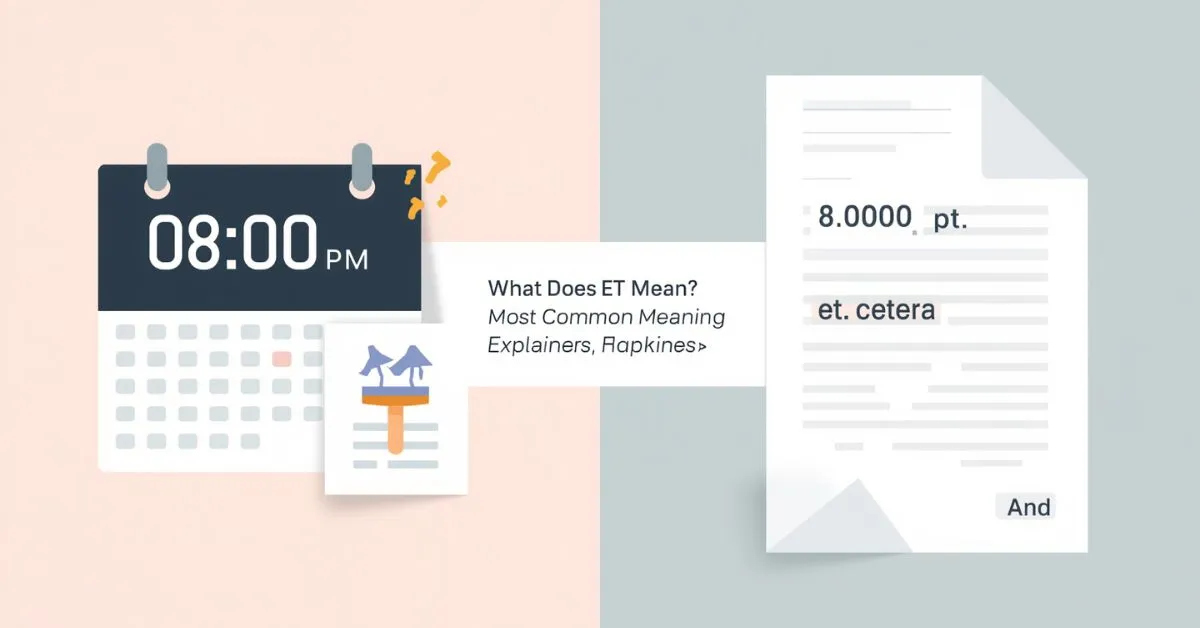
Most often, ET refers to Eastern Time, especially when it appears after a clock time, event listing, TV schedule, or webinar start time. In other settings, et can be the Latin word for “and,” as in et al. The intended meaning depends on where you saw it and how it was used.
If you searched this topic, you probably want a quick answer and an easy way to tell which definition fits. For most readers, the answer has to do with time. However, the same two letters also show up in writing, citations, and a few other contexts, which is why they can feel confusing at first.
This guide starts with the most common use, then moves through the other familiar meanings so you can work out the right one quickly.
The Most Common Use
In everyday situations, this abbreviation usually points to Eastern Time.
You will most often see it in places like:
- TV schedules
- livestream announcements
- online events
- webinar invitations
- sports coverage
- ticketing pages
- press releases
- countdowns for launches or product drops
Examples:
- The game starts at 7:30 p.m. ET
- Join the webinar at 2 p.m. ET
- Results will be posted at 9 a.m. ET
In each of these examples, the label shows that the event follows the time used in the eastern part of North America.
So if you only need the simplest explanation, the short answer is:
It usually refers to Eastern Time.
How It Works in Time Zones
When used in schedules and time-related contexts, the abbreviation stands for Eastern Time.
This is the zone commonly used in the eastern part of the United States and parts of Canada. It is also one of the most frequently referenced time labels in national media, digital scheduling, and event promotion.
Why people use it instead of EST or EDT
This is where many readers get confused.
The shorter form often works as a general name for the eastern time zone. It lets writers avoid choosing between:
- EST = Eastern Standard Time
- EDT = Eastern Daylight Time
That makes it useful for general scheduling, especially when the exact seasonal version is not the main point.
So when a page says:
8 p.m. ET
it usually means:
“Follow the current local time in the Eastern zone”
not necessarily:
“This is always EST”
ET vs EST vs EDT
Here is the simplest way to understand the difference:
| Term | Meaning | When it is used |
|---|---|---|
| ET | Eastern Time | A general label for the Eastern time zone |
| EST | Eastern Standard Time | Used during standard time |
| EDT | Eastern Daylight Time | Used during daylight saving time |
That is why broadcasters, websites, and event organizers often prefer the shorter form. It is cleaner and easier for general audiences to follow.
When It Appears After a Clock Time
If the abbreviation comes directly after a time, it almost always points to Eastern Time.
Examples:
- 6 p.m. ET
- 10:30 a.m. ET
- 1 ET
This is the most important context clue.
If you saw it after a number on a schedule, event page, or announcement, you usually do not need to search for a more complicated explanation.
Where You’ll Usually See It
Most people come across this shorthand in practical, everyday settings rather than in dictionaries.
Common examples include:
TV and streaming schedules
- Watch live at 8 p.m. ET
- New episode airs at 9 ET
Sports coverage
- Kickoff is at 7:00 p.m. ET
- Pregame coverage begins at 6 ET
Webinars and online events
- The training starts at 1 p.m. ET
- Registration closes at noon ET
Product launches and sales
- The sale opens at 10 a.m. ET
- Early access begins at 5 p.m. ET
National news and announcements
- The statement will be released at 4 p.m. ET
If you saw it in any of these situations, it almost certainly refers to a time-zone reference.
Compared With Other U.S. Time Zone Labels
Sometimes readers want more than a simple definition. They also want to see how this eastern label relates to the other major U.S. zones.
Here is a quick-reference version:
| Time Zone | Common Label |
|---|---|
| Eastern Time | ET |
| Central Time | CT |
| Mountain Time | MT |
| Pacific Time | PT |
So if an event says 8 p.m. ET, readers in other U.S. regions often convert from that starting point.
That is one reason this label appears so often in nationwide scheduling.
The Latin Meaning of “et”
Lowercase et is different from uppercase ET.
In Latin, et means “and.”
This is one of the most common non-time uses connected to these letters.
You often see it in formal phrases such as:
- et al.
- et cetera
- older legal or record-style expressions
So if you saw et inside a phrase rather than after a clock time, this Latin meaning may be the correct one.
What does et mean in “et al.”?
This is one of the most common follow-up questions.
et al. means “and others.”
It is often used in:
- academic writing
- research papers
- citations
- reference lists
- article summaries
Example:
“Brown et al. argue that…” means Brown and others argue that…
What does et mean in “et cetera”?
In et cetera, the word et still means “and.”
That phrase is commonly used to mean “and the rest” or “and other similar things.”
This matters because some pages mention et al. but forget that many readers also recognize et from et cetera.
Other Common Uses
Although the time-zone interpretation is the main one for this topic, there are a few other meanings worth knowing.
It can mean extraterrestrial
In sci-fi, movies, or casual conversation, the term can mean extraterrestrial.
Examples:
- That story is about an ET visitor
- Some people use the term when talking about alien life
This meaning is usually easy to spot because the surrounding language refers to aliens, outer space, or science fiction.
It can mean something specialized in a field or workplace
In some industries, the abbreviation may stand for a technical term, internal shorthand, or role title.
This could happen in:
- medicine
- engineering
- education
- company-specific documents
- military or government usage
If you saw it in a technical document, do not assume the public meaning right away. In those cases, the sentence around it matters more than the letters alone.
Rare dictionary-style meanings
Some reference sources also list less common definitions, including highly specialized or shortened forms that ordinary readers rarely need.
For most users, these rare meanings are not the primary answer. The more useful question is still:
- Is this about time?
- Is this part of a Latin phrase?
- Is this about extraterrestrials?
That simple approach solves most real-world cases.
How to Tell What It Means in 5 Seconds
If you are unsure, use this quick method.
| If you saw it here | It most likely means | Example |
|---|---|---|
| After a time | Eastern Time | 8 p.m. ET |
| On a TV or event schedule | Eastern Time | Starts live at 7 ET |
| In a citation | Latin “and” | Smith et al. |
| In a phrase like et cetera | Latin “and” | etc. comes from et cetera |
| In an alien or sci-fi context | Extraterrestrial | ET life |
| In a technical document | A field-specific abbreviation | depends on the industry |
This is the easiest way to interpret it without overthinking it.
The Biggest Confusion: ET vs EST vs EDT
A lot of articles mention this briefly, but it deserves a clearer explanation.
People often assume ET and EST are the same thing. They are not.
ET is the broad label
It refers to the Eastern time zone more generally.
EST is one specific seasonal version
It is used during standard time.
EDT is the other seasonal version
It is used during daylight saving time.
That is why a schedule may use the broader label even when the region is currently observing EDT or EST. The writer is choosing the simpler umbrella term, not the most technical version.
This is one of the most important clarifications on the page because many readers are trying to solve exactly this confusion.
ET vs ETA
Another common misunderstanding is mixing up ET and ETA.
They are not the same.
| Term | Meaning | Example |
|---|---|---|
| ET | Often Eastern Time | The meeting starts at 3 p.m. ET |
| ETA | Estimated time of arrival | My ETA is 3 p.m. |
If the sentence is about arriving somewhere, travel, delivery, or timing your arrival, the correct term is usually ETA, not the shorter abbreviation.
What Most Articles Miss About This Topic
Most articles either define the term as Eastern Time and stop there or list several meanings at once without helping readers figure out which one actually applies. As a result, they miss the real issue.
In reality, most people do not just want a definition. Instead, they want to know:
- which meaning is most likely
- why the interpretation changes by context
- why the shorter label appears instead of EST or EDT
- whether lowercase et means something different
More importantly, the most useful insight is this:
The meaning depends less on the letters and more on the setting
For example, these uses point in completely different directions:
- 9 p.m. ET = Eastern Time
- Jones et al. = and others
- ET contact in a sci-fi discussion = extraterrestrial
So, context matters far more than the letters alone.
Capitalization is a strong clue
While this is not an absolute rule, it is still very helpful:
- ET often signals an abbreviation
- et often signals the Latin word
In other words, capitalization can quickly tell readers which direction to think in.
The dominant meaning is still Eastern Time
Even so, the main interpretation is still Eastern Time.
That matters for SEO and for readers alike. After all, when someone types this broad query into Google, the answer they usually need first is the time-zone meaning.
Only after that should the article move into secondary meanings.
Common Mistakes People Make
Assuming it always means Eastern Time
That is often true, but not always. For instance, in writing and citations, et often means “and.”
Treating ET and EST as identical
They are related, but they are not the same label.
Ignoring capitalization
Uppercase ET and lowercase et often point to different meanings. Therefore, this small detail can change the interpretation.
Looking for slang first
Unlike some internet abbreviations, this term usually is not mainly slang. Instead, it is more often a time-zone label or part of a formal phrase.
Missing the context clue right in front of them
If it is attached to a schedule, the answer is usually simple: it means Eastern Time. So in many cases, the surrounding words already give the answer away.
FAQ
What does it usually stand for?
Usually, it stands for Eastern Time, especially in schedules, TV listings, webinars, and event announcements.
What does it mean after a clock time?
It usually refers to Eastern Time. For example, 7 p.m. ET means 7 p.m. in the Eastern time zone.
Is it the same as EST?
No. Generally speaking, the shorter label is broader, while EST is one specific version used during standard time.
What does et mean in et al.?
In et al., the word et means “and.” So, the full phrase means “and others.”
What does et mean in et cetera?
In et cetera, et also means “and.”
What does it mean in texting?
In texting, it often still refers to Eastern Time if people are arranging a call or event. However, in some cases, it may mean extraterrestrial or a niche shorthand specific to a group.
Why do websites use it instead of EDT or EST?
Because the broader label is simpler and works as a general name for the Eastern time zone without forcing readers to think about the seasonal version. As a result, it is easier for broad audiences to follow.
What does lowercase et mean?
Lowercase et usually refers to the Latin word for “and.”
Conclusion
If you are asking about this abbreviation, the answer most people need is simple:
It usually means Eastern Time.
If you saw it after a time, event listing, schedule, livestream, or broadcast note, that is almost certainly the correct interpretation.
However, if you saw et inside a phrase like et al. or et cetera, it usually means the Latin word “and.”
So, the easiest way to interpret it correctly is to check:
- what comes before and after it
- whether it appears after a time
- whether it is uppercase or lowercase
- whether it is part of a formal phrase
That one habit will help you decode the meaning quickly.
Click Here To Read About : mean mouth bass

Hi, I’m Geoffrey Chaucer. I explore the stories and meanings behind words, turning ideas into clear, insightful writing. Through every article I craft, I aim to spark curiosity, share knowledge, and help readers uncover practical, meaningful truths in everyday life.