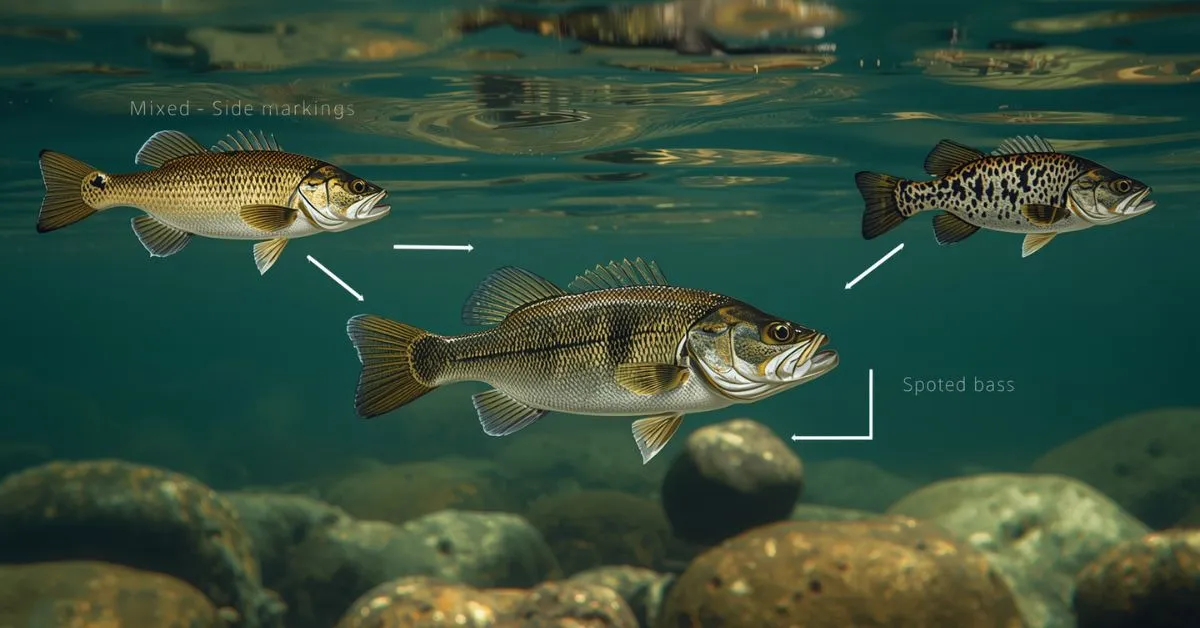
A meanmouth bass is a rare hybrid bass, usually described as a cross between a smallmouth bass and a spotted bass. It is not typically treated as a separate species. Anglers care about meanmouth bass because they are unusual, easy to misidentify, and often show a mix of traits from both parent fish.
If you searched for mean mouth bass because you saw the name online, heard another angler mention it, or caught a bass that did not look quite right, this is the answer you need first:
A meanmouth bass is usually a hybrid.
In most modern bass-fishing talk, that means a fish with smallmouth bass and spotted bass parentage. Some anglers use the term more loosely, which is one reason the topic gets confusing fast.
This guide clears that up in plain English, then shows you how to identify one, where they tend to show up, and why the fish matters beyond simple curiosity.
Meanmouth Bass at a Glance
| Question | Quick Answer |
|---|---|
| What is a meanmouth bass? | A rare hybrid bass, usually smallmouth × spotted bass |
| Is it a real fish? | Yes, but generally treated as a hybrid, not its own standard species |
| Is it common? | No, it is usually considered an unusual catch |
| Why is it confusing? | The nickname is informal, and anglers do not always use it the same way |
| How do you identify it? | Look for a mix of smallmouth and spotted bass traits rather than a perfect species profile |
| Why do anglers care? | It is rare, interesting, hard to classify, and sometimes important for regulations |
What Is a Meanmouth Bass?
A meanmouth bass is an informal fishing term for a hybrid black bass. In most cases, anglers mean a fish that is a smallmouth bass crossed with a spotted bass.
That is the dominant meaning most readers should use.
The confusion starts because meanmouth bass is a nickname, not a tightly standardized scientific label. Some anglers have used it more broadly for other smallmouth-based hybrid bass, which is why you may see slightly different definitions from one page to another.
For most readers, the best practical takeaway is this:
When someone says “meanmouth bass,” they usually mean a smallmouth-spotted bass hybrid.
That single sentence will help you understand most of the articles, videos, and fishing conversations you come across.
Is a Meanmouth Bass a Real Species or Just a Nickname?
It is a real fish, but it is not usually treated as a separate species.
That distinction matters.
A smallmouth bass is a recognized species.
A spotted bass is a recognized species.
A meanmouth bass is typically discussed as a hybrid fish that shows traits from both.
So if you are searching for a species profile in the normal sense, you may end up frustrated. Meanmouth bass is better understood as a hybrid category anglers talk about, not a clean standalone species with one universally fixed definition.
Why Is It Called Meanmouth Bass?
The name sounds official, but it is really more of a fishing-world nickname.
The term likely stuck because the fish often gets described as looking tough, aggressive, or hard-mouthed like the bass it comes from. In practical use, anglers say “meanmouth” because it is shorter and easier than repeating the parent species every time.
The important thing is not the nickname itself. The important thing is knowing that the nickname can sound more precise than it really is.
That is why many people search this phrase after seeing it once and wondering:
- Is that a real kind of bass?
- Is it just another name for spotted bass?
- Is it a smallmouth with odd markings?
- Is it rare?
Those are fair questions. The nickname invites confusion.
How to Identify a Meanmouth Bass
This is the part most people want after the definition.
A meanmouth bass usually looks like a fish that does not fit cleanly into one normal bass profile. It may look mostly like a smallmouth at first glance, but then show traits you would expect on a spotted bass.
The simplest way to think about identification
Do not ask:
“Does this look exactly like a meanmouth bass?”
Ask instead:
“Does this fish look like a mix of smallmouth and spotted bass traits?”
That shift makes field identification much easier.
Quick field checklist
A bass may be a meanmouth if it shows several of these signs at once:
- A body shape that feels close to a smallmouth bass
- Side markings that seem more pronounced or more stripe-like than a classic smallmouth
- Features that do not fully match a clean smallmouth bass identification guide
- Features that also do not look exactly like a standard spotted bass
- A fish caught in water where both species can overlap
No single visual clue proves it by itself. Hybrid fish can show a mixed pattern.
Meanmouth vs smallmouth vs spotted bass
| Feature | Smallmouth Bass | Spotted Bass | Meanmouth Bass |
|---|---|---|---|
| Overall look | Bronze to brown, often with vertical bars or mottling | More defined lateral line and rows of dark spots below it | Often looks “in between” |
| Side markings | Usually lacks the strong spotted pattern | More obvious spots and stripe-like side pattern | May show both faint bars and some spotting |
| Jaw and head profile | Distinct smallmouth look | More spotted-bass look | Mixed or hard to place |
| Classification | Species | Species | Hybrid |
| Field ID confidence | Usually easier | Usually easier | Often lower confidence without close inspection |
What catches people out most often
The biggest ID mistake is assuming any “weird-looking smallmouth” is automatically a meanmouth.
That is not always true.
Some bass simply vary in color, pattern, and body shape. Water clarity, season, age, and local genetics can all affect how a fish looks. That is why confident identification gets harder with hybrids.
Best practical rule
If a fish looks mostly smallmouth, but the markings or profile seem off enough to make you hesitate, a hybrid is possible.
That is usually the point where the “meanmouth bass” label enters the conversation.
Where Are Meanmouth Bass Found?
Meanmouth bass are most likely to be discussed in waters where smallmouth bass and spotted bass overlap.
That usually means lakes, reservoirs, or connected fisheries where those species share enough habitat to make hybridization possible.
Common pattern
You are more likely to hear about meanmouth bass in:
- Rocky reservoirs
- Clear to moderately clear water
- Fisheries with both smallmouth and spotted bass populations
- Transition areas where habitat overlap happens
Why overlap matters
Smallmouth bass and spotted bass do not live exactly the same way, but they can use nearby parts of the same fishery. When that happens consistently, hybrids become more likely.
That habitat overlap is one of the most useful pieces of context because it explains why meanmouth bass are not just random curiosities. They usually show up where the ecology makes the cross possible.
Why Anglers Care About Meanmouth Bass
A lot of fish-related keywords are simple definition searches. This one is different.
Anglers care about meanmouth bass for several reasons.
1. They are rare enough to feel special
Most anglers will never catch one with certainty. That alone gives the fish a “once in a while” reputation.
2. They are hard to identify
People love fish that start arguments at the boat ramp. Meanmouth bass do exactly that.
3. They blend traits anglers already know
Smallmouth bass and spotted bass are both familiar fish with strong followings. A hybrid between them naturally gets attention.
4. They matter in some fisheries
In some waters, hybridization is not just interesting. It also matters for management, conservation, and regulations.
That gives the topic more depth than a simple “fun fish fact” page.
How Anglers Catch Meanmouth Bass
Most people searching this term are trying to understand the fish, not necessarily target it. Still, this section matters because it matches the real-world intent behind the keyword.
You usually do not set out to catch a meanmouth bass the way you target a named species. More often, you catch one while fishing for smallmouth or spotted bass in overlap water.
Likely places to fish
If you want to increase your odds of encountering one, focus on water where both parent species are plausible:
- Rocky points
- Bluffs
- Offshore structure
- Clean hard-bottom areas
- Reservoir transitions where depth and cover change
Productive lure styles
Because you are usually fishing in classic smallmouth/spotted bass water, the same finesse and structure-oriented presentations make sense:
- Drop shot rigs
- Shaky heads
- Finesse jigs
- Ned-style presentations
- Small swimbaits
- Jerkbaits in cooler or clearer water
Best mindset
Do not fish “for meanmouth bass” as if it were a separate program. Fish for smallmouth and spotted bass in shared water, then pay close attention to any fish that looks unusual.
That is the realistic approach.
Can Meanmouth Bass Affect Fishing Regulations?
Yes, in some situations.
This is one of the most overlooked parts of the topic.
Because meanmouth bass are hybrids, they can create questions about:
- classification
- record submissions
- species-specific limits
- how a fish should be counted in a regulation-sensitive fishery
That does not mean every angler needs to panic over identification. It means that if you believe you caught a true hybrid in a place with strict bass rules, it is smart to check local regulations and not rely only on a nickname from social media or a forum thread.
Practical takeaway
If the fish matters for:
- a tournament,
- a state record,
- a regulation limit,
- or a high-profile catch,
get a more careful identification before making assumptions.
Common Mistakes People Make With Meanmouth Bass
Thinking it is a standard species name
It usually is not. It is an informal hybrid term.
Assuming every source means the same thing
Not always. Most modern usage points to smallmouth × spotted bass, but not everyone uses the label with perfect consistency.
Overconfident fish ID
A strange-looking bass is not automatically a meanmouth.
Ignoring the local fishery
Where you caught the fish matters. If the parent species do not overlap in that water, the odds change.
Treating it as trivia only
This topic also touches habitat overlap, hybridization, and sometimes regulation issues.
What Most Articles Miss About This Topic
Most articles make one of two mistakes.
They either:
- give a vague one-line definition and stop there, or
- dive into fish-nerd detail without making the answer clearer.
What readers actually need is something more practical:
The term is useful, but not perfectly precise
That is the single most important clarification. Once you understand that, most of the confusion disappears.
Identification is about pattern recognition, not one magic clue
A meanmouth bass is usually identified by a combination of mixed traits, not one guaranteed marker.
Habitat overlap explains the fish better than jargon does
Many articles say “hybrid” and move on. A better explanation is that these fish tend to show up where smallmouth bass and spotted bass share enough water to cross.
This is not just a naming issue
For serious anglers, it can also become a fisheries, records, or rules issue.
That is why the topic keeps getting attention even though the fish is uncommon.
FAQ
What is a meanmouth bass?
A meanmouth bass is a rare hybrid bass, usually described as a cross between a smallmouth bass and a spotted bass.
Is mean mouth bass the same as meanmouth bass?
Yes. Both spellings refer to the same term. The no-space version is often more common in fishing content.
Is a meanmouth bass a real fish?
Yes. It is a real fish anglers can catch, but it is generally treated as a hybrid rather than a separate standard species.
Is meanmouth bass always a smallmouth and spotted bass hybrid?
Usually, that is what people mean today. But the nickname has been used more loosely in some places, which is why definitions can vary.
Are meanmouth bass rare?
They are generally considered unusual catches, which is part of why anglers find them so interesting.
How do you identify a meanmouth bass?
Look for a fish that shows a mix of smallmouth and spotted bass features rather than matching one clean species profile.
Can you legally keep a meanmouth bass?
That depends on local fishing regulations. If the fish matters for limits, tournaments, or records, check the rules for your area.
Where are meanmouth bass most likely to be found?
They are most likely to come up in fisheries where smallmouth bass and spotted bass overlap, especially in rocky reservoirs and connected waters.
Conclusion
If you remember only one thing from this guide, make it this:
A meanmouth bass is usually a smallmouth-spotted bass hybrid, not a separate standard species.
That simple definition solves most of the confusion.
From there, the next step is understanding why anglers care: the fish is rare, hard to identify, and tied to real questions about habitat overlap, hybridization, and sometimes regulations.
Click Here To Read About : what does kappa mean

Hi, I’m Geoffrey Chaucer. I explore the stories and meanings behind words, turning ideas into clear, insightful writing. Through every article I craft, I aim to spark curiosity, share knowledge, and help readers uncover practical, meaningful truths in everyday life.