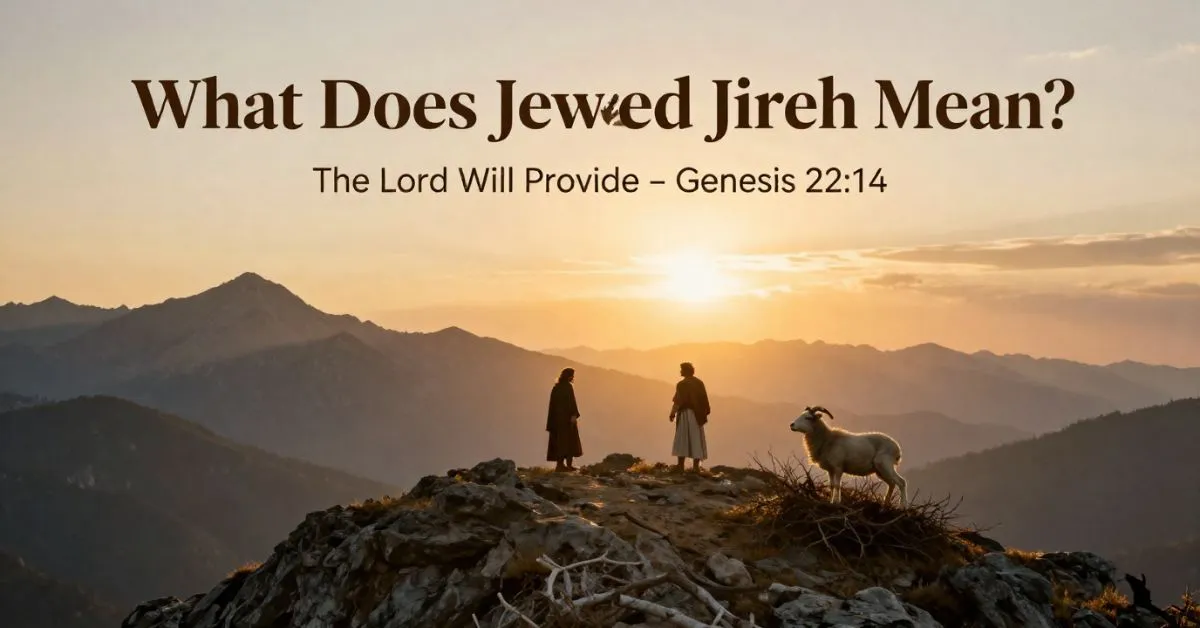
Jehovah Jireh means “the Lord will provide.” The phrase comes from Genesis 22:14, after Abraham names the place where God provided a ram instead of Isaac. In Hebrew, it also carries the idea that the Lord “sees” or “sees to it,” which is why the name points to both God’s awareness and God’s provision.
Jehovah Jireh is one of the most well-known names of God in the Old Testament. People often use it in sermons, worship songs, prayers, and Bible studies to describe God as provider. But the phrase is deeper than a simple slogan. To understand it fully, you have to look at Genesis 22, the story of Abraham and Isaac, the Hebrew wording behind “Jireh,” and the difference between the familiar English form Jehovah Jireh and the more scholarly form Yahweh Yireh.
What does Jehovah Jireh mean in simple terms?
In simple English, Jehovah Jireh means “the Lord will provide.” That is the basic answer most searchers want, and it is correct. In Genesis 22:14, Abraham gives that name to the place where God provides a ram for the burnt offering. Modern translations often render the phrase as “The LORD Will Provide” or “The LORD provides.”
This meaning is why many Christians explain Jehovah Jireh as “God my provider.” That devotional phrase is widely understood, but the biblical wording is slightly more specific. In Genesis 22, the point is not just that God provides in general. The point is that God provides what is needed at the right moment, in the right place, during a serious test of faith.
What does Jireh mean in Hebrew?
The word Jireh is linked to the Hebrew verb ra’ah, which usually means “to see.” That is why some translations and study tools preserve a second layer of meaning: not only “provide,” but also “see,” “be seen,” or “see to it.” The Hebrew idea is rich. It suggests that God does not only give help. He also sees the need ahead of time and takes care of it.
That is an important point because many short articles oversimplify the name. They treat “see” and “provide” as if one must be right and the other must be wrong. In reality, both ideas fit the passage. The deeper sense is that the Lord sees the situation and then acts in provision. That is why many teachers explain Jehovah Jireh as “the Lord will see to it.”
Where is Jehovah Jireh found in the Bible?
Jehovah Jireh comes from Genesis 22:14. The phrase appears in the story where God tests Abraham and tells him to take his son Isaac to the land of Moriah and offer him there. As Abraham and Isaac go up the mountain, Isaac asks where the lamb is for the offering. Abraham answers that God himself will provide the lamb. Later, just before Isaac is sacrificed, the angel of the Lord stops Abraham, and Abraham sees a ram caught in a thicket. He offers the ram instead of his son and names the place accordingly.
This is why the name matters so much. It is not a random title added later. It comes out of a dramatic moment of testing, obedience, covenant faith, sacrifice, substitution, and rescue. The key entities in the story are all part of the meaning: Abraham, Isaac, Mount Moriah, the burnt offering, the ram, the angel of the Lord, and the promise that God will provide. If you remove that context, you lose the force of the phrase.
Why Abraham named the place Jehovah Jireh
Abraham did not use the phrase as a casual statement. He used it as a memorial name after a real encounter with God’s provision. Genesis 22:14 says Abraham called the name of that place “The LORD Will Provide,” and the verse continues with a proverb-like statement about the mountain of the Lord. That means Jehovah Jireh is tied to an event, a location, and a lasting testimony.
The verse is memorable because it sits between promise and fulfillment. Earlier in the story, Abraham tells Isaac that God will provide. Later, God does provide. So the name Jehovah Jireh is not only descriptive. It is also a record that what Abraham trusted God to do, God actually did.
Jehovah Jireh vs. Yahweh Yireh: what is the difference?
Many readers wonder whether Jehovah Jireh and Yahweh Yireh mean different things. They do not. They point to the same phrase in Genesis 22:14. The difference is mainly about pronunciation and tradition. Yahweh is the scholarly reconstruction of the Hebrew divine name YHWH, often called the tetragrammaton. Jehovah is a later Latinized form that became common in Christian tradition.
That is why older English readers often know the phrase as Jehovah Jireh, while some modern translations and study tools use Yahweh-Yireh. For example, some Bible versions render the verse as “Yahweh-Yireh” and then explain that it means “the Lord will provide.” So if someone asks what Jehovah Jireh means, the safest answer is this: it is the traditional English Christian form of the phrase often rendered more directly today as Yahweh Yireh.
Why “Jehovah” is still common
Even though scholars usually prefer Yahweh when discussing the Hebrew name of God, the form Jehovah still appears in many churches, devotionals, hymns, and Christian teaching materials. So from an SEO and user-intent standpoint, it makes sense to answer the keyword exactly as people search it while still explaining the more precise background.
How Bible translations render Genesis 22:14
One of the best ways to understand Jehovah Jireh is to compare how major Bible translations handle Genesis 22:14.
| Translation | Rendering | What it highlights |
|---|---|---|
| KJV | Jehovahjireh / “In the mount of the LORD it shall be seen” | Preserves the traditional English form and the “seen” wording |
| NIV | The LORD Will Provide | Gives the clearest modern meaning |
| NET | The LORD provides / “provision will be made” | Emphasizes provision in straightforward language |
| NASB / NLT | Yahweh-Yireh / “the Lord will provide” | Shows the Yahweh form more directly |
This comparison helps explain why readers sometimes get confused. The KJV preserves the traditional form Jehovahjireh, while many modern translations translate the meaning instead of transliterating it. Neither approach changes the core message. They simply present it in different ways.
What does Jehovah Jireh teach us spiritually?
Spiritually, Jehovah Jireh points to God’s faithful provision. But the biblical meaning is stronger than “God gives me what I want.” In Genesis 22, provision comes during a test. It is tied to trust, obedience, worship, sacrifice, and God’s timing. The name teaches that the Lord sees what is needed and provides what is necessary in His own way.
Jehovah Jireh is not only about money
A common mistake is to reduce Jehovah Jireh to financial blessing. People often use the phrase when talking about bills, jobs, or income, and it can apply there. But the original passage is not mainly about wealth. It is about God’s intervention in a moment of deep need. Provision in the Bible can include guidance, protection, a substitute, strength, daily bread, wisdom, or rescue.
The story also points to substitution
The ram in Genesis 22 is not a minor detail. It is central to the meaning. Abraham does not simply feel better emotionally. God provides a real substitute for the offering. That is why many readers see Jehovah Jireh as a name tied to both provision and substitution. In Christian teaching, this often becomes part of a wider biblical theme about sacrifice and God’s saving provision.
Common mistakes about Jehovah Jireh
1. Thinking it only means “God my provider”
That phrase is popular and understandable, but it is still a simplified summary. The fuller biblical idea is “the Lord will provide” with the Hebrew nuance of seeing to it. The searcher who wants the best answer should know both levels of meaning.
2. Ignoring Genesis 22
Some articles define Jehovah Jireh without really telling the story of Abraham and Isaac. That weakens the explanation. The context is the meaning. Without Abraham, Isaac, Moriah, the ram, and the angel of the Lord, the phrase becomes shallow.
3. Assuming Jehovah is the original ancient pronunciation
Many readers do not realize that Jehovah is a later form, while Yahweh is the pronunciation generally preferred in scholarship for YHWH. That does not make “Jehovah Jireh” unusable. It just means the traditional Christian wording is not the only form people will see.
4. Treating the name like a magic formula
Jehovah Jireh is not a shortcut for getting instant results. In the Bible, it grows out of a real relationship with God, a hard test, and a concrete act of provision. The name points to God’s character, not to a formula for prosperity.
Real examples of how people use Jehovah Jireh
A believer facing a hard season may say, “I trust Jehovah Jireh to provide what my family needs.” A pastor teaching Genesis 22 may explain that Jehovah Jireh means the Lord sees the need before we do. A Bible study leader may compare Jehovah Jireh with other names of God such as Yahweh, Adonai, or El Roi, showing how each name highlights a different part of God’s character. Those uses are strongest when they stay connected to the actual biblical setting.
Practical takeaways
If you want the best short answer to “what does Jehovah Jireh mean,” remember these key points:
- Jehovah Jireh means “the Lord will provide.”
- It comes from Genesis 22:14, after God provides a ram for Abraham.
- The Hebrew idea behind Jireh also connects to seeing or seeing to it.
- Jehovah Jireh and Yahweh Yireh refer to the same biblical phrase.
- The name teaches trust, obedience, and God’s faithful provision in the right time and place.
FAQ
Is Jehovah Jireh in the Bible?
Yes. The phrase comes from Genesis 22:14, where Abraham names the place after God provides the ram.
What is the meaning of Jehovah Jireh in English?
In English, Jehovah Jireh means “the Lord will provide.” Some study resources also explain it as “the Lord will see to it.”
What does Jireh mean by itself?
Jireh comes from a Hebrew verb linked to seeing, which is why the phrase carries the sense of seeing, attending to, and providing for a need.
Is Jehovah Jireh the same as Yahweh Yireh?
Yes. They refer to the same expression in Genesis 22:14. “Jehovah” is the traditional English Christian form, while “Yahweh” is the form scholars generally prefer for YHWH.
Why did Abraham call the place Jehovah Jireh?
Abraham used that name because God provided a ram in place of Isaac during the offering on Mount Moriah. The name marked the place as a witness to God’s provision.
Does Jehovah Jireh mean God will always provide money?
Not specifically. The Genesis 22 context is broader than finances. It shows God providing what is needed in a moment of testing and need.
What Bible verse says “The Lord Will Provide”?
The main verse is Genesis 22:14. Many modern English translations use wording very close to “The LORD Will Provide.”
Is Jehovah Jireh a name of God or a place name?
In Genesis 22, Abraham names the place. Over time, the phrase has also been used as a name or title that describes God’s character as provider.
Conclusion
So, what does Jehovah Jireh mean? The clearest answer is “the Lord will provide.” But the fuller biblical meaning is even richer: the Lord sees the need and sees to it. In Genesis 22, Abraham, Isaac, Mount Moriah, the ram, and the promise of provision all work together to show a God who is not distant or unaware. He is the Lord who sees, the Lord who provides, and the Lord who remains faithful. If you are building a Bible-meaning content cluster, this topic also connects naturally to Yahweh, Adonai, names of God, Genesis 22, and Bible verses about God’s provision.
Click Here To Read More About : what does the name kimberly mean

Hi, I’m Geoffrey Chaucer. I explore the stories and meanings behind words, turning ideas into clear, insightful writing. Through every article I craft, I aim to spark curiosity, share knowledge, and help readers uncover practical, meaningful truths in everyday life.