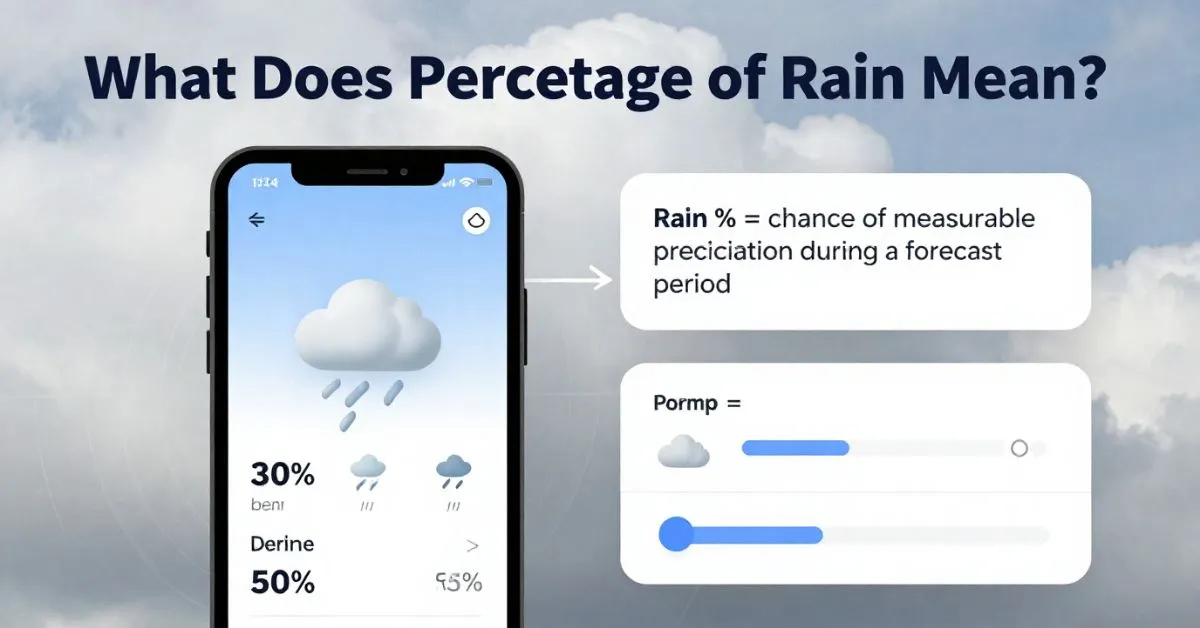
The percentage of rain means the probability of precipitation at your location during a specific forecast period. In plain English, it shows the chance that measurable precipitation such as rain, drizzle, snow, sleet, or freezing rain will fall where you are during that time window. The National Weather Service defines measurable precipitation as 0.01 inch or more.
If you have ever checked a weather app and seen 30%, 50%, or 80% next to a rain icon, you are not alone in wondering what that number really means. Many people think it tells them how long it will rain, how much rain will fall, or how much of the city will get wet. Usually, it means none of those things. The number is mainly about chance, not duration, coverage, or rainfall amount. Once you understand that, weather forecasts become much easier to use in everyday life.
The simple meaning of percentage of rain
The easiest answer to what does percentage of rain mean is this: it is the likelihood of measurable precipitation at a given point during a given time period. Weather forecasters call this the probability of precipitation, often shortened to PoP. The forecast point may be your neighborhood, your ZIP code, or the location your weather app is using. The time period may be an hour, an afternoon, tonight, or part of a day.
So if the forecast says 40% chance of rain this afternoon, it means there is a 40% chance that your forecast point will receive at least 0.01 inch of precipitation during that afternoon period. It does not mean it will rain for 40% of the afternoon. It does not mean 40% of your city will definitely get rain. It does not tell you how heavy the rain will be.
What counts as rain in a weather forecast?
In forecast language, “rain” is often used casually, but the official concept is broader: precipitation. That can include rain, drizzle, showers, thunderstorms, snow, sleet, or freezing rain, depending on temperature and weather conditions. The National Weather Service defines measurable precipitation as 0.01 inch or more of liquid precipitation, or the liquid equivalent of frozen precipitation.
That detail matters because the forecast percentage is about whether measurable precipitation will happen at all. It is not a forecast of rainfall total, storm strength, flooding risk, or travel danger by itself. To judge those things, you need more than the percentage. You may also need the hourly forecast, radar, rainfall amount, storm alerts, and local conditions.
What the percentage does not mean
This is the part that confuses most readers, so it should be completely clear.
| What people think it means | What it really means |
|---|---|
| It will rain that percent of the day | No. It is the chance of measurable precipitation during the forecast period |
| It will rain over that percent of the area | No. The basic public meaning is the chance at your forecast point |
| It tells how hard it will rain | No. It does not measure intensity |
| It tells how much rain will fall | No. Rainfall totals are a separate forecast |
| It means the air is humid | No. Humidity and precipitation chance are different things |
Official National Weather Service explanations are consistent on this point: the percentage describes the probability of measurable precipitation, not the share of time, the exact area coverage in the way most users imagine, or the rainfall amount.
What do 30%, 50%, and 70% chance of rain mean?
These are the versions people search most often, so here is the plain-English breakdown.
What does 30% chance of rain mean?
A 30% chance of rain means precipitation is possible, but it is still more likely that your location will stay dry during that forecast period. This is often the kind of number that makes sense for scattered showers, a weak system, or uncertain timing. You probably do not need to cancel normal plans, but you may want a backup plan if being caught in rain would be a problem.
What does 50% chance of rain mean?
A 50% chance of rain means the forecast is balanced. Rain is just as possible as a dry outcome. If you have flexible outdoor plans, this is usually the point where checking the hourly forecast and radar becomes much more important.
What does 70% or 80% chance of rain mean?
A 70% or 80% chance of rain means precipitation is likely during that time window. That still does not mean nonstop rain all day, but it does mean you should prepare for wet conditions. In National Weather Service forecast language, “likely” is commonly used for around 60% or 70% probability of measurable precipitation.
What does 100% chance of rain mean?
A 100% chance of rain means measurable precipitation is expected during that forecast period. Even then, it does not always mean constant rain from start to finish. It simply means forecasters are highly confident that precipitation will occur at your forecast point within that time block.
Why the time period matters so much
One of the most important parts of reading weather forecasts is understanding the forecast period. A rain percentage is always tied to a time window. On National Weather Service forecasts, the period is often 12 hours unless otherwise specified, though some official fact sheets note that the specified period may range from 1 to 12 hours. That means the same rain percentage can feel very different depending on whether it refers to one hour, one afternoon, or tonight.
For example, 40% chance of rain at 3 p.m. is not the same as 40% chance of rain today. The first is narrower and more useful for a short outing. The second is broader and could include just one wet period within the day. This is one reason weather apps may seem confusing: users often notice the percentage but miss the time label attached to it. The smartest move is always to read the number together with the forecast period.
Percentage of rain vs humidity vs rainfall amount
These weather terms are related, but they are not the same thing.
| Term | What it tells you | What it does not tell you |
|---|---|---|
| Percentage of rain / PoP | Chance of measurable precipitation | How heavy the rain will be |
| Humidity | Moisture in the air | Whether it will definitely rain |
| Rainfall amount | How much precipitation may fall | The exact probability at your location |
| Radar | Where precipitation is currently falling or developing | A perfect promise of what will happen later |
This comparison helps because many users mix these ideas together. Humidity can be high on a day with no rain. Rainfall amount matters when you want to know whether roads may get slick or fields may flood. Radar helps with timing. But the percentage of rain is only about the chance of measurable precipitation during the stated period.
Real examples you can use in daily life
Morning commute example
Your app says 20% chance of rain from 7 a.m. to 9 a.m. That usually means rain is not very likely during your commute. If you drive, you may ignore it. If you walk, bike, or carry electronics, you may still want to glance at radar before leaving.
School sports example
The forecast says 50% chance of rain from 3 p.m. to 6 p.m. for a soccer match. That means a dry game is possible, but a shower or thunderstorm delay is also possible. This is the kind of forecast where the hourly forecast, radar, and local alerts matter more than the single percentage.
Weekend picnic example
The forecast says 80% chance of rain Saturday afternoon. In that case, rain is likely enough that moving the picnic indoors or choosing a backup date is the safer plan.
These examples show the best way to use the forecast: combine the percentage with the time period, your location, and how costly it would be to guess wrong.
Common mistakes people make
Mistake 1: Thinking it means rain duration
A 60% chance of rain does not mean it will rain for 60% of the day. The percentage is about whether measurable precipitation will happen during that period, not how long it lasts.
Mistake 2: Thinking it means rainfall amount
A 30% chance of rain does not mean light rain, and an 80% chance does not always mean heavy rain. You need a QPF or rainfall total forecast for that. NOAA forecast products treat occurrence probability and precipitation amount as different forecast ideas.
Mistake 3: Ignoring the exact location
Weather can be patchy, especially with showers and thunderstorms. A nearby town may get soaked while your neighborhood stays dry. That is why the forecast point and local radar matter.
Mistake 4: Looking at the icon only
A cloud with raindrops can be misleading if you do not also read the number and the time window. Good weather decisions come from combining the icon, the percentage, the timing, and the local forecast details.
How meteorologists think about it
For everyday readers, the public meaning is enough: chance of measurable precipitation at your location during a specific period. Behind the scenes, older National Weather Service technical materials explain probability in terms of forecast confidence and expected precipitation coverage under a given weather setup. That is useful context, but for most users the simpler point-based explanation is the most practical one.
This is why phrases like slight chance, chance, and likely show up in official forecasts. They help translate probability numbers into plain language. National Weather Service glossary pages commonly align slight chance with around 20%, chance with 30% to 50%, and likely with 60% or 70%.
Practical tips for reading rain percentages correctly
If you want to use weather forecasts better, follow these simple rules:
- Check the time period first. A daily percentage is broader than an hourly one.
- Use your exact location when possible. Forecast points matter.
- Pair the percentage with radar. Radar helps with timing and nearby storm movement.
- Look at rainfall totals separately. The percentage does not tell you how much precipitation will fall.
- Be more cautious for important outdoor plans. Weddings, sports, road trips, and photography shoots usually need more than a quick glance at the rain percentage.
FAQs
Does percentage of rain mean how long it will rain?
No. It means the chance of measurable precipitation during the forecast period, not the duration.
Does percentage of rain mean how much rain will fall?
No. Rainfall amount is a separate forecast. The percentage only describes the chance that measurable precipitation will occur.
What does 40% chance of rain mean?
It means there is a 40% chance that your forecast point will receive at least 0.01 inch of precipitation during the stated period.
Is 30% chance of rain high?
Not usually. It means rain is possible, but dry conditions are still more likely for that period.
Is 70% chance of rain high?
Yes. A 70% chance usually means rain is likely enough that you should prepare for wet weather.
Why do weather apps show different rain percentages?
A rain percentage only makes sense with a specific time period and forecast point. Different displays may emphasize different forecast windows, which can make the percentages look different to users.
Does 100% chance of rain mean all-day rain?
No. It means forecasters expect measurable precipitation during that forecast period, not necessarily nonstop rain for the entire period.
Is percentage of rain the same as probability of precipitation?
Yes. In weather forecasting, percentage of rain is the public-facing way many people describe the probability of precipitation, or PoP.
Conclusion
So, what does percentage of rain mean? It means the probability of precipitation at your location during a specific forecast period. It tells you the chance that measurable precipitation, usually 0.01 inch or more, will fall where you are. It does not tell you how long it will rain, how hard it will rain, or exactly how much will fall. Once you combine that number with the hourly forecast, radar, and local weather conditions, the forecast becomes much more useful and much easier to trust.
Click Here To Read More About : what does studious mean

I am Clara Lexis, a writer driven by clarity, depth, and authenticity. My focus is on transforming ideas into meaningful content that is both informative and engaging. I write with intention to communicate clearly, thoughtfully, and with purpose.