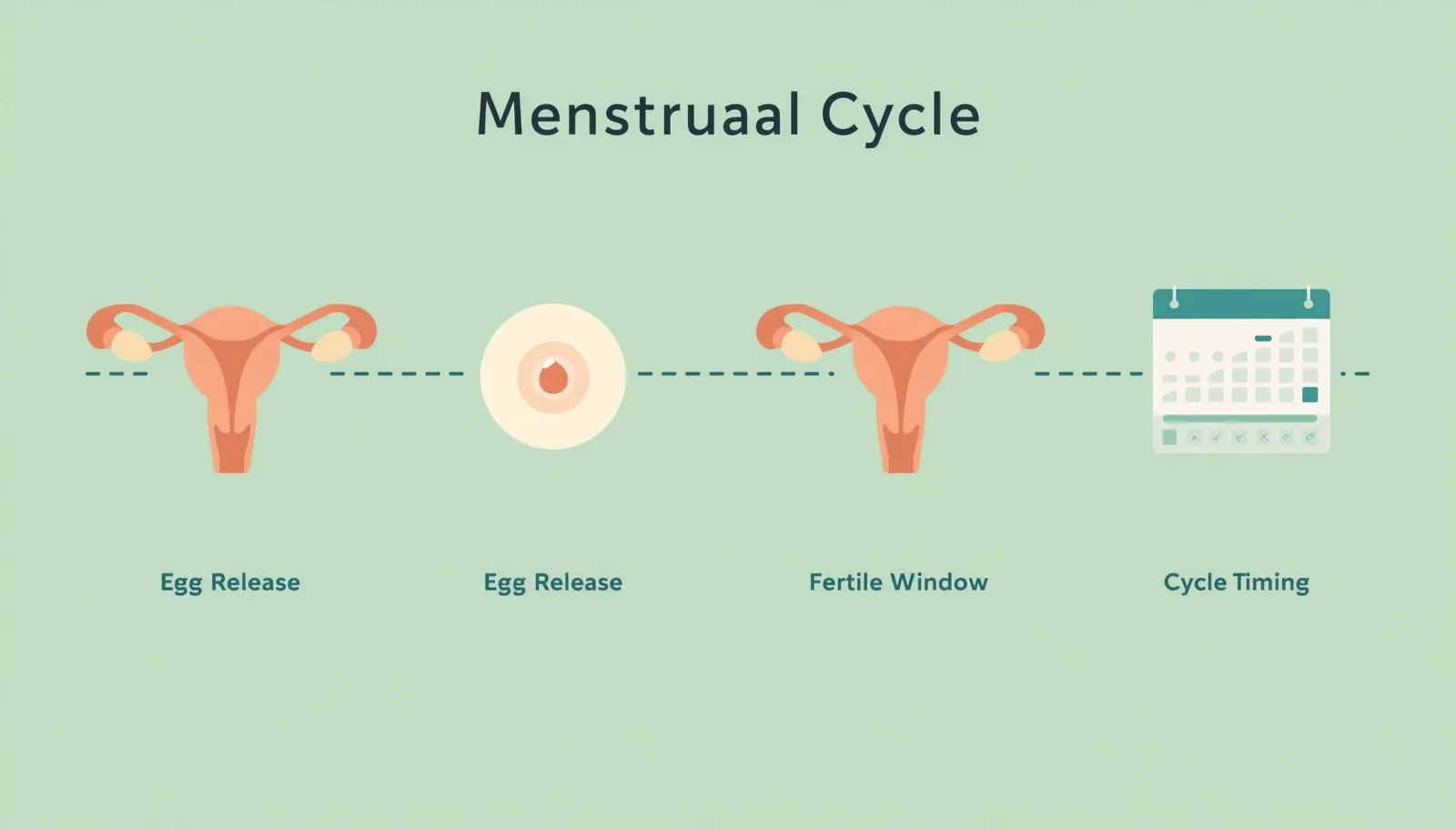
Ovulation means one of your ovaries releases an egg during your menstrual cycle. The egg travels into a fallopian tube, where it may be fertilized by sperm. Ovulation is not the same as your period, but it helps explain fertile days, pregnancy timing, and changes you may notice in your cycle.
- Ovulation means egg release from an ovary.
- It does not automatically mean pregnancy. Pregnancy can happen only if sperm fertilizes the egg.
- Ovulation is not the same as a period. It usually happens before your next period.
- Your fertile window includes the days around ovulation, not only the exact day the egg is released.
- Apps estimate ovulation. They can be helpful, but they do not confirm exactly when you ovulate.
- Irregular, painful, or missing cycles are worth discussing with a healthcare provider.
What Ovulation Means in Simple Words
If you searched “what’s ovulation mean,” the simplest answer is:
Ovulation is when your body releases an egg.
Most people with menstrual cycles have two ovaries. These ovaries store eggs. During a cycle, hormones help one egg mature. When the egg is ready, it is released from an ovary. That release is called ovulation.
After ovulation, the egg moves into a fallopian tube. If sperm is there and fertilizes the egg, pregnancy may begin. If fertilization does not happen, the egg is reabsorbed by the body and hormone levels later change, leading to a period.
Ovulation at a Glance
| Question | Simple Answer |
|---|---|
| What is ovulation? | The release of an egg from an ovary |
| Is ovulation the same as a period? | No |
| Does ovulation mean pregnancy? | No, but pregnancy is possible around this time |
| When does ovulation happen? | Often mid-cycle, but timing varies |
| Can you feel ovulation? | Some people can; many do not |
| Can apps confirm ovulation? | No, most apps estimate it |
What Happens During Ovulation?
Ovulation is part of the menstrual cycle, not a separate event from it. The menstrual cycle is usually counted from the first day of one period to the first day of the next period.
Here is what happens in simple terms.
1. A follicle grows in the ovary
Inside the ovary, a small fluid-filled sac called a follicle helps an egg mature. Usually, one follicle becomes the main, or dominant, follicle for that cycle. Cleveland Clinic explains that a follicle grows in the ovary and then ruptures at ovulation, releasing the egg.
2. Hormones signal the egg to be released
Ovulation is controlled by hormones. A rise in estrogen helps prepare the body, and a surge in luteinizing hormone, often called LH, helps trigger the release of the mature egg.
3. The egg enters the fallopian tube
After release, the egg travels into a fallopian tube. This is where fertilization may happen if sperm is present.
4. The body prepares for a possible pregnancy
After ovulation, progesterone helps prepare the uterine lining for a possible pregnancy. If pregnancy does not happen, estrogen and progesterone levels fall, and the uterine lining sheds as a period.
Ovulation vs. Period vs. Fertile Window
These three terms are related, but they do not mean the same thing.
| Term | What It Means | Why It Matters |
|---|---|---|
| Ovulation | An ovary releases an egg | Pregnancy becomes possible if sperm fertilizes the egg |
| Period | The uterine lining sheds as bleeding | Usually marks the start of a new cycle |
| Fertile window | The days when pregnancy is most likely | Includes the days before ovulation and around ovulation |
A common mistake is thinking ovulation and a period are the same. They are not. Ovulation usually happens before your next period. A period usually happens if pregnancy does not occur.
When Does Ovulation Usually Happen?
Ovulation often happens around the middle of the menstrual cycle, but it does not happen on the same day for everyone.
In a textbook 28-day cycle, ovulation is often estimated around day 14. But real cycles vary. The NHS says regular cycles from 21 to 35 days can be normal, and ovulation often happens around 10 to 16 days before the next period.
That means ovulation may happen earlier or later depending on:
- Cycle length
- Stress
- Illness
- Sleep changes
- Travel
- Breastfeeding
- Coming off hormonal birth control
- Perimenopause
- PCOS
- Thyroid or other endocrine conditions
Cleveland Clinic notes that conditions and life events such as breastfeeding, PCOS, thyroid disorders, menopause, stress, obesity, and excessive exercise can affect ovulation.
Does Ovulation Mean You Can Get Pregnant?
Ovulation means pregnancy is possible, not guaranteed.
An egg can usually be fertilized for about 12 to 24 hours after it is released. Sperm can live inside the female reproductive tract for about 3 to 5 days after sex. This is why pregnancy can happen from sex before ovulation, not only sex on the exact day of ovulation.
So if you are trying to get pregnant, the days before ovulation matter. If you are avoiding pregnancy, it is important not to rely only on an app’s ovulation estimate.
What Is the Fertile Window?
The fertile window is the group of days in a cycle when pregnancy is most likely.
The Office on Women’s Health explains that there are about 6 days during each menstrual cycle when pregnancy can happen; this is called the fertile window.
This usually includes:
- The several days before ovulation
- The day of ovulation
- Sometimes the day after ovulation
The fertile window exists because sperm can survive for several days, while the egg survives for a much shorter time after release.
What It Means If a Period App Says You’re Ovulating
If your period app says you are ovulating, it usually means the app is estimating your ovulation day based on your cycle history.
It does not necessarily mean:
- Your body definitely released an egg that day
- You are pregnant
- You are safe from pregnancy on other days
- Your fertile window is exactly correct
Apps can be useful for tracking patterns, especially if your cycles are regular. But they can be less accurate if your cycle changes, your period is irregular, you recently stopped birth control, you are breastfeeding, or you are under unusual stress.
A better way to use an app is to treat it as a pattern tracker, not as a perfect ovulation detector.
What Ovulation Means in Different Situations
| Situation | What Ovulation Usually Means |
|---|---|
| You are trying to get pregnant | These are the days when timing sex may matter most |
| You are avoiding pregnancy | Pregnancy risk may be higher if sperm is present |
| Your app says “ovulation day” | The app is estimating, not confirming |
| Your cycles are irregular | Ovulation may be harder to predict |
| You are on combined hormonal birth control | Ovulation is usually suppressed when used correctly |
| You recently stopped birth control | Your natural cycle may take time to become predictable |
| You have no symptoms | You may still ovulate without noticing signs |
Some hormonal contraception methods work by stopping ovulation. The NHS lists combined hormonal methods such as the combined pill, contraceptive patch, and contraceptive injection as methods that stop ovulation. Cleveland Clinic also notes that combined hormonal birth control should stop ovulation when used exactly as prescribed.
Common Signs You May Be Ovulating
Some people notice ovulation symptoms. Others notice nothing.
Possible signs include:
- Clear, slippery, stretchy cervical mucus
- Mild one-sided pelvic or lower belly pain
- Light spotting
- Breast tenderness
- Bloating
- Increased sex drive
- Slight rise in basal body temperature after ovulation
- A positive ovulation predictor test
Mayo Clinic notes that vaginal discharge may become more thin, clear, and slippery before ovulation, and basal body temperature may rise slightly around ovulation.
Not having symptoms does not automatically mean you are not ovulating.
What Does Ovulation Pain Feel Like?
Some people feel mild pelvic pain around ovulation. This is sometimes called mittelschmerz.
It may feel like:
- A mild cramp
- A dull ache
- A quick sharp pain
- Pain on one side of the lower abdomen
Cleveland Clinic explains that ovulation pain can happen around ovulation and may be felt in the lower abdomen or pelvis, often in the middle or on one side.
Mild ovulation discomfort can happen. Severe pain, heavy bleeding, fever, dizziness, or pain that feels unusual should be checked by a healthcare provider.
How to Track Ovulation
No tracking method is perfect. The best method depends on whether you are tracking for body awareness, trying to conceive, or avoiding pregnancy.
| Tracking Method | What It Helps With | Limitation |
|---|---|---|
| Period app | Estimates ovulation based on cycle patterns | Prediction only |
| Calendar tracking | Helps identify cycle length over time | Less useful with irregular cycles |
| Cervical mucus | Shows body changes near fertile days | Takes practice to interpret |
| Ovulation predictor kit | Detects LH rise before ovulation | Predicts ovulation, does not confirm pregnancy |
| Basal body temperature | Shows a temperature shift after ovulation | Usually confirms after ovulation happened |
| Fertility monitor | Tracks hormone patterns | Cost and accuracy vary |
| Medical testing | Can confirm ovulation more directly | Requires a clinician |
Cleveland Clinic lists several ways to estimate ovulation, including tracking the menstrual cycle, checking cervical mucus, using ovulation kits, monitoring basal body temperature, and using calendar methods.
Can You Release an Egg Without Knowing?
Yes. You can release an egg without feeling anything unusual.
This is a normal body process, not always a noticeable event. You may not feel pain, notice discharge changes, or see a clear mood or energy shift. That can be completely normal.
If you are trying to understand your cycle, look for patterns over several months instead of relying on one symptom on one day.
Can You Have Bleeding Without Releasing an Egg?
Yes. It is possible to have bleeding without true egg release.
This is one reason a “period” is not always proof that an egg was released. Cleveland Clinic explains that it is possible to get a period without releasing an egg and to release an egg without having a true period.
If bleeding is unpredictable, very heavy, very painful, or repeatedly unusual for you, it is worth discussing with a healthcare provider.
Can Your Body Release More Than One Egg in a Cycle?
Usually, egg release happens once in a cycle. However, more than one egg can sometimes be released during the same fertile window. If more than one egg is fertilized, this can lead to a multiple pregnancy, such as fraternal twins.
This does not usually mean someone releases eggs on completely separate days across the cycle. It means more than one egg may be released around the same mid-cycle period.
What Can Affect Egg Release?
This process can be affected by normal life changes, temporary disruptions, or medical conditions.
Common factors include:
- Stress
- Illness
- Major changes in sleep
- Significant weight changes
- Excessive exercise
- Breastfeeding
- Perimenopause
- PCOS
- Thyroid disorders
- Other endocrine conditions
- Some medications
- Hormonal contraception
ACOG defines PCOS as a hormone imbalance that can affect monthly periods, egg release, the ability to get pregnant, and metabolism.
If your cycles are often missing, very irregular, or difficult to predict, tracking your symptoms can help you prepare for a more useful conversation with a clinician.
Normal Mid-Cycle Signs vs. When to Get Help
| What You Notice | Often Normal | Talk to a Healthcare Provider If… |
|---|---|---|
| Mild one-sided cramps | Can happen around egg release | Pain is severe, sudden, or worsening |
| Clear stretchy discharge | Common near fertile days | Discharge has a bad odor, itching, pain, or unusual color |
| Light spotting | Can happen for some people | Bleeding is heavy, frequent, or new for you |
| No clear symptoms | Many people notice nothing | Cycles are missing or very irregular |
| App prediction changes | Apps adjust based on cycle data | You need reliable pregnancy prevention or fertility guidance |
| Positive predictor test | May suggest an LH rise | You get repeated positives or confusing results |
This table is not a diagnosis tool. It is a practical guide for deciding when something may need medical attention.
What Most Articles Miss About This Topic
Most articles say this process is “when you can get pregnant,” but that explanation is incomplete.
A clearer explanation is:
Egg release is one event. The fertile window is the time around it when pregnancy is most likely.
That distinction matters. The egg usually survives for about 12 to 24 hours after release, but sperm can survive for several days. So the days before the egg is released can be just as important as the day itself.
Another thing many articles miss: this cycle phase is useful to understand even if you are not trying to get pregnant. It can help explain:
- Why discharge changes during the month
- Why some people feel mid-cycle cramps
- Why period apps highlight fertile days
- Why cycle timing can shift
- Why irregular periods may need attention
The final overlooked point is that day 14 is not a rule. It is only a common estimate for a 28-day cycle. Many normal cycles are shorter or longer, and fertile timing can vary.
Quick Medical Safety Note
Talk to a healthcare provider if you have:
- Severe pelvic pain
- Heavy or unusual bleeding
- Bleeding between periods that keeps happening
- Fever with pelvic pain
- Foul-smelling discharge
- Missed periods without a clear reason
- Very irregular cycles
- Pain during sex
- Trouble getting pregnant
- Symptoms of PCOS, such as irregular periods, acne, or excess facial hair
Seek urgent care if pelvic pain is sudden and severe, especially with dizziness, fainting, fever, or heavy bleeding.
FAQs
What does ovulation mean in one sentence?
Ovulation means an ovary releases an egg during the menstrual cycle.
Does it mean I am pregnant?
No. It does not mean you are pregnant. It means an egg has been released, and pregnancy is possible if sperm fertilizes it.
Is it the same as a period?
No. Egg release and a period are different. A period is bleeding that usually happens when pregnancy does not occur.
How long does the egg survive after release?
The egg can usually be fertilized for about 12 to 24 hours after release, but the fertile window lasts longer because sperm can survive for several days.
Can you get pregnant before egg release?
Yes. Pregnancy can happen from sex before egg release because sperm can live in the reproductive tract for several days.
What does it mean on my period app?
It means the app is estimating when your body may release an egg. It does not confirm that it definitely happened.
Can egg release happen right after your period?
It is possible, especially with short or irregular cycles. Pregnancy soon after a period can happen if the egg is released early or the cycle is short.
Can it happen without symptoms?
Yes. Many people release an egg without noticing clear symptoms.
Does birth control stop egg release?
Some methods do. Combined hormonal birth control methods are designed to stop egg release when used correctly. Other methods may work differently, so check with a healthcare provider or pharmacist for guidance.
Can stress delay this part of the cycle?
Stress can affect the menstrual cycle and may delay fertile timing for some people.
What does it mean if my body does not release an egg?
It may mean your body did not release an egg during that cycle. Occasional changes can happen, but frequent missed egg release or irregular cycles may need medical evaluation.
How do doctors confirm egg release?
A clinician may use cycle history, symptoms, blood tests, ultrasound, or other fertility evaluation methods depending on your situation.
Final Takeaway
Ovulation means your ovary releases an egg. It is a normal part of the menstrual cycle and is closely connected to fertile days, but it does not automatically mean pregnancy and it is not the same as a period.
The most useful way to understand ovulation is to think of it as one part of a bigger cycle: your body prepares an egg, releases it, and then either supports a possible pregnancy or starts another period.
If you are tracking ovulation to understand your body, trying to conceive, or avoiding pregnancy, learn your own cycle patterns and speak with a healthcare provider if anything feels irregular, painful, or confusing.
Click Here To Read About : what does nth mean

I am Clara Lexis, a writer driven by clarity, depth, and authenticity. My focus is on transforming ideas into meaningful content that is both informative and engaging. I write with intention to communicate clearly, thoughtfully, and with purpose.