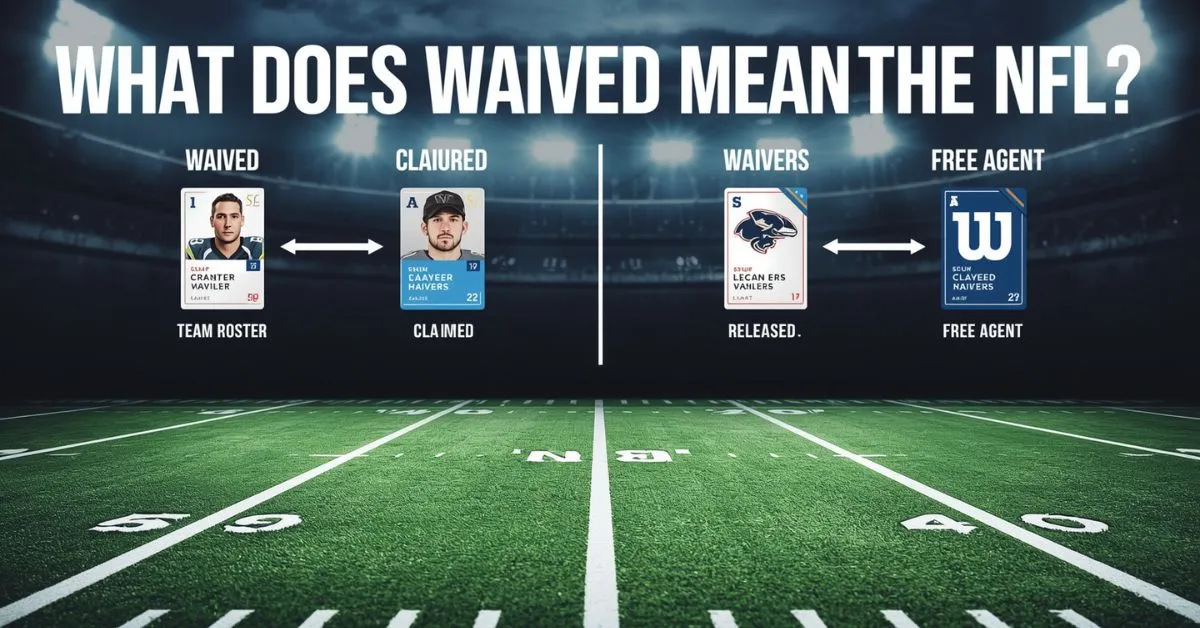
In the NFL, “waived” means a team has ended a player’s contract, but the player is not immediately free to choose a new team. He must first go through the waiver process, where other teams can claim him. If nobody claims him, he clears waivers and usually becomes a free agent.
If you see a headline that says a player was waived, the key point is this: he is not just “cut” in the casual sense.
There is still a league process that decides what happens next. That is why waived, released, claimed off waivers, and cleared waivers do not all mean the same thing.
What waived means in simple terms
In plain English, when an NFL player is waived, his team is moving on from him, but the rest of the league gets a chance to claim his contract before he becomes a normal free agent.
The team with the highest waiver priority gets him if it puts in a claim. If no team claims him during the waiver period, he clears waivers and becomes free to sign.
That is why waived is more precise than the everyday phrase cut. Fans often say a player was cut, but the official transaction is usually either waived or released.
How the NFL waiver process works
The basic process looks like this:
| Step | What happens |
|---|---|
| 1 | A team waives a player |
| 2 | The player enters the waiver process |
| 3 | Other teams get about 24 hours to submit a claim |
| 4 | If multiple teams claim him, the team with the highest waiver priority gets him |
| 5 | If no team claims him, he clears waivers and usually becomes a free agent |
NFL.com says the waiver period generally lasts 24 hours. It also says the waiver period opens on the first business day after the Super Bowl and closes at the end of the regular season. During that period, players who are subject to waivers must pass through that process before becoming free agents.
The order also changes as the season moves along. From the day after the Super Bowl through the third regular-season game, waiver priority is based on draft order. After the third game, it switches to the inverse of the current league-wide standings.
One important detail many casual fans miss: when a team claims a player, it is claiming the player’s contract, not just his rights. NFL Football Operations explains waivers as a system that lets teams place a claim on a player contract before the player becomes a free agent.
Waived vs. released in the NFL
This is the main distinction users usually need.
Waived
A waived player must go through waivers first. Other teams can claim him before he becomes a free agent.
Released
A released player is generally free to negotiate and sign right away. That is the usual outcome for a player with four or more credited seasons who is released from the day after the Super Bowl through the trade deadline.
Cut
“Cut” is informal football language. It is common in headlines and conversation, but it is not the most precise transaction term. In practice, “cut” often means the player was either waived or released.
Which players are subject to waivers?
NFL Football Operations says that a player with fewer than four credited seasons is subject to waivers when released.
A player with four or more credited seasons is generally not subject to waivers when released from the day after the Super Bowl through the trade deadline. After that point, even those players can be subject to waivers.
That four-season line is why younger players are often waived, while more established veterans are often released.
A related term you may see is vested veteran. Sports explainers commonly use that term for players with at least four seasons of service in the release context, which is why they are often treated differently in cutdown moves.
NFL’s free-agency glossary says a credited season is earned when a player is on full-pay status for three or more regular-season games. That matters here because waiver eligibility is tied to credited seasons in NFL’s official waiver explainer.
What does “claimed off waivers” mean?
If a player is claimed off waivers, another team submitted a successful claim before the player cleared. That means the player never reached normal free agency first. He was awarded through the waiver order instead.
This is why waiver priority matters. A team lower in the order may want the same player, but it only gets him if no higher-priority team submits a claim.
What does “cleared waivers” mean?
If no team makes a successful claim during the waiver period, the player has cleared waivers. At that point, he usually becomes a free agent and can sign with any team.
That includes the possibility of returning to the same organization in a different role, often on the practice squad.
NFL roster guidance says teams can form practice squads after the waiver period for final cutdowns expires, and NFL Football Operations also notes that players who clear waivers may be signed to a practice squad in roster-management situations.
Why teams waive players during roster cuts
This is where the term shows up most often.
Teams do not always waive a player because they think he has no value. Sometimes they do it because they are trying to reshape the 53-man roster, keep a position balanced, or get a player through waivers and back onto the practice squad. That is why the word waived often appears during training camp and final roster cutdowns.
NFL.com also notes an important cutdown detail: when a player is claimed after cuts, the claiming team must place him on the 53-man roster and pay him for at least three weeks. That rule helps explain why teams do not blindly claim every interesting player they see. A claim has a real roster cost.
A simple real-life example
Imagine a team has a young backup cornerback it likes, but not enough room to keep him on the active roster. If that player has fewer than four credited seasons, the team cannot simply “release” him in the usual veteran sense.
It has to waive him first. For the next day or so, every other team gets the chance to claim him. If nobody does, he clears waivers and may return on the practice squad. That is one of the most common reasons fans see the word in late August.
Now compare that with an established veteran backup. If he has four or more credited seasons and the timing falls within the standard part of the league calendar, the team can often release him instead.
He then becomes free to sign immediately, which is one reason teams sometimes release veterans rather than risk losing a younger player on waivers.
Waived vs. released vs. cleared waivers: quick comparison
| Term | What it means | What happens next |
|---|---|---|
| Waived | Player must go through the waiver process | Another team can claim him before he becomes a free agent |
| Released | Player is generally free right away in the usual veteran scenario | He can usually sign with any team immediately |
| Claimed off waivers | Another team won the waiver claim | Player goes to that team through waiver priority |
| Cleared waivers | No team claimed the player | He usually becomes a free agent |
| Cut | Informal term | Usually means either waived or released |
What does waived/injured mean?
This is a separate edge case that often confuses readers.
A player can be waived/injured, which means he is waived with an injury designation. That is not the exact same thing as a normal waiver.
NFL transaction coverage and roster-rule explainers note that injured designations can lead to different outcomes, including reverting to injured reserve if the player goes unclaimed in the right situation.
So when you see waived/injured, do not assume it has the exact same path as a healthy player who is simply waived during roster cuts.
Common mistakes people make
Thinking waived means the same thing as released
It does not. A waived player must pass through waivers first. A released player usually does not in the common veteran scenario.
Thinking waived means no team wants the player
Also wrong. A player may be claimed quickly. Waivers are often a sign that the rest of the league now gets a chance to grab him.
Thinking clearing waivers means the player is done with his old team forever
Not necessarily. A player can clear waivers and come back to the same organization on the practice squad.
Thinking waiver order works like fantasy football
Not exactly. Pro Football Network notes that the NFL waiver wire does not reset after each claim the way many fantasy systems do.
What Most Articles Miss About This Topic
Most pages explain waived as “the team cut the player.” That is not wrong, but it is incomplete.
The more important truth is that waived changes who controls the player’s next move. The player cannot simply pick his next team right away because the rest of the league gets first claim through the waiver process. That is the real reason the word matters.
Another detail many articles gloss over is that this is often a roster strategy issue, not a judgment that the player cannot play. Teams waive fringe-roster players all the time hoping they clear and return on the practice squad.
One more subtle point: you will sometimes see websites use both credited seasons and accrued seasons when explaining service-time rules.
NFL’s official waiver explainer uses credited seasons for the waiver cutoff, while its free-agency Q&A defines accrued season separately for free-agency categories. That nuance is small, but it helps explain why football transaction articles can sound inconsistent even when they are trying to describe the same service-time idea.
FAQ
Does waived mean cut in the NFL?
In casual language, yes, people often use them the same way. Technically, though, waived is more specific because it means the player must pass through waivers first.
What is the difference between waived and released?
A waived player goes through the waiver process. A released player, in the usual veteran scenario, becomes free to sign immediately.
What does cleared waivers mean?
It means no team claimed the player during the waiver period, so he can usually sign as a free agent.
Can a waived player go back to the same team?
Yes. If he clears waivers, he may return to the same organization, often on the practice squad.
Why are younger players often waived while veterans are released?
Because the NFL’s waiver rules treat players with fewer than four credited seasons differently from players with four or more credited seasons during much of the league calendar.
What does claimed off waivers mean?
It means another team used its waiver priority to acquire the player before he became a normal free agent.
Conclusion
The cleanest takeaway is this: waived in the NFL means a team has moved on from a player, but the rest of the league gets a chance to claim him before he becomes a free agent. That is why waived is different from released, and why the term shows up so often in roster-cut and transaction news.
Understanding that one distinction makes NFL transaction reports much easier to follow. Instead of reading “waived” as just “gone,” read it as “available, but first through the waiver process.”
Read More Posts:
What Does the Emperor Tarot Card Mean?
Names That Mean White: 75 Beautiful Baby Name Ideas
What Does Renewable Mean? Definition and Examples

Hi, I’m Geoffrey Chaucer. I explore the stories and meanings behind words, turning ideas into clear, insightful writing. Through every article I craft, I aim to spark curiosity, share knowledge, and help readers uncover practical, meaningful truths in everyday life.