Text structure means the way a writer organizes ideas in a paragraph, passage, or full text so the reader can understand how the information fits together.
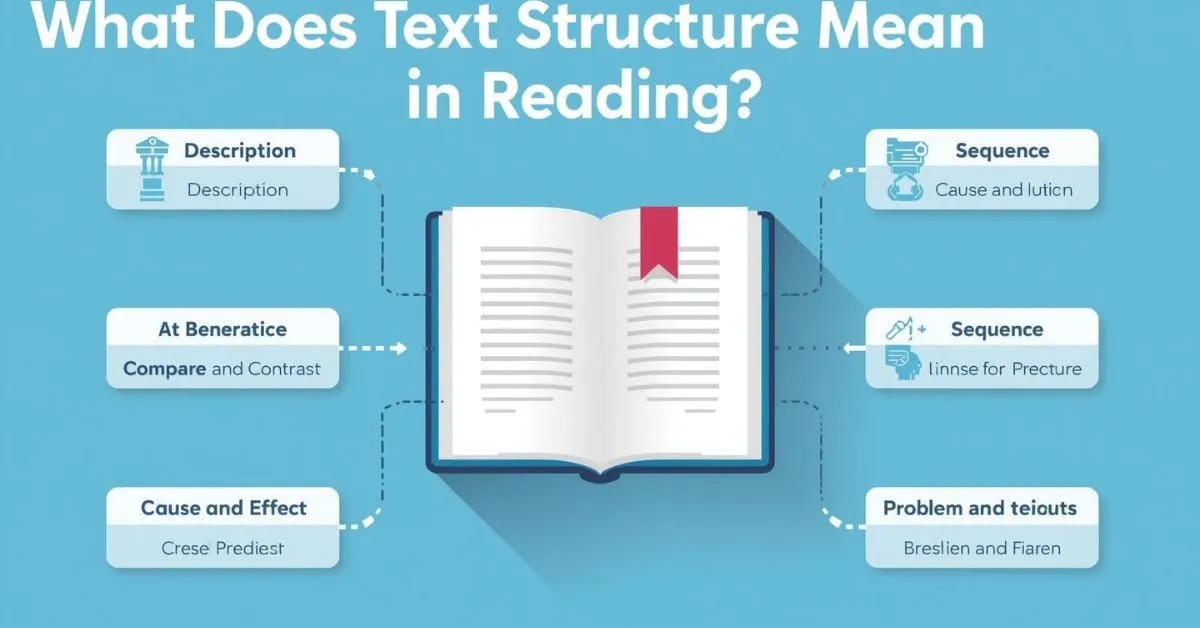
In reading, it usually refers to common patterns like description, sequence, compare and contrast, cause and effect, and problem and solution.
If you saw this term in class, homework, or a reading lesson, the simple version is this: text structure is how writing is organized. Once you understand the pattern, it becomes much easier to follow the meaning, identify the main idea, and explain what the writer is doing.
What Does Text Structure Mean?
Text structure is the organizational pattern of a piece of writing.
It shows how the author arranges ideas so the text makes sense to the reader. A writer might organize ideas by:
- putting events in order
- showing similarities and differences
- explaining causes and results
- presenting a problem and a solution
- describing one topic in detail
That pattern is the text structure.
So if someone asks, “What does text structure mean?”, the clearest answer is:
It means the way information is organized in a text.
Why Text Structure Matters
Text structure is important because it helps readers understand a passage faster and more accurately.
When you can recognize the structure, you can:
- follow the author’s thinking more easily
- predict what kind of information will come next
- find the main idea faster
- notice supporting details more clearly
- summarize more accurately
- improve reading comprehension
For example, if you know a paragraph uses cause and effect, you will look for what happened and why. If it uses compare and contrast, you will look for similarities and differences. That makes reading feel less confusing and more organized.
Text Structure in Simple Words
In simple words, text structure is the shape of the writing.
It is the way the writer builds the passage so the ideas connect clearly.
A very easy way to explain it to a student is:
Text structure is how the writer puts ideas in order.
That is why teachers often ask students to identify text structure in reading comprehension work. They want students to notice how the information is arranged, not just what the topic is.
The 5 Main Types of Text Structure
In reading instruction, five text structures appear most often in informational and expository writing.
1. Description
In a descriptive structure, the writer explains one topic by giving facts, traits, features, or examples.
This structure is common in:
- science texts
- geography writing
- encyclopedia-style entries
- informational passages
Example:
A volcano is an opening in the Earth’s surface where magma, gas, and ash can escape. Some volcanoes are active, while others are dormant or extinct.
Common signal words:
for example, such as, includes, characteristics, consists of, for instance
2. Sequence or Chronological Order
In a sequence structure, ideas, events, or steps are presented in order.
This structure is common in:
- how-to writing
- historical events
- instructions
- process explanations
Example:
First, the seeds are planted in the soil. Next, they are watered regularly. After a few days, the first green shoots begin to appear.
Common signal words:
first, next, then, after, before, later, finally
3. Compare and Contrast
In this structure, the writer explains how two or more things are alike and different.
This structure is common in:
- classroom essays
- product comparisons
- literary analysis
- informational articles
Example:
Both frogs and toads are amphibians, but frogs usually have smoother skin and longer legs, while toads often have drier skin and shorter legs.
Common signal words:
both, similarly, unlike, however, on the other hand, in contrast, different, same
4. Cause and Effect
In a cause-and-effect structure, the writer explains why something happened and what happened because of it.
This structure is common in:
- science explanations
- history passages
- news reports
- social studies writing
Example:
The roads flooded after heavy rainfall, so several schools closed for the day.
Common signal words:
because, since, so, therefore, as a result, caused, led to, due to
5. Problem and Solution
In this structure, the writer presents a problem and then explains how it can be solved.
This structure is common in:
- persuasive writing
- school articles
- community issues
- advice-style writing
Example:
The library was too crowded and noisy for students to study well. To solve the issue, the school opened a quiet study room and added clearer noise rules.
Common signal words:
problem, solution, solve, fix, issue, challenge, answer, resolve, improve
Quick Table: Common Text Structures
| Text Structure | What It Does | Key Question to Ask | Common Signal Words |
|---|---|---|---|
| Description | Explains one topic with details | What is this mostly describing? | for example, such as, includes |
| Sequence | Puts events or steps in order | What happened first, next, and last? | first, next, then, finally |
| Compare and Contrast | Shows similarities and differences | What is being compared? | both, unlike, however, similarly |
| Cause and Effect | Explains reasons and results | What happened, and why? | because, so, therefore, as a result |
| Problem and Solution | Presents an issue and a fix | What is the problem, and how is it solved? | problem, solution, fix, resolve |
How to Identify Text Structure Quickly
A lot of articles define text structure but do not show readers how to find it. This is where many students get stuck.
Here is a simple 3-step method.
Step 1: Ask what the writer is trying to do
Look at the paragraph and ask:
- Is the writer describing one topic?
- Putting events in order?
- Comparing two things?
- Explaining why something happened?
- Presenting a problem and solution?
The writer’s goal often reveals the structure.
Step 2: Look at the relationship between ideas
Do not only hunt for signal words. Look at how the ideas connect.
Ask:
- Are the ideas connected by time?
- By similarity and difference?
- By cause and result?
- By problem and answer?
- By details about one topic?
This is usually the most reliable clue.
Step 3: Use signal words as support, not proof
Signal words are helpful, but they do not always tell the full story.
For example:
- “because” often points to cause and effect
- “however” often points to compare and contrast
- “first” often points to sequence
But a strong reader checks the whole paragraph, not just one word.
Text Structure Examples in Real Life
Text structure is not only a school term. You can see it in everyday reading too.
In blog posts
A tutorial usually uses sequence.
In buying guides
A review comparing two products often uses compare and contrast.
In news reports
A report about an accident may use cause and effect.
In school essays
An essay about a community issue may use problem and solution.
In informational articles
An article introducing a concept often uses description.
This is why understanding text structure helps with more than classroom work. It improves how you read articles, guides, reports, and explanations in general.
Text Structure in Reading vs Writing
The term is used in both reading and writing, but the focus is slightly different.
In reading
Text structure helps you understand how a passage is built.
It helps you:
- follow the author’s organization
- identify the central idea
- notice supporting details
- summarize the passage
- answer comprehension questions
In writing
Text structure helps you organize your own ideas clearly.
It helps you:
- choose the best format for your purpose
- make writing easier to follow
- guide the reader through your ideas
- avoid confusing paragraphs
So in reading, you usually identify the structure.
In writing, you usually choose and use the structure.
Text Structure vs Text Features
This is one of the biggest sources of confusion.
Text structure is the way the ideas are organized.
Text features are tools added to help the reader understand or navigate the text, such as:
- headings
- captions
- charts
- diagrams
- labels
- bold words
- sidebars
Simple example
A science article might use:
- cause and effect as the text structure
- headings and diagrams as text features
So text features help present the content, while text structure organizes the content.
Text Structure vs Sentence Structure
These are also different.
Text structure is about the organization of ideas across a paragraph, passage, or article.
Sentence structure is about how individual sentences are built, such as:
- simple sentences
- compound sentences
- complex sentences
A paragraph can use a compare-and-contrast text structure while still including many different sentence types.
Text Structure vs Author’s Purpose
These ideas are related, but they are not the same.
- Author’s purpose explains why the writer is writing
- Text structure explains how the writer organizes the ideas
For example, a writer may want to inform readers about pollution. To do that, the writer might use:
- description
- cause and effect
- problem and solution
So the purpose and the structure work together, but they are not identical.
Can a Text Have More Than One Structure?
Yes.
This is something many short definition pages do not explain clearly.
A full article, essay, or chapter can contain more than one text structure. For example:
- the introduction may use description
- the next section may use compare and contrast
- another section may use cause and effect
- the ending may use problem and solution
That is why teachers often ask for the main structure of a paragraph or section, not always the entire article.
In real reading, many texts are mixed or layered. The goal is usually to identify the dominant structure in the part you are reading.
Graphic Organizers That Match Text Structure
Graphic organizers can make text structure much easier to understand.
Common matches include:
- Description: web or concept map
- Sequence: timeline or flowchart
- Compare and Contrast: Venn diagram
- Cause and Effect: cause-effect chain
- Problem and Solution: problem-solution chart
These tools are useful because they show the organization visually. They help students organize information in the same pattern the writer used.
3 Short Passage Examples With Answers
Passage 1
The school garden started as an empty patch of land. First, students cleared the weeds. Next, they added fresh soil. Then they planted vegetables and flowers. By the end of the month, the garden had started to grow.
Text structure: Sequence
Why: The events are explained in time order.
Passage 2
Online classes and in-person classes both allow students to learn from teachers. However, online classes offer more flexibility, while in-person classes often provide more direct interaction.
Text structure: Compare and Contrast
Why: The paragraph shows similarities and differences.
Passage 3
The cafeteria produced too much plastic waste each day. To reduce the problem, the school replaced plastic utensils with reusable ones and added more recycling stations.
Text structure: Problem and Solution
Why: The paragraph presents an issue and then gives a fix.
Common Mistakes When Identifying Text Structure
1. Confusing the topic with the structure
The topic tells you what the passage is about.
The structure tells you how the passage is organized.
A passage about weather can be descriptive, chronological, or cause and effect depending on how it is written.
2. Looking only for clue words
Signal words help, but they are not enough on their own.
3. Thinking every long text has only one structure
Many texts mix structures, especially longer informational passages.
4. Confusing text structure with text features
Headings, charts, and captions are not the same as structure.
5. Ignoring the author’s purpose
Knowing the purpose can help you figure out why a certain structure was chosen.
What Most Articles Miss About This Topic
Most articles explain the five common structures, but many stop before they explain the real reading skill behind them.
The deeper point is that text structure helps readers see the logic of a passage.
When you recognize structure, you stop reading sentence by sentence without direction. You start noticing how the ideas fit together. That makes it easier to:
- understand the main point
- predict what comes next
- identify supporting details
- take notes
- summarize clearly
Another thing many articles miss is that signal words are clues, not proof. Strong readers focus on the relationship between ideas first.
Many pages also fail to explain that structure is not limited to school textbooks. It appears in:
- articles
- tutorials
- reports
- comparisons
- reviews
- news writing
- essays
So text structure is not just an academic label. It is a practical way to read more clearly and write more effectively.
FAQs
What does text structure mean in reading comprehension?
It means the pattern a writer uses to organize ideas so readers can understand how the information connects.
What are the five text structures?
The five most commonly taught text structures are description, sequence, compare and contrast, cause and effect, and problem and solution.
How do you identify text structure in a paragraph?
Look at what the writer is trying to do, study how the ideas connect, and then use signal words as extra clues.
Is text structure the same as text features?
No. Text structure is how ideas are organized. Text features are tools like headings, charts, captions, and bold words.
Can one passage have more than one text structure?
Yes. Longer texts often mix structures, but one structure is usually dominant in a paragraph or section.
Is text structure only used in nonfiction?
No. It is especially common in nonfiction and informational text lessons, but fiction can also use patterns like sequence, description, and cause and effect.
Why do teachers ask about text structure?
Because recognizing structure helps students improve comprehension, summarizing, analysis, and overall reading skill.
Conclusion
Text structure means the way a writer organizes ideas in a passage so the reader can follow the meaning clearly. Once you understand that, the term becomes much easier to recognize and use.
Whether you are reading an informational text, writing an essay, or helping a student with comprehension, knowing the structure gives you a clearer way to understand what the writer is doing and why it matters.
Click Below To Read About:
What Does Waived Mean in the NFL? Simple Explanation
What Does Perm Press Mean on a Washer or Dryer?
What Does It Mean When a Dog Eats Grass?

I am Clara Lexis, a writer driven by clarity, depth, and authenticity. My focus is on transforming ideas into meaningful content that is both informative and engaging. I write with intention to communicate clearly, thoughtfully, and with purpose.