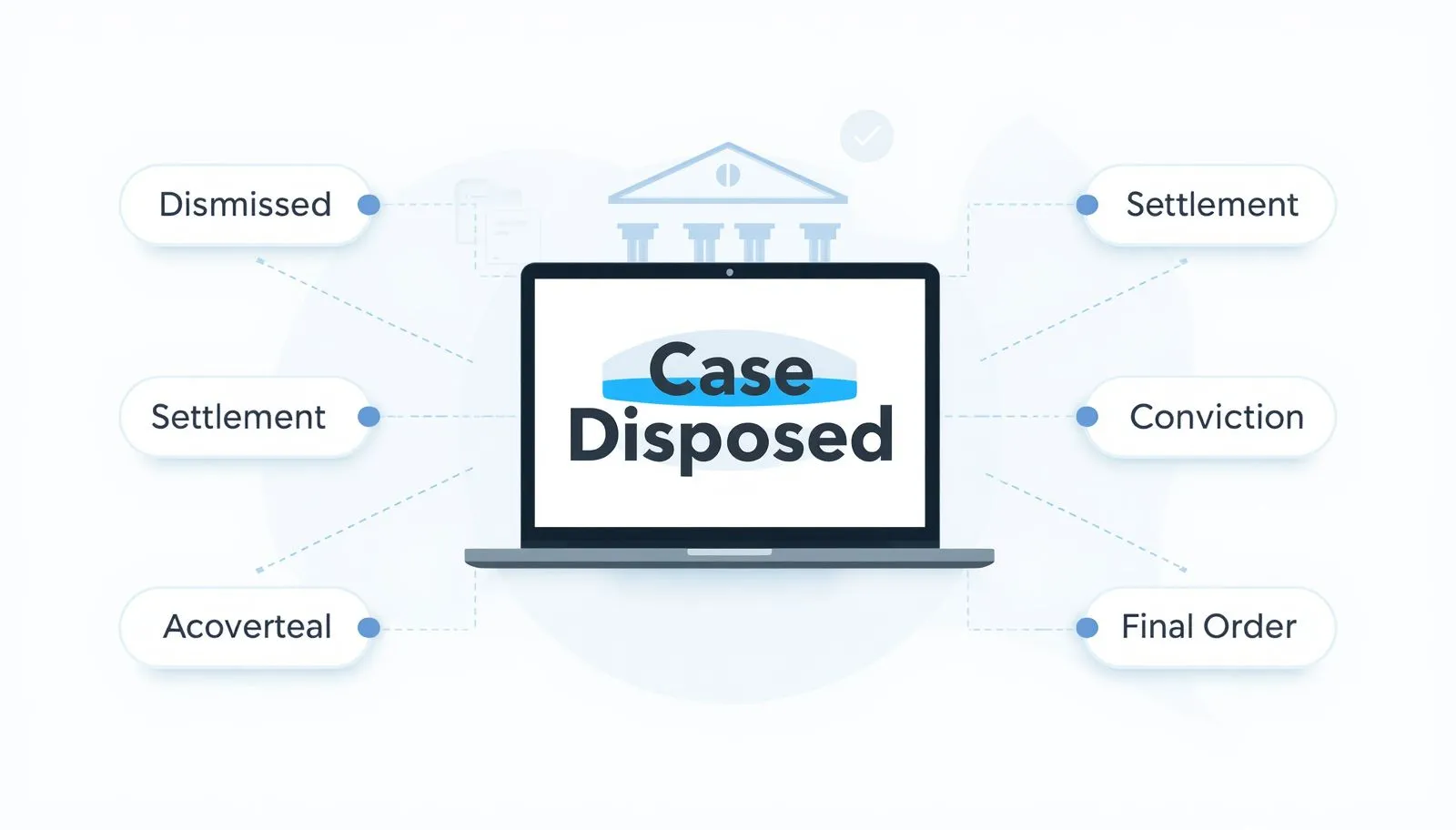
A case disposed means the court has resolved the matter at that stage. However, it does not automatically mean dismissal, victory, loss, conviction, or removal from the record. To understand the real outcome, you must check the final disposition, such as a judgment, dismissal, settlement, sentence, acquittal, withdrawal, or court order.
Legal information note: This article explains general court terminology. Court language and procedures vary by country, state, province, and court system. For advice about your own situation, speak with a qualified lawyer in your jurisdiction.
Quick Answer
When a court record shows a disposed status, the case usually no longer remains pending in that court. Instead, the judge or court system has recorded some type of outcome.
Still, the status alone does not explain what happened. Therefore, you should look for the final order, judgment, decree, sentence, dismissal entry, or detailed disposition.
In simple terms:
Disposed tells you the case reached an outcome. The disposition tells you what that outcome was.
What This Court Status Does and Does Not Mean
Many people see this label online and assume it has one fixed meaning. In reality, courts use it as a broad status term.
It may mean the court:
- Dismissed the matter
- Entered judgment
- Accepted a settlement
- Recorded a plea
- Issued a sentence
- Entered a final order
- Closed the matter after withdrawal
- Resolved the issue after a hearing
However, the term does not automatically mean:
- The case disappeared
- One side won
- The defendant was guilty
- The claim had no merit
- No further duties remain
- The record became sealed
- No appeal deadline applies
For that reason, the final court document matters more than the status label.
Disposed vs. Disposition
Although these words sound similar, they answer different questions.
| Term | Meaning | Why it matters |
|---|---|---|
| Disposed | The court has resolved the matter at that stage | Shows the case is no longer pending in the usual way |
| Disposition | The specific result | Explains how the matter ended |
| Disposition date | The date the result entered the court record | May affect appeal, payment, compliance, or record deadlines |
| Final order, judgment, or decree | The written court decision | Tells the parties what happens next |
Because court portals often show only a short summary, you should open the full docket, order sheet, or case history whenever possible.
Does It Mean the Case Was Dismissed?
Not always.
A dismissal is only one possible outcome. Courts can also resolve matters through settlement, judgment, conviction, acquittal, sentence, withdrawal, compromise, default, or final decree.
For example, a civil lawsuit may end because the judge enters a money judgment. In that situation, the matter has ended, but it was not dismissed.
By contrast, a prosecutor may drop a charge, and the judge may grant dismissal. That matter also reaches a disposed status, but the reason is different.
So, instead of asking only whether the matter ended, ask:
How did it end?
Does It Mean Guilty?
No. In criminal court, this status does not automatically mean guilt.
A criminal matter may end through:
- Dismissal
- Guilty plea
- Conviction after trial
- Acquittal
- Sentence
- Diversion or deferred outcome, where available
- Withdrawal of charges
- Plea agreement
- Other court-approved resolution
In some cases, one charge may end in dismissal while another leads to a plea or sentence. Therefore, you should check each charge separately.
If you need proof of the outcome, ask the court about an official disposition record or certified copy.
Common Court Outcomes That Can Lead to This Status
The table below shows the wording you may see and what it usually means.
| Court wording | Plain-English meaning | What to check next |
|---|---|---|
| Dismissed | The court ended the matter without continuing it | Whether dismissal was with or without prejudice |
| Judgment entered | The court made a formal decision | Payment terms, deadlines, appeal rights, and enforcement |
| Settled or compromised | The parties reached an agreement | Settlement terms or compromise order |
| Withdrawn | The filing party stopped pursuing the matter | Whether refiling remains possible |
| Convicted | A criminal conviction entered | Sentence, fines, probation, and record impact |
| Acquitted | The defendant was found not guilty | Whether all charges ended |
| Default entered | A party failed to appear, respond, or proceed | Default judgment, dismissal, or reopening options |
| Decided on merits | The court reviewed the substance of the dispute | Final reasoning, judgment, or decree |
| Partly allowed | Some claims succeeded while others failed | Exact relief granted and denied |
| Final decree passed | The court issued a final decree | Compliance duties and appeal deadline |
This table also shows why the status alone rarely gives enough information.
Disposed vs. Closed vs. Pending vs. Dismissed
Court websites often use short labels that sound similar. Even so, each one gives a different clue.
| Status | Meaning | Main takeaway |
|---|---|---|
| Pending | The matter still remains active | No final outcome has entered yet |
| Disposed | The court has reached an outcome | You must check the specific result |
| Dismissed | The court ended the claim or charge without continuing it | Refiling may depend on the dismissal type |
| Closed | The court record is administratively inactive | Local systems may use this differently |
| Judgment entered | The court issued a formal decision | Duties, deadlines, or enforcement may follow |
| Settled | The parties resolved the dispute by agreement | The settlement terms may still require action |
As a result, a closed or resolved matter can still carry legal, financial, or record-related consequences.
What It Means in Different Types of Cases
The practical meaning changes depending on the kind of court matter.
Criminal Cases
In criminal court, the outcome may involve dismissal, plea, conviction, acquittal, sentence, diversion, or withdrawal of charges.
You should check:
- Charge-by-charge results
- Plea or verdict
- Sentence
- Fine or restitution
- Probation terms
- Record-sealing options
- Certified disposition record
This step matters because a criminal record can affect employment, immigration, licensing, housing, and background checks.
Civil Lawsuits
In a civil case, the matter may end through judgment, settlement, dismissal, withdrawal, default, or final order.
You should review:
- Final judgment
- Settlement entry
- Dismissal order
- Default judgment
- Appeal deadline
- Payment or enforcement terms
For example, a civil judgment may still require payment even after the court marks the matter as resolved.
Family Court Matters
Family cases may end through final orders, decrees, agreements, or dismissals.
This can apply to:
- Divorce
- Custody
- Child support
- Maintenance or alimony
- Protection orders
- Guardianship
Even after final action, the order may create ongoing duties. For instance, parents may still need to follow custody schedules or support orders.
Traffic Cases
A traffic matter may end after a fine, plea, dismissal, court supervision, or other traffic-court result.
Before assuming the issue is over, check:
- Fine amount
- Points
- License impact
- Payment deadline
- Dismissal terms
- Driving-record consequences
A resolved ticket may still affect your license or insurance, depending on local rules.
Eviction or Housing Cases
In eviction or housing court, the matter may end through judgment, settlement, dismissal, withdrawal, default, or move-out agreement.
You should check:
- Possession order
- Payment plan
- Move-out date
- Judgment amount
- Warrant status
- Settlement terms
Because housing cases can affect future rentals, the final document matters.
Appeals
When an appeal ends, the appellate court may dismiss it, allow it, deny it, remand it, or issue an opinion.
After that, review:
- Appellate judgment
- Mandate
- Remand instructions
- Further appeal deadline
- Any order the lower court must follow
Does the Meaning Change by Country or Court System?
The broad idea usually stays the same: the court has recorded an outcome. However, the exact legal effect can vary.
In Many U.S. Courts
You may see outcomes such as dismissal, judgment, plea, conviction, acquittal, sentence, settlement, withdrawal, or default judgment.
One important distinction involves dismissal type. A dismissal with prejudice usually prevents the same claim from being filed again. A dismissal without prejudice may allow refiling, although deadlines and procedural rules can still limit that option.
In Indian or eCourts-Style Systems
Court-status portals may use phrases such as:
- Disposed
- Contested disposed
- Uncontested disposed
- Disposed by compromise
- Disposed for default
- Disposed on merits
- Dismissed as withdrawn
- Partly allowed
- Final order passed
In this context, the order sheet, final judgment, decree, or certified copy usually gives the clearest answer.
Because legal terminology changes by court system, avoid relying on the summary label alone.
What Does “Disposed by Compromise” Mean?
This phrase usually means the parties reached an agreement, and the court recorded or accepted that settlement.
A compromise may resolve disputes involving money, property, family issues, contracts, or other civil matters. Still, the agreement may require further action.
For example, one party may need to:
- Pay money
- Transfer property
- Withdraw claims
- Follow parenting terms
- Complete agreed conditions
- Comply with a consent order
Therefore, you should read the compromise order or settlement terms carefully.
What Does “Disposed for Default” Mean?
This phrase usually means one party failed to take a required step. That failure may involve not appearing in court, not filing a response, not producing evidence, or not moving the matter forward.
Depending on the court and case type, default may lead to:
- Dismissal
- Default judgment
- Ex parte order
- Case closure
- Possible restoration or reopening request
Since default can affect important rights, read the order to see who defaulted and what the court decided.
What Does “Disposed on Merits” Mean?
This phrase usually means the court considered the substance of the dispute before making a decision.
That differs from a procedural ending. For example, a court may decide a matter on merits after reviewing evidence, hearing arguments, and applying the law to the facts.
Because this type of outcome can affect future rights, read the judgment or final order carefully.
What Does “Disposed After Hearing” Mean?
This phrase means the court took final action after a scheduled hearing.
The hearing may have involved:
- Arguments
- Evidence
- Settlement confirmation
- Plea
- Sentencing
- Default
- Final order
Even then, the phrase does not reveal who won or what the court ordered. The hearing order gives the real answer.
What Does “Disposed After Judgment” Mean?
This wording usually means the court entered a final judgment and then updated the case status.
The judgment may create:
- Payment duties
- Custody or support obligations
- Possession rights
- Sentencing terms
- Injunctions
- Appeal deadlines
- Enforcement options
For that reason, the judgment matters more than the status update.
How to Check the Actual Outcome
When a court record shows that a matter has ended, follow these steps.
1. Search the full record
Use the case number, docket number, party name, ticket number, filing number, or other court identifier.
2. Open the case history
Do not rely on the first summary page. Instead, check the complete docket, order sheet, or hearing history.
3. Read the latest court order
The most recent order often explains the result. Look for words such as:
- Dismissed
- Allowed
- Partly allowed
- Rejected
- Withdrawn
- Settled
- Compromised
- Convicted
- Acquitted
- Sentenced
- Judgment entered
- Decree passed
- Default
- Restored
- Remanded
4. Check the date
The date may affect appeals, payments, compliance, restoration requests, or record deadlines.
5. Request a certified copy
A certified copy can help when the outcome affects employment, immigration, licensing, housing, custody, money, or official records.
6. Ask court staff for procedural help
Court clerks or registry staff can usually explain how to find records or request copies. However, they generally cannot provide legal advice.
7. Get legal advice when consequences matter
Speak with a lawyer if the result affects liberty, criminal history, immigration, professional licensing, property, custody, debt, or appeal rights.
Does the Record Remain Visible?
It may.
A resolved matter does not automatically disappear from public records. Likewise, the status does not mean the record has been sealed, expunged, restricted, or deleted.
Visibility depends on:
- Case type
- Court rules
- Public-record access
- Criminal-record laws
- Juvenile-record protections
- Sealing or expungement eligibility
- Background-check practices
- Whether the record was updated correctly
For criminal cases, the exact outcome matters greatly. A dismissal, acquittal, conviction, plea, or sentence may carry different consequences.
Can the Matter Be Reopened?
Sometimes, but not automatically.
Possible options may include:
- Appeal
- Motion to reopen
- Motion to vacate
- Motion to set aside default
- Reconsideration request
- Restoration application
- Correction of clerical error
- Enforcement proceeding
- Refiling after dismissal without prejudice, where allowed
- Remand from a higher court
However, deadlines can be strict. Also, courts usually require a valid legal reason before revisiting a resolved matter.
Why This Status Can Still Matter
A court outcome may continue to affect you after the status changes.
It may matter for:
- Employment background checks
- Immigration applications
- Professional licensing
- Housing applications
- Driving records
- Child custody
- Child support
- Debt collection
- Property disputes
- Probation conditions
- Appeals
- Record sealing
- Future lawsuits
Because of these possible effects, always check the actual order or disposition.
Common Mistakes to Avoid
Mistake 1: Assuming it means dismissal
A dismissal is only one possible outcome. The matter may also end through judgment, settlement, conviction, sentence, compromise, or default.
Mistake 2: Assuming the record disappeared
Court records may remain visible unless a court or law allows sealing, expungement, or restricted access.
Mistake 3: Ignoring the final order
The status gives a summary. The order explains the legal effect.
Mistake 4: Missing deadlines
Appeal, restoration, reconsideration, payment, and compliance deadlines may run from the final order date.
Mistake 5: Thinking nothing else remains
Even after a court marks a matter resolved, a person may still need to pay fines, follow probation, obey a custody order, satisfy a judgment, or complete settlement terms.
What Most Articles Miss About This Topic
Many explanations say the term means “closed.” While that helps, it does not go far enough.
A better explanation is:
The status does not tell you the result. It tells you that a result exists.
That distinction matters because different outcomes can create very different consequences.
For example:
- A dismissed case may leave no payment duty.
- A civil judgment may create a debt.
- A sentence may require probation or fines.
- A compromise may require future performance.
- A default may need urgent action.
- A decision on merits may affect refiling rights.
- A family order may create continuing obligations.
So, instead of stopping at the status label, look for the final order, judgment, decree, sentence, or certified copy.
What to Do Next
Use this quick checklist:
- Open the full court record.
- Find the final order, judgment, decree, sentence, or dismissal entry.
- Check the exact outcome and date.
- Look for any payments, duties, deadlines, or conditions.
- Request a certified copy if you need proof.
- Review appeal, restoration, or reopening deadlines.
- Talk to a lawyer if the result affects major rights or obligations.
FAQs
What does this court status mean in simple words?
It means the court has resolved the matter at that stage. However, you still need the specific disposition to know how it ended.
Does it mean dismissed?
No. Dismissal is only one possible result. The court may also resolve a matter through judgment, settlement, conviction, acquittal, sentence, compromise, withdrawal, or default.
Does it mean guilty?
No. In criminal court, the outcome may involve guilt, but it may also involve dismissal, acquittal, withdrawal, diversion, or another result.
Is it the same as closed?
Often, the terms overlap. However, “closed” may refer to an administrative status, while “disposed” usually points to a recorded outcome.
Is this status good or bad?
It depends on the actual result. A dismissal or acquittal may help one side, while a judgment, conviction, or adverse order may create consequences.
What does it mean in a civil case?
In a civil matter, it usually means the dispute ended through judgment, settlement, dismissal, withdrawal, default, or final order.
What does it mean in a criminal case?
In criminal court, it means the charge or case reached an outcome, such as dismissal, plea, conviction, acquittal, sentence, or withdrawal.
What does disposed by compromise mean?
It usually means the parties reached an agreement, and the court recorded or accepted it. Read the settlement or compromise order to understand the terms.
What does disposed for default mean?
It usually means one party failed to appear, respond, or proceed. The result may involve dismissal, default judgment, or another court order.
What does disposed on merits mean?
It generally means the court considered the substance of the dispute before making a decision.
Can the matter reopen later?
Sometimes. Appeal, restoration, reopening, reconsideration, or setting aside default may be possible, depending on rules and deadlines.
Can it show on a background check?
Yes, it may. A resolved matter does not automatically disappear from public records or background checks.
How do I find the exact result?
Open the full docket, case history, order sheet, judgment, decree, sentence, or certified disposition record.
Should I get a certified copy?
Consider getting one if the outcome affects employment, immigration, licensing, housing, custody, money, criminal history, or official records.
Conclusion
A disposed court matter has reached an outcome at that stage. Still, the word alone does not tell you whether the result was dismissal, judgment, settlement, conviction, acquittal, compromise, default, sentence, or final order.
To understand what happened, read the actual disposition. When the issue affects your record, money, custody, license, immigration status, or legal rights, get a certified copy and seek legal advice.
Click Here To Read About :what does getting baptized mean

Hi, I’m Geoffrey Chaucer. I explore the stories and meanings behind words, turning ideas into clear, insightful writing. Through every article I craft, I aim to spark curiosity, share knowledge, and help readers uncover practical, meaningful truths in everyday life.