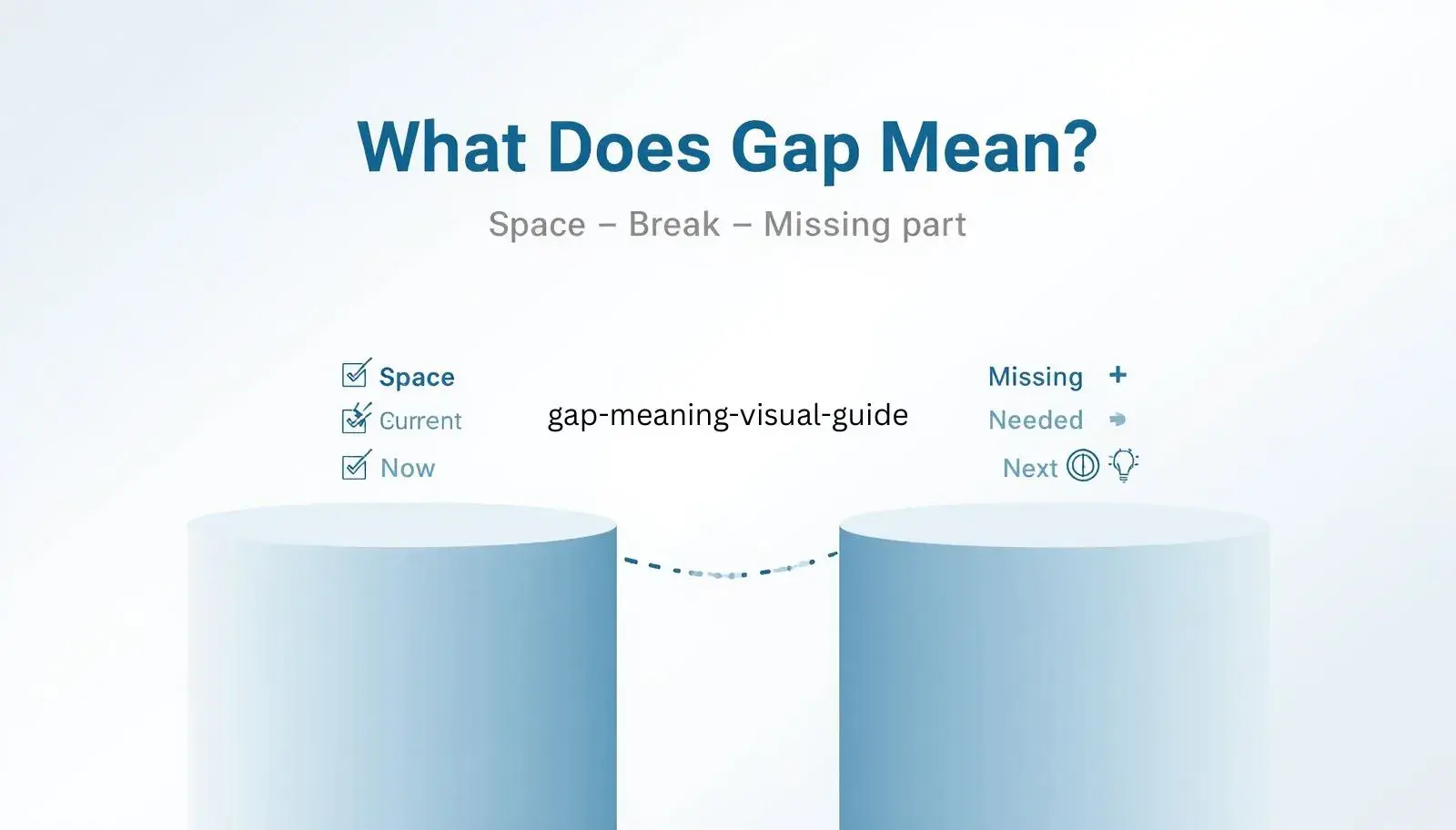
A gap is a space, opening, break, missing part, or difference between two things. People use the word for physical spaces, time intervals, missing knowledge, unequal results, communication issues, business problems, and many other situations.
At its simplest, the word points to something between two sides. Those sides might be two objects, two times, two people, two prices, two expectations, or two levels of understanding.
Quick Definition
| Item | Explanation |
|---|---|
| Pronunciation | /ɡæp/ |
| Word type | Noun and verb |
| Simple meaning | A space, break, missing part, or difference |
| Verb forms | gap, gapped, gapping |
| Similar words | space, opening, break, interval, difference, shortfall, divide |
| Common phrases | close the gap, bridge the gap, fill the gap, gap in the market |
In everyday English, this word often describes either a real space you can see or an abstract difference you need to understand.
Gap Meaning in Simple Words
In simple words, a gap shows that something is open, missing, separate, or different.
For example:
- A space in a fence shows a physical opening.
- Free time between meetings creates a time interval.
- Missing information in a report leaves an incomplete part.
- Unequal income between groups creates a financial difference.
- Poor communication between people creates a disconnect.
Because the word works in so many contexts, the sentence around it usually tells you the correct meaning.
Main Meanings of Gap
1. A Physical Space or Opening
The most basic meaning refers to an empty space between two things.
Examples:
- “There is a small gap under the door.”
- “The child looked through the opening in the wall.”
- “She has space between her front teeth.”
In these examples, the meaning stays physical. You can usually see or measure the space.
2. A Break or Pause in Time
Sometimes, the word describes a pause between two events.
Examples:
- “I have two hours free between classes.”
- “After a long break, he returned to work.”
- “Several months passed between the first update and the next one.”
Here, the idea relates to time rather than a physical opening.
3. A Missing Part or Lack
The word can also show that something is incomplete.
Examples:
- “The report has missing details.”
- “Her explanation leaves several unanswered questions.”
- “This course helped improve my understanding of the topic.”
In this use, the focus sits on what someone still needs to add, learn, or explain.
4. A Difference or Disparity
People often use the term when comparing two groups, numbers, outcomes, or expectations.
Examples:
- “There is a large difference between the two prices.”
- “The income divide has increased.”
- “Customers expected faster service than the company provided.”
This meaning appears often in discussions about money, education, skills, opportunity, and performance.
5. A Pass or Opening in Mountains
In geography, the word can describe a low opening between hills or mountains.
Example:
- “The trail runs through an opening in the mountains.”
Although this meaning appears less often in casual conversation, it still shows up in place names and geographic descriptions.
6. A Technical Space or Separation
In technical fields, the term may describe a specific space between parts.
Examples:
- A spark gap refers to a small space between electrical conductors.
- An air gap describes a physical separation used for safety or security.
- A chart may show a price jump between two trading periods.
Since technical meanings vary by field, context matters even more.
Gap as a Noun and Verb
As a Noun
Most people use gap as a noun.
Examples:
- “There is a space in the fence.”
- “She noticed missing data in the file.”
- “The company wants to reduce the skills divide.”
As a noun, it names the space, break, missing part, or difference.
As a Verb
The word can also work as a verb, although this use appears less often in everyday speech.
Examples:
- “The stock gapped up after the announcement.”
- “The chart gapped down at the market open.”
- “The damaged surface gapped in several places.”
In trading, phrases such as gapped up and gapped down describe a price that opens noticeably higher or lower than the previous trading range.
Meaning by Context
| Context | Meaning | Example |
|---|---|---|
| Everyday English | Space, opening, or difference | “There is space between the chairs.” |
| Time | Pause or interval | “We have free time between meetings.” |
| School | Missing learning or education break | “The student needs help with reading.” |
| Work | Missing skill or process issue | “The team needs stronger data skills.” |
| Business | Difference between current and desired results | “Customer service does not meet the target.” |
| Market | Unmet customer need | “Affordable options are hard to find.” |
| Communication | Disconnect in understanding | “The team misunderstood the deadline.” |
| Money | Difference in income, pay, cost, or value | “The wage difference increased.” |
| Insurance | Shortfall between value and amount owed | “The loan balance exceeded the car value.” |
| Trading | Price jump between trading periods | “The stock opened higher than expected.” |
| Geography | Pass or opening | “The road crosses the mountain pass.” |
| Technology | Physical or system separation | “The network uses an air separation.” |
What It Means in School
In school, the word often describes missing learning, a break in education, or a difference in achievement.
Common school uses include:
- Learning gap: a student needs to understand something they missed.
- Achievement gap: groups of students show different academic outcomes.
- Gap year: a planned break between school, college, work, or another stage.
- Time between classes: free time before the next lesson.
For instance, a teacher might say, “She understands multiplication, but she needs more help with fractions.” That means one part of her learning still needs attention.
What It Means in Business
In business, the term usually shows the distance between the current situation and the desired result.
A company may find this type of issue when:
- sales fall below target
- customers want something the market does not offer
- employees need new skills
- teams misunderstand priorities
- performance does not match expectations
Common business phrases include:
- gap analysis
- skill gap
- market gap
- performance gap
- communication gap
- expectation gap
For example, a company might compare current customer support response times with its target response time. The difference between those two points shows what the business needs to improve.
What It Means in Insurance
In car insurance, GAP insurance usually refers to coverage that may help with the difference between what someone owes on a vehicle and what the vehicle is worth after a covered total loss or theft.
Example:
- The driver owes $18,000 on the loan.
- The vehicle’s value drops to $15,000.
- The remaining $3,000 creates the shortfall.
Policy terms vary, so drivers should always review the exact coverage details before relying on it.
What It Means in Trading
In trading, the word describes a price that opens above or below the previous trading range.
Example:
- A stock closes at $50.
- The next session opens at $55.
- The chart shows a jump between the two price areas.
News, earnings reports, market movement, and low liquidity can all cause this type of price movement. However, the pattern does not guarantee what the price will do next.
What It Means in Text or Conversation
In casual conversation, the word usually keeps its everyday meaning. It may point to a space, difference, break, missing detail, or emotional distance.
Examples:
- “There’s distance between us now.”
Meaning: the relationship feels less close. - “I have free time this afternoon.”
Meaning: the person has an open spot in their schedule. - “Your story has missing details.”
Meaning: part of the explanation does not make sense yet. - “We need to reduce the difference.”
Meaning: two sides need to come closer together.
Usually, the word is not slang. Instead, people use it in casual, academic, professional, and technical settings.
Common Phrases
Bridge the Gap
To bridge the gap means to connect two sides or reduce a divide.
Example:
“The training program helps bridge the gap between school and work.”
Close the Gap
To close the gap means to make a difference smaller.
Example:
“The new coaching plan aims to close the skill gap.”
Fill the Gap
To fill the gap means to provide something that is missing.
Example:
“The extra lesson helped fill the gap in her understanding.”
Widen the Gap
To widen the gap means to make a difference larger.
Example:
“Rising costs widened the gap between income and expenses.”
Gap in the Market
A gap in the market means customers need something that current products or services do not provide well.
Example:
“She noticed a gap in the market for affordable healthy lunches.”
Generation Gap
A generation gap describes differences in attitudes, habits, beliefs, or communication styles between age groups.
Example:
“The generation gap became clear when they discussed social media.”
Communication Gap
A communication gap happens when people do not share, receive, or understand information clearly.
Example:
“A communication gap between departments caused the delay.”
Knowledge Gap
A knowledge gap refers to something a person or group still needs to learn.
Example:
“The workshop helped close the knowledge gap.”
Pay Gap or Wage Gap
A pay gap or wage gap describes a difference in earnings between people, roles, or groups.
Example:
“The company reviewed wage differences across departments.”
Synonyms and Similar Words
The best alternative depends on the sentence.
| Similar Word | Best Use |
|---|---|
| Space | Physical distance |
| Opening | A visible hole or break |
| Break | An interruption |
| Interval | Time between events |
| Difference | A comparison between two things |
| Disparity | A serious or unequal difference |
| Divide | Social, emotional, or political separation |
| Shortfall | Less than the needed amount |
| Lack | Something missing |
| Hiatus | A pause in activity |
| Breach | A serious opening, break, or violation |
Opposite Words
Depending on the context, possible opposites include:
- connection
- link
- continuity
- closure
- overlap
- equality
- agreement
- match
For example, when the word means disconnection, connection works as an opposite. When it means inequality, equality may fit better.
Gap vs Difference vs Lack vs Hole
| Word | Meaning | Example |
|---|---|---|
| Gap | A space, break, missing part, or difference | “There is a gap in the plan.” |
| Difference | A way two things are not the same | “The two prices are different.” |
| Lack | Not enough of something | “The report lacks evidence.” |
| Hole | A physical opening | “There is a hole in the shirt.” |
| Shortfall | Less than the needed amount | “The budget fell short.” |
Although these words overlap, they do not always mean the same thing. A hole usually refers to something physical, while a lack points to something missing. A difference simply compares two things, but a gap often suggests distance, absence, or imbalance between them.
Is It Always Negative?
No. The meaning can be negative, neutral, or positive.
Some uses suggest a problem:
- safety gap
- learning gap
- pay gap
- communication gap
Other uses feel neutral:
- space between meetings
- opening in a fence
- space between words
In some cases, the idea can show opportunity:
- unmet demand in a market
- room for improvement
- available time in a schedule
- missing content that a guide can explain
So, the sentence determines whether the meaning feels negative, neutral, or useful.
Is GAP Different From Gap?
Sometimes GAP in capital letters points to something specific.
For example:
- Gap may refer to the clothing brand.
- GAP insurance uses the term in a specific insurance context.
- GAP may stand for a program, policy, process, or internal term in an organization.
Because acronyms vary, always check the surrounding words before assuming the meaning.
Examples in Sentences
Physical Space
- “There is space between the sofa and the wall.”
- “The dog slipped through the opening in the gate.”
- “Mind the space between the train and the platform.”
Time
- “Several years passed between her first and second books.”
- “I have free time this afternoon.”
- “After five years away, he returned to college.”
Missing Part
- “The report lacks important evidence.”
- “Her memory has missing details from that day.”
- “The course improved her understanding of the topic.”
Difference or Disparity
- “The two prices differ by a large amount.”
- “The income divide has grown.”
- “Expectations and reality did not match.”
Business and Work
- “The company found a weakness in its support process.”
- “The team needs stronger data analysis skills.”
- “The new product serves a need competitors ignore.”
Communication
- “Poor communication caused the mistake.”
- “The manager explained one thing, but the team understood another.”
How to Understand the Meaning in Any Sentence
To understand the word correctly, look for the two sides.
Ask these questions:
- Does the sentence describe physical space?
Then the word means an opening or empty area. - Does it describe time?
Then it means a pause or interval. - Does something seem missing?
Then it points to an incomplete part. - Does the sentence compare two things?
Then it means a difference or disparity. - Does the context involve a specialized field?
Then the meaning may relate to business, insurance, trading, geography, technology, or education.
Consider this example:
“There is a gap between what customers want and what the company offers.”
The two sides are:
- what customers want
- what the company offers
Therefore, the sentence points to an unmet need.
Common Mistakes
Mistake 1: Thinking It Only Means Physical Space
The word can describe visible space, but it can also refer to knowledge, money, time, expectations, skills, emotions, or communication.
Mistake 2: Assuming Every Use Is Negative
Some uses signal problems, while others simply describe time, space, or opportunity.
Mistake 3: Confusing It With “Hole”
A hole usually describes a physical opening. This word can describe both physical and abstract situations.
Mistake 4: Ignoring the Sentence Around It
Context decides the meaning. School, business, insurance, and trading all use the term differently.
Mistake 5: Treating Capitalized GAP as One Fixed Acronym
Capital letters can signal a brand, insurance term, workplace program, or industry-specific acronym. The surrounding text gives the real clue.
What Most Articles Miss About This Topic
Most explanations stop at “space” or “difference.” However, the more useful idea is this:
A gap usually sits between two states.
Those states might include:
- what exists and what someone needs
- what a person knows and what they still need to learn
- what someone expected and what actually happened
- where a company stands now and where it wants to be
- what customers want and what businesses provide
- what a vehicle is worth and what the owner still owes
- what one person said and what another person understood
This approach makes the word easier to interpret. Instead of memorizing every possible use, identify the two sides and ask what separates them.
For example, a learning issue compares current knowledge with needed knowledge. A pay difference compares earnings between people or groups. A market opportunity compares customer demand with available solutions. Once you see the two sides, the meaning becomes much clearer.
FAQ
What does gap mean in simple words?
It means a space, opening, break, missing part, or difference between two things.
What is an example?
“There is a space in the fence” describes a physical opening. “The report has missing details” describes an incomplete part.
Is gap a noun or a verb?
It can work as both. Most people use it as a noun, but it can also work as a verb in phrases such as “the stock gapped up.”
What are the verb forms?
The verb forms are gap, gapped, and gapping.
What does it mean in school?
In school, it can describe missing learning, a break in education, or a difference in achievement.
What does it mean at work?
At work, it may refer to a missing skill, process issue, communication problem, or difference between current performance and a goal.
What does it mean in business?
In business, it often means the distance between the current situation and the desired result. It can also describe an unmet customer need.
What does it mean in a relationship?
In a relationship, it can point to emotional distance, different expectations, poor communication, or a disconnect between two people.
What does bridge the gap mean?
It means to connect two sides or reduce a divide.
What does close the gap mean?
It means to make a difference smaller or solve what is missing.
What does fill the gap mean?
It means to provide something missing.
What does gap in the market mean?
It means customers need something that current products or services do not provide well.
What is another word for gap?
Possible alternatives include space, opening, break, interval, difference, disparity, shortfall, divide, and lack.
What is the opposite?
Possible opposites include connection, continuity, closure, equality, overlap, agreement, or match.
Is it always negative?
No. It can describe a problem, a neutral space, or an opportunity, depending on the sentence.
Conclusion
A gap describes a space, opening, break, missing part, or difference between two things. It may refer to something physical, such as space under a door, or something abstract, such as missing knowledge, unequal pay, unclear communication, or a difference between expectations and reality.
To understand the meaning quickly, look for the two sides in the sentence. Then ask what separates them, what is missing, or what does not match. Once you do that, the meaning becomes clear.
Click Here To Read About :what does the name blake mean

I am Clara Lexis, a writer driven by clarity, depth, and authenticity. My focus is on transforming ideas into meaningful content that is both informative and engaging. I write with intention to communicate clearly, thoughtfully, and with purpose.