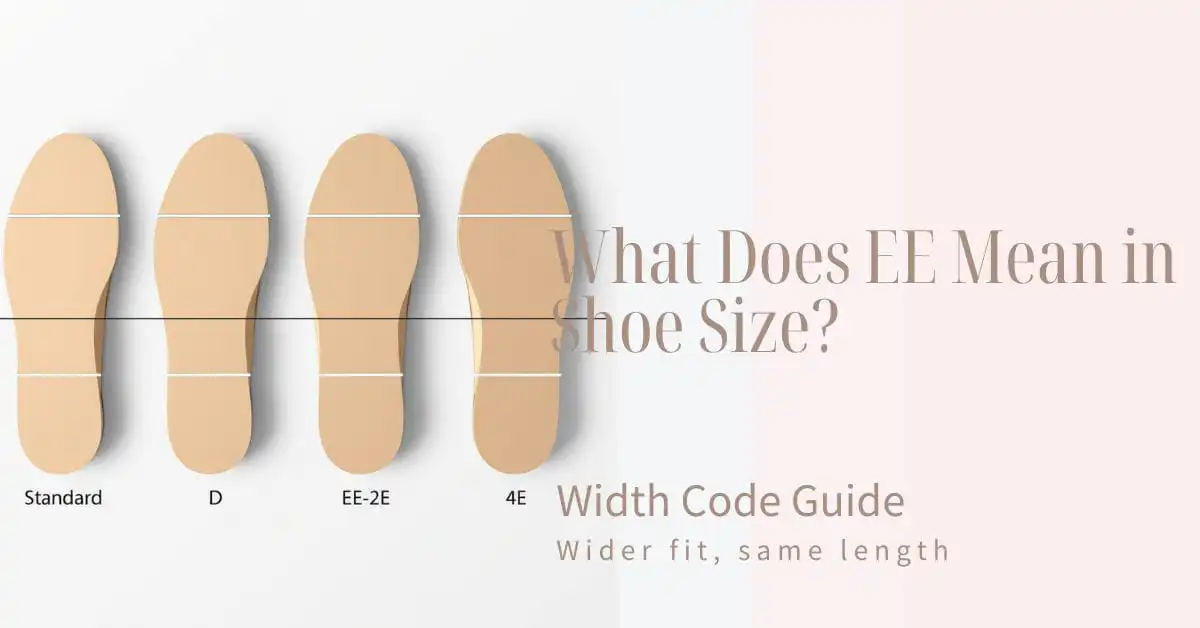
EE in shoe size means the shoe is wider than standard. In many cases, EE is the same as 2E, though the exact label depends on the brand and whether the shoe is men’s or women’s. If your shoes feel tight on the sides but long enough at the toes, an EE width may be the fix instead of going up in length.
EE shoe size meaning at a glance
- EE = a wider shoe width
- EE and 2E are often the same thing
- Men’s standard width is usually D
- Women’s standard width is usually B
- If a shoe has no width marking, it is usually standard width
- EE changes width, not length
If you searched this because you saw EE on a shoe box, product page, or size label, the main thing to know is that it is a width code, not a length code. It tells you how roomy the shoe is across the forefoot, ball of the foot, and sometimes the footbed and upper as well. Brooks explains that width differences are not just about one measurement; they also affect the room and fit of the upper, and extra-wide shoes may also have a wider platform.
What does EE mean in shoe size, exactly?
EE means the shoe is made wider than a standard-width version of the same length. In traditional shoe-width lettering, brands may use E, EE, EEE, and so on to show progressively wider fits. In many athletic shoes, the same idea is often written as 2E or 4E instead.
That is why shoppers get confused. One brand may print EE, another may print 2E, and another may simply label the same kind of fit as Wide or X-Wide. New Balance product listings, for example, commonly show men’s widths as Narrow (B), Standard (D), Wide (2E), X-Wide (4E).
Where EE fits on a shoe width chart
Here is the simplest way to place EE in the wider width system.
| Width code | Typical meaning | Common notes |
|---|---|---|
| B | Standard for many women’s shoes | Can mean narrow in some men’s systems |
| D | Standard for many men’s shoes | Often wide in women’s shoes |
| E | Wide | More common in traditional width systems |
| EE / 2E | Extra width beyond standard | Often the same notation in different systems |
| EEE / 4E | Extra wide or wider still | More common in wide-fit lines |
| XW / XXW | Brand-specific extra-wide labels | Not standardized across all brands |
This is a useful guide, not a universal law. Brand systems vary, and the same code may sit in a slightly different place depending on whether the shoe is men’s, women’s, or unisex.
Is EE the same as 2E?
Usually, yes. In many U.S. shoe listings, EE and 2E refer to the same width step. Traditional dress shoes, boots, and some heritage brands often use EE, while athletic brands often use 2E.
Still, two shoes labeled EE or 2E may not feel identical. The last, toe-box shape, upper materials, arch shape, and how the brand builds width into the shoe all affect real-world fit. That is one reason Brooks, ASICS, and New Balance all direct shoppers to brand-specific fit guides rather than treating width as perfectly interchangeable across brands.
Men’s vs women’s vs unisex width codes
This is one of the biggest points of confusion, and many articles do not explain it clearly enough.
Men’s shoe widths
For many athletic brands:
- D = standard
- 2E = wide
- 4E = extra wide
Women’s shoe widths
For many athletic brands:
- B = standard
- D = wide
- 2E = extra wide
Unisex shoes
Unisex sizing creates extra confusion because width may follow the men’s standard. Brooks states that all-gender or unisex sizes match men’s sizes per industry standards. That means a width label on a unisex shoe may not map the way a women’s shopper expects unless they check the chart first.
What if a shoe has no width marking?
This is one of the most helpful things to know:
If a shoe has no width marking at all, it is usually standard medium width. ASICS says shoe boxes and labels identify widths other than standard, which means unmarked shoes are typically standard width. In practical terms, that usually means D for men and B for women.
This is why many people do not know their width. They have only ever worn standard-width shoes and never needed to think about the code.
Where to find the width code on a shoe
You may see the width in a few different places:
- on the product page
- on the shoe box
- on the size sticker
- on the label under the tongue
- in the site’s width selector or filter
ASICS specifically notes that wide and narrow widths can be identified on the label underneath the tongue.
How to know if you might need EE shoes
You may need EE, 2E, or another wider option if:
- the shoe feels tight across the sides
- the ball of your foot feels squeezed
- the forefoot material visibly stretches or bulges
- your toes feel cramped even though the shoe is long enough
- you keep buying longer shoes just to get more side-to-side room
- the upper rubs or presses around the widest part of your foot
ASICS says visible stretching or bulging on the outside of the forefoot is a good sign that additional width may be needed. Brooks also points to squeezing at the sides as a clue that standard width may not be right.
EE vs going up a size
If the problem is width, sizing up is often the wrong fix.
A longer shoe can give a little extra room, but it can also create heel slip, awkward flex points, extra empty space in front, and a less secure fit. If your current shoe length already feels right, a wider width is usually a better solution than moving up half a size or a full size. Brand fit guides also separate size and width decisions rather than treating one as a substitute for the other.
How to measure foot width at home
You do not need a fitting shop to get a useful starting point.
1. Measure later in the day
New Balance recommends trying shoes on and checking fit later in the day, when feet are naturally a little larger.
2. Measure both feet
New Balance advises checking both feet and buying for the larger one if they differ.
3. Measure the widest part of the foot
Your width is taken across the widest part of the foot, usually around the ball of the foot and forefoot area. Printable size tools from New Balance are built around this kind of measurement workflow.
4. Compare your result with the brand’s chart
This step matters more than people think. Width systems are similar, but not identical, across brands. Always compare your measurement to the brand’s own chart or width guide.
EE vs D vs E vs 4E: quick comparison
| Width | What it usually means | Best shorthand way to think about it |
|---|---|---|
| D | Standard for many men | “Regular men’s width” |
| E | One step wider in traditional systems | “Wide” |
| EE / 2E | Wider again | “Extra width beyond standard” |
| 4E | Wider than 2E in many athletic shoes | “Extra wide / X-wide” |
The exact spacing between these widths is not perfectly standardized across every brand. Use the table to understand the order, not as a guarantee that every EE shoe fits the same.
Common mistakes people make with EE sizes
Assuming EE means the same fit in every brand
It does not. Width codes help, but fit also depends on shoe shape, last, upper material, and how the brand builds volume into the shoe.
Confusing width with length
EE changes the width of the shoe, not the length. If the length is already right, do not assume you need a bigger size number.
Ignoring standard-width defaults
A lot of shoppers see no width marking and assume width is not relevant. In reality, unmarked usually means standard width.
Forgetting that women’s and men’s labels do not map the same way
A D or 2E label can mean different things depending on whether the shoe is men’s or women’s.
Treating “roomy toe box” as the same as “wide shoe”
Some shoes feel generous near the toes without being genuinely wide through the forefoot, midfoot, or platform. Fit still needs to be checked as a full-shoe experience.
What Most Articles Miss About This Topic
Most articles stop at “EE means extra wide” and leave it there. That is only part of the answer.
What people really need to know is that shoe width is not just a letter code. It is also about where the room is added and how the shoe is shaped. Brooks explains that wider versions can change more than one part of the shoe, including the amount of room in the upper and, in extra-wide models, the width of the platform itself. That is why two shoes labeled EE can still feel very different on foot.
Another point many pages miss: unmarked shoes are usually standard width. That is one of the most useful shopping shortcuts because it helps you read a product listing even when no width code appears. ASICS states that only widths other than standard are identified on boxes and labels.
And one more detail that matters in real life: unisex shoes often follow men’s sizing standards, so women shopping unisex styles should check the brand chart before assuming the width label works like a women’s width label. Brooks makes this explicit in its size guide.
Quick answer: should you buy EE shoes?
Buy EE shoes if:
- your current length feels right
- your shoes feel tight at the widest part of your foot
- you regularly feel squeezing on the sides
- you notice forefoot bulging or upper stretching
- standard-width shoes feel restrictive across the ball of the foot
Do not buy EE just because a shoe feels short. If the problem is length, width will not fix it. Use both size and width together.
FAQ
Does EE mean extra wide?
Usually, yes. In many traditional width systems, EE is understood as extra wide. In athletic shoes, that same fit level is often written as 2E or paired with 4E as the next wider option.
Is EE the same as 2E?
In many cases, yes. They are often two ways of writing the same width step, especially across different footwear categories and brands.
Is EE wider than D?
Yes. D is commonly standard for men, while EE or 2E is a wider option. For women, D is often already wide, which is why context matters.
Does EE mean the same thing in women’s shoes?
Not always. In many athletic brands, women’s standard width is B, women’s D is wide, and women’s 2E is extra wide.
What does 4E mean in shoe size?
4E usually means an even wider fit than 2E or EE. In many men’s athletic shoes, 4E is labeled as extra wide or X-wide.
What if my shoe does not show a width?
It is usually standard width. ASICS says boxes and labels identify widths other than standard, which implies unmarked shoes are standard medium width.
Can I just size up instead of buying EE?
Usually not if the real issue is width. A longer shoe may create new fit problems without solving side pressure.
Where can I find the width code?
Look on the product page, shoe box, size label, or under the tongue. ASICS specifically notes that non-standard width identifiers can appear on the label under the tongue.
Conclusion
EE in shoe size means a wider-than-standard fit. In many cases, it is the same as 2E, but the exact label depends on the brand and whether the shoe is men’s, women’s, or unisex. The simplest way to shop smarter is to remember three things: width is different from length, unmarked shoes are usually standard width, and brand charts matter more than guessing from the letters alone.
Click Here To Read About :what does dharma mean

I am Clara Lexis, a writer driven by clarity, depth, and authenticity. My focus is on transforming ideas into meaningful content that is both informative and engaging. I write with intention to communicate clearly, thoughtfully, and with purpose.