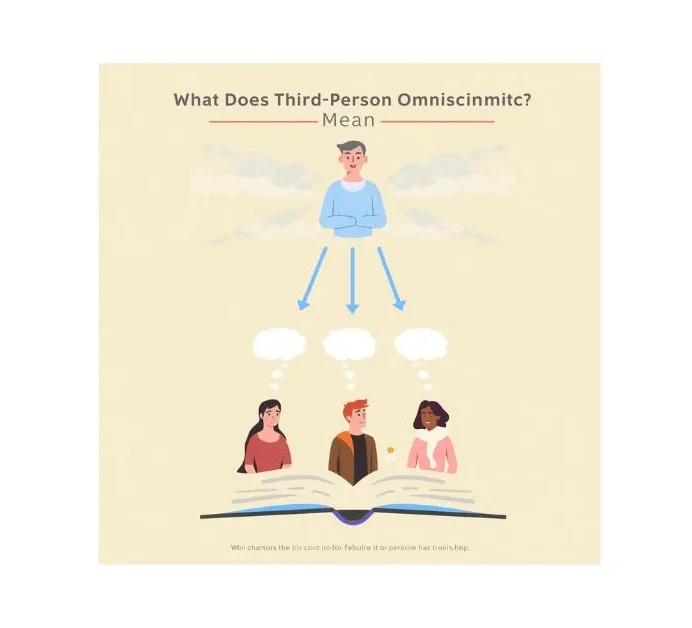
Third person omniscient means a story is told by an outside narrator who knows everything about the characters, events, and story world. This narrator can reveal what different characters think, feel, know, hide, or misunderstand.
In simple words, third person omniscient is an all-knowing third person narrator.
This point of view is common in literature and fiction writing. You may see it in English class, writing guides, book reviews, or discussions about narration. To understand it clearly, it helps to break the phrase into two parts.
Quick Meaning of Third Person Omniscient
| Term | Simple Meaning |
|---|---|
| Third person | The narrator uses words like he, she, they, him, her, and them. |
| Omniscient | All-knowing. |
| Third person omniscient | A narrator outside the story knows everything. |
So, when someone asks, “What does third person omniscient mean?”, the answer is simple:
It means the narrator is not a character in the story, but the narrator knows what is happening everywhere and what multiple characters are thinking or feeling.
Simple Example of Third Person Omniscient
Here is an easy example:
Emma smiled as she opened the letter, certain it contained good news. Across the room, James already knew the truth and wished he had warned her sooner. Neither of them noticed Clara listening from the hallway.
This is third person omniscient because the narrator knows several things at once.
The narrator knows:
- What Emma believes
- What James knows
- What James feels
- What Clara is doing
- What Emma and James do not notice
As a result, the reader understands more than any one character does.
Why Is It Called Omniscient?
The word omniscient means all-knowing.
Therefore, an omniscient narrator knows more than a normal character could know. This narrator can see inside different characters’ minds. The narrator can also explain events from the past, present, or future.
For example, the narrator may know:
- A character’s private thoughts
- A character’s hidden feelings
- A secret another character is keeping
- Something that happened years earlier
- Something that will matter later in the story
- Something happening in another place
However, this does not mean the narrator must tell the reader everything at once. A good narrator only reveals the information that helps the story.
How Third Person Omniscient Works
Third person omniscient works by giving the reader a wider view of the story.
Instead of staying inside one character’s mind, the narrator can move from one character to another. Because of this, the reader can understand different sides of the same event.
For example:
Maya thought Daniel was angry with her. Daniel, however, was only afraid she would discover the truth.
In this sentence, the narrator knows both Maya’s misunderstanding and Daniel’s real feeling.
This is useful because it helps the reader see the conflict more clearly.
How to Identify Third Person Omniscient
To identify third person omniscient, look for two main signs.
First, check the pronouns.
The story will usually use words like:
- he
- she
- they
- him
- her
- them
Next, check what the narrator knows.
A passage may be third person omniscient if the narrator:
- Reveals the thoughts of more than one character
- Shows feelings that characters do not say out loud
- Knows information no single character knows
- Moves between different places or times
- Comments on the meaning of events
- Gives the reader a bigger view than the characters have
A helpful question is:
Is the narrator limited to one character’s knowledge?
If the answer is no, the story may be using third person omniscient point of view.
Annotated Example
Read this short passage:
Leo believed the argument was over, but Nina was still replaying every word in her mind. Upstairs, their father heard the silence and understood that something in the family had changed.
Now let’s break it down.
| Part of the Passage | What It Shows |
|---|---|
| “Leo believed the argument was over” | The narrator knows Leo’s belief. |
| “Nina was still replaying every word” | The narrator knows Nina’s thoughts. |
| “their father heard the silence” | The narrator moves to another character. |
| “something in the family had changed” | The narrator understands the larger meaning of the scene. |
Because the narrator knows more than one character’s thoughts and feelings, this is third person omniscient.
Third Person Omniscient vs. Third Person Limited
Third person omniscient is often confused with third person limited. Both use third person pronouns. However, they are not the same.
The difference is how much the narrator knows.
| Point of View | What the Narrator Knows | Example |
|---|---|---|
| Third person limited | The narrator mainly follows one character. | Maya saw Daniel whispering and wondered what he was hiding. |
| Third person omniscient | The narrator can know many characters’ thoughts and feelings. | Maya wondered what Daniel was hiding, while Daniel silently hoped she would not ask. |
| Third person objective | The narrator only reports actions and dialogue. | Maya looked at Daniel. Daniel folded the note and put it away. |
In short, third person limited stays close to one character.
In contrast, third person omniscient gives the reader a wider view.
Third Person Omniscient vs. Third Person Objective
Third person objective is another type of third person narration. However, it is more limited than omniscient narration.
In third person objective, the narrator only describes what can be seen or heard.
For example:
Nora closed the door. Ben stared at the floor. Neither of them spoke.
This is objective because the narrator does not tell us what Nora or Ben feels.
Now compare it with third person omniscient:
Nora closed the door, relieved the conversation was over. Ben stared at the floor, ashamed that he had not told her the truth.
Here, the narrator tells us what Nora feels and what Ben feels. Therefore, the narrator knows more than an outside observer would know.
Third Person Omniscient vs. Multiple Third Person Limited
This is another common source of confusion.
Some stories follow different characters in different chapters. For example, Chapter 1 may follow Anna, Chapter 2 may follow Mark, and Chapter 3 may follow Priya.
This is often called multiple third person limited.
However, third person omniscient is different. In omniscient narration, one larger narrator can move between characters and reveal different thoughts when needed.
| Feature | Third Person Omniscient | Multiple Third Person Limited |
|---|---|---|
| Narrator position | Outside the whole story | Close to one character at a time |
| Access to thoughts | Can show many characters’ thoughts | Usually shows one character’s thoughts per scene or chapter |
| Narrator voice | Often has one clear voice | May change depending on the viewpoint character |
| Story knowledge | Can know more than all characters | Usually limited to the current character |
So, if the story changes viewpoint by chapter, it may be multiple limited.
However, if one narrator freely knows many characters’ thoughts in the same story space, it may be omniscient.
Is the Omniscient Narrator the Same as the Author?
No, the narrator is not automatically the same as the author.
The author is the real person who writes the story.
The narrator is the voice that tells the story.
For example, an author may create a narrator who sounds wise, funny, serious, distant, or emotional. That narrator is part of the storytelling style.
Therefore, even if the narrator knows everything, it is still a created voice inside the story.
Why Writers Use Third Person Omniscient
Writers use third person omniscient when they want the reader to see the bigger picture.
This point of view works well for stories with:
- Many important characters
- Large families or communities
- Historical events
- Complex conflicts
- Several locations
- A strong narrator voice
- Dramatic irony
- A story world bigger than one person’s experience
For example:
Ava thought Malik had ignored her message. Malik thought Ava wanted space. In truth, both were waiting for the other person to speak first.
This creates tension because the reader understands both sides of the misunderstanding.
As a result, the scene becomes more meaningful.
Pros and Cons of Third Person Omniscient
| Pros | Cons |
|---|---|
| Gives the reader a broad view | Can feel less personal if overused |
| Shows many characters’ thoughts | Can confuse readers if it jumps too often |
| Works well for large casts | Can lead to too much explanation |
| Creates dramatic irony | Needs a strong narrator voice |
| Shows hidden motives and misunderstandings | Can feel distant if not written carefully |
Overall, third person omniscient is powerful. However, it must be controlled. The narrator should not reveal information just because it can.
Instead, each detail should help the reader understand the story better.
Examples of Third Person Omniscient in Literature
Many novels use broad third person narration. However, long books may shift their style from scene to scene. Because of that, it is best to describe these examples carefully.
Pride and Prejudice by Jane Austen
In Pride and Prejudice, the narrator often gives readers a wider view of society, manners, misunderstandings, and character behavior.
Although Elizabeth Bennet is central to the story, the narration can move beyond her private thoughts. As a result, readers understand both personal feelings and social expectations.
Middlemarch by George Eliot
Middlemarch is often discussed as a strong example of broad, socially aware narration.
The narrator can move among different characters and reflect on their motives, choices, and limitations. This helps connect private lives to larger social issues.
War and Peace by Leo Tolstoy
War and Peace has many characters, families, conflicts, and historical events.
Because of this wide scope, broad third person narration helps the story move between people, places, and events. It allows the reader to see more than one character could see alone.
The Lord of the Rings by J.R.R. Tolkien
The Lord of the Rings often uses a broad third person style suited to a large story world.
The narration can follow different characters and events across many places. However, the point of view may vary by scene, so it is best studied as an example of wide third person storytelling rather than a simple single-mode example.
How Third Person Omniscient Creates Dramatic Irony
Dramatic irony happens when the reader knows something a character does not.
Third person omniscient can create dramatic irony because the narrator can reveal hidden information.
For example:
Tomas entered the meeting certain everyone supported him. However, the others had already decided to remove him from the project.
Tomas does not know the truth. The reader does.
Because of this, the reader feels tension and wants to know what will happen when Tomas finds out.
Third Person Omniscient and Narrative Distance
Narrative distance means how close the narration feels to a character’s inner experience.
Third person omniscient can feel close or distant.
A distant narrator might say:
The town misunderstood Lydia, as towns often misunderstand people who refuse to explain themselves.
A closer narrator might say:
Lydia kept walking and told herself she did not care what the town believed.
Both can work. However, they create different effects.
A distant narrator gives a wider view. A closer narrator creates more emotional connection.
Therefore, third person omniscient does not have to feel cold. It can still be emotional when used carefully.
Third Person Omniscient vs. Head-Hopping
Third person omniscient is sometimes confused with head-hopping. However, they are different.
Third person omniscient has a clear narrator who moves between characters with purpose.
Head-hopping happens when the narration jumps between thoughts too quickly or confusingly.
Weak example:
Ryan hated the party. Mia thought Ryan looked nervous. Carlos wondered if Mia liked him. Ryan wanted to leave. Mia remembered her last birthday.
This feels confusing because the narration jumps from one mind to another without a clear reason.
Now compare it with a stronger version:
Ryan hated the party, though he tried to look relaxed. Mia mistook his silence for boredom, while Carlos watched them both and wondered why no one was saying what they meant.
This version is smoother. The narrator still knows more than one character’s thoughts, but the information is connected.
As a result, the reader can follow the scene more easily.
Common Mistakes About Third Person Omniscient
Mistake 1: Thinking all third person stories are omniscient
Not all third person stories are omniscient.
Third person only means the narrator uses pronouns like he, she, and they.
A third person story may be:
- Third person limited
- Third person omniscient
- Third person objective
- Multiple third person limited
So, the pronouns alone are not enough. You also need to check what the narrator knows.
Mistake 2: Thinking omniscient means revealing everything
Omniscient means the narrator can know everything. However, it does not mean the narrator should reveal everything immediately.
A strong narrator may hold back information to create:
- Suspense
- Mystery
- Emotional impact
- Surprise
- Dramatic irony
Therefore, omniscience is about access, not constant explanation.
Mistake 3: Confusing omniscient narration with random perspective shifts
Omniscient narration should feel controlled.
The narrator can move between minds, but each shift should help the reader understand the scene.
If the narration jumps around too often, the reader may feel lost.
Mistake 4: Assuming omniscient narration has no emotion
Third person omniscient can still be emotional.
In fact, it can show how several characters feel at the same time. This can make a scene deeper because the reader sees how different people misunderstand or affect each other.
How to Use Third Person Omniscient in Writing
If you want to write in third person omniscient, start with one question:
Why does this story need an all-knowing narrator?
Use this point of view when the reader needs a larger view than one character can provide.
Practical tips
First, keep the narrator’s voice consistent.
Decide whether the narrator sounds formal, warm, humorous, serious, or reflective.
Next, move between characters carefully.
Do not reveal a character’s thoughts unless they add something useful.
Also, avoid explaining too much.
Even though the narrator knows everything, the reader still needs suspense and discovery.
Finally, make the wider view matter.
The omniscient narrator should help the reader see connections, contrasts, or consequences that one character alone would miss.
What Most Articles Miss About This Topic
Most articles say third person omniscient means “the narrator knows everything.”
That is true. However, it is not the full explanation.
The deeper point is this:
Third person omniscient is not only about what the narrator knows. It is also about how the narrator controls what the reader learns.
An all-knowing narrator may know every secret, fear, memory, and future event. Still, the reader does not need all of that at once.
Good omniscient narration chooses information carefully.
For example, it may reveal one character’s misunderstanding and another character’s hidden motive. As a result, the reader understands the conflict more deeply.
Weak omniscient narration gives too much information without purpose.
Strong omniscient narration guides the reader.
That is the difference many simple explanations miss.
Quick Reference
| Question | Answer |
|---|---|
| What does third person omniscient mean? | A third person narrator knows everything about the story. |
| What pronouns does it use? | He, she, they, him, her, them. |
| Can it show multiple characters’ thoughts? | Yes. |
| Is it the same as third person limited? | No. Limited usually follows one character closely. |
| Is it the same as head-hopping? | No. Omniscient narration is controlled. |
| Why do writers use it? | To show a wider view of characters, events, and consequences. |
FAQs About Third Person Omniscient
What does third person omniscient mean in simple terms?
Third person omniscient means an outside narrator tells the story and knows everything. The narrator can reveal different characters’ thoughts, feelings, motives, and hidden information.
What is a simple example of third person omniscient?
A simple example is: “Mia thought the secret was safe, but across town, Leo had already discovered the truth.” The narrator knows both Mia’s belief and Leo’s knowledge.
How do you identify third person omniscient?
Look for third person pronouns and a narrator who knows more than one character’s thoughts, feelings, or private information.
What is the difference between third person omniscient and third person limited?
Third person limited follows one character closely. Third person omniscient can reveal many characters’ thoughts, feelings, and hidden information.
Is third person omniscient the same as an all-knowing narrator?
Yes. An omniscient narrator is often called an all-knowing narrator because the narrator can know everything about the story world.
Can third person omniscient show every character’s thoughts?
Yes, it can. However, strong writing does not reveal every thought randomly. It only reveals thoughts that help the story.
Is third person omniscient the same as head-hopping?
No. Third person omniscient is controlled and purposeful. Head-hopping is usually confusing because it jumps between thoughts too quickly.
Is third person omniscient good for beginner writers?
It can be useful, but it can also be difficult. Beginner writers may find third person limited easier because it stays close to one character.
Why do authors use third person omniscient?
Authors use it to show a wider view of the story, reveal different motives, create dramatic irony, and connect events across characters.
Is third person omniscient still used today?
Yes. However, many modern stories also use first person or third person limited. The best choice depends on the story’s purpose.
Conclusion
Third person omniscient means a story is told by an outside, all-knowing narrator.
The easiest way to remember it is:
Third person = he, she, they.
Omniscient = all-knowing.
Together, third person omniscient means an all-knowing third person narrator.
This narrator can reveal multiple characters’ thoughts, hidden motives, misunderstandings, and larger story events. Because of this, the reader can see more than any one character can see.
Used well, third person omniscient gives a story depth, scope, and dramatic tension. It helps readers understand not only what happens, but also why it matters.
Click Here To Read About : what does saute mean

Hi, I’m Geoffrey Chaucer. I explore the stories and meanings behind words, turning ideas into clear, insightful writing. Through every article I craft, I aim to spark curiosity, share knowledge, and help readers uncover practical, meaningful truths in everyday life.