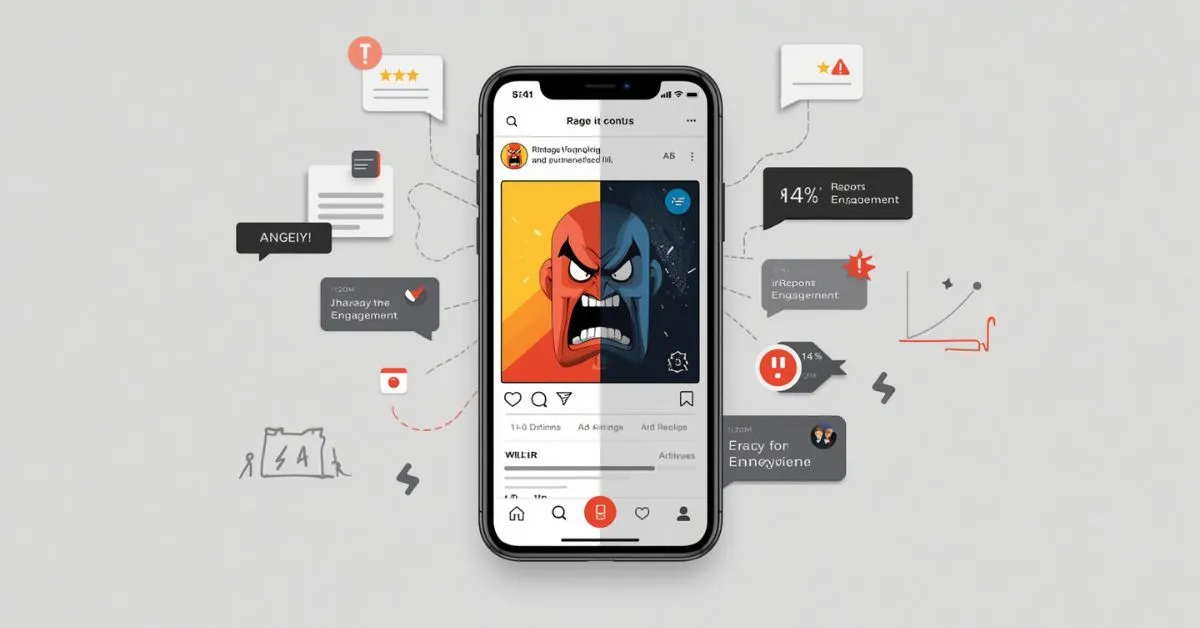
Rage bait means content made to provoke anger or outrage so people react, comment, share, or keep watching.
It is most often used for online posts, videos, headlines, memes, or comments that are deliberately inflammatory because anger creates attention, engagement, and sometimes money.
The term also appears as ragebait, rage bait, and rage-bait, and some dictionaries also note it can be used as a verb.
If you have seen someone say, “That post is obvious rage bait,” they usually mean the content was designed less to start a real discussion and more to trigger people into reacting.
Rage Bait at a Glance
| Term | Simple meaning |
|---|---|
| Rage bait | Content meant to make people angry on purpose |
| Main goal | Attention, engagement, traffic, or money |
| Where it appears | Social media posts, videos, comments, memes, headlines |
| Common reaction | Angry comments, reposts, quote tweets, stitches, duets |
| Related terms | Clickbait, trolling, outrage bait, engagement bait |
Rage bait meaning in simple terms
In plain English, rage bait is anger bait.
The creator says or shows something in a way that feels rude, absurd, unfair, or offensive because they know people will react. Those reactions help the content spread.
That reaction might be:
- comments arguing back
- reposts calling it out
- angry stitches or duets
- longer watch time
- screenshots shared elsewhere
- more profile visits and followers
The shortest accurate answer is:
It means content designed to make people mad so it gets more attention.
Is “rage bait” one word or two?
You may see it written a few different ways:
- rage bait
- ragebait
- rage-bait
These versions usually point to the same idea. You may also come across rage-baiting, which refers to the act of creating or posting this kind of material. Some dictionary-style sources also note that the term can be used as a verb.
Rage bait vs. rage-baiting
A simple way to think about it:
- Rage bait = the post, video, comment, or headline itself
- Rage-baiting = the act of making or sharing it
Examples:
- “That video is obvious rage bait.”
- “He keeps rage-baiting for replies.”
Where people usually see it
This term is mostly used for online content, especially on fast-moving platforms where strong emotional reactions can help a post spread.
Common examples include:
- a social post with an intentionally insulting opinion
- a video caption written to spark arguments
- a headline framed to offend or provoke
- a meme aimed at upsetting a specific group
- a comment that seems built to farm replies
What makes something fit this label?
Not every bad opinion falls into this category. Not every controversial post is fake. The clearest sign is deliberate provocation.
A piece of content is more likely to fit when it seems designed to:
- upset people quickly
- split people into opposing sides
- pull users into arguments
- turn outrage into attention and reach
That is why it overlaps with trolling and engagement bait, but it is more specific. The idea is not just to annoy people. The goal is to turn anger into comments, shares, impressions, and visibility.
Examples of rage bait
Example 1: The “obviously bad” take
“Parents who celebrate their kids’ birthdays are raising spoiled adults.”
Why it feels like rage bait:
It is broad, judgmental, and almost built to annoy parents.
Example 2: The insulting identity post
“Anyone with a normal office job doesn’t know what real work is.”
Why it feels like rage bait:
It targets a huge group and invites defensive replies.
Example 3: The ridiculous flex
“I microwave steak every time. Chefs are just lying to impress people.”
Why it feels like rage bait:
It sounds exaggerated on purpose and dares people to correct it.
Example 4: The inflammatory caption
A normal recipe video with the caption:
“This is why your family secretly hates your cooking.”
Why it feels like rage bait:
The content may be ordinary, but the framing is meant to provoke.
Is rage bait always fake?
No. This is one of the biggest points people misunderstand.
Rage bait can be:
- false
- misleading
- exaggerated
- oversimplified
- technically true but framed in the most inflammatory way possible
So the term does not just mean “wrong information.” It means content presented in a way that is meant to stir anger or outrage. Merriam-Webster and Cambridge both center the definition on deliberate provocation, not on whether the claim is strictly true or false.
Rage bait vs clickbait vs trolling
| Term | Main goal | Main emotion | Typical style |
|---|---|---|---|
| Rage bait | Trigger anger for engagement | Anger, irritation, outrage | Inflammatory takes, insulting captions, provocative headlines |
| Clickbait | Get the click | Curiosity, surprise | Overhyped or misleading headlines |
| Trolling | Get a reaction, disrupt, or annoy | Confusion, annoyance, anger | Deliberate provocation, mockery, chaos |
| Genuine controversial opinion | Express a real belief | Varies | May upset people, but is not necessarily crafted to farm outrage |
A good shortcut is:
Clickbait wants the click.
Rage bait wants the angry reaction.
Trolling wants the reaction itself.
Internet-culture sources often connect rage bait to trolling and flaming, but frame it more clearly as a strategy for driving impressions and engagement.
Why rage bait works so well online
Rage bait works because anger is fast.
People are often more likely to reply, repost, or argue when they feel insulted or outraged than when they see something calm or balanced. In online culture, that emotional reaction can become free distribution for the content. References on the term increasingly describe it not just as random provocation, but as a deliberate engagement strategy tied to the monetized internet.
That is why rage bait often shows up in:
- creator economy content
- viral commentary posts
- culture-war arguments
- outrage-based headlines
- accounts that seem to thrive on “bad takes”
How to spot rage bait fast
A post may be rage bait if it:
- uses extreme wording like “everyone,” “nobody,” “always,” or “never”
- insults a group directly
- sounds absurdly confident about a weak claim
- seems built for quote tweets, stitches, or arguments
- doubles down in the comments instead of clarifying
- feels more interested in reaction than discussion
If your first thought is, “There’s no way this was posted in good faith,” that is often a clue.
When not to call something rage bait
Do not automatically call something rage bait just because:
- you disagree with it
- it is rude
- it is badly argued
- it is controversial
- people got upset
Sometimes a person is simply sincere, clumsy, uninformed, or provocative without strategically trying to farm outrage.
The term is most useful when the content looks intentionally engineered to convert anger into attention.
What Most Articles Miss About This Topic
Many articles reduce this topic to a simple idea: content that is meant to make people angry. That is broadly correct, but it leaves out the part that matters most.
It is about design, not just reaction
Something does not fit this label only because people got upset. The stronger clue is that the post appears built to stir anger on purpose and turn that emotion into comments, shares, and visibility.
Even a true point can be used this way
A creator does not have to invent facts to provoke outrage. They can remove context, exaggerate the stakes, or frame a real point in a deliberately inflammatory way.
It can look casual while being highly calculated
A post may come across as uninformed, random, or impulsive, but it is often framed very carefully to trigger a strong response with as little effort as possible.
The smartest response is often restraint
A long, emotional reply may feel satisfying in the moment, but it can also hand the creator exactly what they wanted: more reach, more interaction, and more momentum.
Did the term become more popular recently?
Yes. The phrase moved from internet slang into wider public conversation when Oxford University Press named it its 2025 Word of the Year, showing how closely it had become associated with online outrage and engagement-driven posting.
FAQ
What does this term mean on social media?
It refers to posts, videos, comments, or captions created to provoke anger so people react, argue, and boost engagement.
Is it the same as clickbait?
No. Clickbait mainly tries to get the click. This tactic is more about triggering irritation or outrage to generate comments, shares, and debate. A piece of content can do both.
What is this kind of post?
It is any post framed in a way that is meant to provoke angry reactions, frustration, or backlash.
Is it always fake?
No. It can be false, misleading, exaggerated, or partly true but presented in the most inflammatory way possible.
What does rage-baiting mean?
It means creating or posting material specifically to stir anger online and drive reactions.
Why do people do this?
Usually for attention, comments, shares, followers, impressions, traffic, or revenue.
Conclusion
If you want the clearest possible answer to what does rage bait mean, it is this:
Rage bait is content made to provoke anger on purpose so people react and help it spread.
Once you understand that, the term becomes much easier to recognize. The next time a post seems absurdly inflammatory, overly confident, and strangely eager for backlash, there is a good chance it is not trying to inform you. It is trying to use your reaction as fuel.
Click Here to Read About : what does consensus mean

Hi, I’m Geoffrey Chaucer. I explore the stories and meanings behind words, turning ideas into clear, insightful writing. Through every article I craft, I aim to spark curiosity, share knowledge, and help readers uncover practical, meaningful truths in everyday life.