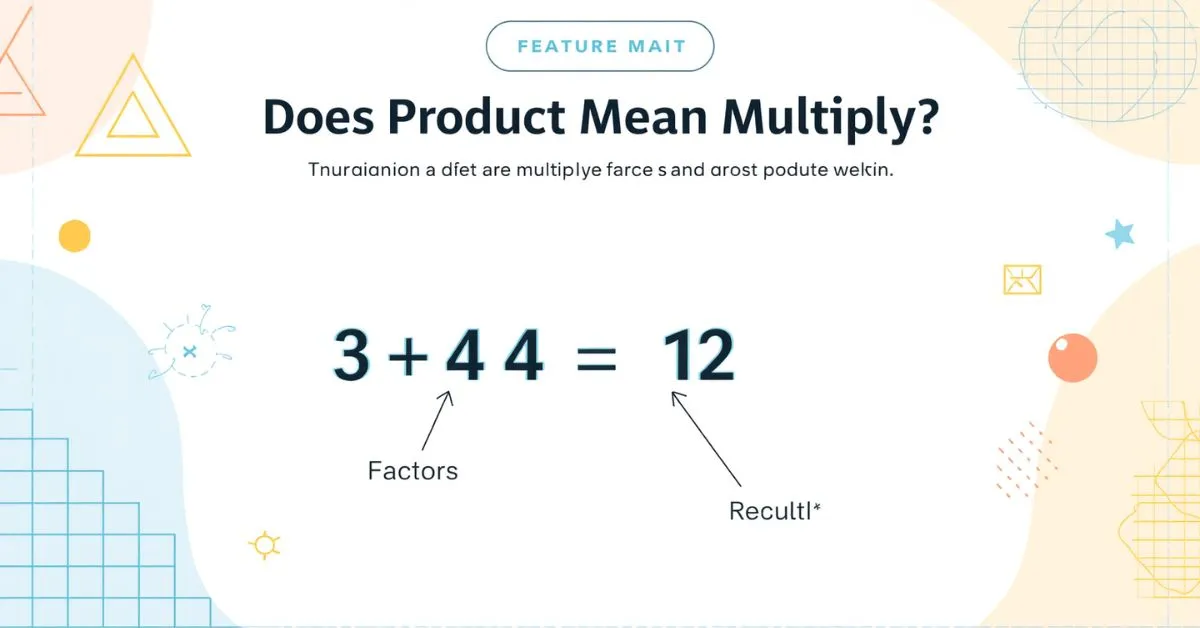
No. In math, multiply is the action, and the product is the answer you get after multiplying. For example, in 3 × 4 = 12, you multiply 3 and 4, and 12 is the product.
If you came here because of a worksheet, quiz, or homework question, that is the key idea you need.
Quick Answer
- Multiply = what you do
- Product = the result
- Factors = the numbers being multiplied
So if a problem says “find the product of 6 and 8,” it means:
6 × 8 = 48
The product is 48.
What Does Product Mean in Math?
In math, the product is the result of multiplication.
That means whenever you multiply two or more numbers, the final answer is called the product.
Example:
- 5 × 2 = 10
- The numbers 5 and 2 are the factors
- The number 10 is the product
This is why teachers and worksheets often use the phrase “find the product.” It simply means multiply and write the answer.
Does Product Mean Multiply or the Answer?
This is where many students get confused.
The word product does not mean the same thing as multiply.
The difference is simple:
- Multiply is the operation
- Product is the result of that operation
Compare these:
- Multiply 7 by 3 → tells you what to do
- Find the product of 7 and 3 → asks for the answer
Both lead to the same math problem:
7 × 3 = 21
But the vocabulary is different.
What “Find the Product” Means on Homework
If a worksheet says:
- Find the product of 4 and 9
- What is the product of 6 and 5?
- Write the product of 2, 3, and 4
It is telling you to use multiplication.
Examples:
- Product of 4 and 9 = 36
- Product of 6 and 5 = 30
- Product of 2, 3, and 4 = 24
A lot of students understand multiplication but get tripped up by the wording. In most school math, “find the product” means “multiply.”
Product vs Multiply vs Factor
These words are related, but they do not mean the same thing.
| Term | Meaning | Example |
|---|---|---|
| Multiply | The action or operation | Multiply 4 and 3 |
| Factor | A number being multiplied | In 4 × 3, the factors are 4 and 3 |
| Product | The result of multiplication | In 4 × 3 = 12, the product is 12 |
Example:
In 8 × 5 = 40:
- 8 is a factor
- 5 is a factor
- 40 is the product
This is one of the most important math vocabulary distinctions to learn early.
Multiplicand, Multiplier, and Product
In some textbooks, you may also see these terms:
- Multiplicand = the number being multiplied
- Multiplier = the number you multiply by
- Product = the result
Example:
In 6 × 4 = 24:
- 6 can be called the multiplicand
- 4 can be called the multiplier
- 24 is the product
Not every classroom uses these words often, but they are helpful if you see them in lessons or study materials.
Does Product Mean Add or Multiply?
Product goes with multiplication, not addition.
Here is the quick difference:
| Operation word | What you do | Result word |
|---|---|---|
| Add | Put numbers together | Sum |
| Subtract | Take one away from another | Difference |
| Multiply | Repeated groups or times | Product |
| Divide | Split into equal parts or groups | Quotient |
So:
- Sum belongs to addition
- Product belongs to multiplication
If a problem says product, do not add unless the problem specifically tells you to.
Examples of Product in Math
Whole number example
3 × 5 = 15
The product is 15.
Zero example
9 × 0 = 0
The product is 0.
Decimal example
1.5 × 4 = 6
The product is 6.
Fraction example
1/2 × 8 = 4
The product is 4.
Three-number example
2 × 3 × 4 = 24
The product is 24.
Variable example
x × y = xy
In algebra, xy is the product of x and y.
This matters because the word product is not limited to basic whole-number multiplication. You can also have a product with decimals, fractions, and algebraic expressions.
Multiplication Properties That Affect the Product
A few multiplication rules can help you understand products better.
1. Zero Property of Multiplication
Any number multiplied by 0 has a product of 0.
Example:
- 12 × 0 = 0
- 0 × 99 = 0
2. Identity Property of Multiplication
Any number multiplied by 1 stays the same.
Example:
- 7 × 1 = 7
- 1 × 13 = 13
3. Commutative Property of Multiplication
You can change the order of the factors, and the product stays the same.
Example:
- 4 × 6 = 24
- 6 × 4 = 24
These are small ideas, but they help students understand how multiplication works instead of just memorizing answers.
Product in Word Problems
The word product often appears in word problems.
Example:
A box has 4 rows of apples with 6 apples in each row. What is the product of 4 and 6?
You multiply:
4 × 6 = 24
So the product is 24.
When you see the word product in a word problem, it is usually a clue that multiplication is needed.
You may also see clue words like:
- times
- groups of
- each
- per row
- multiply
- total in equal groups
Common Mistakes Students Make
1. Thinking product means the same thing as multiply
It does not. One is the action, the other is the result.
2. Mixing up product and sum
If the problem says product, use multiplication.
If it says sum, use addition.
3. Forgetting there can be more than two factors
A product can come from multiplying two or more numbers.
Example:
2 × 3 × 5 = 30
4. Assuming product only applies to whole numbers
You can also find the product of decimals, fractions, and variables.
5. Confusing product with multiple
These words are related, but not identical.
For example:
- 20 is the product of 4 × 5
- 20 is also a multiple of 4 and 5
But in classwork, product usually refers to the answer from multiplication.
What Most Articles Miss About This Topic
Many articles define product correctly, but they skip the part that confuses readers most:
people are usually not asking for a formal dictionary definition. They are trying to understand the wording on a worksheet.
That is why this question keeps coming up.
The real issue is usually this:
- Does product tell me what to do?
- Or does it tell me what the answer is?
The clearest answer is:
- Multiply tells you what to do
- Product tells you what the result is
Another thing many articles miss is that students often confuse product with other operation words, especially sum and quotient. A good explanation should place product in that bigger vocabulary set, not define it in isolation.
Finally, many pages stop at whole-number examples. But students also see products with decimals, fractions, and algebra expressions, so including those examples makes the explanation more complete and more useful.
Quick Practice
Try these on your own.
1. What is the product of 7 and 8?
Answer: 56
2. Does product mean add or multiply?
Answer: It relates to multiplication. The product is the answer you get after multiplying.
3. In 9 × 3 = 27, what is the product?
Answer: 27
4. In 5 × 6, what are the factors?
Answer: 5 and 6
5. What is the product of 0 and 12?
Answer: 0
A short practice section like this helps students make sure they really understand the vocabulary, not just read the definition and move on.
Quick Reference: Math Operation Words
| If the problem says… | You should do… | Example | Answer word |
|---|---|---|---|
| Find the product | Multiply | 6 × 7 | Product |
| Find the sum | Add | 6 + 7 | Sum |
| Find the difference | Subtract | 9 – 4 | Difference |
| Find the quotient | Divide | 20 ÷ 5 | Quotient |
This is useful because many students are really trying to decode math instruction words, not just solve one problem.
FAQ
Does product mean multiply?
Not exactly. Multiply is the action. Product is the result of multiplying.
What does “find the product” mean?
It means to multiply the given numbers and write the answer.
Is the product the answer to a multiplication problem?
Yes. The answer to a multiplication problem is called the product.
What is the difference between product and factor?
A factor is one of the numbers being multiplied. The product is the answer you get at the end.
Does product mean add or multiply?
It is connected to multiplication, not addition.
Can fractions have a product?
Yes. Fractions, decimals, whole numbers, and variables can all have products.
Is product used in algebra too?
Yes. In algebra, the result of multiplying variables or expressions is also called a product.
What is the product of 1 and any number?
The product is that same number, because multiplying by 1 does not change the value.
Final Answer
If you only remember one thing, remember this:
Product does not mean “multiply.” Product means the result of multiplying.
So when you see “find the product,” you should multiply and then write the answer.
Click Here To Read About : what does ds mean

I am Clara Lexis, a writer driven by clarity, depth, and authenticity. My focus is on transforming ideas into meaningful content that is both informative and engaging. I write with intention to communicate clearly, thoughtfully, and with purpose.