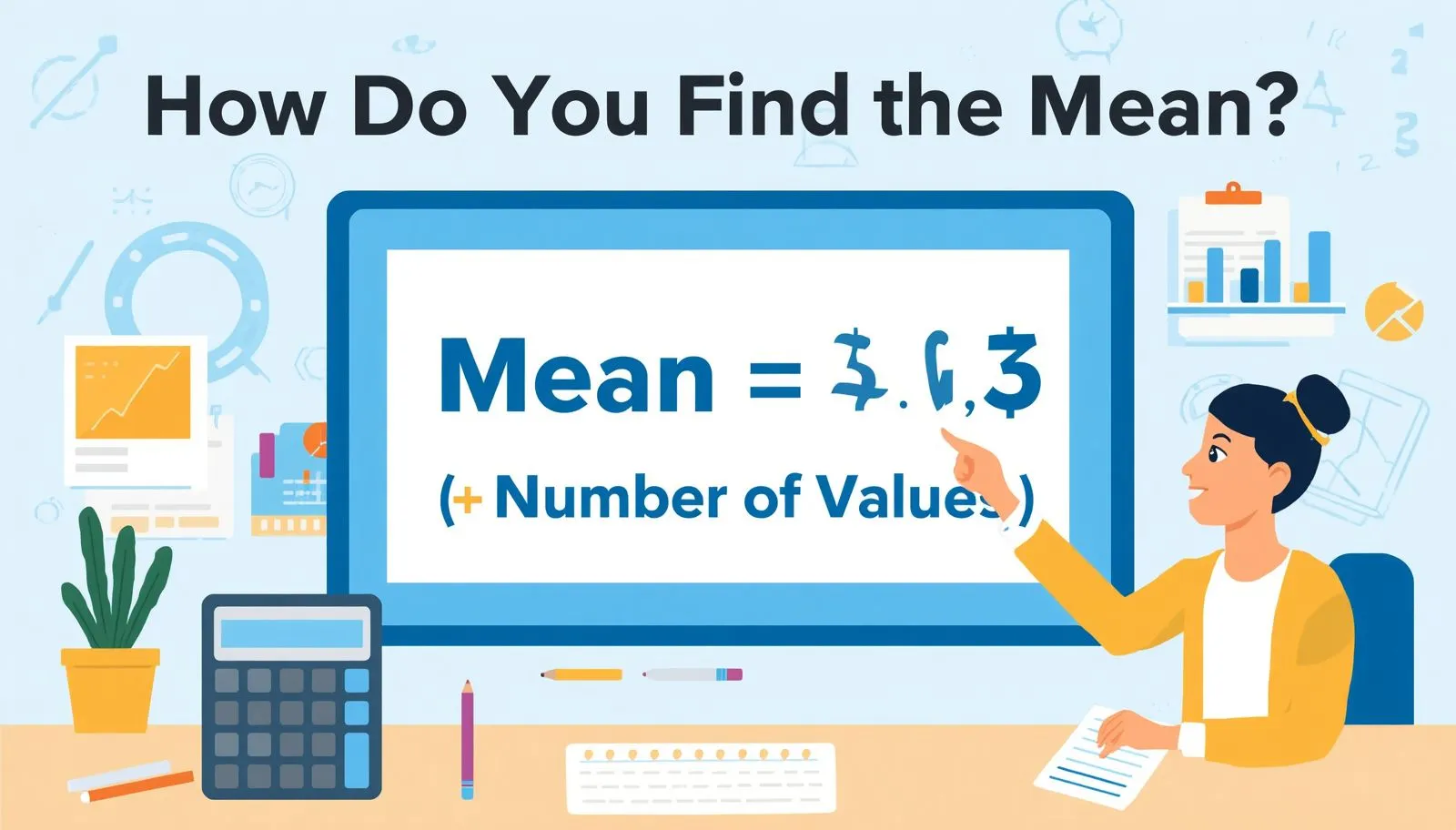
To find the mean, add all the numbers in the data set, then divide by how many numbers there are. For example, the mean of 4, 6, and 8 is 6 because 4 + 6 + 8 = 18, and 18 ÷ 3 = 6.
The mean is the average value of a group of numbers. It is one of the most common ways to describe the center of a data set.
Mean Calculator
Use this calculator to find the mean of any set of numbers.
Enter your numbers separated by commas:4, 6, 8, 10
Result:
Mean = 7
Step-by-step working:
4 + 6 + 8 + 10 = 28
There are 4 numbers.
28 ÷ 4 = 7
Mean = 7
Developer note: Add an interactive input box here so users can enter their own numbers. Show the sum, count, formula, and final mean.
What Is the Mean in Math?
In math, the mean is the average of a set of numbers.
You find it by adding all the values together and dividing by the number of values.
For example:
2, 4, 6
Add the values:
2 + 4 + 6 = 12
There are 3 values.
12 ÷ 3 = 4
So, the mean is 4.
A simple way to think about the mean is this:
The mean is what each number would be if the total were shared equally.
Mean Formula
The basic mean formula is:
Mean = total ÷ number of values
You may also see the formula written like this:
x̄ = Σx ÷ n
Here is what each part means:
| Symbol | Meaning |
|---|---|
| x̄ | The mean |
| Σx | The sum of all values |
| n | The number of values |
In plain English:
Add everything. Count how many values there are. Divide the total by the count.
How to Find the Mean Step by Step
Use these three steps every time.
Step 1: Add all the numbers
Example:
5, 7, 8, 10
5 + 7 + 8 + 10 = 30
Step 2: Count how many numbers there are
There are 4 numbers.
Step 3: Divide the total by the count
30 ÷ 4 = 7.5
The mean is 7.5.
Quick Mean Examples
| Numbers | Add the values | Count | Mean |
|---|---|---|---|
| 2, 4, 6 | 12 | 3 | 4 |
| 3, 5, 7, 9 | 24 | 4 | 6 |
| 10, 20, 30 | 60 | 3 | 20 |
| 1, 2, 2, 5 | 10 | 4 | 2.5 |
| -2, 4, 10 | 12 | 3 | 4 |
Why the Mean Works
The mean works by spreading the total evenly across all values.
Imagine three students scored:
4, 6, and 8 points
Together, they scored:
4 + 6 + 8 = 18 points
If those 18 points were shared equally among the 3 students, each student would have:
18 ÷ 3 = 6 points
That equal-share number is the mean.
So the mean is not just a formula. It is a way to balance a group of numbers.
How to Find the Mean With Repeated Numbers
Repeated numbers count every time they appear.
Example:
4, 4, 7, 9
Add the values:
4 + 4 + 7 + 9 = 24
Count the values:
There are 4 numbers.
Divide:
24 ÷ 4 = 6
The mean is 6.
Do not count the repeated 4 only once. If a value appears twice, it counts twice.
How to Find the Mean With Decimals
The steps are the same when the numbers include decimals.
Example:
2.5, 3.5, 4
Add:
2.5 + 3.5 + 4 = 10
Count:
There are 3 values.
Divide:
10 ÷ 3 = 3.333…
The mean is about 3.33.
If your teacher or worksheet asks for rounding, round to the requested place, such as the nearest tenth or nearest hundredth.
How to Find the Mean With Negative Numbers
Negative numbers are included in the total just like positive numbers.
Example:
-3, 4, 8
Add:
-3 + 4 + 8 = 9
Count:
There are 3 values.
Divide:
9 ÷ 3 = 3
The mean is 3.
A negative number lowers the total, so add carefully.
How to Find the Mean From a Frequency Table
Sometimes a data set is shown in a frequency table. A frequency table tells you how many times each value appears.
Example:
| Score | Number of students |
|---|---|
| 6 | 2 |
| 8 | 3 |
| 10 | 1 |
This means:
- Two students scored 6.
- Three students scored 8.
- One student scored 10.
First, multiply each score by its frequency:
| Score | Frequency | Score × Frequency |
|---|---|---|
| 6 | 2 | 12 |
| 8 | 3 | 24 |
| 10 | 1 | 10 |
Now add the totals:
12 + 24 + 10 = 46
Then add the frequencies:
2 + 3 + 1 = 6
Now divide:
46 ÷ 6 = 7.666…
The mean score is about 7.67.
Frequency Table Formula
Mean = total of all values ÷ total frequency
Or:
Mean = Σfx ÷ Σf
Where:
- x means each value
- f means frequency
- Σfx means add all value × frequency results
- Σf means add all frequencies
How to Find a Missing Number When You Know the Mean
If you know the mean but one number is missing, work backward.
Example:
The mean of 4, 6, 10, and x is 8.
Find x.
There are 4 values.
If the mean is 8, the total must be:
8 × 4 = 32
Now add the known values:
4 + 6 + 10 = 20
Subtract from the total:
32 – 20 = 12
So:
x = 12
Check:
4 + 6 + 10 + 12 = 32
32 ÷ 4 = 8
The missing number is 12.
Mean vs Average: Are They the Same?
In most basic math problems, mean and average mean the same thing.
When someone asks you to “find the mean,” they usually mean:
Add the values and divide by how many values there are.
More specifically, this is called the arithmetic mean.
There are other types of mean, such as geometric mean and harmonic mean, but beginners usually only need the arithmetic mean unless a problem says otherwise.
Mean vs Median vs Mode vs Range
The mean is one way to describe a data set, but it is not the only one.
| Term | How to find it | What it tells you |
|---|---|---|
| Mean | Add all values and divide by the count | The average value |
| Median | Put values in order and find the middle | The middle value |
| Mode | Find the value that appears most often | The most common value |
| Range | Subtract the lowest value from the highest value | How spread out the data is |
Example:
2, 3, 4, 5, 100
The mean is:
2 + 3 + 4 + 5 + 100 = 114
114 ÷ 5 = 22.8
But 22.8 does not feel typical because most numbers are much smaller than 100.
The median is 4, which better represents the middle of this data set.
That does not mean the mean is wrong. It means the mean can be affected by very high or very low values.
When Should You Use the Mean?
Use the mean when you want a simple average and the data is fairly balanced.
The mean is useful for:
- Average test scores
- Average quiz results
- Average daily temperature
- Average points in a game
- Average time spent studying
- Average cost of several items
- Average number of books read
- Average sales per day
Example:
A student gets these quiz scores:
8, 9, 9, 10, 10
Add:
8 + 9 + 9 + 10 + 10 = 46
Divide by 5:
46 ÷ 5 = 9.2
The mean quiz score is 9.2.
This is useful because the scores are close together.
When Can the Mean Be Misleading?
The mean can be misleading when one value is much higher or lower than the rest.
Example:
1, 2, 2, 3, 100
Add:
1 + 2 + 2 + 3 + 100 = 108
Divide by 5:
108 ÷ 5 = 21.6
The mean is 21.6, but most numbers are close to 1, 2, and 3.
The number 100 is an outlier. It pulls the mean upward.
In this case, the median may give a better idea of the typical value.
Which Average Should You Use?
| Situation | Best choice | Why |
|---|---|---|
| Numbers are fairly balanced | Mean | It gives a useful average |
| One value is much higher or lower | Median | It is less affected by outliers |
| You need the most common value | Mode | It shows what appears most often |
| You need to show spread | Range | It shows distance between lowest and highest |
For most beginner math problems, use the mean unless the question asks for median, mode, or range.
Simple Mean vs Weighted Mean
A simple mean treats every value equally.
Example:
80, 90, 100
80 + 90 + 100 = 270
270 ÷ 3 = 90
Simple mean = 90
A weighted mean gives some values more importance than others.
For example, a final exam might count more than a small quiz. In that case, you would not treat every score equally.
For beginner problems, you usually need the simple mean unless the question mentions weights, percentages, or importance.
How to Check If Your Mean Is Correct
After calculating the mean, ask these questions:
- Did I add every value?
- Did I include repeated values?
- Did I count how many values there are?
- Did I divide by the count, not by the largest number?
- Is the mean between the smallest and largest value?
- Is there an outlier that might make the mean less useful?
For a normal set of numbers, the mean should usually be between the smallest and largest number.
Example:
4, 8, 10
The mean should be between 4 and 10.
4 + 8 + 10 = 22
22 ÷ 3 = 7.33
7.33 is between 4 and 10, so the answer makes sense.
Common Mistakes When Finding the Mean
| Mistake | Why it is wrong | Correct method |
|---|---|---|
| Only adding the numbers | The total is not the mean | Divide the total by the count |
| Dividing by the largest number | The largest number is not the count | Divide by how many values there are |
| Ignoring repeated values | Repeated values still count | Count every value |
| Forgetting negative signs | The total changes | Add positive and negative values carefully |
| Assuming the mean must be in the list | It does not have to be | Decimal means are normal |
| Ignoring outliers | Extreme values can change the mean | Compare with the median when needed |
Worked Word Problems
Example 1: Test Scores
A student scores 70, 80, 85, and 95 on four tests. What is the mean score?
Add the scores:
70 + 80 + 85 + 95 = 330
There are 4 scores.
330 ÷ 4 = 82.5
The mean test score is 82.5.
Example 2: Daily Steps
A person walks 4,000; 5,000; 6,500; 7,000; and 7,500 steps over five days. What is the mean number of steps?
Add:
4,000 + 5,000 + 6,500 + 7,000 + 7,500 = 30,000
There are 5 days.
30,000 ÷ 5 = 6,000
The mean is 6,000 steps per day.
Example 3: Missing Score
The mean of 6, 8, 10, and x is 9. Find x.
There are 4 values.
9 × 4 = 36
Add the known values:
6 + 8 + 10 = 24
Subtract:
36 – 24 = 12
x = 12
Practice Questions
Try these before looking at the answers.
Beginner Practice
- Find the mean of 3, 5, 7.
- Find the mean of 10, 20, 30, 40.
- Find the mean of 4, 4, 8, 12.
- Find the mean of 2.5, 3.5, 6.
- Find the mean of -2, 4, 10.
Word Problems
- A student scores 75, 80, 85, and 90. What is the mean score?
- A shop sells 12, 15, 10, 18, and 20 items over five days. What is the mean number of items sold per day?
- The temperatures for four days are 18, 20, 22, and 24 degrees. What is the mean temperature?
Challenge Problems
- The mean of 5, 7, 9, and x is 8. Find x.
- The mean of 4, 6, 8, 10, and x is 9. Find x.
Answer Key
- 5
3 + 5 + 7 = 15; 15 ÷ 3 = 5 - 25
10 + 20 + 30 + 40 = 100; 100 ÷ 4 = 25 - 7
4 + 4 + 8 + 12 = 28; 28 ÷ 4 = 7 - 4
2.5 + 3.5 + 6 = 12; 12 ÷ 3 = 4 - 4
-2 + 4 + 10 = 12; 12 ÷ 3 = 4 - 82.5
75 + 80 + 85 + 90 = 330; 330 ÷ 4 = 82.5 - 15
12 + 15 + 10 + 18 + 20 = 75; 75 ÷ 5 = 15 - 21
18 + 20 + 22 + 24 = 84; 84 ÷ 4 = 21 - 11
8 × 4 = 32; 5 + 7 + 9 = 21; 32 – 21 = 11 - 17
9 × 5 = 45; 4 + 6 + 8 + 10 = 28; 45 – 28 = 17
What Most Articles Miss About This Topic
Most articles explain the formula, but they do not always explain what the answer means.
The mean is not always the most typical number. It is the number you get when the total is shared equally across all values.
That difference matters.
Look at this data set:
2, 3, 3, 4, 100
The mean is:
2 + 3 + 3 + 4 + 100 = 112
112 ÷ 5 = 22.4
The calculation is correct, but 22.4 does not describe most of the numbers very well. Most values are close to 2, 3, and 4.
The number 100 is an outlier, so it pulls the mean upward.
This is why you should not only ask:
“How do I find the mean?”
You should also ask:
“Does the mean represent this data well?”
For balanced data, the mean is usually helpful. For data with extreme values, the median may be more useful.
FAQs
What is the formula for mean?
The formula for mean is:
Mean = sum of values ÷ number of values
Add all the numbers, then divide by how many numbers there are.
How do you find the mean of a set of numbers?
Add every number in the set. Then count how many numbers are in the set. Divide the total by that count.
Is mean the same as average?
In most basic math problems, yes. The mean is the arithmetic average.
Can the mean be a decimal?
Yes. The mean can be a decimal even if all the original numbers are whole numbers.
Example:
2, 3, 8
2 + 3 + 8 = 13
13 ÷ 3 = 4.33
The mean is about 4.33.
Does the mean have to be one of the original numbers?
No. The mean does not have to appear in the original data set.
For example, the mean of 2, 3, and 8 is 4.33. That number is not in the original list.
How do you find the mean with negative numbers?
Add the numbers carefully, including the negative signs. Then divide by the number of values.
Example:
-5, 3, 8
-5 + 3 + 8 = 6
6 ÷ 3 = 2
The mean is 2.
How do you find the mean from a frequency table?
Multiply each value by its frequency. Add those totals. Then divide by the total frequency.
How do you find a missing number if you know the mean?
Multiply the mean by the number of values to find the total. Then subtract the known values. The answer is the missing number.
What is the difference between mean and median?
The mean is the average. The median is the middle value when the numbers are placed in order.
When is the mean misleading?
The mean can be misleading when a data set has an outlier, which is a value much higher or lower than the rest.
What does x̄ mean?
x̄, pronounced “x-bar,” usually means the mean of a sample.
What does Σx mean?
Σx means the sum of all values. In the mean formula, it tells you to add all the numbers.
Conclusion
To find the mean, add all the values and divide by the number of values.
The mean is useful because it gives you a simple average. It works especially well when the numbers are fairly balanced. But when a data set has an unusually high or low number, the mean may not show what is typical.
Once you understand the mean as an equal-share value, the formula becomes much easier to remember:
Mean = total ÷ count
For the next step, learn the difference between mean, median, mode, and range so you know which number best describes a data set.
Click Here To Read About : what does ppv mean

I am Clara Lexis, a writer driven by clarity, depth, and authenticity. My focus is on transforming ideas into meaningful content that is both informative and engaging. I write with intention to communicate clearly, thoughtfully, and with purpose.