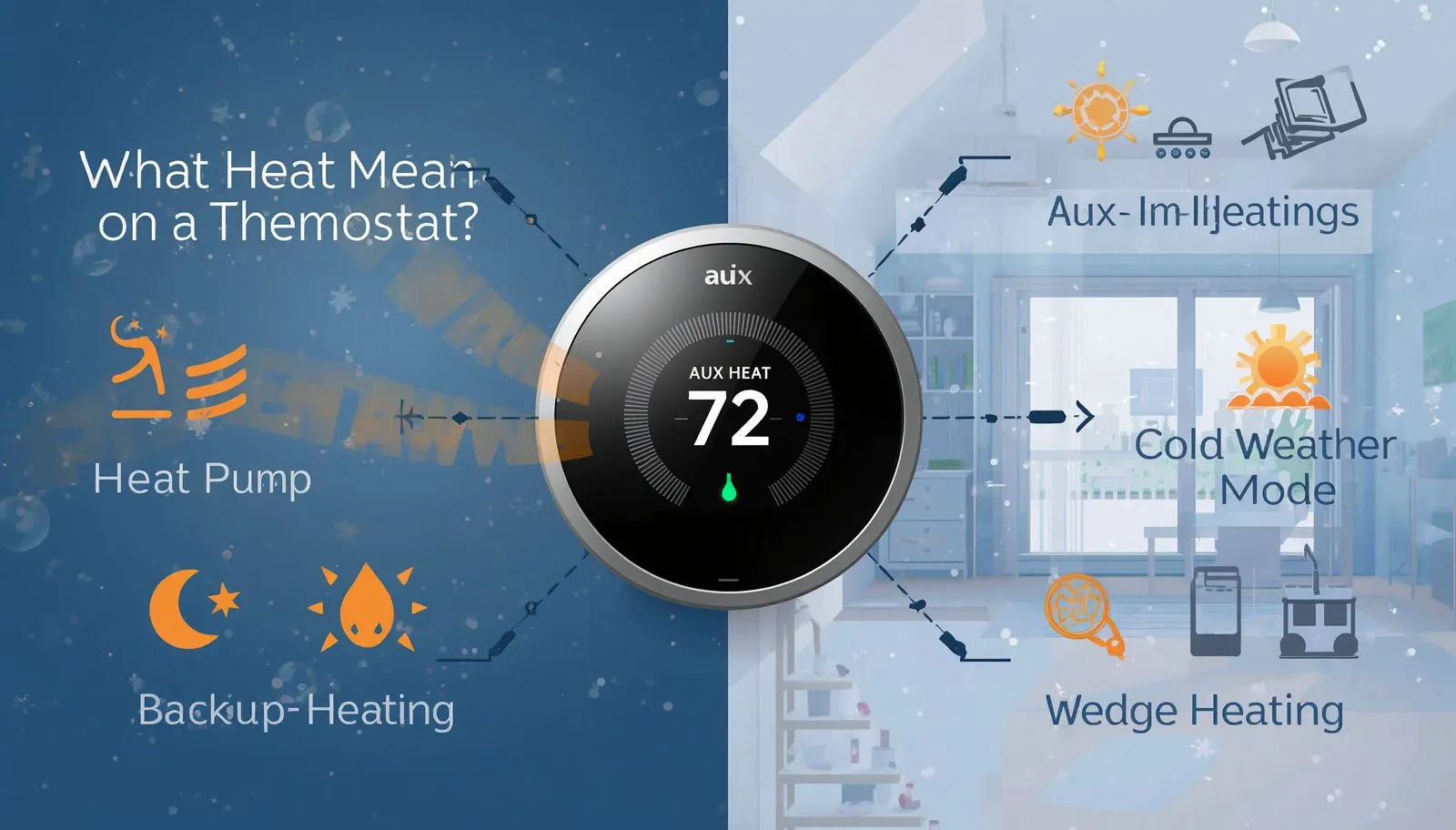
Aux heat means auxiliary heat, a backup heating source that helps your heat pump warm your home when the heat pump cannot keep up by itself. It often turns on during very cold weather, after a large thermostat increase, or during defrost mode. Brief aux heat is usually normal, but constant aux heat can signal a problem.
If your thermostat suddenly says AUX Heat, it usually means your heat pump has called for extra help. That does not automatically mean your system is broken. It does mean your home needs more heat than the heat pump is currently providing on its own.
The key question is not just “What does aux heat mean?” It is:
Is aux heat turning on for a normal reason, or is it warning you that something needs attention?
This guide explains the difference in plain English.
Quick Answer: Should You Worry About Aux Heat?
Use this quick check first.
| If your thermostat says AUX Heat when… | What it usually means | What to do |
|---|---|---|
| It is very cold outside | Your heat pump needs backup support | Usually normal; monitor it |
| You raised the thermostat several degrees | The thermostat triggered second-stage heat | Use smaller temperature changes |
| The outdoor unit is defrosting | The system is clearing frost from the outdoor coil | Usually normal if temporary |
| It is mild outside and aux heat stays on | The heat pump may not be keeping up | Check filter, outdoor unit, and thermostat |
| The outdoor unit is not running | The heat pump may be off, locked out, or malfunctioning | Call an HVAC technician |
| Your thermostat is set to Emergency Heat | Backup heat may be replacing the heat pump | Use only when needed or advised |
Brief aux heat is not usually a crisis. Constant aux heat, especially in mild weather, deserves attention.
What Is Aux Heat?
Aux heat is short for auxiliary heat. “Auxiliary” means extra, backup, or supplemental.
In most homes, aux heat appears on the thermostat when a heat pump needs help reaching the set temperature. Heat pumps are different from furnaces because they usually move heat rather than create it directly. The U.S. Department of Energy explains that heat pumps transfer heat from a cool space to a warm space, similar to how a refrigerator moves heat.
Your auxiliary heat source may be:
- Electric heat strips inside the air handler
- A gas furnace in a dual-fuel heat pump system
- Another backup heat source, depending on your HVAC setup
In many systems, aux heat is the second stage of heating. The heat pump is stage one. Auxiliary heat is stage two.
Why Does Aux Heat Turn On?
Aux heat turns on when your thermostat decides the heat pump needs help. That can happen for several reasons.
1. It Is Very Cold Outside
Heat pumps can work in cold weather, but colder outdoor air makes the job harder. As the outdoor temperature drops, the heat pump may produce less heat or take longer to warm the house.
At some point, your home may reach its balance point.
The balance point is the outdoor temperature where your heat pump alone can no longer keep up with your home’s heating needs. That temperature is not the same for every home. It depends on the heat pump, insulation, ductwork, air leakage, system size, and local climate.
A newer cold-climate heat pump may need aux heat less often. An older heat pump in a drafty home may need it more often.
2. You Raised the Thermostat Too Much at Once
If your home is 65°F and you raise the thermostat to 72°F, the thermostat may call for aux heat to warm the home faster.
This happens because many thermostats use a temperature differential. If the indoor temperature is several degrees below the set point, the thermostat may activate second-stage heat.
That is why a large thermostat jump can make “AUX Heat” appear even when nothing is broken.
3. Your Heat Pump Is in Defrost Mode
In winter, frost can form on the outdoor coil. Heat pumps are designed to run a defrost cycle when needed.
During defrost mode, the system may temporarily switch operation so the outdoor coil can warm up and clear frost. Aux heat may turn on during this process to keep the air from feeling cold indoors.
This is usually normal if it happens briefly and the system returns to regular heating afterward.
4. Your Home Is Losing Heat Too Fast
Sometimes aux heat is not really a heat pump problem. It is a home-performance problem.
Aux heat may run more often if your home has:
- Poor insulation
- Drafty doors or windows
- Leaky ducts
- Blocked vents
- Dirty air filters
- Weak airflow
- An undersized heat pump
- An older or poorly maintained system
The thermostat is simply reacting to the fact that the home is losing heat faster than the heat pump can replace it.
5. Something May Be Wrong With the Heat Pump
Aux heat can also appear when the heat pump is struggling because of a system issue.
Possible causes include:
- Dirty air filter
- Blocked outdoor unit
- Frozen outdoor coil that does not defrost
- Low refrigerant
- Faulty defrost board
- Blower motor problem
- Compressor issue
- Reversing valve problem
- Thermostat wiring or configuration issue
- Outdoor temperature sensor problem
- Tripped breaker or electrical fault
Some of these are simple maintenance issues. Others require professional diagnosis.
Is Aux Heat Normal or a Problem?
Aux heat can be either normal or a warning sign. The context matters.
| Situation | Usually normal? | Why |
|---|---|---|
| Aux heat comes on briefly during freezing weather | Yes | The heat pump needs temporary backup |
| Aux heat appears after a big thermostat increase | Yes | The thermostat is trying to recover quickly |
| Aux heat comes on during defrost mode | Yes | The system is maintaining comfort while clearing frost |
| Aux heat runs constantly in mild weather | No | The heat pump may not be working properly |
| Aux heat runs but the home never warms up | No | The system may have airflow, refrigerant, or equipment issues |
| Aux heat appears while the outdoor unit is off | Possibly no | The heat pump may be locked out, misconfigured, or malfunctioning |
| Aux heat causes a sudden bill spike | Needs attention | Backup heat may be running too often |
A simple way to think about it:
Aux heat is a clue, not a diagnosis.
It tells you the backup heat is running. It does not automatically tell you why.
Aux Heat vs Emergency Heat
Aux heat and emergency heat are often confused because they may use the same backup heating equipment. But they are not the same setting.
| Feature | Aux Heat | Emergency Heat |
|---|---|---|
| How it turns on | Usually automatic | Usually manual |
| What it does | Helps the heat pump | Bypasses or replaces the heat pump |
| Heat pump still runs? | Usually yes | Usually no |
| Common use | Cold weather, defrost, large thermostat recovery | Heat pump failure or temporary emergency backup |
| Should you select it yourself? | Usually no | Only when needed or advised |
| Cost impact | Can increase costs | Often more expensive if used unnecessarily |
Aux heat supports the heat pump. Emergency heat is usually used when the heat pump should not be relied on.
For example, if your outdoor heat pump unit is damaged, frozen solid, or not running, emergency heat may keep the home warm until service is completed. But if the heat pump is working normally, leaving emergency heat on can waste energy.
Does Aux Heat Cost More?
Aux heat often costs more, especially if your system uses electric resistance heat strips.
A heat pump is efficient because it transfers heat instead of generating heat directly. The Department of Energy says a properly installed air-source heat pump can deliver up to two to four times more heat energy than the electrical energy it consumes.
Electric resistance heat, including many electric strip heaters, works differently. It converts electricity directly into heat. That can be useful as a backup, but it is usually more expensive to run for long periods. DOE also advises against thermostat setbacks that cause backup heat to come on because electric resistance or strip heat is usually more expensive to operate.
That does not mean aux heat should never run. It means you usually want to avoid unnecessary aux heat.
Why Aux Heat Starts at Different Temperatures in Different Homes
Some homeowners see aux heat at 40°F. Others rarely see it until the weather is much colder. That difference is normal.
Aux heat depends on your system’s balance point, which is affected by:
- Heat pump size and age
- Outdoor temperature
- Home insulation
- Air leakage
- Duct condition
- Thermostat settings
- Airflow
- Whether the system is all-electric or dual-fuel
- Whether the heat pump is designed for cold climates
A well-insulated home with a properly sized cold-climate heat pump may stay comfortable with less backup heat. A leaky home with an older system may need auxiliary heat more often.
This is why there is no single outdoor temperature where aux heat is always “good” or always “bad.”
Not All Aux Heat Systems Work the Same Way
The meaning of aux heat is similar across systems, but the backup heat source can vary.
Electric Heat Strips
Many heat pump systems use electric heat strips inside the air handler. These are sometimes called strip heat or electric resistance heat.
They can warm the air quickly, but they often use more electricity than heat pump-only operation.
Gas Furnace Backup
In a dual-fuel system, the heat pump may use a gas furnace as backup heat. The thermostat may switch between the heat pump and furnace based on outdoor temperature, utility costs, or system settings.
This setup is common in colder climates or homes where gas backup is preferred.
Cold-Climate Heat Pumps
Cold-climate heat pumps are designed to perform better at lower outdoor temperatures. They may still use auxiliary heat, but often less frequently than older or standard systems.
Older Heat Pump Systems
Older heat pumps may rely on aux heat more often, especially during cold snaps or when maintenance has been neglected.
Seeing AUX Heat Right Now? Check These 5 Things
Before assuming the worst, run through this quick homeowner checklist.
1. Check the Outdoor Temperature
If it is freezing or near freezing, brief aux heat may be normal.
2. Check Your Thermostat Setting
Make sure the thermostat is set to Heat, not Emergency Heat.
Also check whether you recently raised the temperature several degrees. If you did, the thermostat may have triggered second-stage heat.
3. Check the Air Filter
A dirty filter restricts airflow. Poor airflow can make the system work harder and may cause aux heat to run more often.
4. Check the Outdoor Unit
Look for obvious airflow blockages, such as snow, leaves, plants, or debris around the unit.
Do not remove panels or touch electrical parts. Just make sure the unit has clear space around it.
5. Watch Whether Aux Heat Turns Off
If aux heat appears briefly and then shuts off, the system may be working normally.
If aux heat stays on for a long time, especially in mild weather, it is time to investigate further.
What If Aux Heat Runs Constantly?
Constant aux heat is not something to ignore.
It may mean:
- The heat pump cannot keep up
- The thermostat is misconfigured
- The system is stuck in backup heat
- The outdoor unit is not running
- Airflow is restricted
- The system is low on refrigerant
- The defrost cycle is not working correctly
- The home has significant heat loss
A short aux heat cycle is one thing. Aux heat running for hours when it is not extremely cold is another.
Call an HVAC technician if:
- Aux heat runs all day
- The outdoor unit is not turning on
- The home does not reach the set temperature
- Ice does not clear from the outdoor unit
- Breakers trip
- You notice burning smells
- Airflow from vents is weak
- Your energy bill suddenly rises without a clear weather reason
Do not open electrical compartments, handle refrigerant, bypass safety controls, or disable backup heat wiring yourself.
How to Reduce Unnecessary Aux Heat
You cannot prevent aux heat in every situation, and you should not disable it as a shortcut. But you can reduce unnecessary use.
Use Smaller Thermostat Changes
Raise the temperature one or two degrees at a time instead of making large jumps.
This helps the heat pump warm the home without immediately calling for backup heat.
Avoid Deep Setbacks in Cold Weather
For many heat pump systems, “set it and forget it” works better in winter than large overnight setbacks. DOE notes that heat pump thermostat setbacks can cause inefficient operation if backup heating turns on.
Use a Heat-Pump-Compatible Thermostat
If you use a programmable or smart thermostat, make sure it is configured for a heat pump system.
Helpful settings may include:
- Aux heat lockout
- Compressor lockout
- Outdoor temperature sensor settings
- Smart recovery or adaptive recovery controls
- Dual-fuel balance point settings
- Heating stage differential
These settings should be configured carefully. Incorrect settings can make aux heat run too often or prevent backup heat when it is actually needed.
Keep Airflow Strong
Replace dirty filters, keep vents open, and make sure furniture is not blocking supply or return vents.
Keep the Outdoor Unit Clear
The outdoor unit needs airflow. Keep leaves, snow, weeds, and storage items away from it.
Schedule Routine Maintenance
Routine maintenance can help identify airflow restrictions, refrigerant issues, electrical problems, defrost control faults, blower issues, and thermostat configuration problems. DOE notes that professional heat pump maintenance may include checking ducts, filters, airflow, refrigerant charge, electrical terminals, motors, and controls.
Common Mistakes Homeowners Make With Aux Heat
Mistake 1: Assuming Aux Heat Means the System Is Broken
Aux heat can be normal. The problem is not that aux heat appeared. The problem is when it appears too often, runs too long, or shows up in conditions where the heat pump should handle the load.
Mistake 2: Turning On Emergency Heat Too Soon
Emergency heat is not the same as aux heat. Do not switch to emergency heat just because you see “AUX Heat” on the display.
Mistake 3: Making Big Thermostat Jumps
Large temperature increases can trigger auxiliary heat. A heat pump usually performs better with steady, moderate settings.
Mistake 4: Ignoring a Dirty Filter
A dirty filter can cause comfort problems that look like equipment problems. Always check airflow basics first.
Mistake 5: Trying to Disable Aux Heat
Aux heat is a safety and comfort backup. If it runs too often, fix the cause instead of trying to remove the backup.
What Most Articles Miss About This Topic
Most articles explain aux heat as “backup heat,” but that is only half the answer.
The more useful idea is this:
Aux heat is not the problem by itself. It is a signal that your system needed help at that moment.
That signal could be normal, like a cold morning or a defrost cycle. Or it could point to something that needs attention, like poor airflow, thermostat misconfiguration, outdoor unit failure, low refrigerant, or a home that is losing heat too quickly.
The thermostat message alone does not tell the whole story. You need to look at:
- Outdoor temperature
- How long aux heat stays on
- Whether the heat pump is running
- Whether the home reaches the set point
- Whether the system recently entered defrost mode
- Whether the thermostat was raised several degrees
- Whether the filter and outdoor unit are clean
- Whether energy bills have changed suddenly
That is why the best response is not panic. It is pattern recognition.
Brief aux heat during cold weather is often normal. Constant aux heat in mild weather is not.
When to Call an HVAC Technician
Call for service if you notice any of these signs:
- Aux heat stays on for hours
- Aux heat runs frequently above normal cold-weather conditions
- The outdoor unit does not run
- The thermostat is not reaching the set point
- The system blows cool or lukewarm air for long periods
- The outdoor unit is heavily iced and does not defrost
- Your electric bill rises sharply
- Breakers trip
- You smell burning
- You hear unusual noises
- Airflow is weak even after changing the filter
An HVAC technician can check the thermostat setup, electric heat strips, defrost board, refrigerant charge, compressor, blower motor, outdoor temperature sensor, ductwork, and overall heat pump performance.
FAQ
What does aux heat mean?
Aux heat means auxiliary heat. It is a backup heating source that helps your heat pump warm your home when the heat pump cannot keep up on its own.
Is aux heat bad?
No. Aux heat is not bad when it runs briefly during cold weather, defrost mode, or recovery after a thermostat change. It may be a problem if it runs constantly.
Why does my thermostat say aux heat?
Your thermostat says aux heat because it has activated backup heating. This may happen because it is cold outside, the thermostat was raised several degrees, the heat pump is defrosting, or the heat pump is struggling.
Does aux heat cost more?
Often, yes. Electric auxiliary heat usually costs more to run than heat pump-only heating because electric resistance heat generates heat directly instead of transferring it efficiently.
Should I turn off aux heat?
Usually, no. Aux heat is an important backup feature. If it runs too often, find and fix the cause rather than disabling the backup heat.
What is the difference between aux heat and emergency heat?
Aux heat usually turns on automatically to help the heat pump. Emergency heat is usually a manual setting that relies on backup heat when the heat pump is not working properly.
Why does aux heat come on when I raise the thermostat?
A large thermostat increase can trigger second-stage heat. The thermostat may use aux heat to close the gap between the current temperature and the set temperature faster.
Why is aux heat running constantly?
Constant aux heat may be caused by very cold weather, poor airflow, a dirty filter, blocked outdoor unit, thermostat settings, refrigerant problems, defrost issues, or a heat pump malfunction.
Should the outdoor unit run when aux heat is on?
In many systems, yes. Aux heat often helps the heat pump while the heat pump continues running. If the outdoor unit is not running at all, the system may need service.
What temperature triggers aux heat?
There is no universal temperature. Aux heat depends on your system, thermostat settings, home insulation, heating load, and outdoor conditions. Some systems use aux heat near freezing; others may wait until colder temperatures.
Can a smart thermostat reduce aux heat?
Yes, if it is configured correctly for a heat pump. Settings such as aux heat lockout, compressor lockout, adaptive recovery, and dual-fuel balance point can affect when aux heat runs.
Why does aux heat come on at night?
Aux heat may come on at night because outdoor temperatures drop, the home loses heat faster, or the thermostat is recovering from a nighttime setback.
Is emergency heat more expensive than aux heat?
It can be, especially if emergency heat relies entirely on electric resistance heat. Emergency heat is usually meant for temporary use when the heat pump is not working properly.
Conclusion
Aux heat means your heat pump is using backup heat to help warm your home. That can be completely normal during cold weather, defrost cycles, or large thermostat changes.
The warning sign is not simply seeing “AUX Heat.” The warning sign is aux heat that runs constantly, appears in mild weather, or comes with poor heating performance.
Start with the basics: check the thermostat mode, air filter, outdoor unit, and how long aux heat stays on. If the system cannot keep up or the outdoor unit is not working, schedule HVAC service before the problem gets worse.
Click Here To Read About : does low blood count mean cancer

Hi, I’m Geoffrey Chaucer. I explore the stories and meanings behind words, turning ideas into clear, insightful writing. Through every article I craft, I aim to spark curiosity, share knowledge, and help readers uncover practical, meaningful truths in everyday life.