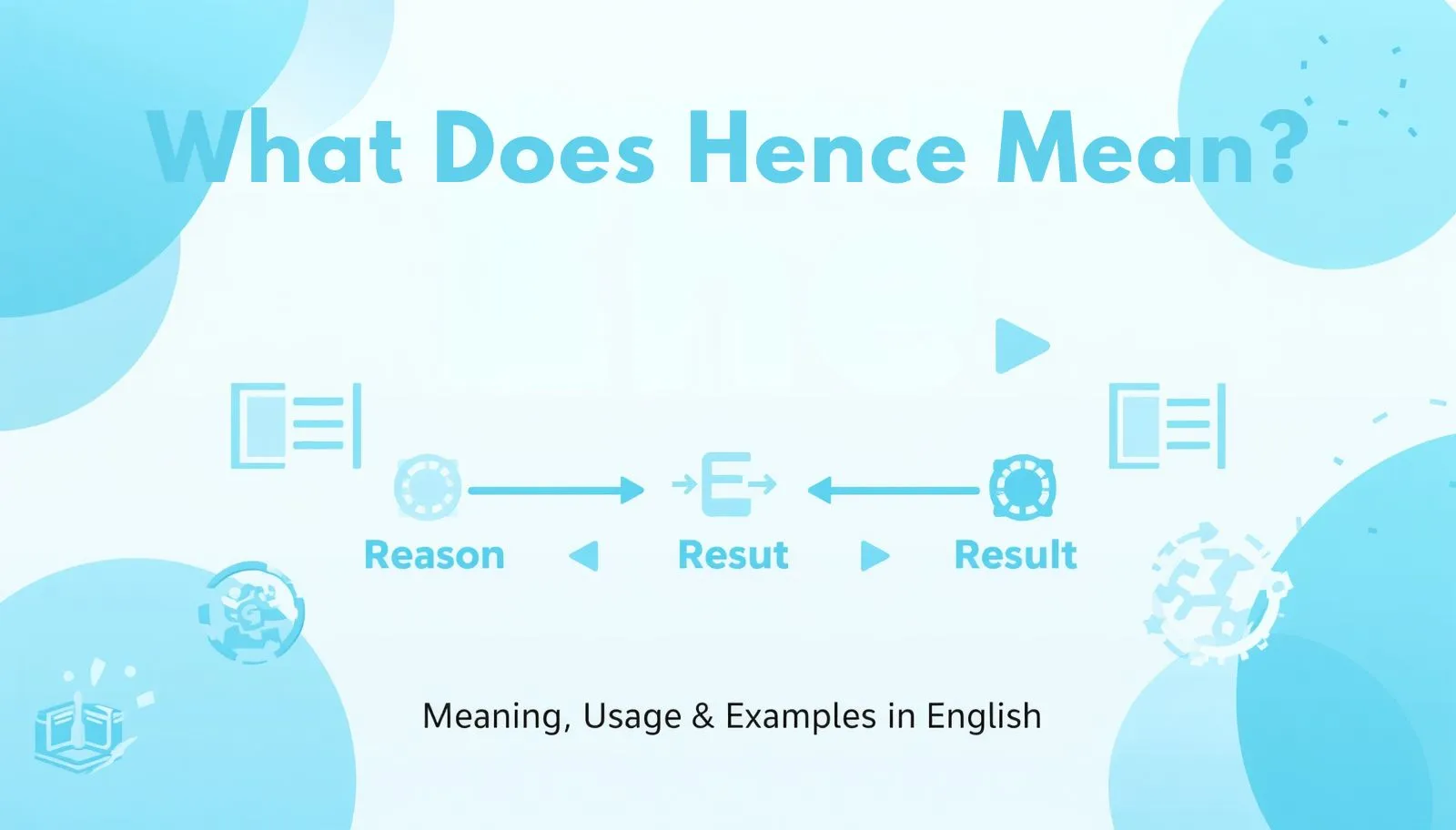
Hence means “for this reason,” “therefore,” or “as a result.” The word connects a reason with a result. For example, “The road closed; hence, we turned back” means the road closed, so we turned back. In time expressions, it can also mean “from now,” as in “two weeks hence.”
This word often appears in essays, formal writing, books, reports, and careful explanations. Although it has a simple meaning, it can sound too formal in everyday speech. That is why many people use “so,” “therefore,” or “as a result” instead.
Quick Meaning at a Glance
| Question | Answer |
|---|---|
| Meaning | Therefore, for this reason, as a result |
| Pronunciation | hens |
| Part of speech | Adverb |
| Tone | Formal |
| Simple synonym | So |
| Formal synonym | Therefore |
| Example | The road closed; hence, we turned back. |
How to Pronounce Hence
Say hence like “hens.”
It has one syllable. The final sound works like an s, even though the word ends in ce.
What Part of Speech Is Hence?
The word functions as an adverb. More specifically, it often works like a transition word because it connects one idea to another.
Example:
The evidence seemed weak; hence, the lawyer changed the argument.
Here, the second idea follows from the first. The weak evidence caused the lawyer to change the argument.
The Main Meanings of Hence
This term has a few related meanings. Most modern readers need the first one, but the others help explain phrases that may appear in books, essays, or formal writing.
| Meaning | Explanation | Example | Modern use |
|---|---|---|---|
| Therefore / for this reason | Shows a result | The test failed; hence, the team repaired the system. | Common in formal writing |
| From now / from this time | Points to a future time | Two weeks hence, we will review the results. | Formal or literary |
| From this source or origin | Explains where something comes from | Her family came from Italy, hence the surname. | Still useful |
| From this place / away | Older meaning of “from here” | Go hence. | Archaic or literary |
For most everyday situations, think of the word as a formal version of “so” or “therefore.”
Meaning 1: Therefore or As a Result
The most common modern meaning is “therefore,” “for this reason,” or “as a result.”
Examples:
- The weather became dangerous; hence, the airline canceled the flight.
- She missed the deadline; hence, the company rejected the application.
- The instructions confused many users; hence, the team rewrote them.
- Heavy rain flooded the road; hence, the organizers delayed the event.
In each sentence, the first idea gives the reason. The second idea gives the result.
Meaning 2: From Now or From This Time
In time expressions, the word can mean “from now” or “from this time.”
Examples:
- A week hence, we will know the answer.
- Two months hence, the project should reach completion.
- Several years hence, this decision may look different.
Plain-English versions:
- A week hence = a week from now
- Two months hence = two months from now
- Several years hence = several years from now
However, this usage sounds formal. In everyday writing, “from now” usually feels clearer.
Meaning 3: From This Source or Origin
Sometimes the word explains where a name, idea, problem, or result comes from.
Examples:
- The town has many pine trees, hence the name Pine Valley.
- Her grandfather came from France, hence the French surname.
- The product uses rare materials, hence the higher price.
In these examples, the word means “that explains” or “that is the reason for.”
Meaning 4: From This Place or Away
Older English sometimes uses the word to mean “from here” or “away from this place.”
Example:
Go hence.
This means:
Go away from here.
Modern speakers rarely use this meaning in normal conversation. You may still see it in older books, poetry, religious texts, or intentionally dramatic writing.
How to Use It in a Sentence
The simplest pattern is:
Reason + hence + result
Examples:
- The data looked incomplete; hence, the analyst reviewed it again.
- The cost rose sharply; hence, the company changed its plan.
- The road closed suddenly; hence, we chose another route.
Another common pattern uses the word before a noun phrase.
Examples:
- The server crashed, hence the delay.
- The wording confused readers, hence the complaints.
- The handmade process takes longer, hence the higher price.
This shorter pattern often means “which explains.”
Common Phrases With Hence
Hence the Name
“Hence the name” means “that explains the name.”
Example:
The village sits beside a clear lake, hence the name Clearwater.
Meaning:
The village has that name because it sits beside a clear lake.
Hence the Need
“Hence the need” means “that is why something is needed.”
Example:
Many customers misunderstood the policy, hence the need for clearer instructions.
Meaning:
Customers misunderstood the policy, so clearer instructions became necessary.
Hence the Problem
“Hence the problem” means “that explains the problem.”
Example:
The system never received updates, hence the problem.
Meaning:
The lack of updates explains the problem.
Hence My Question
“Hence my question” means “that is why I am asking.”
Example:
The rule seems unclear, hence my question.
Meaning:
The rule seems unclear, so I am asking about it.
Hence Why
“Hence why” means “that is why” or “which is why.”
Example:
The roads froze overnight, hence why school started late.
People often say this casually, especially online. However, careful writers usually avoid it because it can sound redundant. Since the word already means “for this reason,” adding “why” often repeats the same idea.
Cleaner options:
- The roads froze overnight; hence, school started late.
- The roads froze overnight, which is why school started late.
- The roads froze overnight, so school started late.
For formal writing, choose “hence,” “therefore,” or “which is why.”
Hence vs Therefore, Thus, So, Because, and Consequently
These words all connect ideas, but they do not work in exactly the same way.
| Word | Meaning | Tone | Best use | Example |
|---|---|---|---|---|
| Hence | For this reason / as a result | Formal | Logical results | The evidence looked weak; hence, the lawyer revised the case. |
| Therefore | For that reason | Formal or neutral | Conclusions | The evidence looked weak; therefore, the lawyer revised the case. |
| Thus | In this way / as a result | Formal | Result or method | The tool changed position; thus, the cut became cleaner. |
| So | For that reason | Casual | Everyday speech | It rained, so we stayed home. |
| Because | For the reason that | Neutral | Giving the cause | We stayed home because it rained. |
| Consequently | As a result | Formal | Consequences | Demand fell; consequently, the factory reduced production. |
Difference Between Hence and Therefore
These two words have very similar meanings.
Example with therefore:
The road closed; therefore, we took another route.
Example with hence:
The road closed; hence, we took another route.
Both sentences mean almost the same thing. Still, therefore sounds more common and neutral. Hence sounds more concise, formal, or slightly literary.
Use therefore when you want a familiar formal connector. Choose hence when the sentence needs a shorter, sharper transition.
Difference Between Hence and Thus
These words overlap, but they have different strengths.
Hence usually points to a reason or cause.
Thus can mean “as a result” or “in this way.”
Example:
The data looked unreliable; hence, the team questioned the conclusion.
This means the unreliable data caused doubt.
Another example:
Hold the brush at an angle; thus, you create a smoother line.
Here, thus means “in this way.” In that sentence, hence would sound less natural.
Difference Between Hence and Because
Because introduces the reason.
Hence introduces the result.
Example with because:
Because it rained, we stayed home.
Example with hence:
It rained; hence, we stayed home.
Use because before the cause. Use hence before the result.
Difference Between Hence and Henceforth
These two words look similar, but they do not mean the same thing.
Hence means therefore, as a result, or sometimes from now.
Henceforth means from this time forward.
Examples:
The rule confused readers; hence, the editor rewrote it.
Meaning:
The rule confused readers, so the editor rewrote it.
Now compare:
Henceforth, all payments must go through the online portal.
Meaning:
From now on, all payments must go through the online portal.
Do not use henceforth as a replacement for therefore.
How to Punctuate Hence Correctly
Since the word often appears in formal writing, punctuation can make the sentence easier to read.
1. Use a Semicolon Before It
A common formal pattern looks like this:
Complete sentence + semicolon + hence + result
Example:
The deadline passed; hence, the manager declined the request.
This structure works well when both parts could stand as complete sentences.
2. Add a Comma After It When Needed
A comma after the word often improves clarity.
Example:
The budget changed; hence, the team adjusted the timeline.
Some short sentences can work without the comma, but the comma usually makes the sentence smoother.
3. Use It Before a Noun Phrase
The word can also introduce a short noun phrase.
Examples:
- The file disappeared, hence the confusion.
- The material costs more, hence the price increase.
- The speaker arrived late, hence the schedule change.
This pattern feels natural in both formal and semi-formal writing.
4. Use “And Hence” for a Smooth Link
The phrase “and hence” connects a result directly to the previous idea.
Example:
The design weighs less and hence travels more easily.
This means:
The design weighs less and therefore travels more easily.
When the Word Sounds Natural
This term works best in formal, logical, or explanatory writing.
Good examples:
- The sample size remained small; hence, the findings require caution.
- The product uses handmade parts, hence the higher price.
- The file contained errors; hence, the program failed to open it.
Each sentence explains a clear cause-and-effect relationship.
When It Sounds Awkward
The word can create an overly formal tone in casual situations.
Awkward:
I felt hungry; hence, I made a sandwich.
Better:
I felt hungry, so I made a sandwich.
Awkward:
I forgot my jacket; hence, I felt cold.
Better:
I forgot my jacket, so I felt cold.
Awkward:
She liked the song; hence, she played it again.
Better:
She liked the song, so she played it again.
The grammar works, but the tone feels too formal for everyday speech.
Common Mistakes
Mistake 1: Using It Instead of Because
Incorrect:
Hence it rained, we stayed inside.
Correct:
Because it rained, we stayed inside.
Also correct:
It rained; hence, we stayed inside.
Mistake 2: Using “Hence Why” in Formal Writing
Casual:
The file went missing, hence why the process failed.
Better:
The file went missing; hence, the process failed.
Also good:
The file went missing, which is why the process failed.
Mistake 3: Making Simple Sentences Too Formal
Awkward:
I felt tired; hence, I went to bed.
Better:
I felt tired, so I went to bed.
Mistake 4: Missing the Time Meaning
In this sentence:
Six months hence, the results may change.
The word does not mean therefore. It means:
Six months from now, the results may change.
Quick Practice: Which Sentence Sounds Better?
| Situation | Better sentence | Why |
|---|---|---|
| Casual conversation | I felt hungry, so I ate. | “So” sounds more natural. |
| Academic writing | The sample remained small; hence, the results need caution. | The formal tone fits. |
| Business update | The supplier delayed shipment; hence, the launch date changed. | The sentence shows clear cause and result. |
| Time expression | Two weeks from now, we will decide. | “From now” sounds clearer for most readers. |
| Literary tone | Many years hence, this choice may seem wise. | The elevated style fits. |
What Most Articles Miss About This Topic
Many explanations stop at “hence means therefore.” That answer helps, but it does not explain the full usage.
The word does two jobs at once. First, it shows a result. Second, it gives the sentence a formal or logical tone.
That is why this sentence sounds correct but unnatural:
I wanted coffee; hence, I made some.
Most people would say:
I wanted coffee, so I made some.
By contrast, this sentence sounds natural in formal writing:
The evidence looked incomplete; hence, the researcher avoided a final conclusion.
Another detail matters too. In time phrases, the word means “from now.”
Example:
Three years hence, the decision may look different.
Finally, phrases like “hence the name” use the word to explain origin or source.
Example:
The town sits near a wide river, hence the name Riverside.
So, the best practical understanding is this:
The word can mean “for this reason,” “as a result,” “from this time,” or “from this source,” depending on context.
FAQs
What does hence mean in simple words?
It means therefore, for this reason, or as a result. In time expressions, it can also mean from now.
How do you pronounce hence?
Say it like “hens.” It has one syllable.
What part of speech is hence?
It functions as an adverb. Writers often use it as a transition word to show a result.
Is hence a formal word?
Yes. The word sounds formal and appears more often in essays, reports, academic writing, and polished explanations than in casual speech.
How do you use hence in a sentence?
Place it before a result.
Example:
The road closed; hence, we turned back.
Is hence the same as therefore?
The two words have very similar meanings. Both can mean for that reason or as a result. However, therefore sounds more common, while hence sounds more formal.
Does hence mean because?
Not exactly. Because introduces the reason. Hence introduces the result.
Example:
Because it rained, we stayed home.
It rained; hence, we stayed home.
What does “hence why” mean?
It means that is why or which is why. Many people use it casually, but formal writing usually sounds cleaner with hence, therefore, or which is why.
Is “hence why” correct?
People use it often in informal speech, but careful writers may avoid it because it can repeat the same idea. The word already means for this reason.
What does “hence the name” mean?
It means that explains the name or that is where the name comes from.
Example:
The area has many pine trees, hence the name Pine Valley.
What does “two weeks hence” mean?
It means two weeks from now.
Can you start a sentence with hence?
Yes, but it sounds formal.
Example:
The contract lacked a signature. Hence, the agreement did not take effect.
For casual writing, so often sounds better.
What is a simpler word for hence?
The simplest replacement is so. More formal options include therefore, consequently, accordingly, and as a result.
Is hence still used today?
Yes. Writers still use it, especially in formal writing. It appears less often in everyday conversation.
What is the difference between hence and henceforth?
Hence means therefore, as a result, or sometimes from now. Henceforth means from this time forward.
Conclusion
Hence usually means “therefore,” “for this reason,” or “as a result.” It works best when you want to connect a cause with a result in formal writing.
For casual writing, use so.
For giving a reason, use because.
For time phrases, use from now if you want a clearer modern style.
Click Here To Read About : what does lauren mean

I am Clara Lexis, a writer driven by clarity, depth, and authenticity. My focus is on transforming ideas into meaningful content that is both informative and engaging. I write with intention to communicate clearly, thoughtfully, and with purpose.