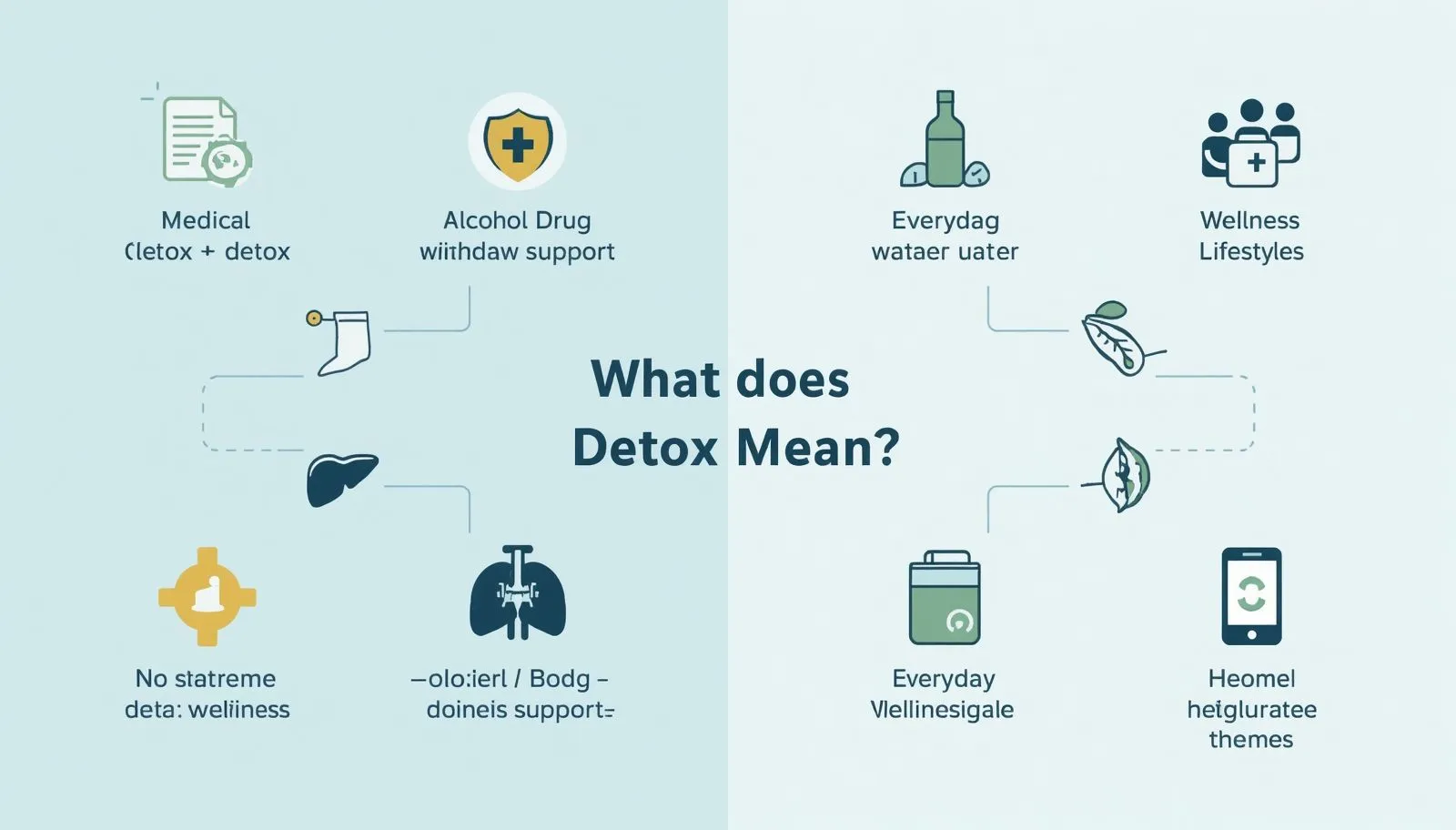
Detox means removing, reducing, or stopping exposure to something harmful or unwanted. In medicine, the term often refers to supervised withdrawal from alcohol or drugs. However, in wellness content, it may describe cleanses, teas, diets, fasting, or supplements that claim to remove “toxins.” Because the meaning changes by context, medical withdrawal care and commercial cleanse products should not be treated as the same thing.
You may see the word on a rehab website, supplement label, juice bottle, social media post, or wellness plan. As a result, it can feel confusing. Sometimes, it describes a serious medical process. In other cases, it simply means taking a break from something that feels unhealthy or overwhelming.
A helpful way to understand the term is to ask four questions:
- What is being removed?
- Why is it being removed?
- How is it being removed?
- Does the claim involve medical risk or marketing language?
Quick Meaning by Context
| Context | Meaning | Example | What to know |
|---|---|---|---|
| Medical care | Supervised withdrawal or removal of harmful substances | Alcohol withdrawal care, opioid withdrawal care | May require professional support |
| Body function | Natural processing and elimination of substances | Liver and kidney function | Happens continuously |
| Wellness marketing | A cleanse, supplement, drink, or diet promoted as cleansing | Juice cleanse, herbal tea, fasting plan | Claims may be vague |
| Toxic exposure | Treatment for poisoning or harmful exposure | Heavy metal poisoning care | Requires medical guidance |
| Lifestyle use | Taking a break from a habit or influence | Digital break, social media break | Usually metaphorical |
Detox as a Noun, Verb, and Everyday Phrase
This word can work in several ways. For that reason, looking at how it appears in a sentence can make the meaning much clearer.
As a noun
A noun names a thing, place, or process.
Examples:
- “He entered a withdrawal care program.”
- “The hospital has a detox unit.”
- “Alcohol withdrawal support may need medical supervision.”
In these examples, the word may refer to a facility, treatment stage, or supervised process. Therefore, the surrounding words matter.
As a verb
A verb describes an action.
Examples:
- “She is coming off alcohol with medical support.”
- “He wants to stop using caffeine for a while.”
- “I’m taking a break from social media this weekend.”
Because the verb form appears in both medical and casual conversations, context is important. For instance, stopping alcohol after heavy use is very different from taking a weekend break from social media.
As an adjective
The term also appears before another noun.
Examples:
- Detox clinic
- Cleanse plan
- Herbal tea
- Withdrawal program
- Supplement kit
- Liver support product
Here, readers need extra caution. A clinic and a tea product do not have the same purpose, evidence, or safety profile.
Detox vs Detoxification
Detoxification is the formal version of the word. It refers to making a substance less harmful, removing harmful substances, or helping the body process and eliminate them.
By contrast, detox is the shorter everyday version. People use it in medical, wellness, and lifestyle conversations.
For general readers, the shorter word is easier to understand. However, medical or scientific content often uses detoxification for precision.
Medical Detox vs Wellness Cleanse
This distinction matters more than almost anything else in the topic.
| Feature | Medical withdrawal care | Wellness cleanse |
|---|---|---|
| Main purpose | Manage withdrawal, intoxication, or toxic exposure | Promote cleansing, resetting, or wellness |
| Common setting | Hospital, clinic, residential center, outpatient program | Home, wellness program, online plan |
| Examples | Alcohol withdrawal care, opioid withdrawal support | Juice cleanse, herbal tea, fasting cleanse |
| Supervision | Often clinical | Usually self-directed |
| Evidence level | Depends on the condition and treatment | Often limited or unclear |
| Main risks | Withdrawal complications or medical instability | Dehydration, nutrient gaps, laxative misuse |
| Best next step | Clinical assessment | Check evidence and safety first |
Medical withdrawal care can be necessary and sometimes urgent. Meanwhile, a wellness cleanse usually refers to a commercial or lifestyle routine. For that reason, the two should not be treated as equal.
What Medical Detox Usually Involves
Medical detox means helping someone safely stop or reduce alcohol, drugs, or another substance while managing withdrawal symptoms.
Clinicians may also call this withdrawal management or medically supervised withdrawal. These terms are often clearer because they describe what actually happens: the person receives support while the body adjusts.
A medical process may include:
- Health assessment
- Monitoring of symptoms
- Medication support when appropriate
- Hydration and nutrition support
- Safety planning
- Referral to ongoing treatment
What happens during supervised withdrawal?
First, a clinician reviews the person’s health history, substance use, medications, mental health, and previous withdrawal symptoms.
Next, the care team monitors symptoms such as tremors, sweating, nausea, anxiety, insomnia, blood pressure changes, confusion, or seizures.
After that, medication may help reduce risk or discomfort when appropriate. The exact approach depends on the substance, dose, duration of use, and the person’s overall health.
Finally, the person usually needs a follow-up plan. Ongoing care may include counseling, medication-assisted treatment, outpatient support, residential treatment, or relapse-prevention planning.
Detox is not the same as rehab
Many people assume withdrawal care “cures” addiction. However, that is not accurate.
A supervised withdrawal process may help someone get through the first physical stage of stopping a substance. Still, long-term recovery often requires continued care, behavioral support, medical follow-up, and relapse-prevention strategies.
Alcohol Withdrawal and Detox
Alcohol-related withdrawal care refers to stopping or reducing alcohol while the body adjusts.
For people who drink heavily or have alcohol dependence, withdrawal can become serious. Symptoms may include anxiety, sweating, shaking, nausea, insomnia, fast heart rate, confusion, hallucinations, or seizures.
Because severe withdrawal can be dangerous, heavy drinkers should not treat alcohol cessation like a casual cleanse. Instead, they should seek medical guidance before stopping suddenly.
Seek urgent medical help for symptoms such as:
- Seizures
- Confusion
- Hallucinations
- Severe shaking
- Chest pain
- Fainting
- Severe dehydration
- High fever
- Loss of consciousness
Professional support matters most when someone has a history of severe withdrawal, long-term heavy drinking, multiple substance use, or major health conditions.
Drug Detox and Withdrawal
Drug-related withdrawal care means stopping or reducing a substance while the body clears it or adapts to its absence.
This process can involve opioids, sedatives, stimulants, prescription medications, or non-prescribed substances. Symptoms vary widely. For example, opioid withdrawal may involve anxiety, muscle aches, sweating, nausea, vomiting, diarrhea, insomnia, and abdominal cramping.
Some substances can create dangerous withdrawal symptoms when stopped suddenly. Alcohol, benzodiazepines, barbiturates, and some long-term prescriptions require special caution.
Therefore, people should seek medical guidance before stopping substances that may cause severe withdrawal.
What Detox Means for the Body
In a biological sense, detoxification describes how the body processes, changes, and removes substances.
Your body already performs these functions every day. For example, the liver helps process alcohol, medications, and other compounds. Meanwhile, the kidneys remove waste and extra fluid through urine.
The digestive system also moves waste through stool. In addition, the lungs remove carbon dioxide, while the skin, lymphatic system, immune system, and circulatory system help maintain balance.
This does not mean a person needs a special cleanse to make the body work. Rather, it means healthy organs already support normal elimination and processing.
What “Toxins” Actually Means
The word toxins causes much of the confusion.
In medical or scientific contexts, a harmful substance may include:
- Alcohol
- Drugs
- Heavy metals
- Poisonous chemicals
- Certain medications at unsafe levels
- Environmental pollutants
- Bacterial toxins
- Metabolic waste products
In wellness marketing, however, the term often stays vague. A product may promise to “flush toxins” without naming the substance, explaining the mechanism, or showing measurable results.
That vagueness should raise questions. Ideally, a trustworthy claim should explain:
- Which substance is involved
- Where it is in the body
- How the method removes or reduces it
- What evidence supports the claim
- Who should avoid the product or routine
- What risks may occur
Without those details, the claim may rely more on marketing than evidence.
What a Wellness Cleanse Usually Means
A wellness cleanse usually refers to a short-term diet, drink, supplement, fasting plan, or routine promoted as a way to reset the body, support digestion, reduce bloating, improve energy, or lose weight.
Common examples include:
| Type | What it involves | Possible concern |
|---|---|---|
| Juice cleanse | Drinking mostly or only juices | Low protein, low calories, blood sugar swings |
| Herbal tea cleanse | Tea promoted for cleansing or weight loss | May contain laxatives or stimulants |
| Fasting plan | Avoiding food or eating very little | Nutrient gaps, fatigue, low blood sugar |
| Colon cleanse | Enemas, laxatives, or irrigation | Dehydration, bowel irritation, electrolyte issues |
| Supplement kit | Pills, powders, herbs, or drops | Interactions, hidden ingredients, weak evidence |
| Sauna routine | Sweating to release impurities | Dehydration or overheating |
| Liver cleanse | Product claiming to reset or clean the liver | Often vague or unsupported |
Some people feel better after these routines because they drink more water, stop alcohol temporarily, eat fewer ultra-processed foods, or reduce calories. Even so, those changes do not prove that a product removed specific harmful substances.
Do Cleanses Really Remove Toxins?
For most commercial cleanse products, evidence remains limited or unclear.
A person may lose weight during a cleanse because they eat fewer calories, reduce salt, drink more fluids, or empty the bowels more often. However, short-term weight loss does not prove that harmful substances left the body.
Similarly, headaches, tiredness, nausea, or irritability during a cleanse do not automatically mean “toxins are leaving.” Those symptoms may come from caffeine withdrawal, dehydration, hunger, low blood sugar, or a sudden change in routine.
So, instead of asking whether a product sounds cleansing, ask whether it makes a clear, specific, and evidence-based claim.
Does Detox Mean Weight Loss?
No. Detox and weight loss are not the same thing.
Some cleanse plans may cause temporary weight changes because they restrict food, carbohydrates, calories, or salt. Once normal eating resumes, that weight may return.
A plan that promises dramatic weight loss in a few days deserves caution. Generally, sustainable results come from consistent habits, not short-term restriction.
Better long-term supports include balanced meals, enough protein, fiber-rich foods, hydration, regular movement, sleep, and limiting alcohol.
Is Detox the Same as a Cleanse?
In wellness marketing, the two words often overlap. Still, they are not identical in every context.
| Term | Common meaning | Example |
|---|---|---|
| Detox | Removing or reducing something harmful or unwanted | Alcohol withdrawal care, digital break |
| Cleanse | Short-term routine marketed as cleaning or resetting the body | Juice cleanse, colon cleanse |
| Detoxification | Formal term for making something less harmful or removing it | Liver detoxification |
| Withdrawal management | Clinical care during substance withdrawal | Medically supervised alcohol withdrawal |
The main takeaway is simple: a clinical withdrawal program and a cleanse product should not be judged by the same standards.
Heavy Metal Detox and Poisoning
Heavy metal removal is one area where detoxification may be medically real. However, it should not be self-treated.
Toxic exposure to substances such as lead, mercury, arsenic, or iron may require professional testing and treatment. In specific cases, clinicians may use chelation therapy to bind and remove certain metals.
However, chelation should not be used casually or for unsupported wellness claims. It can carry risks and requires medical supervision.
Anyone who suspects poisoning or toxic exposure should contact emergency services or a poison control center.
Digital Detox Meaning
A digital detox means taking a planned break from phones, apps, email, social media, or screens.
This use is metaphorical. It does not involve removing toxins from the body.
For example, a person might:
- Turn off non-essential notifications
- Take a weekend away from social media
- Keep a phone out of the bedroom
- Avoid work email after hours
- Create screen-free meals
- Take breaks from news apps
The goal is usually to reduce distraction, stress, overstimulation, or compulsive screen use.
How to Judge a Detox Claim
Before trying a product, cleanse, tea, supplement, or program, use this checklist.
| Question | Why it matters |
|---|---|
| Does it name the harmful substance? | Vague claims are hard to verify |
| Does it explain the mechanism? | Real processes should make sense |
| Does it cite credible evidence? | Testimonials are not enough |
| Does it promise fast weight loss? | That may signal water loss or restriction |
| Does it rely on laxatives? | Misuse can cause dehydration and electrolyte problems |
| Does it warn high-risk people? | Responsible advice should mention safety |
| Does it claim to treat disease? | Disease claims need strong evidence |
| Does it replace medical care? | That is a major warning sign |
A good rule is simple: the more dramatic the promise, the more evidence the claim should provide.
Red Flags in Detox Marketing
Be careful with phrases such as:
- “Flush toxins overnight”
- “Reset your metabolism instantly”
- “Cleanse your liver in 24 hours”
- “Lose 10 pounds in 3 days”
- “Works for everyone”
- “No side effects”
- “Removes heavy metals naturally”
- “Cures bloating, fatigue, acne, and disease”
- “Feeling bad means toxins are leaving”
Marketing language often sounds scientific without being specific. For that reason, vague promises need careful reading.
Who Should Avoid Cleanses or Ask a Clinician First?
Some people face higher risks from fasting, laxatives, herbs, supplements, colon cleansing, or very restrictive diets.
Speak with a qualified healthcare professional first if you:
- Are pregnant or breastfeeding
- Have diabetes
- Have kidney disease
- Have liver disease
- Have heart disease
- Have an eating disorder history
- Take prescription medications
- Have a history of seizures or fainting
- Are underweight
- Are older or medically fragile
- Are stopping alcohol, opioids, sedatives, or multiple substances
In these situations, a cleanse can create more risk than benefit.
What the Term Does Not Mean
The word does not automatically mean:
- Your body is dirty
- Your organs are failing
- You need a product
- You must stop eating solid food
- You need laxatives
- You are losing fat
- You are curing a disease
- You are treating addiction fully
- You are doing something safe
Instead of asking, “Should I do a detox?” ask:
What problem am I trying to solve, and is this method safe, specific, and evidence-based?
Common Examples and What They Usually Mean
| Phrase | Usual meaning | How to understand it |
|---|---|---|
| “He went to detox” | Medical or supervised withdrawal care | Usually substance-related |
| “I’m doing a juice cleanse” | Short-term juice-only diet | Likely calorie restriction |
| “Liver support supplement” | Product claiming to support liver function | Check evidence and ingredients |
| “Digital break” | Time away from screens | Lifestyle use |
| “Detox symptoms” | Symptoms during withdrawal or a cleanse | Could have many causes |
| “Heavy metal removal” | Claimed or medical removal of metals | Requires testing and care |
| “Full-body cleanse” | Broad wellness marketing phrase | Often vague |
What Most Articles Miss About This Topic
Many articles define the term too narrowly. Some focus only on withdrawal care, while others focus only on wellness cleanses.
A better explanation is that the word changes meaning by context.
Someone searching for the definition may be trying to understand:
- A loved one entering alcohol withdrawal care
- A product claiming to cleanse the liver
- A juice cleanse on social media
- A medical article about detoxification
- A possible heavy metal exposure
- A planned break from screens
- Symptoms during a cleanse or withdrawal
Because the word covers so many situations, context matters more than the label.
A practical interpretation comes down to four questions:
- What is being removed?
Alcohol, drugs, heavy metals, waste products, screens, or something vague? - How is removal supposed to happen?
Medical care, normal organ function, food restriction, laxatives, supplements, or lifestyle boundaries? - What evidence supports it?
Is there credible support, or mostly marketing? - What risks exist?
Could the approach cause withdrawal complications, dehydration, nutrient gaps, or medication interactions?
Ultimately, the clearest definition is this: detox means reducing or removing a harmful substance, exposure, or habit, but the evidence, safety, and meaning depend on context.
FAQs
What does detox mean in simple words?
It means removing, reducing, or stopping exposure to something harmful or unwanted. Depending on context, it may involve medical withdrawal care, normal body processes, a wellness cleanse, or a lifestyle break.
What does the term mean medically?
In medicine, it usually refers to supervised withdrawal from alcohol, drugs, or another substance while managing symptoms and reducing health risks.
Is detoxification different from detox?
Yes. Detoxification is the formal term, while detox is the shorter everyday version.
Is a cleanse the same thing?
Not always. Wellness brands often use the words together, but a cleanse product is not the same as medical withdrawal care.
Does the body need special cleanses?
The body already processes and removes substances through organs such as the liver, kidneys, lungs, and digestive system. Therefore, most people do not need extreme cleanse routines for normal body function.
Do herbal teas cleanse the body?
Many tea products make broad claims without proving that they remove specific harmful substances. In addition, some may contain laxatives or stimulants.
Does detox mean weight loss?
No. Some plans cause temporary weight changes because they restrict calories or reduce water weight. However, that does not prove toxin removal or lasting fat loss.
What does alcohol detox involve?
It involves stopping or reducing alcohol while the body adjusts. Because heavy or long-term alcohol use can lead to dangerous withdrawal, medical guidance may be necessary.
What does drug detox involve?
It means stopping or reducing a drug while managing withdrawal symptoms and health risks. The process depends on the substance, dose, duration of use, and personal health.
What is a digital detox?
A digital detox is a planned break from phones, apps, social media, email, or screens. It is a lifestyle phrase, not a medical process.
Can detox be dangerous?
Yes. Alcohol or sedative withdrawal can be dangerous without care. Also, some cleanses may cause dehydration, electrolyte imbalance, nutrient gaps, or medication interactions.
What is the safest way to support natural body function?
Focus on balanced meals, enough fluids, quality sleep, regular movement, limited alcohol, and medical advice for existing conditions. Additionally, avoid extreme routines and vague product claims.
Conclusion
Detox can mean different things depending on context. In medical settings, it may describe supervised withdrawal from alcohol or drugs. In biology, it refers to the body’s normal processing and removal of substances. Meanwhile, in wellness marketing, it often appears on cleanses, teas, supplements, diets, or fasting plans. In everyday life, it can simply mean taking a break from something.
The safest way to understand the term is to look beyond the label. Ask what is being removed, how the process works, whether credible evidence supports the claim, and whether any risks apply.
For related guidance, explore articles on medical withdrawal care, alcohol withdrawal symptoms, liver and kidney health, supplement safety, and how to evaluate wellness claims.
Click Here To Read About : what is rbf mean

I am Clara Lexis, a writer driven by clarity, depth, and authenticity. My focus is on transforming ideas into meaningful content that is both informative and engaging. I write with intention to communicate clearly, thoughtfully, and with purpose.