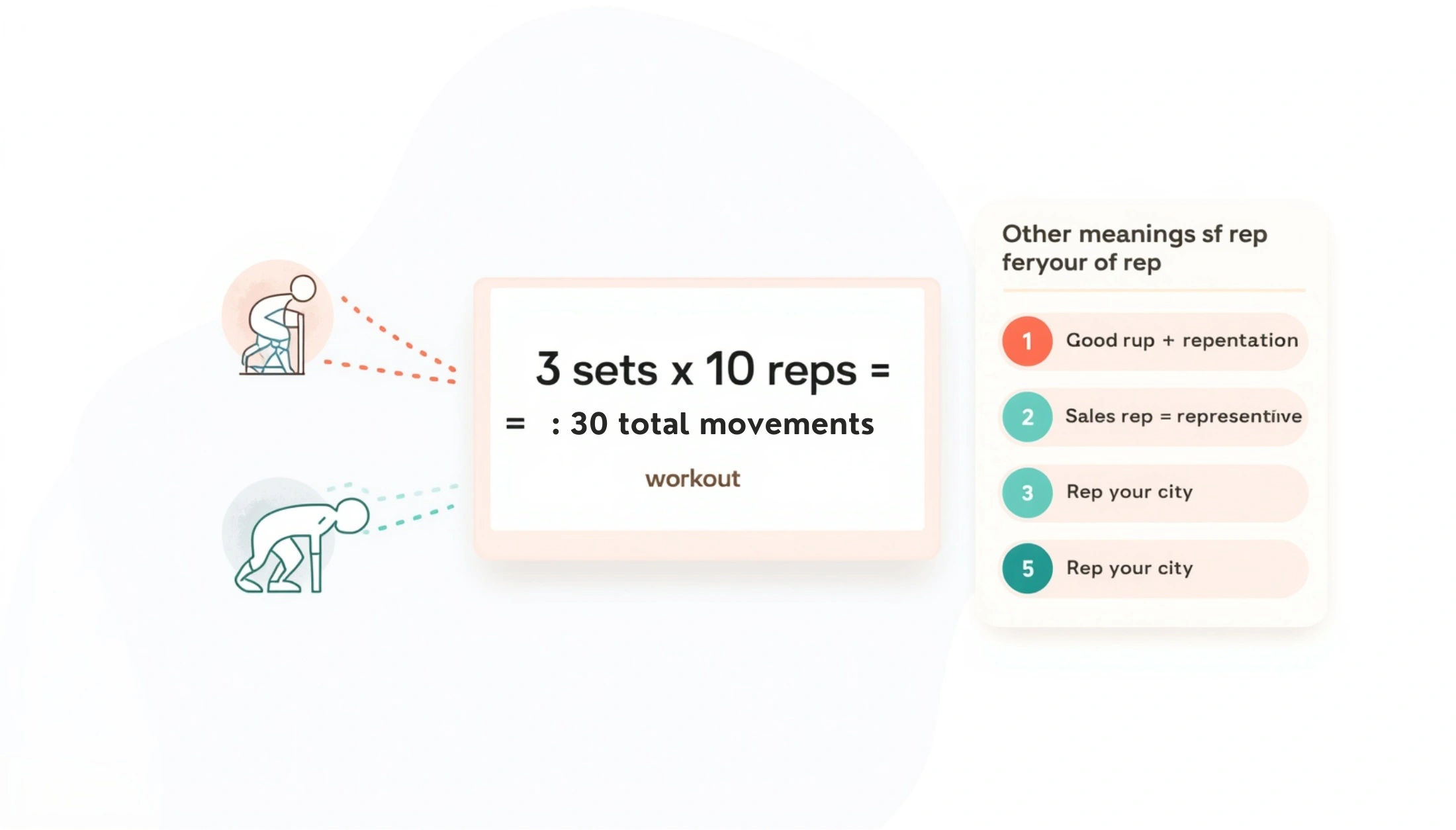
Reps usually means repetitions in exercise. In simple terms, one rep is one complete movement, such as a push-up, squat, or bicep curl. So, when a workout says “10 reps,” you repeat that movement 10 times. Outside fitness, however, “rep” can also mean reputation, representative, or represent.
You may see the term in a gym app, workout video, training plan, text message, or business conversation. At first, it can feel unclear because the meaning changes by context. Fortunately, once you understand the surrounding words, the meaning becomes easy to spot.
This guide explains the fitness meaning first, then shows how the word works in slang, texting, and business situations.
Quick Meaning by Context
| Where you saw it | Meaning | Example |
|---|---|---|
| Workout plan | Repetitions | “Do 10 reps” means repeat the movement 10 times |
| Gym app | Exercise movements | “3 sets of 12” means 3 rounds of 12 movements |
| Texting or social media | Reputation | “He has a good rep” means people think well of him |
| Business or customer service | Representative | “Talk to a sales rep” means talk to a sales representative |
| Informal speech | Represent | “I rep my city” means I support or represent my city |
In most cases, context gives you the answer. When a sentence mentions exercises, sets, weights, or workouts, the term usually refers to repeated exercise movements. Meanwhile, business or social situations often point to a different meaning.
Meaning in Exercise
In fitness, the term is short for repetitions. It tells you how many times to perform a specific exercise movement.
For example:
| Exercise instruction | Meaning |
|---|---|
| 1 push-up | 1 rep |
| 10 push-ups | 10 reps |
| 1 squat | 1 rep |
| 12 squats | 12 reps |
| 1 bicep curl | 1 rep |
| 8 bicep curls | 8 reps |
So, if your workout says:
Do 10 reps of squats.
That instruction simply means:
Do 10 squats.
A repetition is not the entire workout. Instead, it is one completed movement within an exercise.
What Counts as One Rep?
One rep includes the full movement from the starting position, through the exercise, and back to the correct finish position. However, each exercise has its own movement pattern.
Push-up example
For one push-up, you start in a push-up position, lower your body with control, and push back up to the starting position. After that full movement, you have completed one repetition.
Squat example
During one squat, you stand upright, lower your body by bending your knees and hips, then return to standing. Once you complete that full motion, it counts as one repetition.
Bicep curl example
With one bicep curl, you begin with your arm extended, curl the weight upward, and lower it back down with control. The complete curl counts as one repetition.
However, quality matters more than speed. A useful movement should feel controlled, complete, and safe.
Reps vs Sets: What Is the Difference?
Although people often mention these terms together, they mean different things.
A rep is one exercise movement.
A set is a group of repeated movements before a rest break.
| Term | Meaning | Example |
|---|---|---|
| Rep | One complete movement | 1 push-up |
| Reps | Multiple repeated movements | 10 push-ups |
| Set | A group of reps | 10 push-ups before resting |
| 3 sets of 10 | 10 movements repeated 3 times | 30 total movements |
This distinction helps you read workout plans more easily. Once you know the difference, phrases like “3 sets of 10” become much less confusing.
For a deeper related article, link internally to your guide on reps vs sets.
What Does 3 Sets of 10 Mean?
The phrase 3 sets of 10 means you do 10 repetitions, rest, and then repeat that round two more times.
Here is how it looks with squats:
| Round | What you do |
|---|---|
| Set 1 | 10 squats |
| Rest | Take a short break |
| Set 2 | 10 squats |
| Rest | Take another short break |
| Set 3 | 10 squats |
Altogether, you complete 30 squats.
This structure helps you pace the workout. Instead of doing every movement at once, you divide the work into manageable rounds.
How to Read Workout Notation Like 3×10, 4×8, or 5×5
Workout plans often use shorthand. Usually, the first number shows the number of sets, while the second number shows the number of repetitions per set.
| Workout notation | Meaning | Total movements |
|---|---|---|
| 3×10 | 3 sets of 10 | 30 |
| 4×8 | 4 sets of 8 | 32 |
| 5×5 | 5 sets of 5 | 25 |
| 2×12 | 2 sets of 12 | 24 |
For example:
Lunges — 3×10 each leg
This usually means:
- 3 sets
- 10 movements per leg
- 30 total movements per leg
Also, watch for phrases such as “each side,” “each arm,” or “each leg.” These details change the total number you perform.
For more help, link internally to how to read a workout plan.
How Many Should Beginners Do?
There is no perfect number for everyone. Your ideal amount depends on the exercise, your current ability, your goal, and how well you can keep proper form.
A beginner-friendly approach works best when you start with a number you can control. Then, stop before your form breaks down. If needed, use lighter resistance and add more over time as you improve.
For many beginner bodyweight movements, 6 to 12 controlled repetitions may work as a useful starting range. Some exercises may need fewer, while others may allow more. Still, the highest number is not always the best number.
The right choice is the amount you can perform safely and consistently. Therefore, a simple rule helps:
Stop a set when you can no longer perform clean, controlled movements.
If you feel sharp pain, dizziness, or unusual discomfort, stop the exercise. Then, consider asking a qualified trainer or healthcare professional for guidance.
Low, Moderate, and High Rep Ranges
Fitness plans often use different repetition ranges for different goals. Although these ranges are not strict rules, they can help you understand the purpose of a workout.
| Range | Often used for | Simple explanation |
|---|---|---|
| Low | Strength-focused training | Fewer movements, usually with more resistance |
| Moderate | General strength and muscle-building | Balanced effort and volume |
| High | Muscular endurance | More repeated effort, often with lighter resistance |
Low range
Low-range training usually uses fewer repetitions per set and more resistance.
For example:
5 heavy squats
This style often supports strength-focused training. However, it requires proper technique and a suitable load.
Moderate range
Moderate-range training appears often in general fitness and muscle-building routines.
For example:
8 to 12 dumbbell rows
This approach gives you enough repeated work without requiring extremely heavy weight.
High range
Higher-range training usually involves lighter resistance and more repeated movement.
For example:
15 to 20 bodyweight squats
This method can support endurance, movement practice, or lighter conditioning work. Ultimately, the right range depends on your goal, exercise choice, fitness level, and effort.
How Rep Ranges Change Based on Your Goal
The same exercise can feel very different depending on how many repetitions you perform, how much resistance you use, and how long you rest.
| Goal | Common approach | What to focus on |
|---|---|---|
| Learn form | Lower to moderate range | Slow, controlled technique |
| Build strength | Lower range with more resistance | Quality, rest, and control |
| Build muscle | Moderate range with enough challenge | Consistent volume and effort |
| Improve endurance | Higher range with lighter resistance | Repeated movement and stamina |
| General fitness | Mixed ranges | Balance, consistency, and gradual progress |
No single range works best for every person or every exercise. In fact, many good workout plans use a mix.
Do More Reps Mean a Better Workout?
Not always.
More repetitions can increase the amount of work you do. However, they do not automatically make a workout better. For example, 20 rushed movements with poor form may help less than 8 controlled movements done well.
Useful exercise movements usually include:
- Control
- Stable posture
- Safe technique
- Appropriate speed
- Full intended range of motion
- Enough effort without reckless strain
So, instead of only asking, “How many did I do?” ask:
Did I perform them with control and good form?
That question gives you a better way to judge workout quality.
What Makes a Good Rep?
A good repetition combines control, technique, and purpose. You are likely moving well when you understand the exercise, avoid rushing, choose resistance you can control, and complete the movement without losing form.
On the other hand, poor movement may involve swinging, bouncing, twisting, cutting the range short, or relying on momentum. Therefore, the count matters, but the way you move matters too.
Common Gym Phrases
You may hear these phrases in workout videos, training programs, or gym conversations.
| Phrase | Meaning |
|---|---|
| “Do 10 reps” | Repeat the exercise 10 times |
| “Rep it out” | Keep doing repetitions, often near the end of a set |
| “Last rep” | Final repetition in the set |
| “Clean reps” | Movements performed with good form |
| “Half reps” | Incomplete movements, sometimes intentional but often a form issue |
| “AMRAP” | As many reps as possible |
| “One-rep max” | The most weight someone can lift for one complete movement |
| “Reps in reserve” | How many more good movements you could still perform |
These phrases become easier to understand once you know the basic meaning. Additionally, they help you follow gym videos and training programs with more confidence.
What Does AMRAP Mean?
AMRAP often means as many reps as possible.
For example:
Push-ups — AMRAP in 60 seconds
This means:
Perform as many controlled push-ups as you can in 60 seconds.
Even so, AMRAP should not encourage careless movement. Form still matters, especially when fatigue builds.
What Is a One-Rep Max?
A one-rep max, often written as 1RM, means the most weight someone can lift for one complete repetition of an exercise.
For example:
If someone can bench press 100 pounds once, and cannot complete a second repetition, that weight may be their one-rep max for the bench press.
Beginners usually do not need to test a true one-rep max. Because it can be demanding, this type of testing works best with proper coaching, safe equipment, and careful technique.
What Are RPE and Reps in Reserve?
Some workout plans use effort-based terms instead of only giving a number.
RPE
RPE stands for rating of perceived exertion. It describes how hard a set feels.
A low RPE feels easy, while a high RPE feels very difficult.
Reps in reserve
Reps in reserve, often shortened to RIR, means how many more good repetitions you think you could still perform before stopping.
For example:
If you finish 10 repetitions and feel like you could have done 2 more with good form, you had about 2 reps in reserve.
You do not need to master these terms right away. However, they help when you start reading more detailed workout plans.
Warm-Up Reps vs Working Reps
Not every repetition in a workout serves the same purpose.
Warm-up movements
Warm-up movements prepare your body for the exercise. They usually feel lighter and easier.
Example:
10 bodyweight squats before weighted squats
Working movements
Working movements make up the main part of your workout. These usually feel more challenging and support your main training goal.
Example:
3 sets of 10 weighted squats
This distinction matters because a workout may include both warm-up sets and working sets. As a result, not every repetition carries the same training purpose.
Common Beginner Mistakes
| Mistake | Why it matters | Better approach |
|---|---|---|
| Confusing reps and sets | Makes workout plans harder to follow | Remember: reps are movements, sets are groups |
| Rushing the movement | Reduces control and form quality | Move with control |
| Counting incomplete movements | Makes progress harder to measure | Use a consistent range of motion |
| Using too much weight | Can cause form to break down | Choose resistance you can control |
| Chasing high numbers only | More is not always better | Match the range to your goal and ability |
| Ignoring pain | Can increase risk | Stop if something feels wrong |
The goal is not simply to finish the number. Instead, aim to perform useful, controlled work.
Other Meanings Outside the Gym
Although the fitness meaning is common, “rep” has several other uses. The correct meaning depends on the sentence.
Reputation
In casual speech, rep can be short for reputation.
For example:
- “He has a good rep” means people think well of him.
- “That company has a bad rep” means people often view it negatively.
- “I do not want to hurt my rep” means someone wants to protect their image.
This meaning appears often in school, work, social media, and everyday conversation.
Representative
A rep can also be a representative.
Examples include:
- Sales rep = sales representative
- Customer service rep = customer service representative
- Company rep = company representative
- Student rep = student representative
- Political rep = political representative
In this context, a rep speaks, works, or acts for a company, organization, class, or public group.
Represent
In informal speech, rep can also mean represent.
For example:
- “I rep my city” means “I represent or support my city.”
- “She reps her team” means “She supports or represents her team.”
- “They rep that brand” means they strongly support or represent that brand.
This meaning is casual, so tone and context matter.
Rep vs Reps: Singular and Plural
| Word | Meaning | Example |
|---|---|---|
| Rep | One repetition, reputation, or representative | “Do one rep” / “sales rep” |
| Reps | Multiple repetitions or multiple representatives | “Do 10 reps” / “the reps are calling” |
| Repetition | Full fitness term | “Complete 12 repetitions” |
| Representative | Full business term | “Ask a representative” |
| Reputation | Social meaning | “Good rep” |
In fitness, rep is singular and reps is plural.
- 1 rep
- 2 reps
- 10 reps
The Fastest Way to Understand the Meaning
Use these context clues:
| Context clue | Likely meaning |
|---|---|
| Exercises, weights, sets, or workouts nearby | Repetitions |
| Company, customer, job, or organization nearby | Representative |
| Image, credibility, or public opinion nearby | Reputation |
| Identity, pride, support, or belonging nearby | Represent |
With this simple check, you can usually understand the word in seconds.
What Most Articles Miss About This Topic
Many articles define the term and stop there. That gives a quick answer, but it does not fully solve the confusion.
The better explanation is that the meaning changes by context.
In a workout, the term tells you how many times to repeat an exercise. In a job title, however, it usually points to a representative. During texting, it may refer to reputation. In informal speech, meanwhile, it may mean represent.
That is why the same short word can appear in very different sentences:
| Sentence | Meaning |
|---|---|
| “Do 10 reps” | Do 10 repetitions |
| “Call the sales rep” | Call the sales representative |
| “He has a good rep” | People think well of him |
| “I rep my city” | I represent my city |
Many pages also miss an important fitness point: movement quality matters as much as the count.
Beginners often focus only on finishing the assigned number. However, controlled movement gives you a better foundation than rushed or sloppy technique.
In other words, a repetition should not just be counted. It should be performed well.
Practical Examples
Workout app
You see:
Goblet squats — 3×12
This means:
Do 3 sets of 12 goblet squats.
Total: 36 squats.
Fitness video
The instructor says:
Give me 15 more.
In this situation, the instructor means:
Repeat the exercise 15 more times.
Text message
Someone says:
That place has a bad rep.
Here, the phrase means:
People often view that place negatively.
Sales page
You see:
Speak with a product rep.
In this case, the page means:
Speak with a product representative.
Social media caption
Someone writes:
Always rep your city.
Here, the phrase means:
Always represent or support your city.
Should You Say Rep or Reps?
Use rep when you mean one. Then, use reps when you mean more than one.
Correct examples:
- “Do 1 rep.”
- “Do 10 reps.”
- “That was my last rep.”
- “How many should I do?”
- “She is a sales rep.”
- “The customer service reps are busy.”
In fitness, people often use the plural form because workout plans usually involve more than one movement.
FAQs
What does reps mean?
In most workout contexts, it means repetitions. Specifically, it tells you how many times to repeat an exercise movement.
What does it mean in a workout?
The term shows the number of times you should perform an exercise. For example, “8 reps” means you complete the movement 8 times.
What is one rep?
One rep is one complete exercise movement. For instance, lowering into a squat and standing back up counts as one squat rep.
What does 3 sets of 10 mean?
This means you do 10 repetitions, rest, and repeat that round 3 times. Altogether, you complete 30 movements.
What does 3×10 mean in exercise?
It usually means 3 sets of 10. In practice, you perform 10 movements, rest, and repeat for 3 total sets.
Are reps and sets the same thing?
No. A rep is one movement, while a set is a group of repeated movements performed before resting.
What does rep mean in texting?
In texting, rep may mean reputation or represent. For example, “good rep” means good reputation, while “rep your city” means represent your city.
What does sales rep mean?
A sales rep is a sales representative. In other words, this person represents a company and helps sell its products or services.
What does good rep mean?
Good rep means good reputation. As a result, it suggests people generally think well of someone or something.
Do more reps mean better results?
Not always. More can help in some cases, but form, resistance, rest, effort, and consistency also matter.
What does AMRAP mean?
AMRAP often means “as many reps as possible.” In a workout, it asks you to complete as many controlled movements as you can within the instructions.
What does one-rep max mean?
A one-rep max, or 1RM, is the most weight someone can lift for one complete movement. Because it can be demanding, beginners should approach it carefully and with proper guidance.
Conclusion
In exercise, reps means repetitions. One repetition is one complete movement, such as one push-up, squat, or bicep curl. Therefore, when a workout says “10 reps,” you perform that movement 10 times.
Outside the gym, the same short word can mean something different. For instance, a sales rep is a representative, while a good rep means a good reputation. To rep something can also mean to represent or support it.
To choose the right meaning, look at the context. If the sentence includes exercises, sets, weights, or a workout plan, it refers to repeated exercise movements.
For more beginner-friendly help, read our guides on reps vs sets, how to read a workout plan, and common fitness terms.
Click Here To Read About : what does how many mean in math

I am Clara Lexis, a writer driven by clarity, depth, and authenticity. My focus is on transforming ideas into meaningful content that is both informative and engaging. I write with intention to communicate clearly, thoughtfully, and with purpose.