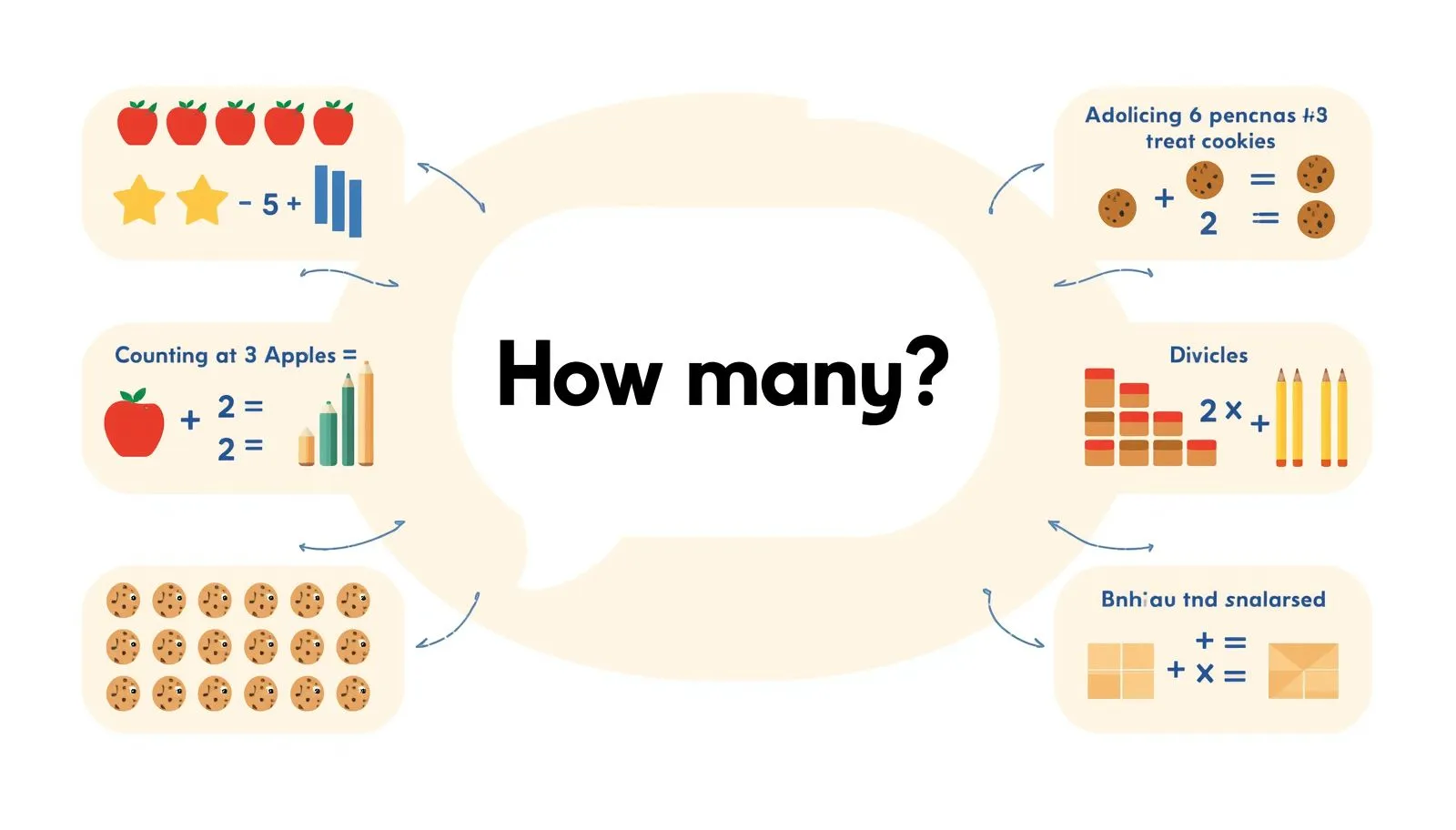
In math, “how many” asks you to find a number or quantity. The answer may be the number of objects, groups, units, outcomes, or times something happens. Sometimes you can count directly. Other times, you need to add, subtract, multiply, divide, or compare.
This guide explains the phrase in simple language for students, parents, tutors, and teachers. It also shows how the meaning changes in word problems, measurement, graphs, and early probability.
Quick Answer for Kids
The phrase means:
Find the number.
For example, if someone asks:
How many apples are on the table?
They want the number of apples.
You may count the apples one by one. However, in a word problem, you may need to use an operation.
For example:
- How many blocks are there? → Count them.
- How many are left? → Subtract.
- How many are there in all? → Add or multiply.
- How many does each person get? → Divide.
- How many more? → Compare two amounts.
So, the phrase tells you what to find. The rest of the problem tells you how to find it.
Simple Meaning in Math
This question usually asks for a quantity.
A quantity means an amount or number.
Most of the time, the phrase refers to things you can count, such as:
- pencils
- apples
- students
- books
- coins
- boxes
- blocks
- days
- votes
- groups
Example:
How many pencils are on the desk?
If there are 8 pencils, the answer is:
8 pencils
Notice that the answer includes both the number and the unit.
The Math Word Behind the Idea: Cardinality
In math vocabulary, this kind of question often asks for cardinality.
Although the word sounds advanced, the idea is simple.
Cardinality means the number of items in a set or group.
For example:
Set: {apple, apple, apple, apple}
Cardinality: 4
That means the group has 4 apples.
For younger students, cardinality simply means:
Count the items and say the total.
As a result, when a teacher asks about the number of blocks in a group, the student finds the group’s cardinality.
How Children First Learn This Idea
Children usually begin with counting.
One important early skill is one-to-one correspondence. This means a child points to or touches each object once while saying one number.
Example:
⭐ ⭐ ⭐ ⭐ ⭐
A child counts:
1, 2, 3, 4, 5
Then the child says:
There are 5 stars.
This skill matters because a child may know number words but still skip an object or count the same one twice. Careful counting builds the foundation for understanding quantity.
Quick Reference: Common Meanings
The same question phrase can appear in many types of math problems.
| Phrase | What It Usually Asks For | Common Math Thinking |
|---|---|---|
| How many are there? | A count | Counting |
| How many in all? | A total | Addition or multiplication |
| How many altogether? | A total | Addition or multiplication |
| How many are left? | A remaining amount | Subtraction |
| How many more? | A difference | Subtraction / comparison |
| How many fewer? | A difference | Subtraction / comparison |
| How many each? | An equal share | Division |
| How many groups? | Number of groups | Division |
| How many times? | Repeated action or comparison | Multiplication or division |
| How many ways? | Possible arrangements or outcomes | Counting, probability, combinatorics |
This table can help, but it should not replace careful reading.
The best rule is:
The phrase tells you the answer should be a number. The story tells you which operation to use.
Does the Phrase Mean Add?
Sometimes, yes.
It points to addition when the problem asks you to combine groups or find a total.
Addition Example
Mia has 4 red marbles and 3 blue marbles.
How many marbles does Mia have in all?
You combine the groups:
4 + 3 = 7
Mia has 7 marbles.
Here, the words “in all” show that the problem asks for a total.
Does It Mean Subtract?
In some problems, yes.
Subtraction usually fits when the question asks what is left, what remains, or how two amounts are different.
Subtraction Example
Noah had 10 crayons. He gave 4 crayons to his friend.
How many crayons does Noah have left?
He started with 10 and gave away 4:
10 − 4 = 6
Noah has 6 crayons left.
In this case, the word “left” shows that the amount went down.
Can It Mean Multiply?
Yes. Multiplication often appears when the problem uses equal groups.
Multiplication Example
There are 5 bags. Each bag has 6 marbles.
How many marbles are there in all?
There are 5 equal groups of 6:
5 × 6 = 30
The answer is 30 marbles.
The phrase “each bag has 6” shows equal groups, so multiplication works well.
Can It Mean Divide?
Yes. Division fits when something gets shared equally or split into equal groups.
Division Example
There are 20 cookies. Four children share them equally.
How many cookies does each child get?
You divide 20 cookies among 4 children:
20 ÷ 4 = 5
Each child gets 5 cookies.
Here, the words “share equally” and “each child” point to division.
“How Many More” and “How Many Fewer” Mean Compare
Students often see the word “more” and think they should add. However, comparison questions usually require subtraction.
Comparison Example
Zoe has 12 stickers. Max has 8 stickers.
How many more stickers does Zoe have than Max?
You compare 12 and 8:
12 − 8 = 4
Zoe has 4 more stickers than Max.
The same idea works with “fewer.”
Example:
Max has 8 stickers. Zoe has 12 stickers.
How many fewer stickers does Max have than Zoe?
Again, compare the two numbers:
12 − 8 = 4
Max has 4 fewer stickers.
How to Choose the Right Operation
Instead of asking, “Do I add or subtract?”, start with a better question:
What number am I trying to find?
After that, use the story to choose the operation.
1. Find the Unit
Look for the thing being counted.
Examples include:
- apples
- books
- minutes
- dollars
- students
- boxes
- groups
- votes
- inches
- outcomes
If the question asks for boxes, answer in boxes. Likewise, if it asks for minutes, answer in minutes.
The unit keeps your answer focused.
2. Identify the Unknown Number
The unknown is the number you need to figure out.
Example:
There are 18 pencils. Each box holds 6 pencils.
How many boxes are needed?
You already know the number of pencils: 18.
The unknown is the number of boxes.
So, divide:
18 ÷ 6 = 3
Answer:
3 boxes
3. Notice the Action in the Story
Next, ask what happens in the problem.
| Story Action | Likely Operation |
|---|---|
| Things join together | Addition |
| Something gets taken away | Subtraction |
| Equal groups repeat | Multiplication |
| Items get shared equally | Division |
| Two amounts get compared | Subtraction |
| Outcomes need counting | Counting / probability |
This approach works better than memorizing keywords because the same phrase can appear in different problem types.
4. Check Whether the Groups Are Equal
Equal groups often signal multiplication or division.
Example:
There are 4 trays. Each tray has 5 cookies.
How many cookies are there?
Each tray has the same number, so multiply:
4 × 5 = 20
Now compare that with this problem:
One tray has 3 cookies, one has 5 cookies, and one has 7 cookies.
How many cookies are there?
The groups differ, so add:
3 + 5 + 7 = 15
Both problems ask for a number, but they need different operations.
5. Check Whether the Answer Makes Sense
After solving, ask:
- Should the answer be bigger or smaller?
- Did I use the correct unit?
- Does the number fit the story?
- Did I count groups or items?
- Did I compare the correct numbers?
Example:
Sara had 15 candies. She ate 6. How many candies are left?
An answer of 21 would not make sense because eating candies should reduce the amount.
The correct answer is:
15 − 6 = 9
Sara has 9 candies left.
Examples in Different Math Topics
This question pattern appears in many areas of math, not only basic counting.
Counting
How many stars are there?
⭐ ⭐ ⭐ ⭐
Answer:
4 stars
You count each object once.
Addition
There are 6 cats and 3 dogs.
How many animals are there in all?
Use addition:
6 + 3 = 9
Answer:
9 animals
Subtraction
There were 14 birds in a tree. Five flew away.
How many birds are left?
Use subtraction:
14 − 5 = 9
Answer:
9 birds
Multiplication
There are 3 rows of chairs. Each row has 8 chairs.
How many chairs are there?
Use multiplication:
3 × 8 = 24
Answer:
24 chairs
Division
There are 24 students. Each table seats 4 students.
How many tables are needed?
Use division:
24 ÷ 4 = 6
Answer:
6 tables
Measurement
This wording can also ask about units of measurement.
Example:
How many inches are in 2 feet?
Since 1 foot has 12 inches:
2 × 12 = 24
Answer:
24 inches
Another example:
How many minutes are in 3 hours?
Since 1 hour has 60 minutes:
3 × 60 = 180
Answer:
180 minutes
In measurement problems, the unit matters a lot.
Data and Graphs
Graphs and charts often use this kind of question.
Example:
A bar graph shows that 9 students chose pizza and 6 students chose tacos.
How many more students chose pizza than tacos?
Compare the two numbers:
9 − 6 = 3
Answer:
3 more students chose pizza.
In data questions, the phrase may ask for a count, a total, a difference, or a category value shown on a graph.
Probability and Outcomes
Sometimes the question asks about possible outcomes.
Example:
A spinner has 4 equal sections: red, blue, green, and yellow.
How many possible colors can the spinner land on?
Answer:
4 possible colors
The answer is still a number, but now it counts possible results.
“How Many Ways” in Math
In later math, “how many ways” often asks for possible arrangements or combinations.
Example:
How many ways can you arrange the letters A, B, and C?
The possible arrangements are:
- ABC
- ACB
- BAC
- BCA
- CAB
- CBA
There are 6 ways.
For younger students, this simply means:
Count all the possible choices or arrangements.
“How Many” vs. “How Much”
Students often confuse these two phrases.
| Phrase | Usually Used For | Example |
|---|---|---|
| How many | Countable things | How many apples? |
| How much | Amounts, measurements, or cost | How much water? |
Use the first phrase for things you can count one by one:
- books
- chairs
- coins
- students
Use the second phrase for amounts that people usually measure rather than count individually:
- water
- sand
- time
- money
However, everyday speech has exceptions.
For example, someone might ask:
How much money do you have?
They might also ask:
How many dollars do you have?
Both can make sense because money is an amount, while dollars are countable units.
Visual Ways to Understand the Question
Visual models make word problems easier, especially for young learners.
| Problem Type | Helpful Visual |
|---|---|
| Counting objects | Counters, blocks, fingers, tally marks |
| Addition | Number line, drawing groups together |
| Subtraction | Crossing out, number line, take-away drawing |
| Multiplication | Arrays, equal groups |
| Division | Equal sharing circles, groups |
| Comparison | Bar model, side-by-side drawing |
| Data | Bar graph, picture graph, tally chart |
Array Example
There are 3 rows of stars. Each row has 4 stars.
How many stars are there?
Visual:
⭐ ⭐ ⭐ ⭐
⭐ ⭐ ⭐ ⭐
⭐ ⭐ ⭐ ⭐
This shows 3 rows of 4:
3 × 4 = 12
Answer:
12 stars
Arrays help students see multiplication instead of guessing.
Examples by Grade Level
As students grow, this question appears in more advanced ways.
| Level | Example | What It Teaches |
|---|---|---|
| Kindergarten | How many blocks are there? | Counting |
| Grade 1 | How many apples are there in all? | Addition |
| Grade 2 | How many are left? | Subtraction |
| Grade 3 | How many equal groups are there? | Multiplication and division |
| Grade 4+ | How many inches are in 3 feet? | Measurement conversion |
| Upper elementary | How many students chose soccer on the graph? | Data reading |
| Middle school | How many outcomes are possible? | Probability |
| Later math | How many ways can objects be arranged? | Combinatorics |
Because of this, the phrase is not only a counting question. It becomes a flexible math question pattern across many topics.
Common Mistakes Students Make
Mistake 1: Assuming the Question Always Means Addition
Example:
Lily had 13 stickers. She gave away 5.
How many stickers are left?
Adding gives:
13 + 5 = 18
That does not fit the story. Since Lily gave stickers away, the number should go down.
Correct:
13 − 5 = 8
Answer:
8 stickers
Mistake 2: Treating “More” as an Addition Clue Every Time
Example:
Ben has 15 cards. Omar has 9 cards.
How many more cards does Ben have?
The word more appears, but the question asks for a comparison.
Correct:
15 − 9 = 6
Answer:
Ben has 6 more cards.
Mistake 3: Ignoring the Unit
Example:
There are 30 students. Each bus holds 10 students.
How many buses are needed?
The question asks for buses, not students.
Correct:
30 ÷ 10 = 3
Answer:
3 buses
Always check the unit before writing the final answer.
Mistake 4: Counting Items When the Problem Asks for Groups
Example:
There are 16 muffins. Each box holds 4 muffins.
How many boxes are needed?
The answer should not be 16 muffins because the question asks for boxes.
Correct:
16 ÷ 4 = 4
Answer:
4 boxes
Mistake 5: Using Keywords Without Understanding
Keywords can help, but they can also mislead.
A better method is:
- Name the unit.
- Find the unknown.
- Understand the action.
- Choose the operation.
- Check the answer.
This method helps students solve the problem instead of guessing from one word.
Practice Problems With Answers
Try these examples.
1. Counting
There are 7 blocks on the floor.
How many blocks are there?
Answer:
7 blocks
No operation is needed because the number already appears.
2. Addition
Emma has 5 pencils. She buys 4 more.
How many pencils does she have now?
Math:
5 + 4 = 9
Answer:
9 pencils
The amount increases.
3. Subtraction
There are 12 cookies. Five are eaten.
How many cookies are left?
Math:
12 − 5 = 7
Answer:
7 cookies
The amount decreases.
4. Multiplication
There are 6 boxes. Each box has 3 toys.
How many toys are there?
Math:
6 × 3 = 18
Answer:
18 toys
Equal groups make multiplication useful.
5. Division
There are 18 apples. They go equally into 3 baskets.
How many apples are in each basket?
Math:
18 ÷ 3 = 6
Answer:
6 apples in each basket
Equal sharing makes division useful.
6. Comparison
A red team scored 14 points. A blue team scored 9 points.
How many more points did the red team score?
Math:
14 − 9 = 5
Answer:
5 more points
The question compares two amounts.
What Most Articles Miss About This Topic
Many explanations say the phrase means “find the number.” That is true, but it does not go far enough.
The more useful idea is this:
The phrase identifies the unknown number. It does not automatically identify the operation.
That distinction helps students avoid keyword traps.
| Question | Unknown Number | Operation |
|---|---|---|
| How many apples are there? | Number of apples | Count |
| How many apples are there in all? | Total apples | Add or multiply |
| How many apples are left? | Remaining apples | Subtract |
| How many apples does each child get? | Apples per child | Divide |
| How many more apples does Ana have? | Difference | Subtract |
| How many ways can the apples be arranged? | Possible arrangements | Count possibilities |
For stronger problem-solving, use this process:
- Name the unit.
Are you finding apples, boxes, groups, inches, minutes, or outcomes? - Find the unknown.
What number is missing? - Understand the action.
Are things joined, removed, compared, grouped, or shared? - Choose the operation.
Count, add, subtract, multiply, divide, or count possibilities. - Check the answer.
Does the number make sense in the story?
This approach teaches real understanding instead of simple keyword matching.
FAQ
What does “how many” mean in math?
It means you need to find a number or quantity. The answer may come from counting, adding, subtracting, multiplying, dividing, comparing, or counting possible outcomes.
What does the phrase mean in a word problem?
In a word problem, it tells you that the answer should be a number. However, the story tells you which operation to use.
Does it mean add?
Not always. It can mean add when the problem asks for a total, such as “in all” or “altogether.” Other problems may require subtraction, multiplication, division, or comparison.
Does “how many are left” mean subtract?
Usually, yes. This wording asks for the remaining amount after something gets taken away, used, removed, or lost.
What does “how many in all” mean?
It usually asks for a total. You may add different groups or multiply equal groups.
What does “how many altogether” mean?
It asks for the total number. Depending on the problem, you may use addition or multiplication.
What does “how many more” mean?
It asks for the difference between two amounts. Most of the time, you subtract to compare the numbers.
What does “how many fewer” mean?
It also asks for a difference. You compare two numbers and usually subtract.
What does “how many each” mean?
This wording usually appears when items are shared equally. Division often helps you find the answer.
What does “how many groups” mean?
It asks for the number of groups that can be made. Division often works in these problems.
What does “how many ways” mean in math?
It asks for the number of possible choices, arrangements, or outcomes. This wording appears in probability and combinatorics.
What is the difference between “how many” and “how much”?
Use “how many” for countable things, such as apples, books, or students. Use “how much” for amounts, measurements, or cost, such as water, time, or money.
How do I know which operation to use?
Read the whole problem first. Then identify the unit, the unknown number, and the action in the story. Join groups with addition, take away with subtraction, use equal groups for multiplication or division, and subtract when comparing.
Conclusion
In math,How many asks you to find a number or quantity. Sometimes you count directly. In other cases, you calculate the answer from the information in the problem.
The key idea is simple:
The phrase tells you what to find. The rest of the problem tells you how to find it.
So, before choosing an operation, read the full question. Then look for the unit, the unknown number, and the action in the story.
For more practice, continue with lessons on math word problems, addition word problems, subtraction word problems, multiplication word problems, division word problems, and how many vs. how much.
Click Here To Read About : what does the star of david mean

Hi, I’m Geoffrey Chaucer. I explore the stories and meanings behind words, turning ideas into clear, insightful writing. Through every article I craft, I aim to spark curiosity, share knowledge, and help readers uncover practical, meaningful truths in everyday life.