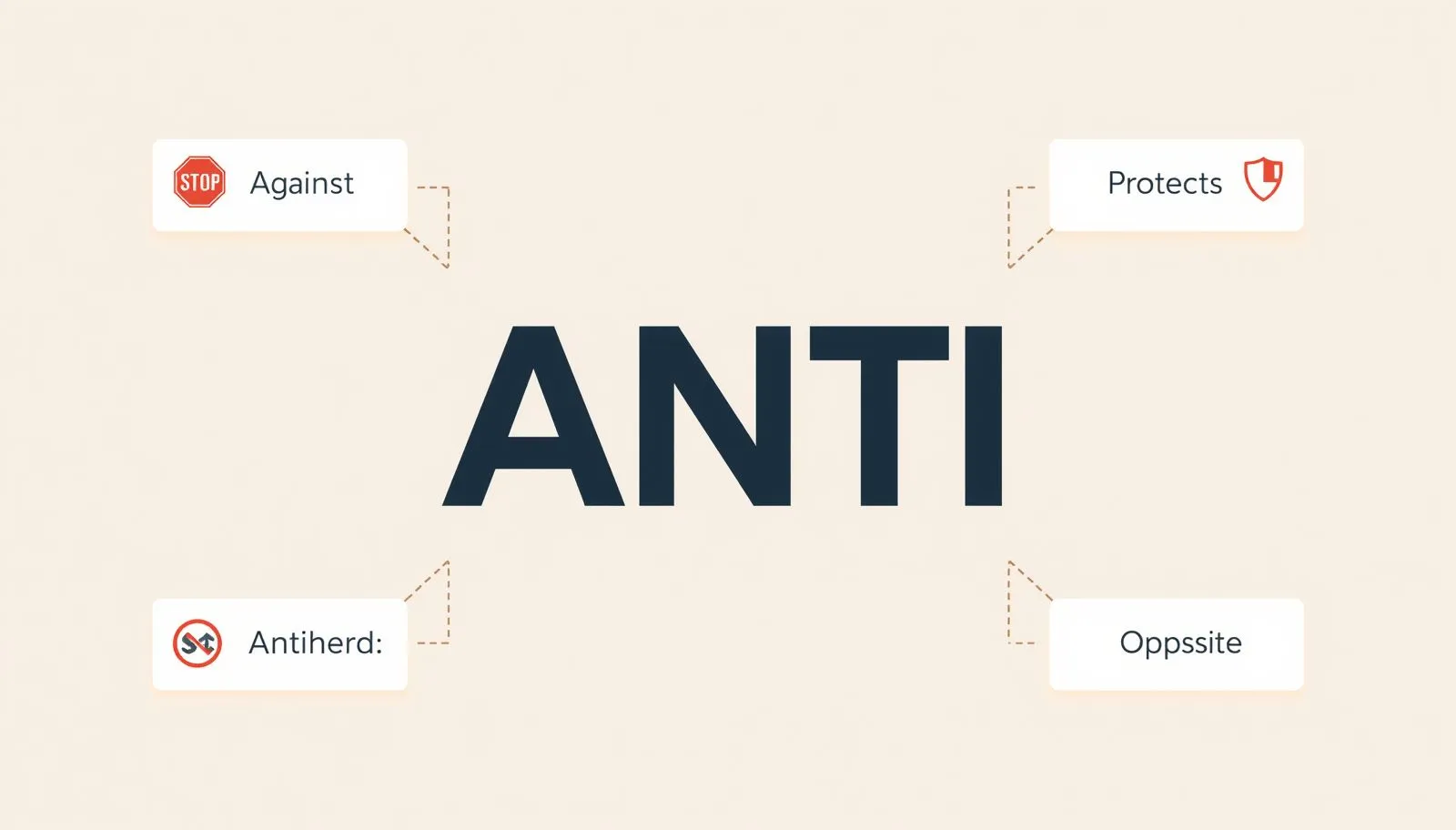
Anti means “against,” “opposed to,” or “working against” something. As a prefix, anti- can also mean preventing, counteracting, protecting against, or opposite of something. You see it in words like antiwar, antivirus, antifreeze, antacid, antihero, and anticlimax.
Anti Meaning at a Glance
| Term | Meaning |
|---|---|
| anti | against, opposed to, or not in favor of something |
| anti- | a prefix meaning against, opposite, preventing, or counteracting |
| Opposite of anti | usually pro, meaning for or supportive of |
| Common examples | antiwar, antivirus, antifreeze, antibacterial, antihero |
| Main confusion | anti does not always mean hate; it often means prevention, protection, or contrast |
In simple terms, anti tells you that something is positioned against another thing in some way.
That “against” relationship can be emotional, political, practical, scientific, medical, or literary. That is why antiwar, antivirus, antifreeze, and antihero all use anti, even though they are used in very different situations.
What Does Anti Mean in Simple English?
In everyday English, anti means:
- against something
- opposed to something
- working against something
- designed to prevent something
- designed to reduce or counteract something
- opposite of the usual version in some words
Examples:
- Antiwar means opposed to war.
- Antivirus means working against computer viruses.
- Antifreeze means something that helps prevent freezing.
- Antacid means something that counteracts acid.
- Antihero means a main character who is not a traditional hero.
A helpful shortcut is:
When you see anti, ask: “What is this word against, preventing, reducing, or opposite to?”
That question usually reveals the meaning.
Is Anti a Prefix, Word, or Both?
Anti can be a prefix, adjective, preposition, or noun. Most people see it as a prefix, but it can also stand alone in conversation.
| Use | Meaning | Example |
|---|---|---|
| Prefix | against, opposite, preventing, or counteracting | Antivirus software protects against viruses. |
| Adjective | opposed to something | She is anti the new policy. |
| Preposition | against | They are anti big corporations. |
| Noun | a person who opposes something | The debate split people into pros and antis. |
In formal writing, anti is most often seen as the prefix anti-. In casual speech, people may use anti by itself.
Example:
“I’m not anti technology. I just think people should use it more carefully.”
This means the person is not completely against technology, but they have concerns about how it is used.
How to Pronounce Anti
The word anti is commonly pronounced in two ways:
- AN-tee
- AN-tie
Both pronunciations are widely understood. Pronunciation can vary by region, accent, and the word being used.
For example, some people say:
- AN-tee-virus
- AN-tie-virus
Both are recognizable in everyday English.
Anti Means “Against” or “Opposed To”
This is the most common meaning.
Examples:
| Word | Meaning |
|---|---|
| antiwar | against war |
| anti-corruption | against corruption |
| anti-bullying | against bullying |
| anti-discrimination | against unfair treatment |
| anti-censorship | opposed to censorship |
Example sentence:
The students joined an antiwar march.
This means the students joined a march opposing war.
Anti Means “Preventing” Something
Sometimes anti does not describe an opinion. It describes a function.
Examples:
| Word | Meaning |
|---|---|
| antifreeze | prevents freezing |
| anti-theft | designed to prevent theft |
| anti-slip | designed to prevent slipping |
| anti-aging | intended to reduce visible signs of aging |
| anti-lock brakes | help prevent wheels from locking |
Example sentence:
The stairs have an anti-slip surface.
This means the surface is designed to help prevent slipping.
Anti Means “Counteracting” or “Neutralizing”
In health, science, and everyday product language, anti often means reducing or working against an effect.
Examples:
| Word | Meaning |
|---|---|
| antacid | counteracts acid |
| antidote | counteracts poison or harm |
| antihistamine | blocks or reduces histamine effects |
| anti-inflammatory | reduces inflammation |
| antiperspirant | reduces perspiration or sweating |
Example sentence:
She took an antacid after dinner.
This means she took something to counteract stomach acid.
Anti Means “Protecting Against”
Some anti words describe protection from a threat or problem.
Examples:
| Word | Meaning |
|---|---|
| antivirus | protects against computer viruses |
| antibacterial | works against bacteria |
| antiseptic | helps prevent or reduce infection-causing microbes |
| anti-malware | protects against malicious software |
| anti-fraud | designed to detect or prevent fraud |
Example sentence:
The company installed anti-malware tools on every computer.
This means the tools help protect against harmful software.
“Opposite” or “Not the Usual Kind”
Some words with this prefix are about contrast rather than direct opposition.
Examples:
| Word | Meaning |
|---|---|
| antihero | a main character who lacks traditional heroic qualities |
| anticlimax | a disappointing or weaker ending after buildup |
| antithesis | the direct opposite of something |
| antonym | a word with the opposite meaning |
| antagonist | a person or force that opposes another |
Example sentence:
The novel’s main character is an antihero, not a classic hero.
This does not mean the character is “against heroes.” It means the character does not fit the traditional hero type.
Word Root and Origin
The prefix anti- comes from Greek and is commonly used in English to mean against or opposite.
You may also see related forms such as ant- in some words, especially before vowels or in older word forms.
Examples:
| Word | Breakdown | Meaning |
|---|---|---|
| antonym | ant + onym | a word with the opposite meaning |
| antacid | ant + acid | something that works against acid |
| Antarctic | ant + arctic | opposite the Arctic region |
| antagonist | ant + agonist | one who struggles against or opposes |
| antidote | anti + dote | something given against poison or harm |
You do not need to memorize every form. The main idea is simple: this word part often signals opposition, contrast, prevention, or counteraction.
Common Words Using This Prefix
Here are useful examples grouped by context.
Everyday Uses
| Word | Meaning |
|---|---|
| antifreeze | prevents freezing |
| anti-theft | helps prevent theft |
| anti-slip | helps prevent slipping |
| anti-noise | reduces or blocks noise |
| anti-glare | reduces glare |
| anti-aging | intended to reduce visible signs of aging |
Technology Uses
| Word | Meaning |
|---|---|
| antivirus | protects against computer viruses |
| anti-malware | protects against harmful software |
| anti-spam | blocks or reduces unwanted messages |
| anti-fraud | helps detect or prevent fraud |
| anti-tracking | helps limit online tracking |
Health and Science Uses
| Word | Meaning |
|---|---|
| antibiotic | used against certain bacterial infections |
| antibacterial | works against bacteria |
| antiseptic | helps prevent or reduce infection |
| antihistamine | reduces histamine-related allergy symptoms |
| anti-inflammatory | reduces inflammation |
| antacid | counteracts acid |
| antidote | counteracts poison or harm |
| antibody | a protein that helps the body recognize and fight harmful substances |
Social and Political Uses
| Word | Meaning |
|---|---|
| antiwar | opposed to war |
| anti-corruption | opposed to corruption |
| anti-bullying | against bullying |
| anti-discrimination | against unfair treatment |
| anti-censorship | opposed to censorship |
| anti-establishment | opposed to established power structures |
Literature and Language Uses
| Word | Meaning |
|---|---|
| antihero | a central character who lacks classic heroic traits |
| anticlimax | a weaker or disappointing ending after buildup |
| antithesis | the direct opposite of something |
| antonym | a word with the opposite meaning |
| antagonist | a person or force opposing the main character or goal |
Opposition vs Support: Anti and Pro
The usual opposite of anti is pro.
| Word | Meaning | Example |
|---|---|---|
| anti | against or opposed to | antiwar |
| pro | for or supportive of | pro-peace |
| neutral | not clearly for or against | neutral position |
Example:
She opposes the proposal, but he supports it.
In real life, people can have mixed views. Someone might disagree with one part of an idea without rejecting the whole thing.
Against vs Before: Anti and Ante
These two word parts are easy to confuse, but they mean different things.
| Word Part | Meaning | Example |
|---|---|---|
| anti | against or opposed to | antivirus |
| ante | before | antebellum |
Examples:
- Antivirus refers to protection against viruses.
- Antebellum means before a war.
- Antidote works against poison or harm.
- Antechamber is a room before a larger room.
Simple memory trick:
Anti = against
Ante = before
Anti, Non, Un, Counter, and Pro
This prefix is sometimes confused with other negative or opposing word parts. They are related, but not identical.
| Prefix | Main Meaning | Example | How It Differs |
|---|---|---|---|
| anti- | against, opposed to, preventing, or counteracting | antiwar | suggests active opposition or resistance |
| non- | not; absence of | nonverbal | simply means “not,” without opposition |
| un- | not or reverse | unhappy, undo | often negates or reverses |
| counter- | against in response | counterattack | usually responds back against something |
| pro- | in favor of | pro-environment | usually signals support |
Examples:
- Antiwar means opposed to war.
- Nonviolent means not violent.
- Unhappy means not happy.
- Counterattack means an attack made in response.
- Pro-environment means supportive of environmental protection.
The key difference: this prefix often suggests opposition or resistance, while non- may simply mean absence.
Is It Always Negative?
No. The prefix is not always negative.
Its tone depends on what the word is working against.
Examples:
- Anti-bullying is generally positive because it opposes bullying.
- Antivirus is protective because it works against computer viruses.
- Anti-theft is practical because it helps prevent theft.
- Anti-inflammatory is useful because it reduces inflammation.
- Antiwar describes a position against war.
It does not automatically mean anger, hate, extremism, or negativity. It simply shows that something is against, preventing, reducing, resisting, or contrasting with something else.
Does It Mean Hate?
Not usually.
This is a common misunderstanding. If someone is opposed to something, they may strongly disagree with it, but the word itself does not automatically suggest hatred.
For example:
“I’m against wasting food.”
This means the person dislikes the behavior or wants to avoid it. It does not necessarily mean they are angry or extreme.
Context matters.
Hyphen Rules for This Prefix
Sometimes words with this prefix use a hyphen, and sometimes they do not.
| Form | Common Spelling | Note |
|---|---|---|
| antivirus | one word | established compound |
| antifreeze | one word | established compound |
| antibiotic | one word | established compound |
| anti-aging | hyphenated | often written with a hyphen |
| anti-inflammatory | hyphenated | commonly hyphenated |
| anti-theft | hyphenated | clearer with a hyphen |
| anti-American | hyphenated | usually hyphenated before a proper adjective |
| antiwar / anti-war | both seen | style may vary |
A practical rule:
- Use a dictionary spelling for common words.
- Add a hyphen if the word is hard to read without one.
- Use a hyphen before proper nouns or proper adjectives.
- Stay consistent within the same article, document, or website.
Medical, Technical, and Scientific Uses
This prefix appears often in medicine, technology, and science because many terms describe something that works against a problem.
Examples:
- Antibiotic: works against certain bacteria.
- Antihistamine: blocks or reduces histamine effects.
- Anti-inflammatory: reduces inflammation.
- Antivirus: protects against computer viruses.
- Antimatter: matter made of particles that correspond to ordinary particles but have opposite properties.
- Antiparticle: a particle counterpart with opposite physical properties.
How to Understand Anti in Any Word
Use this simple method when you see a new anti word.
1. Find the base word
Look at what comes after anti.
Example:
antiwar
Base word:
war
2. Ask what anti is doing
Is it showing opposition, prevention, protection, counteraction, or contrast?
Example:
antiwar = opposed to war
3. Check the context
The same prefix can work differently in different fields.
Examples:
- Antivirus is technical.
- Antacid is health-related.
- Antiwar is social or political.
- Antihero is literary.
- Antifreeze is practical and everyday.
The base word gives you the clue, but the context gives you the exact meaning.
Common Mistakes to Avoid
Mistake 1: Assuming It Always Means Hate
The prefix can show opposition, but it does not always suggest hatred.
For example, anti-theft technology does not “hate” theft. It is simply designed to help prevent theft.
Mistake 2: Thinking It Is Always Political
Some words with this prefix are political, but many are not.
Terms like antifreeze, antacid, antivirus, and antibacterial are practical, scientific, medical, or technical.
Mistake 3: Confusing It with Ante
These two word parts look similar, but they mean different things.
- Anti means against.
- Ante means before.
For example, antivirus refers to protection against viruses, while antebellum refers to something before a war.
Mistake 4: Misreading Antihero
An antihero is not simply a villain or a person who fights heroes.
It usually means a main character who lacks traditional heroic qualities. An antihero may be flawed, reluctant, morally complicated, or unlike the classic idea of a hero.
Mistake 5: Treating Every Use as the Same Kind of “Against”
This prefix can signal different types of opposition or contrast, such as:
- moral opposition
- political disagreement
- physical prevention
- chemical counteraction
- technical protection
- conceptual contrast
The exact meaning depends on the word and the context.
What Most Articles Miss About This Topic
Many explanations stop with a simple answer:
Anti means against.
That is true, but it is not the full picture.
A more useful explanation is:
This prefix can show opposition, prevention, protection, counteraction, or contrast.
That small difference explains why the same word part appears in very different terms.
| Word | Meaning |
|---|---|
| antiwar | opposed to war |
| antifreeze | prevents freezing |
| antacid | counteracts acid |
| antivirus | protects against viruses |
| antihero | contrasts with a traditional hero |
| anticlimax | opposite of an exciting climax |
The most important point is that this word part does not always describe a negative attitude. Sometimes it describes a useful function.
That is why it appears in moral language, medicine, technology, literature, science, and everyday product names.
Mini Practice: Can You Guess the Meaning?
Try using the “against, preventing, counteracting, or opposite” rule.
| Word | Best Meaning |
|---|---|
| anti-theft | designed to prevent theft |
| antiwar | opposed to war |
| antacid | counteracts acid |
| antihero | a nontraditional hero |
| antibacterial | works against bacteria |
Once you identify the base word, you can usually understand the full term.
Quick Summary
This word part usually means against, opposed to, preventing, counteracting, protecting against, or opposite of something.
Most of the time:
- antiwar = against war
- antivirus = against viruses
- antifreeze = prevents freezing
- antacid = counteracts acid
- antihero = opposite of a traditional hero type
The easiest way to understand it is to look at the word it attaches to and ask what kind of “against” relationship it creates.
FAQs
What does anti mean in simple words?
It usually means against or opposed to something. Depending on the word, it can also suggest prevention, protection, counteraction, or contrast.
What does anti mean as a prefix?
As a prefix, anti- is added to the beginning of a word to show that something works against, prevents, reduces, or contrasts with something else.
Is anti a word by itself?
Yes. It can stand alone as an adjective, preposition, or noun. For example, “She is anti the proposal” means she is against it.
Does it mean against or opposite?
It can mean both. In antiwar, it means against war. In words like antithesis or antonym, it points to an opposite meaning.
Does it always mean negative?
No. Words like anti-bullying, antivirus, and anti-theft are usually protective or helpful.
Does it mean hate?
No. It can show disagreement or opposition, but it does not automatically mean hate. Someone may oppose something because they think it is harmful, unfair, risky, or unnecessary.
What is the opposite of anti?
The opposite is usually pro, which means for or supportive of something.
What is the difference between anti and ante?
Anti means against. Ante means before. For example, antivirus means protection against viruses, while antebellum means before a war.
What is the difference between anti and non?
Anti suggests opposition or resistance. Non usually means not or without. For example, antiwar means opposed to war, while nonviolent means not violent.
What are common words that use this prefix?
Common examples include antivirus, antifreeze, antibacterial, antiwar, anti-theft, anti-aging, antacid, antidote, antihero, and anticlimax.
What does it mean in medicine?
In health-related words, it often means working against, reducing, blocking, or counteracting something. Examples include antibiotic, antihistamine, antacid, and anti-inflammatory.
What does it mean in slang?
In casual speech, it can mean someone is against, uninterested in, or strongly opposed to something. For example, “I’m anti drama” usually means “I try to avoid drama.”
Conclusion
The alternative usually means against or opposed to, but its meaning can shift depending on the word. It may also suggest prevention, protection, counteraction, or contrast.
That is why it appears in many areas of English, from everyday words like antifreeze to medical terms like antacid, technology words like antivirus, and literature terms like antihero.
The practical takeaway is simple:
Look at the word after the prefix. That word tells you what is being opposed, prevented, reduced, protected against, or contrasted.
For more vocabulary help, explore related guides on common English prefixes, word roots, and commonly confused words.
Click Here To Read About : what does alternative mean

Hi, I’m Geoffrey Chaucer. I explore the stories and meanings behind words, turning ideas into clear, insightful writing. Through every article I craft, I aim to spark curiosity, share knowledge, and help readers uncover practical, meaningful truths in everyday life.