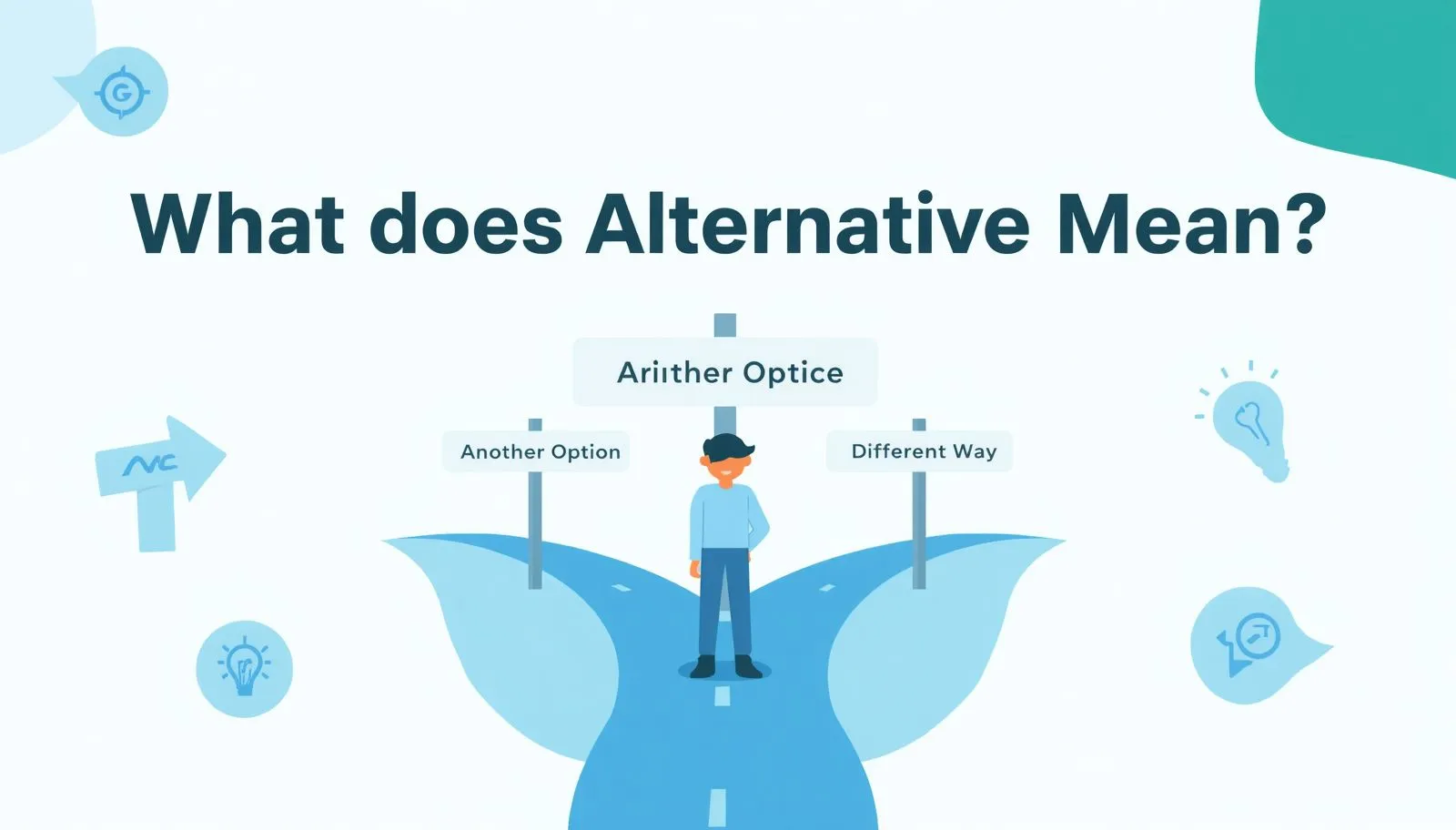
Alternative means another choice, option, or way to do something. It can also describe something different from the usual or traditional choice. For example, if one road closes, drivers may take a different road as an alternative route.
Quick Meaning
| Word | Meaning |
|---|---|
| Alternative | Another possible choice, method, or replacement |
| Part of speech | Noun and adjective |
| Common phrase | Alternative to |
| Simple example | “The bus is an alternative to driving.” |
| Closest synonyms | Option, choice, substitute, replacement, backup |
You use this word when more than one possibility exists. For instance, people talk about different routes, backup plans, product substitutes, learning methods, energy sources, music styles, and lifestyle choices.
A simple way to understand the word is to ask:
Alternative to what?
Once you know what someone wants to replace, compare, or avoid, the meaning becomes much clearer.
What It Means in Simple Words
In simple words, an alternative is something else you can choose.
For example:
- If coffee runs out, tea can work instead.
- When the main road closes, another road may serve as a different route.
- After a first plan fails, a backup plan can help.
- If a product costs too much, a cheaper brand may solve the problem.
- When someone avoids dairy milk, oat milk may be a useful substitute.
So, when someone asks, “Is there an alternative?” they usually mean:
“Is there another option?”
How to Pronounce Alternative
Here is a simple pronunciation guide:
- American English: awl-TUR-nuh-tiv
- British English: ol-TUR-nuh-tiv
Pronunciation can vary by accent. However, speakers usually stress the second syllable:
al-TER-na-tive
Alternative as a Noun
As a noun, the word means another choice or possible replacement.
Examples
- “We need to find another option.”
- “Walking can replace driving for short distances.”
- “This software has several alternatives.”
- “If the hotel has no rooms, we should look for another place.”
- “The cheaper model may suit your budget better.”
In these examples, the word points to a thing, plan, action, or possibility someone can choose instead of the first one.
Alternative as an Adjective
As an adjective, it describes a different choice, method, or style.
Examples
- “We need another plan.”
- “She suggested a different method.”
- “The driver took a different route.”
- “The company is testing renewable energy sources.”
- “Some students learn better through nontraditional education programs.”
Here, the word describes the noun after it, such as plan, method, route, energy, or education.
Word Forms
| Word Form | Part of Speech | Meaning | Example |
|---|---|---|---|
| alternative | Noun | Another choice | “We need an alternative.” |
| alternative | Adjective | Different from the usual choice | “They chose an alternative method.” |
| alternatives | Plural noun | More than one other choice | “There are several alternatives.” |
| alternatively | Adverb | As another possibility | “Alternatively, we could meet tomorrow.” |
Example With “Alternatively”
Use alternatively when you want to introduce another possible idea.
Example:
“We could take the train. Alternatively, we could drive.”
This means driving gives you another possible choice.
What “Alternative To” Means
The phrase alternative to means something can replace or stand in for something else.
Examples
- “Cycling is an alternative to driving.”
- “This app can replace expensive design software.”
- “Unsweetened drinks give people an alternative to sugary drinks.”
- “We need another supplier.”
- “Online classes may work instead of in-person lessons.”
The usual structure looks like this:
alternative to + noun
Examples:
- alternative to coffee
- alternative to plastic
- alternative to surgery
- alternative to public transport
- alternative to traditional schooling
What “No Alternative” Means
No alternative means no other realistic choice exists.
Examples
- “We had no alternative but to cancel the event.”
- “There was no other route.”
- “She had no choice except to accept the decision.”
- “The store had closed, so we had to go somewhere else.”
A common structure is:
have no alternative but to + verb
Example:
“We had no alternative but to leave.”
In other words, leaving became the only practical option.
Common Phrases With Alternative
The word appears in many everyday phrases. Each phrase carries a slightly different meaning.
| Phrase | Meaning | Example |
|---|---|---|
| Alternative route | Another road or path | “The bridge is closed, so take another route.” |
| Alternative plan | A backup or different plan | “If it rains, we need a backup plan.” |
| Alternative approach | A different way to handle something | “The teacher tried a new approach.” |
| Alternative method | Another way to do a task | “She found a different method for solving the problem.” |
| Alternative explanation | Another possible reason | “There may be another explanation.” |
| Alternative product | A different product that can replace another | “This brand costs less and works well.” |
| Alternative medicine | Health practices outside conventional medical care | “He asked his doctor about other therapies.” |
| Alternative energy | Energy sources beyond traditional fossil fuels | “Solar power is a form of cleaner energy.” |
| Alternative lifestyle | A lifestyle outside mainstream norms | “They chose a less conventional lifestyle.” |
| Alternative music | Music outside mainstream commercial styles | “She listens to alternative rock.” |
| Viable alternative | A realistic or practical option | “Remote work became a practical option.” |
| Cheaper alternative | A less expensive choice | “This software costs less.” |
| Better alternative | A choice that may work better | “There may be a better way.” |
| Only alternative | The only other choice | “The only option left was to wait.” |
Meaning by Context
Context often changes the exact meaning. Because of that, the surrounding words matter.
| Context | Meaning | Example |
|---|---|---|
| Everyday conversation | Another option | “Do we have another choice?” |
| Travel | Another route or way | “Use the other road.” |
| Work | A backup plan or different strategy | “Let’s prepare another plan.” |
| School | A different method or explanation | “The teacher gave another explanation.” |
| Shopping | A substitute product | “This one costs less.” |
| Food | A replacement ingredient or drink | “Oat milk can replace dairy milk.” |
| Health | A non-conventional or additional care approach | “Talk to a qualified professional before trying other treatments.” |
| Energy | A different source of power | “Wind power offers another energy source.” |
| Music | A style outside mainstream pop | “She enjoys alternative rock.” |
| Lifestyle | A less conventional way of living | “They prefer a different lifestyle.” |
Alternative vs Option vs Choice vs Substitute
These words overlap, but they do not always mean the same thing.
| Word | Simple Meaning | Best Used When | Example |
|---|---|---|---|
| Alternative | Another possible choice, often instead of something else | You compare or replace one thing with another | “We need an alternative to plastic.” |
| Option | One available possibility | You list what someone can choose | “You have three options.” |
| Choice | The act or result of choosing | You focus on the decision | “It was a difficult choice.” |
| Substitute | Something that directly takes the place of another thing | One thing replaces another | “Honey can substitute for sugar.” |
| Replacement | A new thing used instead of an old or missing thing | Something no longer works or no longer exists | “We need a replacement battery.” |
| Preference | The thing someone likes more | You describe what someone favors | “Her preference is tea.” |
| Selection | A chosen item or a group of choices | You choose from a set | “The store has a wide selection.” |
Simple Difference
An option means any possible choice.
An alternative usually means another choice that can replace or stand beside the first one.
A substitute often replaces something more directly.
Alternative vs Alternate
These two words look similar, so people often mix them up. Still, they usually have different meanings.
Alternative
Use alternative when you mean another option, choice, method, or replacement.
Examples:
- “We need an alternative plan.”
- “This design gives us another option.”
- “Do you know a good replacement for this app?”
Alternate
Use alternate when you mean every other one, taking turns, or switching back and forth.
Examples:
- “The meetings happen on alternate Mondays.”
- “The players alternate turns.”
- “She works on alternate weekends.”
Quick Rule
Use alternative for another choice.
Use alternate for taking turns or every other one.
How to Use It in a Sentence
Here are practical examples from common situations.
Everyday Examples
- “Do we have another option?”
- “I do not like that idea. Can we think of something else?”
- “The other choice is to wait until tomorrow.”
Work Examples
- “The supplier cannot deliver on time, so we need another source.”
- “The team presented a different strategy.”
- “This tool could replace the software we use now.”
School Examples
- “The teacher gave another explanation.”
- “The student solved the problem in a different way.”
- “The school offers nontraditional learning programs.”
Travel Examples
- “The road is closed, so drivers must use another route.”
- “Flying costs too much, so the train may work better.”
- “We need a different way to reach the airport.”
Shopping Examples
- “This brand is expensive. Is there a cheaper one?”
- “The store recommended another product.”
- “This phone works well if you want something affordable.”
Food Examples
- “Soy milk can replace dairy milk.”
- “You can use yogurt instead of cream in some recipes.”
- “Fruit gives you a healthier choice than candy.”
Health-Related Examples
- “Some people ask about other therapies.”
- “Before trying a new treatment, speak with a qualified healthcare professional.”
- “For serious health conditions, discuss all treatment decisions carefully.”
Culture and Music Examples
- “She enjoys alternative music.”
- “Non-mainstream fashion often looks different from popular styles.”
- “The magazine covers independent artists and creative subcultures.”
Is an Alternative Always Better?
No. Another choice does not automatically mean a better choice.
Sometimes it works better. In other cases, it creates new trade-offs.
For example:
- A different route may avoid traffic, yet take longer.
- A cheaper product may save money, but offer fewer features.
- A backup plan may solve one issue while creating another.
- A new treatment may sound appealing, although it may not suit every health situation.
Before choosing, ask:
- Does it solve the actual problem?
- Is it safe?
- Can you afford it?
- Will it save time?
- What trade-offs come with it?
- Does it fit your goal?
A good option depends on the situation, not just the label.
How to Know Which Meaning Fits
To understand the word in a sentence, look at the context first.
1. Find the original thing
Example:
“She suggested an alternative schedule.”
The original thing is the current schedule.
2. Identify the other possibility
In that sentence, the other possibility is a different schedule.
3. Decide whether it replaces something or simply offers another style
Example:
“He enjoys alternative music.”
Here, the word does not mean replacement music. Instead, it points to music outside mainstream styles.
4. Look for “alternative to”
Example:
“Cycling is an alternative to driving.”
That means cycling can replace driving in some situations.
5. Watch for “no alternative”
Example:
“They had no alternative but to close the store.”
This means closing the store became the only realistic choice.
Common Mistakes
Mistake 1: Thinking It Always Means Better
Another choice can help, but it can also bring drawbacks.
Better sentence:
“This may be the better option.”
That version clearly shows you are judging quality, not just naming a second possibility.
Mistake 2: Confusing It With “Alternate”
Use this word when you mean another choice.
Use alternate when you mean every other one, taking turns, or switching back and forth.
Correct:
- “We need a different plan.”
- “We meet on alternate Fridays.”
Mistake 3: Leaving Out the Comparison
The sentence “This is another option” can feel incomplete if the reader does not know what you are comparing it with.
Clearer versions:
- “This could replace our current plan.”
- “This works instead of coffee.”
- “This route can replace driving.”
Since the term often compares two things, naming both sides makes your sentence easier to understand.
Mistake 4: Using It to Mean Opposite
Another option does not always mean the opposite.
For example, tea can replace coffee for some people, but tea is not the opposite of coffee. It simply gives someone a different drink to choose.
Mistake 5: Overusing “Another Alternative”
People often say “another alternative” in conversation, and it may sound natural. Still, shorter wording usually reads better.
Try:
- “another option”
- “another possibility”
- “a different choice”
- “a backup plan”
- “another way forward”
What Most Articles Miss About This Topic
Most explanations stop at “another option.” Although that definition works, it does not fully show how the term behaves in real sentences.
The more useful point is this:
The word usually depends on comparison.
It often connects one choice to another.
For example:
- “A bus is another option.”
This makes sense, but it still feels incomplete. - “A bus can replace driving in this situation.”
Now the comparison becomes clear.
In addition, a second choice does not always match the original perfectly. It may solve the same problem in a different way, but it can also bring trade-offs.
For example:
- A cheaper product may lack some features.
- A different route may take more time.
- Another explanation may sound possible but still need proof.
- A backup plan may work only in certain conditions.
Therefore, the most practical takeaway is simple:
A second choice only has value when it fits the problem, goal, and context.
FAQ
What does alternative mean in simple words?
It means another choice, option, or way to do something. It can also describe something different from the usual choice.
What is an example?
If you cannot take the train, the bus may work instead. Likewise, if you do not drink dairy milk, oat milk may replace it.
Does it mean choice?
Yes. It often points to a choice, especially one that can replace or stand beside another choice.
Is it the same as option?
Not exactly. An option means any available possibility. This word often refers to a different possibility that can replace the first one.
Does it mean replacement?
Sometimes. However, it can also describe another possible choice without fully replacing the original.
What does “alternative to” mean?
The phrase means something can replace or serve instead of another thing. For example, tea can work instead of coffee.
What does “no alternative” mean?
It means no other realistic choice exists. For example, “We had no choice but to leave” means leaving became the only practical option.
Is it a noun or adjective?
It can be both. As a noun, it names another choice. As an adjective, it describes something different or another possible way.
What is the difference between alternative and alternate?
Alternative means another choice. Alternate usually means every other one or taking turns, as in alternate weekends or alternate turns.
Can it mean unusual?
Yes. In some contexts, it can mean nontraditional, unconventional, or different from mainstream styles.
Is another option always better?
No. A second option may help, but it is not automatically better. Its value depends on cost, safety, quality, convenience, and purpose.
What is a good synonym?
Useful synonyms include option, choice, substitute, replacement, backup, possibility, and different approach. Choose the word that fits the sentence.
Conclusion
Alternative refers to another possible choice, replacement, or way to do something. It can work as a noun or adjective, and context shapes its exact meaning.
For the clearest understanding, ask:
What is it replacing or being compared with?
Once you know that, the meaning becomes much easier to understand and use correctly.
For related vocabulary help, explore guides on alternative vs alternate, option vs choice, and substitute vs replacement.
Click Here To Read About : what does discrete mean

Hi, I’m Geoffrey Chaucer. I explore the stories and meanings behind words, turning ideas into clear, insightful writing. Through every article I craft, I aim to spark curiosity, share knowledge, and help readers uncover practical, meaningful truths in everyday life.