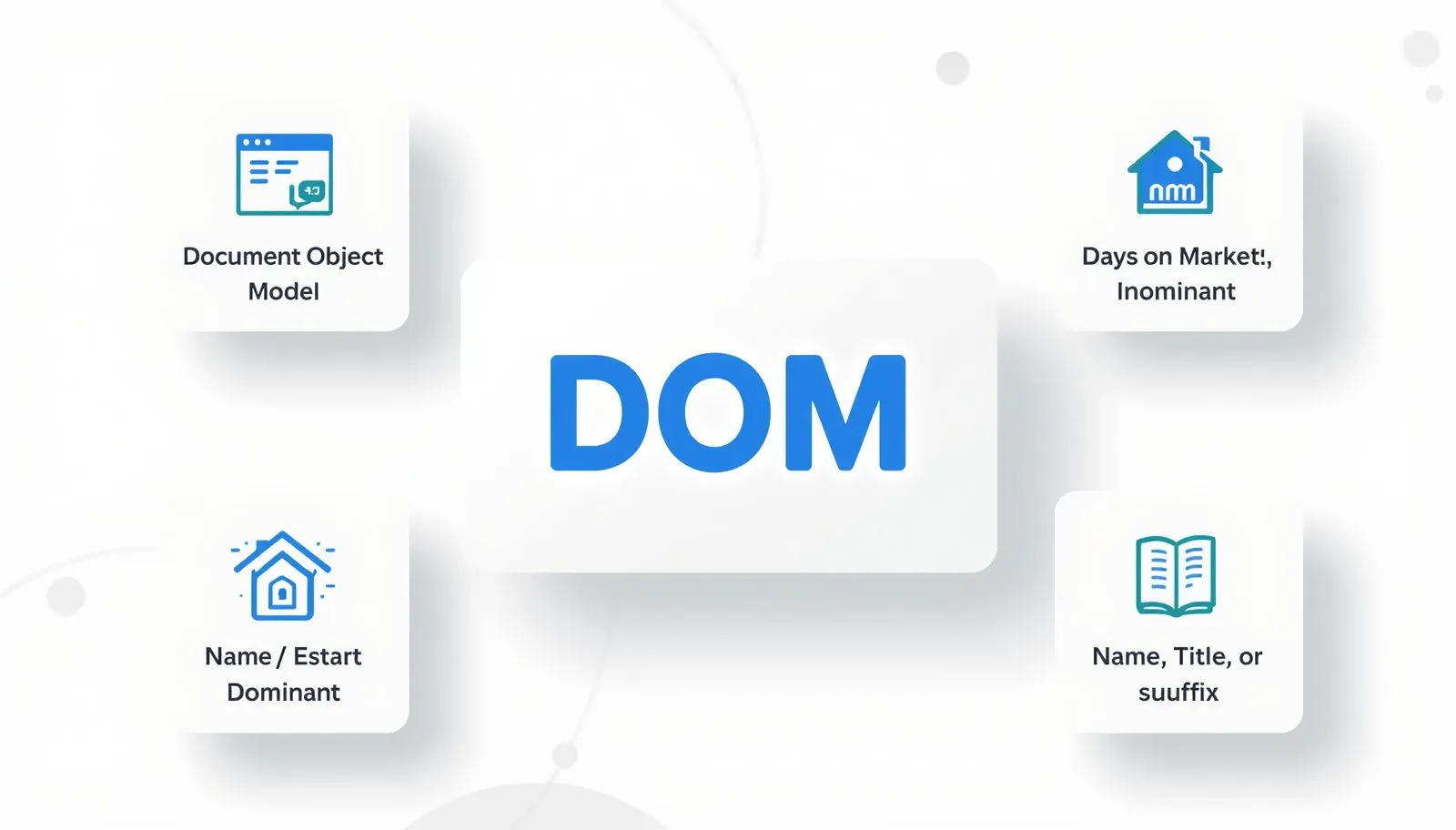
DOM changes meaning based on context. In coding, it means “Document Object Model.” In texting or dating, “dom” often means “dominant.” Real estate listings use the abbreviation for “days on market.” You may also see “Dom” as a name, title, or part of words like “kingdom” and “freedom.”
The same letters can point to several unrelated ideas. A web tutorial, a dating profile, and a home listing may all use them differently, so the surrounding topic gives the best clue.
Find the Meaning by Context
| Where it appears | Likely meaning | Example |
|---|---|---|
| JavaScript, HTML, browser, or coding topic | Document Object Model | “JavaScript changes the page structure.” |
| Texting, dating, kink, or relationship profile | Dominant | “I prefer a soft dom.” |
| Real estate listing, MLS, or property page | Days on market | “DOM: 34” |
| Religious, historical, or formal writing | Title | “Dom John” |
| Casual sentence about a person | Nickname | “Dom is coming over.” |
| End of a word | Suffix | freedom, kingdom, fandom |
| Certain slang conversations | Dirty old man | Usually a negative label |
A dictionary list can help, but real context usually answers the question faster.
Capitalization Clues
| Form | Meaning | Common clue |
|---|---|---|
| DOM | Acronym | Tech, real estate, or formal abbreviation |
| dom | Slang or shortened term | Texts, dating, or relationship conversations |
| Dom | Name or title | Used before or instead of a person’s name |
| -dom | Suffix | Attached to another word |
Capital letters offer a useful hint. Still, online writing is often casual, so the topic around the word matters more.
In Web Development
In web development, the abbreviation stands for Document Object Model. This refers to the browser’s live structure of a web page.
First, the browser reads the HTML. After that, it builds a structured model that scripts can access. JavaScript can then change text, update buttons, open menus, check forms, or refresh part of a page.
Developers use this page model to:
- Change headings or paragraphs
- Open and close menus
- Add shopping cart items
- Respond to button clicks
- Check form fields
- Update content without a full reload
When a developer says “change the DOM,” they usually mean changing the live page that users see or interact with.
Simple Coding Example
<p id="message">Hello</p>
<button onclick="changeText()">Change text</button>

<script>
function changeText() {
  document.getElementById("message").textContent = "Updated text!";
}
</script>
The browser loads the paragraph and button. After someone clicks, JavaScript finds the paragraph and changes its text.
That small action shows how scripts update a live web page.
Tree, Nodes, Elements, and Events
A browser organizes a page like a tree. Each part sits inside that structure.
Here is the simple version:
- The full page acts as the document.
- Each part works as a node.
- Tags such as
<h1>,<p>, and<button>act as elements. - Details such as
id,class, andhrefwork as attributes. - Clicks, typing, scrolling, and form submissions count as events.
Because of this structure, JavaScript can react when someone clicks, types, scrolls, or submits a form.
HTML vs CSS vs JavaScript vs the Page Model
These terms often appear together, but each one has a different job.
| Term | What it does | Simple role |
|---|---|---|
| HTML | Defines content | Adds headings, text, buttons, images, and links |
| CSS | Controls design | Sets colors, spacing, fonts, and layout |
| JavaScript | Adds behavior | Makes the page interactive |
| Page model | Gives scripts access to the live page | Lets code read and change page parts |
HTML gives the page structure. CSS controls the look. JavaScript adds actions. The browser’s live model connects code to what users see.
Is It Part of JavaScript?
Not exactly.
JavaScript often works with the browser’s page model, but the two are separate. JavaScript is the programming language. The browser provides the structure that scripts use to reach page elements.
This distinction helps beginners avoid confusion. Code can update a page only after it knows which element to target.
In Texting and Slang
In texting, dating, kink, or relationship contexts, dom often means dominant.
A dominant person usually takes a leading role in a consensual dynamic. The opposite role often appears as sub, short for submissive.
You may see this meaning in:
- Dating profiles
- Private messages
- Online communities
- Relationship discussions
- Romance content
- Kink-related conversations
- Phrases such as “dom/sub,” “soft dom,” or “D/s dynamic”
Do not assume this meaning unless the conversation clearly points to dating, relationships, or power dynamics.
Dominant Does Not Mean Abusive
People sometimes misunderstand this meaning.
A healthy dominant role depends on consent, communication, and boundaries. The label never gives someone permission to pressure, control, or harm another person.
A safe dynamic usually includes:
- Clear consent
- Honest communication
- Agreed boundaries
- Respect
- Safety
- Aftercare when relevant
For that reason, behavior matters more than the label.
What Does “Soft Dom” Mean?
A soft dom usually means a dominant person who leads in a gentle, caring, and emotionally attentive way.
The exact meaning can vary by person. Often, though, it suggests warmth, praise, reassurance, patience, and communication instead of harshness.
Example:
“I prefer a soft dom.”
That sentence may describe someone who wants a partner to take the lead while staying kind and emotionally present.
Can It Mean “Dirty Old Man”?
Yes. In some slang conversations, DOM can stand for dirty old man.
People usually use this phrase as a negative label for an older man whose behavior seems inappropriate or lecherous. This meaning differs from “dom” as a consensual dominant role.
| Slang use | Meaning | Tone |
|---|---|---|
| dom | Dominant | Neutral in consensual contexts |
| DOM | Dirty old man | Negative or critical |
Since the phrase can insult someone, avoid using it unless the context clearly supports that meaning.
In Real Estate
In real estate, the abbreviation means days on market. This number shows how long a property has appeared for sale.
Example:
DOM: 28
That usually means the home has spent 28 days on the market.
Buyers, sellers, and agents use this number to understand listing activity.
Why Days on Market Matters
This real estate number can help people make better decisions.
For buyers, a higher number may suggest:
- The seller may negotiate
- The price may need adjustment
- The property may have issues
- Demand may move slowly in that area
For sellers, the same number may suggest:
- The asking price needs review
- Photos or staging need improvement
- The listing description needs stronger details
- The marketing strategy needs adjustment
Even so, one metric never tells the whole story. Season, location, price range, property type, and local demand can all affect how long a home stays available.
Is a High Number Bad in Real Estate?
Not always.
A longer listing period can raise questions, yet it does not automatically signal a serious problem. Some homes take longer to sell because they cost more, sit in rural areas, have unusual layouts, or enter the market during a slower season.
For better judgment, compare the property with similar homes nearby. Local context gives the number meaning.
DOM vs CDOM in Real Estate
Some real estate systems also use CDOM, which means cumulative days on market.
| Metric | Meaning | Why it matters |
|---|---|---|
| DOM | Days in the current listing period | Shows current listing age |
| CDOM | Total market exposure across listing periods | Shows broader listing history |
MLS rules can differ by area. Therefore, buyers and sellers should ask an agent how the local system calculates these numbers.
As a Name or Nickname
Dom can also work as a person’s name or nickname.
It often comes from names such as:
- Dominic
- Dominick
- Dominique
- Domenico
Example:
“Dom said he’ll call later.”
Here, the word likely refers to a person.
As a Religious or Honorific Title
Dom can work as a formal title in religious, historical, Portuguese, or Brazilian contexts.
You may see it before the name of certain monks, clergy members, nobles, or men of rank.
Example:
“Dom John Chapman”
This meaning appears less often in everyday conversation. However, it can show up in biographies, religious writing, historical texts, and formal references.
What Does “-dom” Mean at the End of a Word?
The suffix -dom appears in words such as:
- kingdom
- freedom
- wisdom
- fandom
- officialdom
- dukedom
In this form, it often suggests a state, condition, realm, rank, office, or group.
| Word | How “-dom” works |
|---|---|
| kingdom | Refers to a realm or territory |
| freedom | Describes the state of being free |
| fandom | Describes a community of fans |
| officialdom | Refers to officials as a group |
| dukedom | Refers to the rank or territory of a duke |
This word ending differs from the abbreviation in coding or real estate.
Other Abbreviation Meanings
In dictionaries and specialized writing, dom. may also shorten words such as:
- domestic
- dominant
- dominion
These meanings appear less often in everyday search. Still, they may show up in older texts, grammar references, dictionaries, or specialized documents.
Meanings in One Sentence
| Context | Simple meaning |
|---|---|
| Coding | The browser’s live model of a web page |
| JavaScript | The page structure that scripts can read and change |
| Texting | Often means dominant |
| Dating | May describe a preferred role in a consensual dynamic |
| Real estate | Days on market |
| Names | Short for Dominic, Dominick, Dominique, or Domenico |
| Religion/history | A formal title |
| Word endings | A suffix meaning state, realm, rank, or group |
Common Mistakes
Assuming It Always Means Document Object Model
That meaning fits web development, not every situation. A property listing or dating profile uses a different sense.
Assuming It Always Has an Adult Meaning
The term can refer to a person, a title, a suffix, a technical concept, or a real estate metric. Context decides the meaning.
Confusing the Page Model With HTML
HTML provides markup. The browser turns that markup into a live structure that scripts can access.
Treating Days on Market as the Whole Story
In real estate, this number helps, but it needs local context. A high number in one market may look normal in another.
Ignoring Capitalization
Capitalization gives clues. Still, people type casually, so context matters more.
What Most Articles Miss About This Topic
Most articles explain only one meaning and leave readers to guess.
A coding guide may explain the technical meaning well. However, it will not help someone who saw “dom” in a dating profile.
A slang page may explain “dominant.” Yet it will not help someone reading a property listing.
A dictionary page may list formal definitions. Still, it may not show how to choose the right one.
The missing piece is context.
Ask one question first:
Where did I see this term?
If the surrounding words include HTML, JavaScript, browser, node, or element, the meaning likely relates to web development.
When the surrounding words include dating, sub, soft, kink, or relationship roles, it likely means dominant.
If the surrounding words include MLS, listing, buyer, seller, or property, it likely means days on market.
When it appears before a person’s name, it may work as a title or nickname. At the end of a word, it likely works as the suffix “-dom.”
That simple approach prevents the most common mistake: choosing the first definition instead of the one that fits the situation.
FAQs
What does DOM stand for?
It often stands for Document Object Model in web development. Real estate uses it for days on market. Some slang contexts also use it for dirty old man.
What does it mean in coding?
Coding contexts use it for the browser’s live representation of a web page. Developers rely on this structure to change page content, layout, and behavior.
What does it mean in JavaScript?
JavaScript uses the page structure to access elements. For example, a script can change text, add new elements, or respond to clicks.
What does it mean in HTML?
HTML provides the markup. The browser then builds a live object-based version of the document from that markup.
Is it the same as HTML?
No. HTML acts as the written source, while the browser’s live page structure gives scripts something to interact with.
Is it part of JavaScript?
No. JavaScript often works with it, but the browser provides the page model as a separate interface.
What does dom mean in texting?
Texting contexts often use it for dominant, especially in dating or relationship conversations. Some cases may also use it for dirty old man.
What does dom mean from a girl?
The meaning depends on the conversation. A dating context may point to dominant, while another situation may simply refer to a person named Dom.
What does dom mean from a guy?
Context decides the answer. He may mean dominant, mention someone named Dom, or use another meaning based on the topic.
Is it always related to BDSM?
No. It only relates to BDSM or power dynamics when the surrounding conversation points that way.
What does soft dom mean?
A soft dom usually describes a dominant person who leads with care, patience, warmth, and emotional awareness.
What is the difference between dom and sub?
In relationship or BDSM contexts, dom means dominant, while sub means submissive. Healthy use of these roles depends on consent and communication.
What does it mean in real estate?
Real estate uses it for days on market. This shows how long a home has appeared for sale.
What counts as a good number in real estate?
A good number depends on the local market. Compare it with similar homes nearby instead of judging it alone.
What does a high number mean in real estate?
A high number may suggest slower demand, pricing issues, or negotiation room. However, local conditions, seasonality, and property type can also affect it.
What does CDOM mean?
CDOM means cumulative days on market. It tracks broader market exposure across listing periods, depending on local MLS rules.
What does Dom mean as a name?
Dom often shortens Dominic, Dominick, Dominique, or Domenico.
What does Dom mean as a title?
It can serve as a formal title in some religious, Portuguese, Brazilian, or historical contexts.
What does “-dom” mean in words?
The suffix “-dom” can suggest a state, condition, realm, rank, office, or group. Examples include freedom, kingdom, fandom, and dukedom.
Final Takeaway
The DOM changes with context.
In web development, the term usually points to Document Object Model.
Texting or dating contexts often use it for dominant.
Real estate uses it for days on market.
As “Dom,” it may work as a name or title.
As “-dom,” it works as a suffix in words such as freedom and kingdom.
Before choosing a definition, look at where the term appears. The surrounding topic will usually point to the right answer.
Click Here To Read About : what does a yellow lightsaber mean

Hi, I’m Geoffrey Chaucer. I explore the stories and meanings behind words, turning ideas into clear, insightful writing. Through every article I craft, I aim to spark curiosity, share knowledge, and help readers uncover practical, meaningful truths in everyday life.