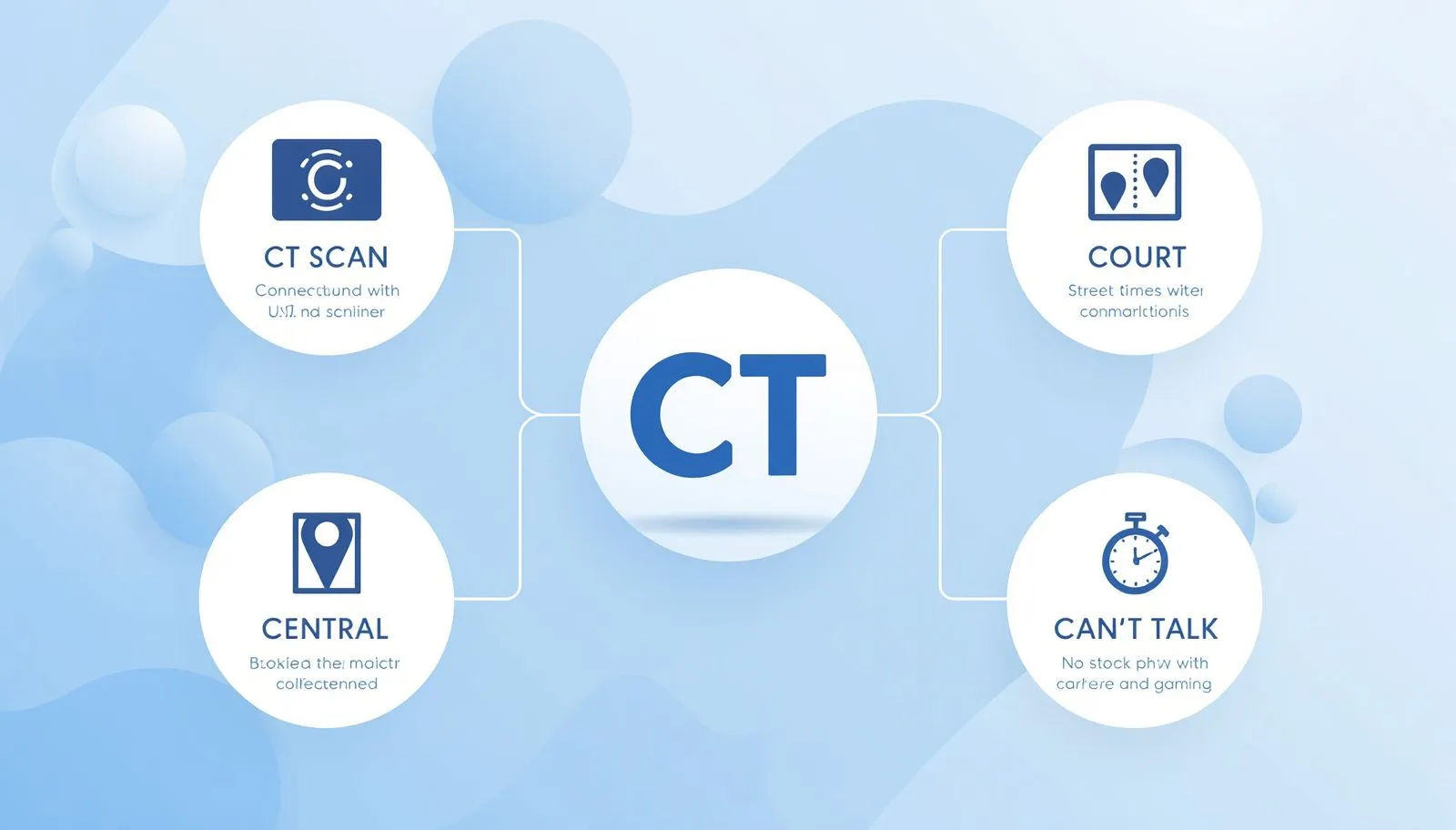
CT usually refers to computed tomography in medical settings. A CT scan, also known as a CAT scan, uses X-rays and computer processing to create detailed images inside the body. In other contexts, the abbreviation can mean Connecticut, Court, Central Time, “can’t talk,” or Counter-Terrorist.
This abbreviation can feel confusing because people use it in many different places. You might see it on a medical form, in a scan report, on a mailing address, inside a text message, on a meeting invite, or during a video game.
Because of that, context matters most. The words around the abbreviation usually tell you which meaning fits.
Medical note: This article explains common meanings in plain English. It does not replace advice from a doctor, radiologist, or qualified healthcare professional.
Quick CT Meaning Guide
| Where you saw it | Most likely meaning | Example |
|---|---|---|
| Medical form, hospital, scan report | Computed tomography | “Your scan is scheduled for Monday.” |
| Doctor’s note or radiology report | CT scan / CAT scan | “Chest scan with contrast” |
| City and state in a U.S. address | Connecticut | “Hartford, CT 06103” |
| Street name in an address | Court | “25 Maple Ct” |
| Meeting invite or event listing | Central Time | “The webinar starts at 3 PM CT.” |
| Text message | Can’t talk | “CT right now, call later.” |
| Gaming, especially tactical shooters | Counter-Terrorist / defender-side area | “One enemy near CT.” |
| Crypto discussion | Crypto Twitter | “CT is reacting to the news.” |
| Online comments or debates | Conspiracy theory / theorist | “That sounds like a CT.” |
For a fast answer, check the setting first. Medical words such as “scan,” “contrast,” “radiology,” “abdomen,” or “chest” usually point to computed tomography. Meanwhile, a city name points to Connecticut, and a street name often points to Court.
CT Meaning in Medical Terms
In medicine, CT stands for computed tomography. This imaging test uses X-rays and computer technology to create detailed cross-sectional pictures of the inside of the body.
Healthcare professionals may also use related names, including:
- CT scan
- CAT scan
- Computerized tomography
- Computed axial tomography
- Computerized axial tomography
Most people use CT scan and CAT scan to describe the same test. Today, medical professionals usually say “CT scan,” while “CAT scan” remains a familiar older term.
What Is a CT Scan?
A CT scan helps doctors look inside the body without surgery. It can show bones, organs, soft tissues, blood vessels, muscles, the brain, the lungs, the abdomen, and the pelvis.
Compared with a regular X-ray, this scan gives doctors more detail. Instead of producing one flat image, the scanner captures images from many angles. Then, computer software turns those images into thin visual slices.
As a result, doctors can examine internal structures more clearly.
How a CT Scan Works
During the test, you lie on a table that moves through a large circular scanner. Inside the machine, an X-ray source rotates around your body while detectors collect image data.
Next, a computer processes that data into detailed image slices. Doctors can review those slices one by one or combine them to create a more complete view of the scanned area.
A simple way to understand it is this:
- A regular X-ray works like a flat photo.
- A CT scan works more like looking through thin layers of the body.
This extra detail often helps doctors find problems that a basic X-ray may not show clearly.
What a CT Scan Can Show
Doctors may use this scan to look for many types of conditions or injuries. The exact purpose depends on the body part being examined.
Common examples include:
- Bone fractures
- Internal bleeding
- Tumors or masses
- Infections
- Blood clots
- Kidney stones
- Brain injuries
- Lung problems
- Abdominal conditions
- Injuries after trauma
However, the scan itself does not equal a diagnosis. Instead, it gives doctors images that help them understand what may be happening.
Why a Doctor May Order This Test
A doctor may request computed tomography when they need a clearer view inside the body. For example, they might use it to investigate symptoms, check an injury, guide a procedure, plan treatment, or monitor a condition.
Common reasons include:
- Severe headache after an injury
- Chest pain or breathing problems
- Abdominal pain
- Possible internal bleeding
- Stroke-like symptoms
- Unexplained swelling or a mass
- Complex bone injury
- Kidney stone symptoms
- Follow-up after treatment
Still, the reason depends on the patient’s symptoms, medical history, exam findings, and earlier test results.
Meaning of CT With Contrast
A scan “with contrast” uses a special material that makes certain tissues, organs, or blood vessels easier to see.
Depending on the test, the healthcare team may give contrast:
- Through an IV
- As a drink
- In another way for specific exams
Contrast can help highlight blood vessels, digestive organs, inflammation, tumors, or other areas that need a closer look.
You may see phrases like these:
| Phrase | Meaning |
|---|---|
| CT with contrast | Scan using contrast material |
| CT without contrast | Scan without contrast material |
| CT abdomen with contrast | Abdominal scan using contrast |
| CT angiography | Imaging focused on blood vessels |
| CT chest | Chest scan |
| CT head | Head scan |
| CT pelvis | Pelvic scan |
Before the test, tell your healthcare team if you have kidney disease, diabetes, thyroid problems, allergies, a history of contrast reaction, or pregnancy concerns. Those details can affect how the team prepares you.
CT Scan vs CAT Scan
A CT scan and a CAT scan usually mean the same thing.
The older term CAT scan comes from “computed axial tomography” or “computerized axial tomography.” Over time, “CT scan” became the more common medical term.
So, when one person says “CAT scan” and another says “CT scan,” they usually refer to the same imaging test.
CT Scan vs X-Ray vs MRI
These tests all help doctors see inside the body, yet they work differently.
| Test | Uses ionizing radiation? | Often used for | Main difference |
|---|---|---|---|
| X-ray | Yes | Bones, chest checks, simple injuries | Produces quick, flat images |
| CT scan | Yes | Trauma, bleeding, organs, bones, stones, tumors, blood vessels | Creates detailed image slices |
| MRI | No ionizing radiation | Brain, spine, joints, nerves, soft tissue | Uses magnets and radio waves |
Doctors often choose CT when they need speed and detailed internal images. By contrast, MRI may work better for certain soft tissue, nerve, spine, or joint questions. X-rays often help when a simpler, faster image is enough.
Ultimately, the right test depends on the medical question.
Are CT Scans Safe?
Doctors use this test widely because it can provide important medical information. Even so, it does use ionizing radiation because it relies on X-rays.
For that reason, healthcare professionals weigh the benefit against the possible risk. When a doctor recommends the scan, they usually believe the information it provides will help guide care.
Before your appointment, tell the team if you:
- Are pregnant or might be pregnant
- Have kidney disease
- Had a previous reaction to contrast
- Have severe allergies
- Take diabetes medication
- Have thyroid problems
- Recently had several imaging tests
Do not delay an urgent medical scan based only on general online information. Instead, ask your doctor why the test matters and what it may help clarify.
What Happens During the Scan?
The process depends on the type of exam, but many appointments follow a similar pattern.
First, you arrive at the hospital or imaging center. Then, the team may ask you to change into a gown and remove metal items. After that, a technologist positions you on the table.
If your test requires contrast, the team gives it before or during the scan. Next, the table moves through the scanner while you stay still. At certain moments, the technologist may ask you to hold your breath briefly.
Finally, a radiologist reviews the images and prepares a report for the doctor who ordered the test.
Many scans take only a short time. However, appointments with contrast or extra preparation may take longer.
Who Reads the Results?
A radiologist usually reviews the images and writes the report. Then, your doctor explains what the findings mean in relation to your symptoms, exam, and medical history.
This step matters because imaging reports can include technical language. Rather than trying to interpret the report alone, ask your healthcare professional:
- What did the scan show?
- Is anything urgent?
- Do I need another test?
- What happens next?
- Should I follow up with a specialist?
A scan gives information, but your doctor connects that information to your overall health.
Meaning in an Address
In addresses, the abbreviation can mean Connecticut or Court.
The position of the abbreviation tells you which meaning applies.
| Address example | Meaning |
|---|---|
| Hartford, CT | Connecticut |
| 25 Maple Ct | Maple Court |
| 25 Maple Ct, Hartford, CT | First Ct = Court; second CT = Connecticut |
Connecticut
After a city name, CT usually means the U.S. state of Connecticut.
Example:
New Haven, CT 06510
This means:
New Haven, Connecticut 06510
Court
After a street name, Ct usually means Court.
Example:
18 Willow Ct
This means:
18 Willow Court
Therefore, “Ct” near a street name and “CT” near a city name can mean different things in the same address.
Meaning in Texting
In texting, CT can mean “can’t talk.”
Someone may use it when they are busy, in a meeting, driving, or unable to continue the conversation.
Example:
“CT right now. I’ll call later.”
In clearer wording, that means:
“Can’t talk right now. I’ll call later.”
Although some people use this shorthand, not everyone recognizes it. For important messages, writing “can’t talk” avoids confusion.
Meaning in Time Zones
In schedules, meeting invites, webinars, or event listings, CT often means Central Time.
Example:
“The meeting starts at 4 PM CT.”
This means:
“The meeting starts at 4 PM Central Time.”
To avoid confusion across regions, write the time more clearly when the event matters.
Better examples include:
- 4 PM Central Time
- 4 PM CT / Chicago time
- 4 PM Central Time, 5 PM Eastern Time
Clear time zones help prevent missed meetings.
Meaning in Gaming
In tactical shooter games, CT often means Counter-Terrorist or a defender-side area.
Players commonly use the term in games such as Counter-Strike and Valorant. In those games, “CT” may describe a spawn area, route, or enemy position.
Examples:
“One CT.”
“Watch CT.”
“They’re coming from CT spawn.”
Here, the player gives a location callout, not a medical or address-related meaning.
Meaning on Social Media
Online communities also use CT in different ways.
In crypto discussions, CT often means Crypto Twitter, which refers to cryptocurrency conversation on X/Twitter.
Example:
“CT is reacting to the market news.”
This means:
“Crypto Twitter is reacting to the market news.”
In other comment threads, the abbreviation may mean conspiracy theory or conspiracy theorist.
Example:
“That sounds like a CT.”
In that case, the person likely means:
“That sounds like a conspiracy theory.”
Again, the topic of the conversation usually reveals the correct meaning.
How to Choose the Right Meaning
Use this quick decision guide.
| Clue | Likely meaning |
|---|---|
| Scan, radiology, contrast, abdomen, head, chest | Computed tomography |
| After a city name | Connecticut |
| After a street name | Court |
| After a time | Central Time |
| In a casual message | Can’t talk |
| In Valorant, Counter-Strike, or FPS callouts | Counter-Terrorist / defender-side area |
| In crypto posts | Crypto Twitter |
| In online debates | Conspiracy theory / theorist |
In short, do not decode the abbreviation from the letters alone. Look at the setting first.
Common Mistakes to Avoid
Assuming it always means a medical scan
Medical settings often use CT for computed tomography. Outside healthcare, though, the abbreviation may point to something completely different.
Confusing Connecticut with Court
This happens often in addresses.
Example:
25 Cedar Ct, Hartford, CT
Here, the first “Ct” means Court. The second “CT” means Connecticut.
Treating the scan name as a diagnosis
A scan is a test, not a diagnosis. The images help doctors investigate a concern, but the result needs professional interpretation.
Using CT in important scheduling without clarity
“3 PM CT” may confuse readers in other regions. For important events, write “Central Time.”
Assuming texting shorthand is obvious
Some people understand CT as “can’t talk,” while others do not. Clear wording works better when tone, timing, or urgency matters.
What Most Articles Miss About This Topic
Many articles present CT as a simple abbreviation list. That approach helps a little, but it misses the real issue: the abbreviation changes meaning by context.
The address example shows this best:
25 Maple Ct, Hartford, CT
In that single line, the abbreviation has two meanings:
- Maple Ct means Maple Court.
- Hartford, CT means Hartford, Connecticut.
Medical context creates another important distinction. When doctors use CT, they usually mean computed tomography. Still, the abbreviation alone does not explain why the scan was ordered, what the results show, or whether the finding needs treatment.
Different audiences also read the abbreviation differently. A doctor, gamer, postal worker, crypto trader, and texter may all use it correctly in their own setting.
The practical rule is simple: the surrounding words decide the meaning.
Real-Life Examples
Medical appointment
“Your abdominal scan is scheduled for Friday.”
Meaning:
A computed tomography scan of the abdomen is scheduled.
Medical report
“CT chest with contrast”
Meaning:
A chest scan using contrast material.
City and state
“Stamford, CT”
Meaning:
Stamford, Connecticut.
Street address
“14 Oak Ct”
Meaning:
14 Oak Court.
Text message
“CT now, call later.”
Meaning:
Can’t talk now, call later.
Meeting invite
“Class starts at 7 PM CT.”
Meaning:
Class starts at 7 PM Central Time.
Gaming callout
“Watch CT.”
Meaning:
Watch the Counter-Terrorist or defender-side area.
FAQs
What does CT stand for?
It can stand for computed tomography, Connecticut, Court, Central Time, can’t talk, Counter-Terrorist, Crypto Twitter, or conspiracy theory. The correct meaning depends on the context.
What does it mean medically?
In medicine, the abbreviation usually refers to computed tomography. This scan uses X-rays and computer processing to create detailed internal images.
What does CT scan stand for?
A CT scan stands for computed tomography scan. Some people also call it a CAT scan.
Is a CT scan the same as a CAT scan?
Yes. Both names usually describe the same imaging test. “CAT scan” is the older common term, while “CT scan” is more common today.
What can this scan show?
It can show bones, organs, soft tissues, blood vessels, injuries, infections, bleeding, kidney stones, tumors, and other findings, depending on the area examined.
Why would a doctor order one?
A doctor may order one to investigate symptoms, check injuries, look for bleeding, guide treatment, plan surgery, or monitor a known condition.
What does “with contrast” mean?
“With contrast” means the healthcare team uses a special material to make certain areas easier to see on the images.
Is the scan painful?
The scan itself usually does not hurt. However, lying still may feel uncomfortable for some people, and IV contrast can cause a brief warm sensation or metallic taste.
Does CT mean Connecticut?
Yes. After a city name, CT usually means Connecticut.
Does Ct mean Court?
Yes. After a street name, Ct often means Court.
What does it mean in texting?
In texting, it may mean “can’t talk.” Because not everyone knows that shorthand, clearer wording is often better.
What does it mean in a meeting invite?
In a meeting invite, it usually means Central Time.
What does it mean in gaming?
In tactical shooter games, it often means Counter-Terrorist or a defender-side location.
How can I tell which meaning is correct?
Look at the nearby words. Medical terms point to computed tomography. A city name points to Connecticut. A street name points to Court. A time points to Central Time. Game callouts point to gaming terminology.
Conclusion
In healthcare, CT usually means computed tomography, a scan that creates detailed images inside the body. In other settings, the same abbreviation can mean Connecticut, Court, Central Time, can’t talk, Counter-Terrorist, Crypto Twitter, or conspiracy theory.
Context gives you the answer. When the abbreviation appears in a medical report, appointment note, address, schedule, or important message, check the surrounding words before making assumptions.
Click Here To Read About : what does dom mean

Hi, I’m Geoffrey Chaucer. I explore the stories and meanings behind words, turning ideas into clear, insightful writing. Through every article I craft, I aim to spark curiosity, share knowledge, and help readers uncover practical, meaningful truths in everyday life.