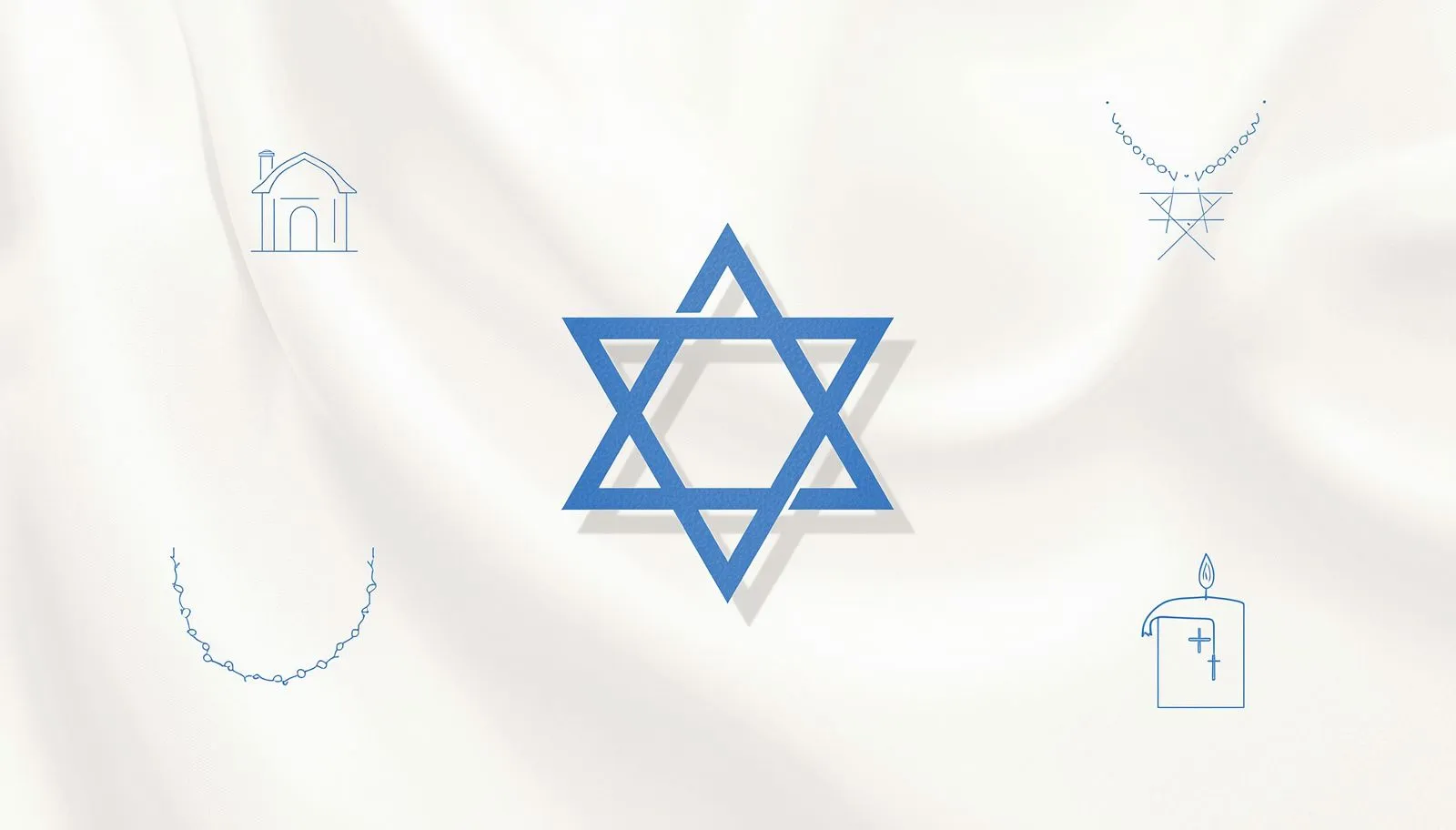
The Star of David is the best-known modern symbol of Jewish identity. It represents Judaism, Jewish heritage, the Jewish people, and, in some settings, Israel or Holocaust remembrance. In Hebrew, people call it the Magen David, which means “Shield of David.” Because its shape comes from two overlapping triangles, it is also known geometrically as a hexagram.
You may have seen this symbol on a necklace, synagogue, tombstone, Israeli flag, Holocaust memorial, or Jewish ritual object. In each setting, however, the meaning changes slightly. Therefore, the clearest way to understand it is to separate its broad Jewish meaning from the specific place where it appears.
Quick Meaning by Context
| Where You See It | What It Usually Means |
|---|---|
| Synagogue | Jewish worship, community, and identity |
| Necklace or ring | Personal Jewish identity, faith, heritage, or pride |
| Jewish tombstone | Jewish memory, burial identity, and connection to Jewish life |
| Israeli flag | Jewish national identity and the State of Israel |
| Holocaust memorial | Jewish suffering, persecution, remembrance, survival, and resilience |
| Judaica objects | Jewish home life, ritual, tradition, or cultural belonging |
| Magen David Adom | Israel’s emergency medical and disaster response service |
Context matters because the same symbol can carry different emotional weight. For example, a person wearing it on jewelry may be expressing family heritage, religious identity, or solidarity. Meanwhile, the same shape in a Holocaust museum points to persecution, memory, and survival. On Israel’s flag, by contrast, it carries national meaning.
What Is the Star of David?
The symbol consists of two overlapping equilateral triangles. Together, they create a six-pointed star called a hexagram.
Today, most people recognize it as a Jewish symbol. It appears on synagogues, Jewish gravestones, Judaica, community buildings, and Israel’s flag. However, the shape itself existed before it became strongly linked with Jewish identity.
In everyday speech, people may call it the Jewish star, Magen David, Shield of David, six-pointed Jewish star, or hexagram. Although those terms overlap, they are not always identical. “Hexagram” describes the shape, while “Magen David” describes the Jewish symbol and its meaning.
A simple explanation works best: it is the most widely recognized modern symbol of Jewish identity, and its meaning can include Judaism, heritage, peoplehood, Israel, or remembrance depending on context.
Why Is It Called the Magen David?
Magen David means Shield of David in Hebrew. The name connects the symbol with King David, one of the most important figures in Jewish tradition.
Still, that name does not prove King David carried this exact shape on his shield. Many people repeat that idea, but historians treat it carefully because early Jewish sources do not clearly support it. As a result, it is better to describe the shield connection as a traditional association rather than a proven origin.
A more accurate explanation is that the name links the symbol to Jewish tradition, Davidic identity, and protection. However, the claim that it literally appeared on King David’s shield remains uncertain.
This distinction prevents a common mistake. The symbol has deep Jewish meaning, but its later communal use matters more than an unsupported origin story.
Is It Biblical?
King David appears throughout the Hebrew Bible, yet the six-pointed symbol does not appear there as his clear personal emblem. In other words, David is biblical, while the symbol’s widespread Jewish use developed later.
That does not make the symbol less meaningful. Many symbols gain power because communities adopt them, preserve them, and pass them down. Over time, Jewish communities gave the six-pointed star a lasting role in religious, cultural, and public life.
How This Six-Pointed Star Became a Jewish Symbol
The history is more layered than many quick explanations suggest. At first, the hexagram appeared in more than one culture as a decorative, symbolic, or protective shape. Later, Jewish communities began using it more visibly.
During the Middle Ages, the symbol appeared more often in Jewish settings, although it had not yet become the main emblem of Judaism. Then, from the early modern period onward, Jewish communities in parts of Europe used it more publicly. By the 19th century, many Jewish groups increasingly adopted it as a recognizable emblem of Jewish identity.
Timeline: From Shape to Jewish Symbol
| Period | What Happened |
|---|---|
| Antiquity | Six-pointed stars appeared as decorative or symbolic shapes in more than one culture. |
| Middle Ages | Jewish communities used the shape more often, although it was not yet the central Jewish symbol. |
| 17th century | European Jewish communities helped strengthen its public Jewish association. |
| 19th century | Jewish groups increasingly adopted it as a visible emblem of Judaism and Jewish identity. |
| 1897 | The Zionist movement used the star at its Congress, giving it wider international prominence. |
| Holocaust era | Nazi authorities forced many Jews to wear star badges as tools of persecution and humiliation. |
| 1948 and after | The symbol became central on Israel’s flag and remained a major sign of Jewish identity worldwide. |
So, the symbol did not begin as the single official emblem of Judaism. Instead, Jewish communities gave it meaning over time through repeated use, public identity, survival, memory, and continuity.
What Does It Symbolize in Judaism?
In Jewish life, the symbol commonly points to Jewish identity, community, heritage, faith, peoplehood, protection in some interpretations, connection to history, and continuity across generations.
Judaism includes religion, ancestry, culture, language, memory, tradition, and peoplehood. Because of that, this symbol can feel religious to one Jewish person and more cultural or ancestral to another.
For example, someone may wear a pendant to show faith. Another person may wear it to honor family history. Someone else may see it as a sign of resilience or solidarity. Therefore, it is best not to reduce the symbol to only one personal meaning.
Spiritual Meanings
Many people attach spiritual meaning to the two overlapping triangles. One common interpretation sees the upward triangle as movement toward God or heaven. The downward triangle, meanwhile, can suggest divine presence reaching into the world. Together, the shape may express connection between the spiritual and physical realms.
In Jewish mystical thought, especially Kabbalah, some interpretations connect the six points and center with divine attributes known as the sefirot. These readings can add depth for people interested in Jewish spirituality. However, not every Jewish person understands the symbol this way.
Therefore, mystical explanations should be described as interpretations rather than one universal definition. This approach respects both religious depth and Jewish diversity.
Why Are There Six Points?
The six points come from the symbol’s structure. Two overlapping triangles create six outer points and a center.
Different traditions explain those points in different ways. Some people connect them with six directions: north, south, east, west, up, and down. Others link them with spiritual ideas about divine presence, balance, or protection.
Even so, the clearest explanation remains simple. The six-pointed shape became meaningful because Jewish communities gave it lasting symbolic value.
What Does It Mean on the Israeli Flag?
On Israel’s flag, the blue six-pointed star represents Jewish national identity and the State of Israel. The flag places it between two horizontal blue stripes.
The modern Israeli flag developed from Zionist symbolism. Before Israel became a state, the Zionist movement used a similar design as a sign of Jewish national renewal. Consequently, the symbol gained a strong national meaning in that setting.
Even so, the symbol itself is broader than the modern State of Israel. On the flag, it has national meaning. On a necklace, synagogue, or ritual object, it may express religious, cultural, personal, or communal identity.
What Did the Yellow Star Mean During the Holocaust?
During the Holocaust, Nazi authorities forced many Jews to wear yellow star badges. They used these badges to identify, isolate, humiliate, control, and persecute Jewish people.
This was not the symbol’s ordinary Jewish meaning. Instead, Nazi authorities turned a Jewish emblem into a tool of oppression. Today, the yellow star carries the weight of Holocaust memory.
It reminds people of antisemitic persecution, stripped rights, Jewish suffering, and the responsibility to remember victims and survivors. For that reason, this context should be handled with care and precision.
Star of David vs. Menorah vs. Seal of Solomon
Several symbols can look or sound related, but they do not mean the same thing.
| Symbol | What It Is | Main Association |
|---|---|---|
| Star of David | Six-pointed star made from two overlapping triangles | Modern Jewish identity, Judaism, Jewish peoplehood, and Israel in some contexts |
| Menorah | Seven-branched lampstand from ancient Jewish tradition | Judaism, Temple tradition, light, and continuity |
| Seal of Solomon | Symbol that may appear as a hexagram or pentagram in different traditions | Mystical, magical, religious, and cultural traditions beyond Judaism |
| Hexagram | General geometric term for a six-pointed star | Shape description, not always Jewish by itself |
The menorah has older roots as a specifically Jewish religious symbol. Meanwhile, the hexagram simply names the shape. The Jewish meaning comes from context and tradition.
What Does It Mean on Jewelry?
On jewelry, the symbol usually expresses a personal connection to Jewish identity. That connection may involve religion, culture, ancestry, family memory, or solidarity.
Someone might wear it because they are Jewish and want to show pride. Alternatively, it may remind them of family, faith, a loved one, support for Jewish people, or resilience after persecution.
Jewelry often carries private meaning. Because of that, it is better not to assume every wearer intends the same message.
What Does It Mean on a Gravestone?
On a Jewish gravestone, the symbol usually marks the person’s Jewish identity or connection to Jewish burial tradition.
In this setting, it does more than decorate the stone. It may express belonging, memory, faith, family identity, or connection to the Jewish people.
What Is Magen David Adom?
Magen David Adom means Red Shield of David or Red Star of David. It is Israel’s emergency medical, ambulance, blood services, and disaster response organization.
This example shows how the symbol can appear outside strictly religious contexts. Here, it functions in a humanitarian and emergency-service setting while still drawing on Jewish and Israeli identity.
What the Symbol Does and Does Not Mean
| It Usually Means | It Does Not Always Mean |
|---|---|
| Jewish identity | That the person is Israeli |
| Judaism or Jewish heritage | A political statement |
| Connection to Jewish peoplehood | One universal spiritual interpretation |
| Jewish remembrance or continuity | A symbol that began directly in the Bible |
| Israel, when used on Israel’s flag | That every use refers to the Israeli state |
| Protection in some interpretations | That King David definitely used this exact shape |
This distinction helps readers avoid overgeneralizing. The symbol has a broad Jewish meaning, but the exact message depends on setting, speaker, and purpose.
Common Misconceptions
It has always been the main symbol of Judaism
Today, the symbol is one of the most recognizable signs of Jewish identity. Historically, though, it did not always hold that central role.
The Bible clearly identifies it as King David’s symbol
The name refers to David, but the Bible does not clearly describe this six-pointed shape as David’s personal emblem.
It only means religion
For some people, it does carry religious meaning. For others, it represents culture, ancestry, memory, peoplehood, or solidarity.
It always means Israel
Because the symbol appears on Israel’s flag, people sometimes assume every use refers to the state. In reality, Jewish communities use it worldwide in many religious, personal, and cultural contexts.
Every six-pointed star has the same meaning
A six-pointed star is a hexagram. It becomes the Jewish symbol when context gives it that meaning.
How to Interpret It Respectfully
The best way to understand the symbol is to ask where it appears and who uses it. On a synagogue, it likely points to Jewish worship or community life. If someone wears it on a necklace, it may express personal identity. In a Holocaust museum, it may refer to persecution and remembrance. When it appears on Israel’s flag, it carries national meaning.
Respect also means avoiding quick assumptions. A Jewish person wearing the symbol does not necessarily speak for all Jews, represent a political position, or use it for the same reason another person might.
Ultimately, it is a living symbol used by a living community.
Is It Okay for Non-Jewish People to Wear It?
A non-Jewish person can wear the symbol, but respect matters. Because it carries Jewish identity, history, and memory, people should not treat it as a costume, trend, or random decoration.
Respectful use may include a genuine family connection, conversion to Judaism, thoughtful solidarity with Jewish people, or educational, memorial, and interfaith use.
When in doubt, remember that the symbol is not just a geometric design. It carries centuries of meaning.
What Most Articles Miss About This Topic
Many articles say, “It is the symbol of Judaism,” and stop there. That answer is true, but incomplete.
The deeper point is that this symbol changes meaning by context. It can point to Jewish faith in one place, Jewish peoplehood in another, Israeli national identity somewhere else, and Holocaust remembrance in a museum or memorial.
Another overlooked point involves the difference between origin and meaning. The six-pointed shape has a complex history, yet its modern meaning is clear because Jewish communities gave it identity, memory, and emotional weight.
So, the strongest answer is not simply “it means Judaism.” A better answer is that it is the best-known modern symbol of Jewish identity, and its exact meaning depends on whether it appears in religious, cultural, personal, Israeli, or Holocaust-related contexts.
FAQs
What does the Star of David symbolize?
It symbolizes Jewish identity, Judaism, Jewish heritage, and the Jewish people. In some contexts, it can also point to Israel, protection, Holocaust remembrance, or personal connection to Jewish history.
What does Magen David mean?
Magen David means “Shield of David” in Hebrew. It is the Hebrew name for the six-pointed Jewish symbol.
Is it religious or cultural?
It can be both. Some people use it as a religious symbol, while others connect it with ancestry, culture, peoplehood, family history, or solidarity.
Is it in the Bible?
The Bible includes King David, but it does not clearly present the six-pointed symbol as his personal emblem. Its widespread Jewish use developed later.
Why is it on Israel’s flag?
Israel’s flag uses the symbol because it had already become a widely recognized sign of Jewish identity and Zionism before the state’s founding.
What did the yellow star mean during the Holocaust?
Nazi authorities forced many Jews to wear yellow star badges to identify, isolate, humiliate, and persecute them. Today, the yellow star represents Holocaust memory and antisemitic persecution.
Is it the same as a hexagram?
Not exactly. A hexagram is the geometric six-pointed shape. The Jewish symbol comes from the meaning, tradition, and context attached to that shape.
Is it the same as the Seal of Solomon?
They can look similar, but they do not always mean the same thing. The Star of David mainly represents Jewish identity, while the Seal of Solomon appears in several mystical, religious, and cultural traditions.
Why does it have six points?
The six points come from two overlapping triangles. Some interpretations connect the points with directions, divine attributes, or the relationship between heaven and earth.
Does every Jewish person use it?
No. Jewish people relate to the symbol in different ways. Some wear it proudly, some use it religiously, some see it culturally, and others may not use it personally.
What does it mean spiritually?
Spiritually, it can represent protection, connection between heaven and earth, divine presence, or Kabbalistic ideas such as the sefirot. These are interpretations, not one universal meaning for everyone.
Conclusion
The Star of David represents Jewish identity, Judaism, heritage, and connection to the Jewish people. Its Hebrew name, Magen David, means Shield of David, although the claim that King David literally used this exact shape remains uncertain.
Its meaning changes by setting. On a synagogue, it can point to worship and community. Jewelry may express personal identity or heritage. Israel’s flag gives the symbol national meaning. In Holocaust history, the yellow star represents persecution, memory, and survival.
Ultimately, the simplest takeaway is this: the symbol is the best-known modern sign of Jewish identity, but its full meaning includes faith, culture, peoplehood, history, remembrance, and belonging.
Click Here To Read About : what does soak mean

I am Clara Lexis, a writer driven by clarity, depth, and authenticity. My focus is on transforming ideas into meaningful content that is both informative and engaging. I write with intention to communicate clearly, thoughtfully, and with purpose.