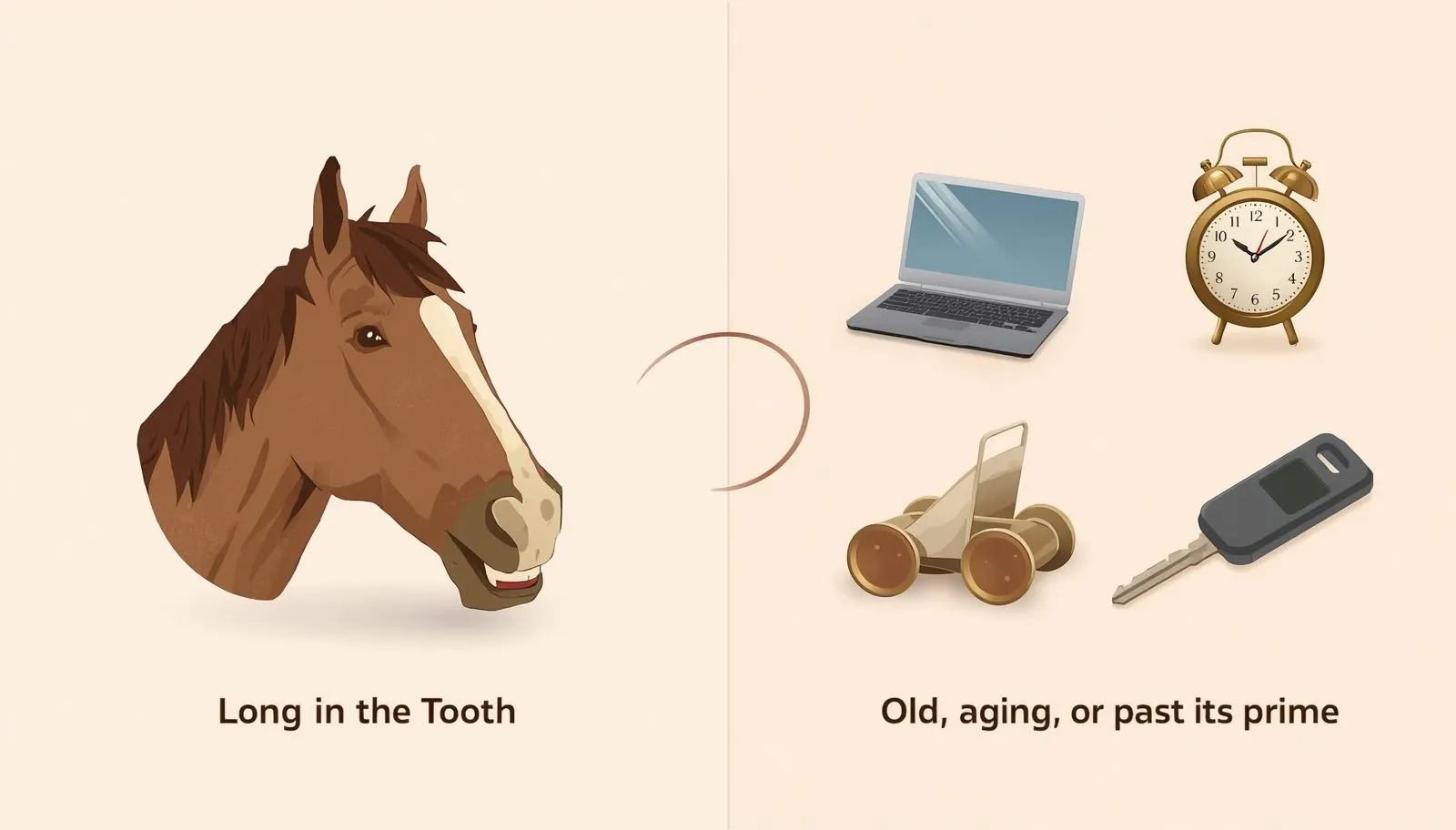
“Long in the tooth” means old, aging, or past one’s prime. In other words, it describes someone or something that is no longer young, fresh, modern, or at its best. For example, you might say, “This laptop still works, but it’s getting long in the tooth.”
In most cases, the phrase is informal. Therefore, it works best in casual conversation, light commentary, or humorous writing. However, because it can sound critical when used about a person, it should be used carefully.
Long in the Tooth Meaning at a Glance
| Phrase | Meaning |
|---|---|
| Long in the tooth | Old, aging, or past one’s prime |
| Tone | Informal; sometimes humorous, sometimes critical |
| Best used for | Yourself, objects, technology, systems, jokes, ideas |
| Use carefully with | Direct comments about another person’s age |
| Example | “That phone is getting long in the tooth.” |
In simple terms, long in the tooth means that age is starting to show. However, it does not usually refer to actual teeth. Instead, it is a figurative expression.
As a result, the phrase can describe people, objects, technology, jokes, trends, ideas, and systems.
Simple Examples of “Long in the Tooth”
To understand the phrase more clearly, look at these examples:
- “My car is getting long in the tooth, but it still runs well.”
- “I’m a bit long in the tooth for all-night parties.”
- “That software is reliable; however, it’s becoming long in the tooth.”
- “The joke was funny years ago, but now it feels long in the tooth.”
- “Some fans think the series is getting long in the tooth.”
- “The design looks long in the tooth compared with newer apps.”
As you can see, the phrase often means old but not necessarily useless. For instance, a long-in-the-tooth car may still run. Similarly, long-in-the-tooth software may still work, although it may feel outdated.
Where Did “Long in the Tooth” Come From?
The phrase is usually linked to horses. Historically, people looked at a horse’s teeth to estimate its age. As horses age, their teeth and gums change. Consequently, older horses may appear to have longer teeth.
Over time, this idea became a metaphor. First, the phrase described aging horses. Later, people began using it for humans. Eventually, it expanded even further and became a way to describe old objects, outdated ideas, aging technology, and worn systems.
So, in short:
“Long in the tooth” comes from judging age by teeth, especially in horses. Today, it means old, aging, outdated, or past one’s prime.
Is “Long in the Tooth” Rude?
Yes, it can be. However, it depends on context.
When you use the phrase about yourself, it often sounds humorous. For example:
- “I’m getting long in the tooth for late-night concerts.”
- “I’m too long in the tooth to sleep on the floor anymore.”
In these examples, the speaker is joking about their own age. Therefore, the phrase feels light and self-deprecating.
On the other hand, when you use it directly about another person, it can sound rude. For example:
- “You’re long in the tooth for this job.”
- “She’s looking long in the tooth.”
- “He’s too long in the tooth to keep up.”
These examples can sound dismissive because they suggest someone’s age is a problem. Therefore, it is better to avoid using the phrase directly about another person unless the tone is clearly friendly and the situation is informal.
By contrast, the phrase is usually safer when used about things:
- “This laptop is getting long in the tooth.”
- “The company’s booking system is long in the tooth.”
- “That slogan feels a bit long in the tooth.”
In these cases, the phrase simply means something is dated, aging, or ready for an update.
Long in the Tooth Examples by Context
People
When used about a person, long in the tooth usually means that the person is getting older or may be considered too old for a specific activity.
For example:
- “He joked that he was getting long in the tooth for competitive rugby.”
- “I’m a little long in the tooth for backpacking without a proper bed.”
- “Some critics said the actor was long in the tooth for the role.”
However, this use can sound judgmental. Therefore, it is usually safer to use the phrase about yourself rather than someone else.
Technology
The phrase is also commonly used for technology. In this context, it usually means outdated, aging, or due for an upgrade.
For example:
- “My phone is getting long in the tooth.”
- “The app works; however, the interface is long in the tooth.”
- “That operating system is becoming long in the tooth.”
Although the technology may still function, it may no longer feel modern. Therefore, the phrase suggests that an update or replacement may be needed soon.
Cars, Tools, and Equipment
Similarly, the phrase can describe cars, tools, machines, or equipment.
For example:
- “The truck is long in the tooth, but it’s dependable.”
- “Our office printer is getting long in the tooth.”
- “The machine is reliable, though a bit long in the tooth.”
In these examples, the item is not necessarily broken. Instead, it is simply showing signs of age.
Jokes, Ideas, and Trends
In addition, long in the tooth can describe things that feel overused or no longer fresh.
For example:
- “That meme is getting long in the tooth.”
- “The joke was funny at first; however, now it’s long in the tooth.”
- “The campaign idea feels long in the tooth.”
Here, the phrase does not refer to physical age. Instead, it means the idea, joke, or trend has become stale.
Work and Business
In business settings, the phrase may describe old systems, outdated policies, or stale processes.
For example:
- “The policy is getting long in the tooth and needs a review.”
- “Our onboarding process is a little long in the tooth.”
- “That sales deck is long in the tooth compared with our current positioning.”
However, in formal writing, clearer wording is often better. Therefore, instead of saying “long in the tooth,” you might say outdated, due for review, or ready for an update.
What “Long in the Tooth” Does Not Mean
It does not literally mean long teeth
Although the phrase comes from teeth, it is not usually about actual teeth. Instead, it is an idiom.
It does not always mean useless
A long-in-the-tooth car, laptop, system, or tool may still work well. However, it may feel old, worn, or outdated compared with newer options.
It does not mean “experienced” in a positive sense
“Experienced” is usually a compliment. By contrast, long in the tooth can sound more critical.
For example:
- “She is an experienced manager.” This sounds positive.
- “She is long in the tooth for that role.” This may sound rude.
Therefore, if you want to praise someone, use words like experienced, seasoned, knowledgeable, or skilled instead.
It does not only apply to people
Although the phrase can describe people, it can also describe:
- technology
- vehicles
- equipment
- jokes
- ideas
- systems
- brands
- designs
- policies
- trends
As a result, the phrase is more flexible than a simple synonym for “old.”
Long in the Tooth vs Similar Phrases
| Phrase | Meaning | Tone |
|---|---|---|
| Long in the tooth | Old, aging, or past one’s prime | Informal; sometimes critical |
| Over the hill | Past one’s best age or ability | Often rude or joking |
| No spring chicken | Not young anymore | Informal; usually mild |
| Past one’s prime | No longer at peak ability or condition | Neutral to critical |
| Getting on in years | Becoming older | Softer and more polite |
| Outdated | No longer current | Best for things, systems, and ideas |
| Experienced | Skilled through time and practice | Positive |
Overall, long in the tooth is less polite than “experienced” but often softer than “over the hill.” However, tone still matters.
Long in the Tooth Synonyms
The best synonym depends on what you want to say.
If you mean a person is older
- older
- aging
- getting older
- getting on in years
- advanced in age
If you mean something is outdated
- outdated
- dated
- old-fashioned
- no longer current
- behind the times
- obsolete
- due for an update
If you mean someone has experience
- experienced
- seasoned
- knowledgeable
- veteran
- well-practiced
If you mean something is past its best
- past its prime
- past its best days
- worn
- tired
- no longer fresh
Therefore, before choosing a synonym, consider whether you mean old, outdated, experienced, or past peak condition.
Common Mistakes With “Long in the Tooth”
Mistake 1: Using it as a compliment
First, do not assume the phrase is complimentary. Although it may sound playful, it often suggests age has become noticeable or limiting.
Mistake 2: Saying it directly about someone’s appearance
Second, avoid comments like:
“You’re looking long in the tooth.”
This can sound insulting. Instead, avoid commenting on someone’s age or appearance unless there is a respectful reason to do so.
Mistake 3: Using it in formal writing
Third, avoid the idiom in formal writing when clarity matters.
Instead of:
“The policy is long in the tooth.”
Use:
“The policy is outdated and should be reviewed.”
Mistake 4: Thinking it only applies to people
Fourth, remember that the phrase can also describe objects, technology, systems, jokes, and ideas.
Mistake 5: Missing the context
Finally, remember that the phrase usually means old in relation to something.
For example, a person may be long in the tooth for a physically demanding sport. However, that same person may be perfectly suited for coaching, leadership, or mentoring.
Similarly, a laptop may be long in the tooth for video editing but still fine for writing emails.
What Most Articles Miss About This Topic
Most explanations say “long in the tooth means old.” That is true. However, it is incomplete.
More precisely, the phrase means:
Old enough that age, wear, or outdatedness has started to matter.
This distinction is important because the phrase depends heavily on context.
For instance, a phone can be long in the tooth even if it still works. Likewise, a joke can be long in the tooth because people have heard it too many times. Similarly, a business process can be long in the tooth because it no longer fits current needs.
Therefore, the phrase is not only about age in years. Instead, it is about whether something still feels fresh, suitable, effective, or current.
That is why this sentence works:
“The software is long in the tooth, but it still gets the job done.”
It means the software is old or dated, but not necessarily broken.
By contrast, this sentence can sound rude:
“You’re long in the tooth for this role.”
That sentence implies the person’s age is a problem. Therefore, it should be avoided in most situations.
FAQ
What does “long in the tooth” mean?
“Long in the tooth” means old, aging, or past one’s prime. In many cases, it suggests that age, wear, or outdatedness has become noticeable.
What does “getting long in the tooth” mean?
“Getting long in the tooth” means becoming old or starting to show signs of age. For example, a phone, car, joke, or system can all get long in the tooth.
Where did “long in the tooth” come from?
The phrase comes from the idea of estimating a horse’s age by looking at its teeth. Over time, it became a general metaphor for age.
Is “long in the tooth” rude?
It can be rude if used directly about another person. However, it is often harmless when used about yourself, objects, technology, or ideas.
Can “long in the tooth” describe technology?
Yes. For example, a phone, laptop, app, website, or software system can be long in the tooth if it still works but feels old or outdated.
Is “long in the tooth” the same as “old”?
Not exactly. Although both words relate to age, long in the tooth often suggests that age has become noticeable, relevant, or limiting.
What is another way to say “long in the tooth”?
Depending on context, you could say old, aging, dated, outdated, past its prime, getting on in years, or past its best days.
Is “long in the tooth” the same as “over the hill”?
They are similar. However, over the hill usually sounds more directly critical or joking about a person. Meanwhile, long in the tooth can also describe objects, systems, ideas, and technology.
Can I use “long in the tooth” in professional writing?
Usually, clearer wording is better. Therefore, instead of saying a system is “long in the tooth,” say it is outdated, due for review, or ready for an update.
What is the opposite of “long in the tooth”?
Depending on context, the opposite could be new, fresh, young, modern, current, up to date, or in its prime.
Final Takeaway
In short, long in the tooth means old, aging, outdated, or past one’s prime. Although the phrase comes from judging age by teeth, especially in horses, it is now used much more broadly.
However, because it can sound critical, use it carefully when talking about people. By contrast, it is usually safe and natural when describing objects, technology, systems, jokes, trends, or ideas that are showing their age.
Click Here To Read About : what does rs mean in slang

Hi, I’m Geoffrey Chaucer. I explore the stories and meanings behind words, turning ideas into clear, insightful writing. Through every article I craft, I aim to spark curiosity, share knowledge, and help readers uncover practical, meaningful truths in everyday life.