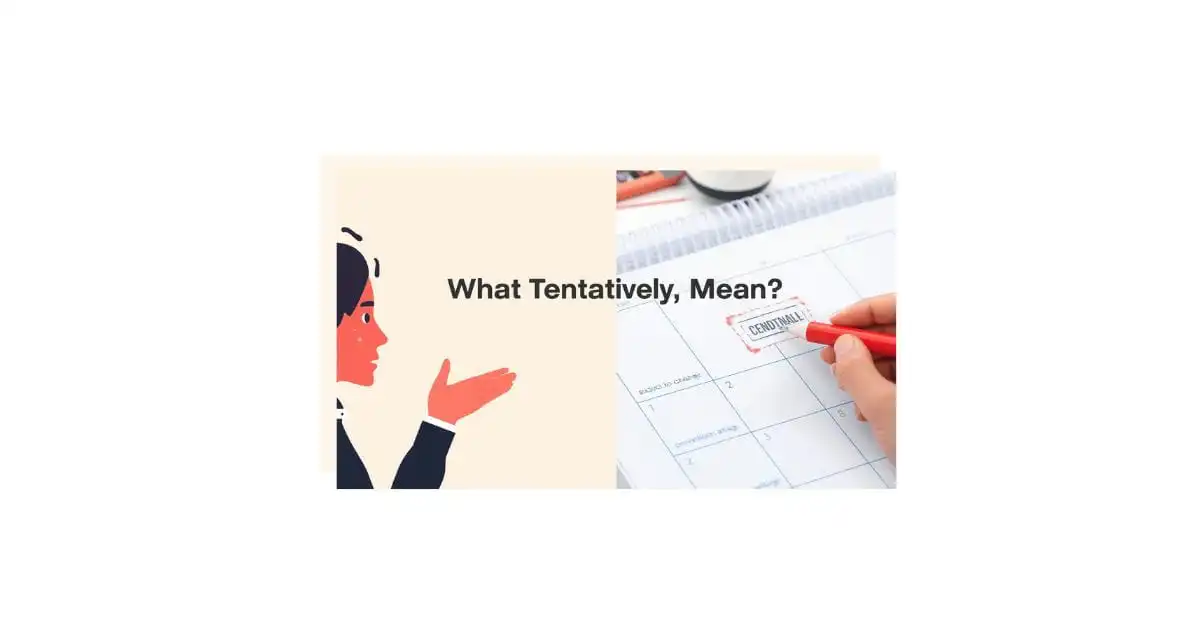
Tentatively means not fully certain, confident, or final. In most cases, the word has two common uses. First, it can describe doing something carefully or hesitantly. Second, it can show that something is provisional and may change later.
Meaning at a glance
- Word: tentatively
- Part of speech: adverb
- Simple meaning: in a way that is uncertain, cautious, or not final
- Common use: plans, schedules, agreements, suggestions, and careful actions
For example, if someone says a meeting is scheduled for now but not fully locked in, they usually mean the timing could still change. Likewise, if a person agrees in a tentative way, they are often saying yes for the moment, but not making a final promise.
Simple definition in plain English
In everyday English, this word usually points to one of two ideas:
- With hesitation or caution
- In a way that is not final and could still change
Because of that, it works in both emotional and practical situations.
- A person may speak this way because they feel unsure.
- A team may choose a date this way because the plan is still flexible.
So, although the word is small, the context matters a lot.
The two main meanings
1) A cautious, hesitant, or unsure way of acting
In this sense, the word describes how someone behaves, speaks, reacts, or suggests something.
Examples
- She tentatively raised her hand.
- He tentatively suggested a new idea.
- The child tentatively stepped into the pool.
- I tentatively said yes.
Here, the meaning often includes:
- caution
- uncertainty
- limited confidence
- careful movement or speech
Even so, it does not always mean fear. In many situations, it simply shows that someone is being careful because they are not fully sure what will happen next.
2) A plan, decision, or date that is not final yet
In another common use, the word appears with plans, dates, titles, approvals, and agreements.
Examples
- The meeting is tentatively set for Thursday.
- We tentatively agreed on the budget.
- The project is tentatively titled “North Star.”
- The trip is tentatively planned for August.
In these cases, the idea is slightly different. Instead of describing behavior, it shows that the current plan exists, but it is still open to change.
Quick reference table
| Use | Meaning | Example | Plain-English meaning |
|---|---|---|---|
| Describing behavior | Cautiously or hesitantly | “She tentatively knocked.” | She knocked carefully because she was unsure |
| Describing a suggestion | Without full confidence | “He tentatively proposed a solution.” | He suggested it carefully, not strongly |
| Describing a schedule | Provisional, not final | “The interview is tentatively scheduled for Monday.” | Monday is the current plan, but it may change |
| Describing agreement | Early or conditional agreement | “We tentatively agreed.” | There is basic agreement, but it is not final |
What “tentatively scheduled” means
This phrase means something is planned for now but not fully confirmed.
Example
“The appointment is tentatively scheduled for 2 p.m.”
In other words:
- 2 p.m. is the current plan
- the time may still shift
- confirmation may still depend on approval, availability, or other details
As a result, this phrase is common in:
- work emails
- event planning
- interviews
- appointments
- project timelines
A useful distinction
Many people focus only on the word scheduled. However, the more accurate reading is scheduled for now. That difference is small, but important.
What “tentatively agreed” means
This phrase usually means people have reached a basic or early agreement, but the matter is not fully settled yet.
Example
“We tentatively agreed to meet on Friday.”
That usually suggests:
- Friday works for now
- details could still change
- no one is making a firm final commitment yet
Therefore, it sounds softer than:
- “We agreed”
- “It’s confirmed”
- “It’s final”
Other common phrases
Tentatively approved
This usually means something has early approval, although final approval may still depend on further review or certain conditions.
Tentatively planned
This means there is already a plan in place. However, the plan is still flexible.
Tentatively titled
This is often used for books, articles, presentations, or projects. It means the current title is only a working title and may change later.
Tentatively confirmed
People do use this phrase, but it can sound slightly awkward. That is because confirmed sounds firm, while the adverb softens it. In practice, most people mean confirmed for now or provisionally confirmed.
Tentatively vs temporarily vs hesitantly
These words are related in some situations. Even so, they do not mean the same thing.
| Word | Main meaning | Example | What it really implies |
|---|---|---|---|
| Tentatively | Not final, cautious, or uncertain | “The date is tentatively set.” | It may change |
| Temporarily | For a limited time | “The office is temporarily closed.” | It will not last forever |
| Hesitantly | In an unsure or reluctant way | “She hesitantly answered.” | She answered without confidence |
The easiest way to remember the difference
- Tentatively = not final or not fully confident
- Temporarily = not permanent
- Hesitantly = unsure in behavior or tone
For instance, a date can be tentative without being temporary. On the other hand, a closure can be temporary without being uncertain.
Tentative vs tentatively
This is another point that confuses many readers.
- It is usually an adjective
- This is the adverb form
Examples
- We made a tentative plan.
- We tentatively planned the launch.
So, use this when describing a noun. By contrast, use tentatively when describing how something is done.
How to use it in a sentence
A simple rule can help:
Use this word when you want to show uncertainty, caution, or lack of finality.
In everyday conversation
- She tentatively asked if the seat was taken.
- I tentatively said I could come.
- He tentatively smiled.
In work or planning
- We tentatively booked the call for Tuesday.
- The team tentatively approved the draft.
- The launch is tentatively planned for next month.
In writing or discussion
- I would tentatively suggest another option.
- The report tentatively concludes that demand is rising.
- They tentatively identified the issue.
When the word sounds natural
It sounds natural when:
- a plan is still developing
- a decision is not final
- a speaker wants to avoid sounding too certain
- someone is acting carefully or a little unsure
Natural examples
- We tentatively picked Wednesday.
- She tentatively reached out after a long silence.
- The document is tentatively titled “Q4 Growth Plan.”
When it sounds less natural
Sometimes it can sound odd if:
- the situation is already final
- you want strong confidence
- the sentence needs direct language instead of cautious language
Less natural example
- We tentatively signed the final contract and completed payment.
If the contract is already complete, then words like officially, formally, or definitively are usually a better fit.
Common mistakes people make
Mistake 1: Thinking it always means nervous
Not always. In some cases, it simply means carefully or not finally confirmed.
Mistake 2: Treating it as the same as “temporarily”
These words are different. One is about certainty, while the other is about duration.
Mistake 3: Assuming it means “no”
Actually, it often means not final yet, not rejection.
Mistake 4: Ignoring the context
The meaning changes slightly depending on what the word describes.
- If it describes a person’s action, it usually suggests caution or hesitation.
- If it describes a plan or date, it usually suggests that the arrangement is provisional.
What Most Articles Miss About This Topic
Most articles stop at saying the word means “uncertain.” While that is true, it is still incomplete.
The more useful distinction is this:
- When it describes a person’s behavior, it usually means hesitantly, cautiously, or without full confidence.
- When it describes a plan, date, title, or agreement, it usually means provisional, not final, or subject to change.
That difference matters because it changes how the sentence should be understood.
Compare these examples:
- “She tentatively opened the door.”
This describes how she acted. - “The meeting is tentatively scheduled for Friday.”
This describes the status of the plan.
Just as importantly, the word does not always signal weakness. In many professional settings, it actually shows accuracy and responsibility. People use it when they want to communicate a real plan without pretending it is fully settled.
That is why it appears so often in:
- calendars
- project plans
- interviews
- event schedules
- approvals
- polite workplace communication
Synonyms and near-synonyms
Depending on the sentence, similar words may include:
- cautiously
- hesitantly
- provisionally
- uncertainly
- conditionally
- preliminarily
Even so, these are not perfect replacements in every case.
Example
- “She tentatively answered” is close to hesitantly answered
- “The meeting is tentatively scheduled” is closer to provisionally scheduled
Because of that, context matters more than using one direct substitute.
Opposites
Depending on the sentence, the opposite could be:
- definitely
- confidently
- firmly
- officially
- finally
- decisively
Examples
- “Tentatively scheduled” vs “officially scheduled”
- “Tentatively agreed” vs “firmly agreed”
- “Tentatively answered” vs “confidently answered”
Does it mean something is not confirmed?
Often, yes. In schedules, plans, and agreements, it usually shows that something is still open and not completely settled.
Can it still mean yes?
Yes. In many situations, it means “yes for now” or “yes unless anything changes.”
What does “tentatively scheduled” mean in an email?
It usually means a time or date has been chosen for the moment, but the sender is still leaving room for changes.
Is it a formal word?
It works in both casual and formal English. However, you will see it more often in professional, academic, and planning-related contexts.
What is the difference between “tentative” and the adverb form?
Tentative usually describes a noun, while tentatively describes an action or the way something is said or done.
Is it the same as “temporarily”?
No. One relates to uncertainty or flexibility, while the other refers to something that lasts only for a limited period.
What does “tentatively agreed” mean?
It usually shows that there is early agreement, although the details are not fully locked in.
Does it sound weak?
Not at all. In many cases, it sounds thoughtful, careful, or polite rather than weak.
Conclusion
The simplest way to understand tentatively is to think of it as showing uncertainty, caution, or flexibility.
In most cases, it points to one of two ideas:
- acting carefully or with some hesitation
- describing something that is still open to change
A quick way to read it correctly is to check the context.
Ask yourself:
Is it describing how someone acts, or is it describing a plan that is not final yet?meaning usually becomes clear right away
Click Here To Read About : what does shallow mean

Hi, I’m Geoffrey Chaucer. I explore the stories and meanings behind words, turning ideas into clear, insightful writing. Through every article I craft, I aim to spark curiosity, share knowledge, and help readers uncover practical, meaningful truths in everyday life.