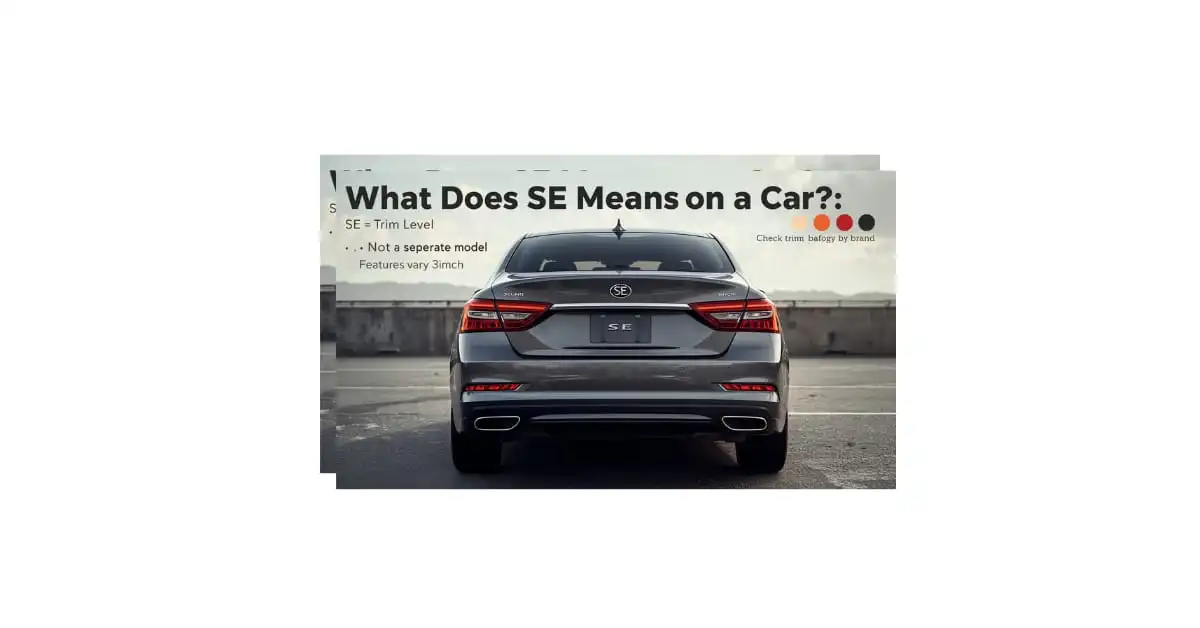
SE on a car usually refers to a trim level. It does not mean a completely different model, and it does not mean the exact same thing on every vehicle. In plain English, SE is a badge that tells you which version of the car you are looking at, usually with a specific mix of features, styling, and price. Edmunds explains that trim levels are the named versions of a model that help buyers understand equipment differences, while current Honda, Toyota, and Hyundai lineups show SE being used as a real trim name within those model ranges.
If you saw SE in a used-car listing, on a trunk badge, or on a dealer’s trim comparison page, the main thing to know is this: SE tells you where the car sits in the lineup, not everything that car includes by itself. To understand whether it is worth buying, you need to check the actual feature list for that exact year, make, and model.
SE Usually Means a Trim Level, Not a Separate Model
A car’s trim level is the version of that model sold with a certain bundle of standard equipment, styling details, and pricing. That is why two cars with the same model name can feel very different in features and cost. Edmunds notes that trim names such as SE, LX, SEL, and Limited help identify how equipped a vehicle is and what options or packages may come with it.
That matters because many people search “what does SE mean on a car” when what they really want to know is one of these things:
- Is SE better than the base model?
- Does SE mean sporty?
- Is SE worth paying extra for?
- Is SE the same across every brand?
- How do I know whether a used-car listing labeled “SE” is accurate?
This article is built to answer those real questions, not just define the letters.
Does SE Always Mean “Special Edition”?
Not in one universal, industry-wide way.
Many shoppers read SE as “Special Edition,” and sometimes people also interpret it as “Sport Edition.” But from a buying perspective, that wording is less important than what the badge does in practice: it identifies a trim in that brand’s lineup. The safest way to read SE is “a specific trim with a specific equipment package” rather than assuming the letters always expand to the same phrase on every car. That fits how trim levels are described by Edmunds and how official manufacturer trim pages present SE across current model lines.
So if you are comparing cars, do not get stuck on the letters alone. Focus on:
- standard features
- safety equipment
- infotainment and comfort upgrades
- wheel and exterior styling changes
- price difference from the base trim
That is where the buying decision happens.
What SE Means in Real Car Lineups
One reason this topic confuses people is that SE is real, but not standardized. Different brands use it differently, and some brands that used SE in the past may rename their trims later.
Honda Accord SE
Honda’s current Accord lineup includes both LX and SE trims. On Honda’s trim comparison page, the Accord SE sits above the LX in price and adds features such as heated front seats, Blind Spot Information System, and 19-inch wheels, while keeping the same 192-horsepower rating listed for both trims. That is a good example of SE meaning more features and a different trim position, not necessarily more power.
Toyota Camry SE and Corolla SE
Toyota currently uses SE as an official trim name in more than one model line. The 2026 Corolla build page lists trims including LE, Hybrid LE, SE, Hybrid SE, XSE, and Hybrid XLE, while Toyota’s Camry pages also use SE and XSE in the lineup. That shows SE working as part of Toyota’s trim ladder rather than as a universal code with one fixed meaning everywhere. Toyota also notes that trim information can be subject to change and may differ by region, which is another reason to verify the exact vehicle you are shopping.
Hyundai Elantra SE
Hyundai’s current Elantra pages also show SE as a named trim. That supports the bigger point: SE is commonly used by manufacturers as a lineup designation, but what it includes depends on the actual model and year.
Why Brand Examples Matter
Here is the part many short definition pages miss: SE is meaningful only inside its own lineup. A Toyota SE is not automatically equivalent to a Honda SE, and neither one is guaranteed to match an older SE trim from another brand. Even Ford’s current Escape lineup no longer uses SE as a trim name in the current 2025 and 2026 model pages, instead using names such as Active, ST-Line, ST-Line Select, ST-Line Elite, and Platinum. That is a good reminder that trim naming changes over time.
What SE Usually Tells You as a Buyer
In real-world buying terms, an SE trim often means the car is a step above the most basic version, but not always the highest trim. Depending on the model, that can mean upgrades like:
- larger wheels
- heated seats
- blind-spot monitoring
- better infotainment
- styling changes
- convenience features
- extra driver-assistance tech
Honda’s current Accord SE is a good example of this kind of feature-based upgrade path.
What SE does not automatically mean:
- a stronger engine
- a rare collector edition
- a luxury trim
- the same features across every brand
- a better deal without checking the price difference
That distinction is important because buyers often assume “SE” means “sportier” or “premium,” when it may simply mean a different feature bundle.
SE vs Base Model vs Other Common Trims
Use this as a quick buying guide, not a universal rulebook.
| Trim label | What it usually tells you |
|---|---|
| Base / entry trim | Lowest starting price, core features only |
| SE | Usually a step up in equipment, styling, or convenience |
| LE | Often an efficiency or comfort-focused mainstream trim, depending on brand |
| SEL | Usually positioned above SE in brands that use both |
| XSE | Often a sportier or more premium version above SE |
| Limited / Touring / Platinum | Usually higher-end trims with more premium equipment |
That general pattern is consistent with how current manufacturer lineups and buyer guides present trim ladders, but the exact position still depends on the model. Toyota’s current Corolla lineup, for example, clearly separates SE and XSE, while Hyundai separates SE from higher trims in its Elantra range.
Does SE Mean the Car Is Sportier?
Sometimes in appearance, yes. Automatically in performance, no.
This is one of the biggest misunderstandings around SE. On some vehicles, the SE trim may include a sportier look, larger wheels, darker trim pieces, or upgraded seats. But that does not guarantee a stronger engine or a different suspension. Honda’s current Accord comparison page is a good example: the LX and SE share the same listed horsepower, while the SE adds convenience, safety, and appearance upgrades.
So if you are hoping for a faster version, do not assume the SE badge means that. Check:
- horsepower
- drivetrain
- suspension differences
- wheel and tire sizes
- sport mode or drive mode changes
How to Tell What SE Means on Your Specific Car
This is the section most buyers actually need.
1. Check the manufacturer’s trim comparison page
This is the cleanest way to confirm what the SE trim includes for a specific model year. Official trim pages from Honda, Toyota, and Hyundai list feature differences trim by trim.
2. Check the VIN
If you are shopping used, the badge on the car and the dealer listing are not always enough. NHTSA’s VIN decoder explains that a VIN is the vehicle’s identifying number and can be used to pull encoded vehicle information through its public decoder tools.
3. Look at the window sticker or equipment sheet
Even when the trim name is correct, a car may have option packages that change what it actually includes. The window sticker or official equipment list is usually more useful than the badge alone. Edmunds also distinguishes between trims, options, packages, and accessories for exactly this reason.
4. Compare features, not just badges
Two cars can both be labeled SE and still feel very different if they are from different brands or years. Compare the actual equipment list before assuming they are equivalent.
Common Mistakes Buyers Make With SE Trims
Assuming SE always means the same thing
It does not. Current Honda, Toyota, and Hyundai pages all use SE, but not in an identical way.
Assuming SE is always faster
Not necessarily. Sometimes the difference is comfort, safety, or styling rather than engine output. Honda’s current Accord SE shows exactly that.
Trusting the badge without checking the VIN
Badges can be missing, swapped, or misunderstood in used-car listings. NHTSA’s VIN tools are a better way to verify vehicle identity details.
Comparing SE trims across brands as if they are equal
A Corolla SE, Accord SE, and Elantra SE are not interchangeable grades. The letters may match, but the equipment, pricing, and trim position can differ.
What Most Articles Miss About SE Badges
Most articles spend too much time on what the letters might stand for and not enough time on how shoppers should use that information correctly.
The better way to read an SE badge is this:
- It is a trim clue, not the whole answer
- It is only meaningful inside that model’s lineup
- It may mean more features without more performance
- It can change by model year
- It should always be checked against the VIN, trim page, and equipment list before buying
That is why the best next step after seeing “SE” is never “assume you know what it means.” It is “verify what this exact car includes.”
Is an SE Trim Worth It?
Often, yes, especially if the price jump from the base model is small and the added features are things you actually want. Heated seats, blind-spot monitoring, larger wheels, or a better screen can make an SE trim feel like the sweet spot in a lineup. Honda’s current Accord SE is a good example of that kind of middle-ground value upgrade.
But the only smart way to judge value is to compare:
- price difference from the lower trim
- features you will use every day
- resale appeal
- insurance and ownership costs
- whether a higher trim gives you much more for only a little extra
In other words, SE can be a great value trim, but only in context.
FAQ
What does SE stand for on a car?
It is commonly read as Special Edition, but for buyers the more useful meaning is that SE identifies a trim level in the lineup. The exact meaning and feature set depend on the brand, model, and year.
Is SE a good trim level?
Often, yes. SE trims are commonly positioned above the base model and can add convenience, styling, or safety features without jumping all the way to the most expensive trim.
Is SE better than the base model?
Usually, yes in terms of equipment. But “better” depends on whether the added features matter to you and whether the price increase makes sense. Honda’s current Accord SE, for example, adds features over the LX.
Is SE the same as SEL?
No. When a brand uses both, SEL is usually a separate trim and is often positioned above SE. The exact order depends on the manufacturer. Edmunds explains that trim codes vary by automaker, and current Hyundai lineups separate SE from higher trims.
Does SE mean a sports car package?
Not automatically. It may include sportier looks or a nicer feature package, but it does not always mean extra horsepower or a performance suspension.
How do I verify what SE means on a used car?
Check the manufacturer’s trim comparison page, decode the VIN, and review the window sticker or official equipment sheet. NHTSA provides a public VIN decoder that can help identify vehicle information from the VIN.
Conclusion
If you searched “what does SE mean on a car,” the best answer is simple: SE usually means a trim level, not a separate car model. It often signals a version with more features than the base trim, but it does not tell you the exact equipment by itself. The smart move is to treat SE as a starting point, then verify the actual trim details with the manufacturer’s comparison page, the VIN, and the vehicle’s equipment list.
Click Here To Read About : what does integrated mean

Hi, I’m Geoffrey Chaucer. I explore the stories and meanings behind words, turning ideas into clear, insightful writing. Through every article I craft, I aim to spark curiosity, share knowledge, and help readers uncover practical, meaningful truths in everyday life.