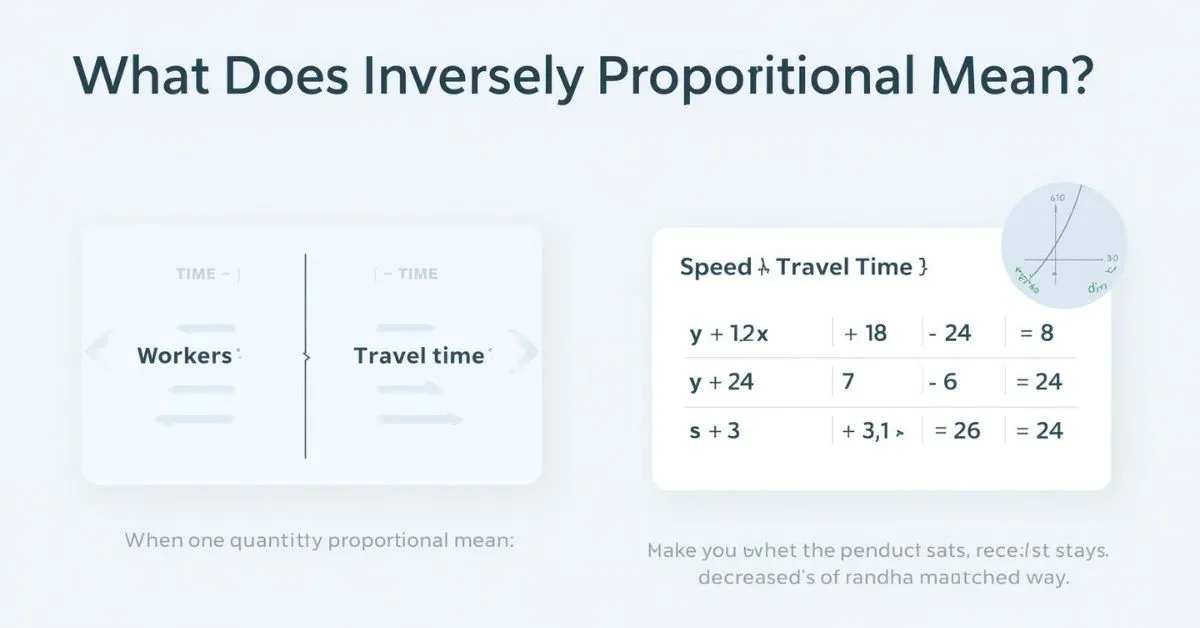
Inversely proportional means two quantities change in opposite directions in a matching way: when one increases, the other decreases so that their product stays constant. In math, this is usually written as y∝x1 or y=xk, where k is a constant.
If that still sounds abstract, use this shortcut:
- if one value doubles, the other halves
- if one value triples, the other becomes one-third
- if one value is cut in half, the other doubles
That is the simplest way to recognize inverse proportion. This “same factor, opposite direction” explanation is consistent with how leading educational references define inverse variation and inverse proportion.
Why people search this term
Most people who search what does inversely proportional mean are not looking for a formal textbook definition alone. They usually want one of four things:
- a plain-English meaning
- a simple formula
- an easy example
- a way to tell whether a table, graph, or word problem shows inverse proportion
That is why the best-performing pages for this topic do more than define the phrase. They also show formulas, graphs, examples, and problem-solving steps.
What inversely proportional means in simple words
Two things are inversely proportional when one goes up and the other goes down in a precise mathematical pattern.
That precise pattern matters.
A lot of articles say, “one increases while the other decreases.” That is only partly true. Lots of things move in opposite directions without being inversely proportional.
For a relationship to be truly inverse, the values must change in a way that keeps the product constant. That is the key difference between a general opposite trend and a real inverse proportion.
The fastest way to tell if something is inversely proportional
Use the 3-test rule
1) Do the values move in opposite directions?
If one goes up while the other goes down, that is your first clue.
2) Does doubling one halve the other?
This is the easiest mental test. If one quantity doubles and the other halves, the relationship may be inverse.
3) Does the product stay constant?
Multiply each pair of matching values. If the answer stays the same, the variables are inversely proportional. Leading math resources consistently use the constant-product test as the core check.
Inversely proportional formula
The standard inverse proportion formula is:y=xk
Here:
- x and y are the two variables
- k is the constant of proportionality
You can also write it as:xy=k
That second form is often the quickest one to use in problems, because it tells you the product must stay the same. Educational references also describe inverse proportion as inverse variation, which is another common term for the same idea.
Inversely proportional vs directly proportional
This is one of the easiest places to get confused, so it helps to compare them side by side.
| Feature | Directly proportional | Inversely proportional |
|---|---|---|
| What happens? | Both values move in the same direction | One goes up while the other goes down |
| Formula | y=kx | y=xk |
| What stays constant? | The ratio y/x | The product xy |
| Quick test | Double one, double the other | Double one, halve the other |
| Graph shape | Straight line through the origin | Curved graph |
That distinction matches the way strong math explainer pages compare direct and inverse relationships.
A quick table example
Here is a simple inverse proportion table:
| x | y | xy |
|---|---|---|
| 2 | 12 | 24 |
| 3 | 8 | 24 |
| 4 | 6 | 24 |
| 6 | 4 | 24 |
Because the product is always 24, the relationship is inversely proportional. This kind of table-based identification is common in instructional pages and is one of the clearest ways to teach the concept.
Solved examples of inverse proportion
Example 1: Workers and time
A job takes 6 hours for 4 workers. How long would it take 8 workers, assuming the amount of work stays the same?
Step 1: Use the constant-product idea
workers×hours=k
Step 2: Find the constant
4×6=24
Step 3: Solve for the new time
8×t=24 t=3
Answer: 8 workers would take 3 hours.
This is a classic inverse proportion example, but only because the total amount of work stays fixed. That “fixed condition” is essential and often left out in weaker articles.
Example 2: Speed and travel time
If a journey takes 5 hours at 60 km/h, how long would it take at 100 km/h for the same distance?
Step 1: Use the inverse relationship
For a fixed distance:speed×time=k
Step 2: Find the constant
60×5=300
Step 3: Solve
100×t=300 t=3
Answer: the trip would take 3 hours.
Speed and time are one of the most common real-life examples used in math education for inverse proportion.
Example 3: Find the missing value from a table
Suppose y is inversely proportional to x, and when x=5, y=12. What is y when x=8?
Step 1: Find k
k=xy=5⋅12=60
Step 2: Use the formula
y=860 y=7.5
Answer: y=7.5y = 7.5y=7.5
This is the typical format used in inverse variation exercises: find the constant first, then substitute the new value.
How to solve inverse proportion problems
If you are working through a homework problem, use this order every time:
1. Identify the two quantities
Make sure you know what is changing.
2. Check whether the relationship is really inverse
Do not assume it is inverse just because one value rises and the other falls.
3. Write the formula
y=xk
orxy=k
4. Find the constant k
Use the values you already know.
5. Substitute the missing value
Plug in the new number and solve.
6. Check whether the answer makes sense
If one value increased, the other should decrease in a true inverse relationship.
This step-by-step approach closely reflects the structure of top-performing educational pages that are designed to solve the user’s problem, not just define the term.
What the graph of inverse proportion looks like
The graph of a simple inverse proportion, such as y=xk, is a curve, not a straight line. It is often described as a hyperbola.
That matters because many students expect every proportional relationship to make a straight line. That is true for direct proportion, but not for inverse proportion. Educational math references explicitly distinguish the graph shapes this way.
A simple way to remember it:
- direct proportion → straight line
- inverse proportion → curved graph
Real-life examples of inverse proportion
You will often see inverse proportion in contexts like these:
- speed and time, for a fixed distance
- workers and time, for the same amount of work
- frequency and wavelength, when wave speed is constant
These examples are widely used in teaching materials because they show the core rule clearly: one value increases, the other decreases in a mathematically linked way.
When two things are not inversely proportional
This is the part many articles skip.
Just because two values move in opposite directions does not mean they are inversely proportional.
For example:
- temperature and jacket sales
- stress and free time
- price and consumer interest
Those may show a loose opposite trend, but they do not automatically follow the inverse formula y=xk.
A true inverse proportion needs more than opposite direction. It needs a matching factor relationship or a constant product. That distinction is one of the most important clarifications for beginners.
What most articles miss about this topic
Most articles explain inverse proportion too narrowly. They define it, show one formula, then move on.
What readers usually still need is this:
Inverse does not mean negative
It does not mean one value must be below zero. It means the variables are connected through a reciprocal relationship.
Opposite direction is not enough
Many beginners mistake any “one up, one down” pattern for inverse proportion. That is not accurate.
Fixed conditions matter
“More workers means less time” is only a clean inverse relationship if the job itself stays the same.
“More speed means less travel time” only works for the same distance.
Related ideas are not always the same idea
You may also see inverse variation, indirect proportion, or even inverse-square relationships in science and math content. Inverse variation is commonly used as another name for inverse proportion, while inverse-square relationships are related but not identical to the simple form y=xk.
Quick recap
If two quantities are inversely proportional:
- one increases while the other decreases
- doubling one halves the other
- their product stays constant
- the formula is usually y=xk
If you remember those four points, you can recognize most inverse proportion questions quickly.
FAQ
What does inversely proportional mean in math?
It means two quantities change in opposite directions in a way that keeps their product constant. It is usually written as y∝x1 or y=xk.
What is the easiest test for inverse proportion?
The easiest test is to multiply matching pairs of values. If the product stays the same, the relationship is inversely proportional.
Is inverse proportion the same as inverse variation?
In most math resources, yes. The two terms are commonly used to describe the same kind of relationship.
Is inversely proportional the same as negative correlation?
No. Negative correlation is broader. Inverse proportion is a specific mathematical relationship with a formula and a constant-product rule.
What does an inverse proportion graph look like?
It looks like a curve rather than a straight line. For equations like y=xk, the graph is often described as a hyperbola.
Can inverse proportion involve squares?
Sometimes you will see relationships described as inversely proportional to the square of something, such as inverse-square relationships. That is related, but it is not the same as the simple inverse proportion y=xk.
Conclusion
The simplest way to understand what inversely proportional means is this: when one value goes up, the other goes down in a matching way so their product stays the same.
That gives you more than a definition. It gives you a practical test, a usable formula, and a reliable way to solve problems.
Click Here To Read About : what does integrated mean

Hi, I’m Geoffrey Chaucer. I explore the stories and meanings behind words, turning ideas into clear, insightful writing. Through every article I craft, I aim to spark curiosity, share knowledge, and help readers uncover practical, meaningful truths in everyday life.